

How a 10/1 Interest-Only ARM Changes Your Payments
A 10/1 interest-only ARM has a fixed interest rate for 10 years, then a rate that can change once a year. If the loan also has a 10-year interest-only period, your required payments during that time cover interest but do not reduce the loan balance. After year 10, payments must cover both principal and interest over the remaining term. Your payment can rise even if the rate does not.
That lower starting payment can free up cash, but it is not the same as saving money. As you compare options in October 2026, ask lenders for quotes on both this loan and a 30-year fixed mortgage, including an estimate of the payment after the interest-only period.
I’m Peter Babjak of Simply Financial Inc, a Chicago mortgage broker who has guided homebuyers through financing since 2007. I help borrowers evaluate 10 1 arm interest only loans alongside other options, starting with what they can afford now and after payments change.
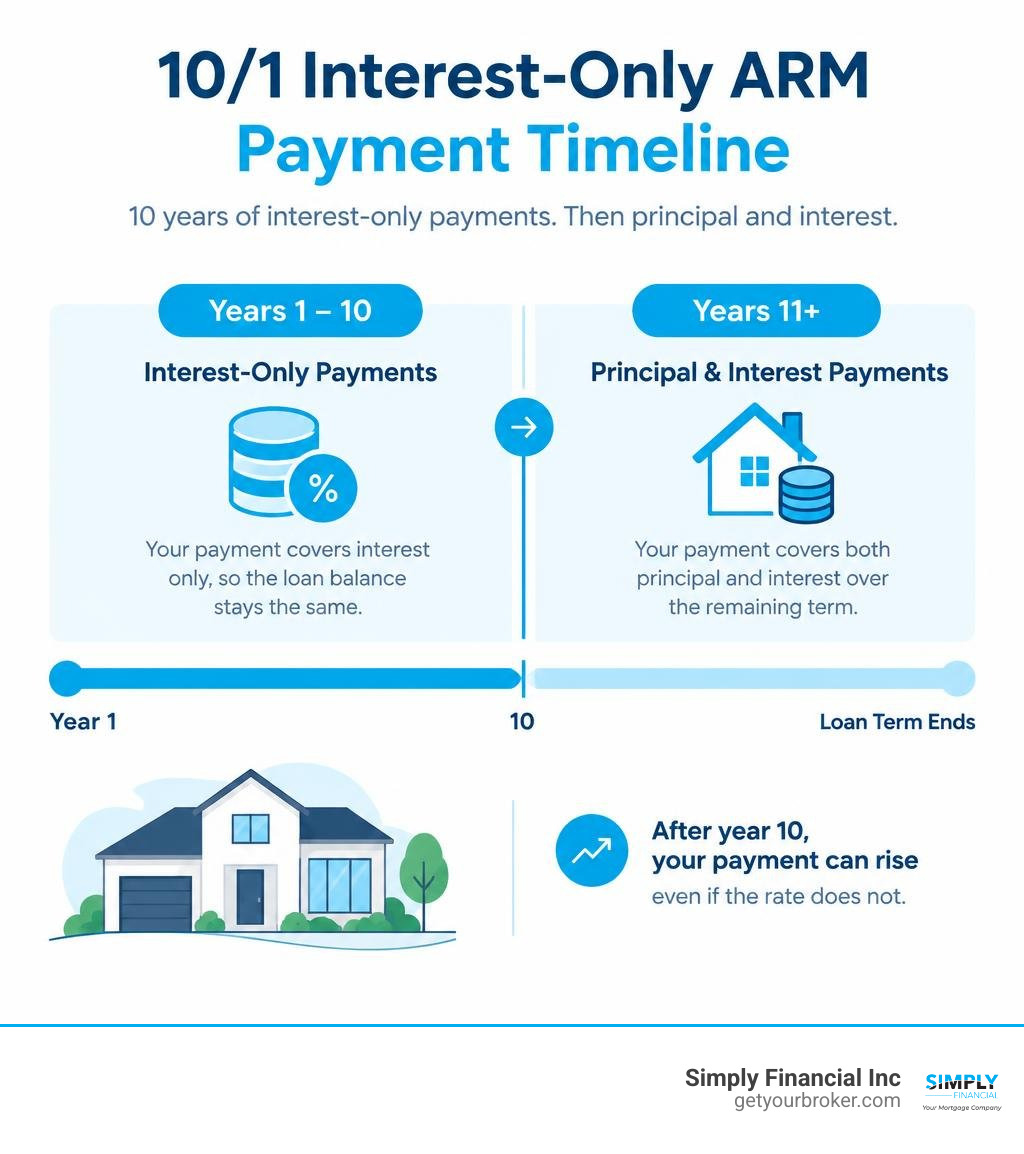
Understanding the 10/1 ARM Interest-Only Mortgage Structure
Navigating home financing means matching loan mechanics to your long-term cash flow goals. When you explore a 10 year fixed rate interest only mortgage, understanding how the interest rate is built provides essential clarity.
A hybrid adjustable-rate mortgage (ARM) blends elements of fixed-rate stability with market-driven variable pricing. For the first 120 months (10 full years), your interest rate is locked. Once that decade concludes, the loan transitions to an annual adjustment cycle.
The variable interest rate is calculated using a straightforward formula:
$$\text{Fully Indexed Rate} = \text{Index Rate} + \text{Margin}$$
- The Index: Most modern adjustable loans use the 30-day average Secured Overnight Financing Rate (SOFR) published by the Federal Reserve Bank of New York, or the 1-Year Treasury Constant Maturity index. In October 2026, these benchmarks generally hover between 3.50% and 4.25%.
- The Margin: This is a fixed percentage set by your lender during underwriting (often averaging around 2.75%) that never changes over the loan’s life.
Because conventional agency guidelines (like Fannie Mae or Freddie Mac) rarely back extended interest-only payment periods, these products are primarily offered by Non-Qualified Mortgage (Non-QM) lenders, portfolio banks, and private wealth divisions. These specialty programs allow borrowers seeking jumbo financing in markets like Chicago, Illinois, or across Florida to structure custom payment schedules.
| Loan Stage / Scenario | Loan Balance | Interest Rate | Monthly Payment | Payment Composition |
|---|---|---|---|---|
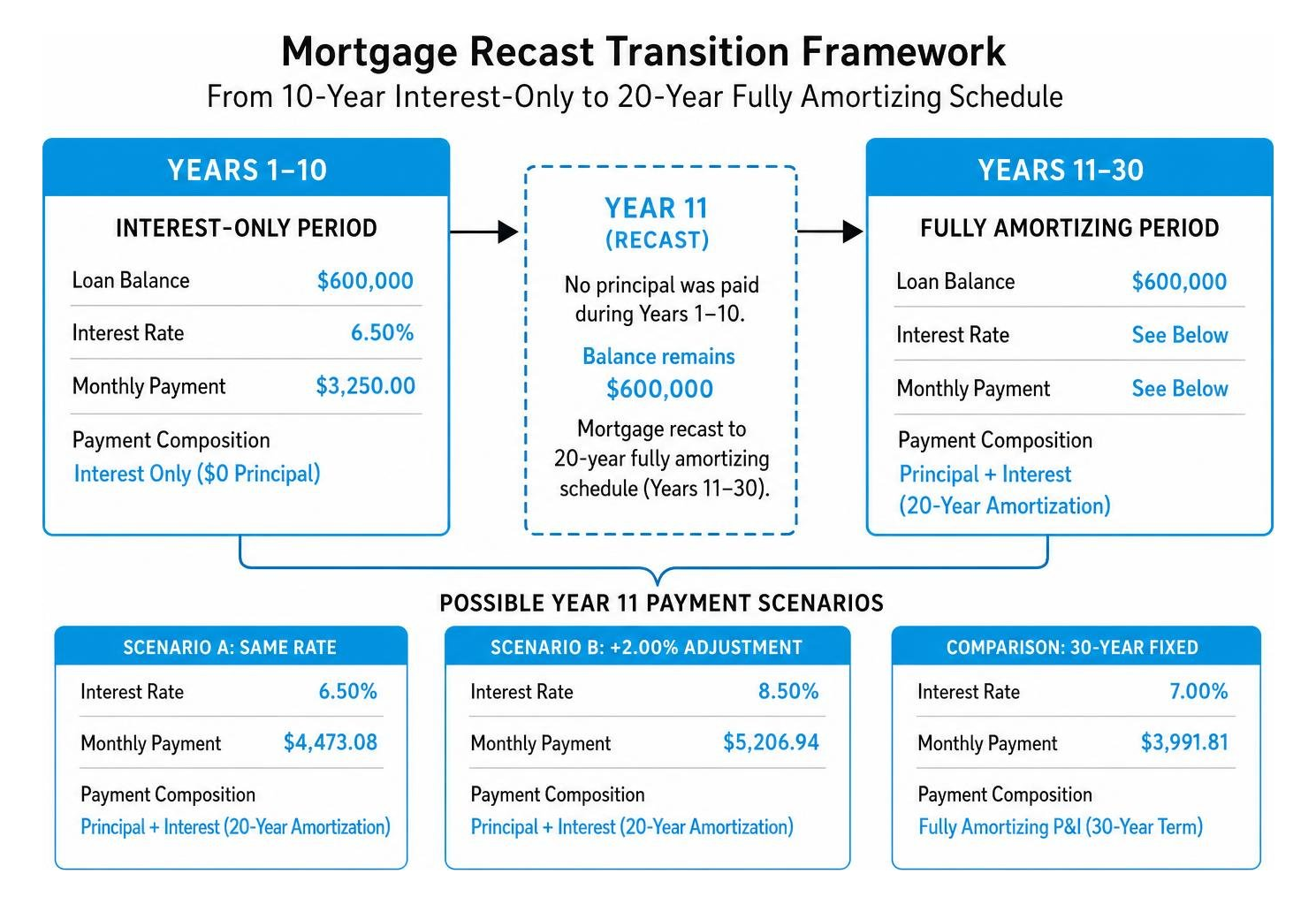
| Years 1–10 (Interest-Only Period) | $600,000 | 6.50% | $3,250.00 | Interest Only ($0 Principal) |
| Year 11 (Recast: Same Rate) | $600,000 | 6.50% | $4,473.08 | Principal + Interest (20-Year Amortization) |
| Year 11 (Recast: +2.00% Adjustment) | $600,000 | 8.50% | $5,206.94 | Principal + Interest (20-Year Amortization) |
| 30-Year Fixed Comparison (Full Term) | $600,000 | 7.00% | $3,991.81 | Fully Amortizing Principal + Interest |
How the 10-Year Fixed Period Amortization Resets
When year 11 arrives, the mortgage undergoes an “amortization recast.” Because you made zero required principal payments during the initial 10-year window, the full original balance ($600,000 in the example above) must now be paid down over the remaining 20 years of a standard 30-year term.
This creates a dual impact on your monthly obligation:
- Compressed Amortization: You are paying off a 30-year balance in just 20 years.
- Variable Rate Adjustments: The new interest rate will fluctuate based on the index plus margin, subject to contractual rate caps.
Rate caps protect you from unlimited increases:
- Initial Adjustment Cap: Limits how much the rate can shift up or down at the first reset in year 11 (commonly 2% or 5%).
- Periodic Cap: Limits subsequent yearly adjustments (typically 1% to 2% annually).
- Lifetime Cap: Sets the absolute ceiling the rate can never exceed, usually 5% to 6% above the original note rate.
If you are exploring shorter-term options, you might look into a 7-1 ARM interest only or a 5 year variable rate mortgage, though a 10/1 offers double the stability before that first adjustment arrives.
How to Calculate Your 10/1 ARM Interest-Only Monthly Payments
Calculating your payment during the initial 10-year window is straightforward:
$$\text{Monthly IO Payment} = \frac{\text{Loan Amount} \times \text{Interest Rate}}{12}$$
For instance, on an $800,000 jumbo loan with an initial interest rate of 6.25%: $$\text{Annual Interest} = \$800,000 \times 0.0625 = \$50,000$$ $$\text{Monthly Payment} = \frac{\$50,000}{12} = \$4,166.67$$
By comparison, a standard 30-year fixed loan on that same $800,000 balance at 6.75% requires roughly $5,189 per month. Choosing the interest-only structure frees up over $1,000 in monthly cash flow—funds that can be deployed into liquid reserves, business expansion, or alternative investment opportunities.
Understanding 10/1 Interest-Only ARM Payment Stages

A 10/1 interest-only structure splits your loan into two distinct financial chapters. Planning for both is key to managing your mortgage successfully.
How the 10-Year Interest-Only Period Affects Payment Predictability
A decade is a meaningful amount of time in real estate and personal finance. Over 10 years, homeowners often change jobs, expand businesses, start families, or relocate. According to national housing statistics, the average homeowner moves or refinances roughly every 7 to 10 years.
During this first decade, your monthly obligation remains fixed. If you are balancing complex business revenue cycles or investing capital into properties across Illinois or Florida, predictable interest-only payments give you total budget control.
Planning for Payments After the Interest-Only Period
The trade-off for early payment flexibility appears in year 11. If you retain the mortgage past month 120, your payment will jump because:
- Zero Principal Was Built Automatically: Equity accumulation during the first 10 years relies entirely on market appreciation or voluntary extra payments.
- The 20-Year Payoff Window Starts: Repaying the entire principal balance in 240 months requires substantially larger monthly principal allocations.
Borrowers who want traditional, steady equity accumulation often find better alignment with our fixed rate mortgage guide 2026 or a standard 10 year fixed mortgage.
Strategic Benefits, Risks, and Qualification Rules

An interest-only structure is a strategic financial tool designed for borrowers who proactively manage their balance sheets.
Who Benefits Most from a 10/1 Interest-Only Loan?
- Commission and Bonus-Structured Earners: Professionals with irregular compensation can manage small mandatory monthly payments, then pay down principal in lump sums when annual bonuses arrive.
- Real Estate Investors: Investors holding properties for short-to-medium horizons use interest-only payments to maximize immediate net operating income (NOI) and cash yields.
- High-Net-Worth Individuals: Borrowers with significant liquid assets often prefer keeping cash invested in high-yield vehicles rather than locking equity into home principal.
- Transitional Homeowners: Buyers who know they will relocate, downsize, or upgrade within 7 to 10 years can take advantage of lower payments without facing the recast period.
Evaluating the Financial Risks: Payment Shock and Negative Amortization
While modern 10/1 ARMs are structured with consumer safeguards, borrowers should evaluate potential risks:
- Payment Shock: When the interest-only period ends, your payment will rise. If market rates climb simultaneously, hitting the initial adjustment cap, payments can increase by 40% to 60% overnight.
- Negative Amortization Protection: Modern qualifying mortgages prohibit negative amortization (where your principal balance grows because payments don’t cover accrued interest). With a standard 10/1 IO ARM, your principal balance simply remains unchanged until you make principal payments.
- Exit Strategy Requirement: Having a clear strategy—such as refinancing into a standard loan, selling the property, or paying off the balance—is essential before year 10 concludes.
To review current market pricing across traditional options, check our overview of 10 year home loan rates and 10 year mortgage refinance rates. If you are evaluating government-insured loans instead, see our review of current mortgage rates FHA 30 year fixed.
Frequently Asked Questions About 10/1 Interest-Only ARMs
What happens when the 10-year interest-only period ends?
At the end of year 10, the loan recasts. Your monthly payment is recalculated based on the remaining balance, the new adjustable interest rate, and a 20-year fully amortizing schedule. This ensures the loan balance reaches zero by the end of year 30.
Are 10/1 interest-only ARMs difficult to find in today’s mortgage market?
Because Fannie Mae and Freddie Mac do not purchase 10-year interest-only loans, you won’t find them at every retail bank. However, specialty Non-QM wholesale lenders, regional portfolio banks, and mortgage brokerages like Simply Financial Inc have access to these tailored products for qualified borrowers in Illinois and Florida.
Can you make principal payments during the interest-only period?
Yes. Modern residential ARMs do not carry prepayment penalties for making voluntary principal payments. You can make interest-only payments during tighter cash-flow months and pay extra toward principal whenever you choose.
Conclusion
A 10/1 interest-only ARM offers an attractive combination of 10-year rate stability and short-term payment flexibility. For high-earning professionals, savvy real estate investors, and borrowers with clear 7-to-10-year financial plans, it provides an effective way to optimize cash flow without committing to permanent amortization schedules.
At Simply Financial Inc, we help homeowners navigate the lending landscape with confidence. Whether you are looking at conventional financing, jumbo portfolio products, government options, or tailored hybrid ARMs, our team provides transparent guidance from our Chicago headquarters at 5632 W Lawrence Ave Chicago IL.
Ready to find the right loan structure for your next property? Review our home loan options guide 2026, browse our mortgage loan options guide 2026, and explore our comprehensive mortgage loan options to get started today.