

Current Landscape of 15 Year Conventional Mortgage Rates in 2026
Current 15-year conventional mortgage rates in October 2026 are averaging in the mid-6% range, with recent benchmarks sitting between roughly 6.42% and 6.68%. While 30-year mortgages have hovered in the low-to-mid 7% range, 15-year terms continue to offer a notable discount. Borrowers exploring our fixed-rate mortgage guide 2026 will find that the 15-year fixed loan remains one of the most reliable vehicles for rapid equity accumulation and interest savings.
Historically, the 15-year fixed loan has spanned a wide spectrum. Freddie Mac data shows an all-time record low of 2.10% reached in July 2021, contrasted against a staggering peak of 18.63% in September 1981. Even looking back to the fourth quarter of 1998, 15-year conventional rates averaged 6.42%. Today’s environment sits comfortably near historical midpoints, offering stability for borrowers ready to commit to a compressed payoff timeline.
Understanding Daily Benchmark Movements in 15 Year Conventional Mortgage Rates
Daily mortgage rate benchmarks fluctuate based on real-time pricing engines and investor demand for mortgage-backed securities (MBS). Unlike weekly surveys that reflect retrospective snapshots, daily indices capture immediate pricing adjustments.
A key benchmark is the 15-Year Fixed Rate Conforming Mortgage Index (OBMMIC15YF) | FRED | St. Louis Fed, powered by Optimal Blue. This index tracks actual locked rates across more than one-third of all residential mortgage transactions in the United States.
Recent daily observations highlight the micro-movements inherent to the market:
- September 25, 2026: 6.573%
- September 28, 2026: 6.672%
- September 29, 2026: 6.569%
- September 30, 2026: 6.623%
- October 1, 2026: 6.681%
Simultaneously, Freddie Mac’s Primary Mortgage Market Survey (PMMS) recorded a weekly average of 6.42% in late September 2026 (up from 6.26% the previous week and 5.49% a year prior). Why does a daily locked index read higher than a survey average? Weekly surveys typically assume ideal borrower profiles—top-tier credit scores, pristine debt ratios, and zero discount points—whereas transaction-based indices aggregate real-world locks across diverse borrower situations.
Economic Drivers Influencing Today’s Yields and Pricing
Mortgage rates do not move in isolation; they are heavily tethered to broader macroeconomic data. The primary anchor is the benchmark 10-year Treasury yield. Because mortgage-backed securities compete directly with government bonds for institutional investor capital, yields and mortgage pricing move in tandem.
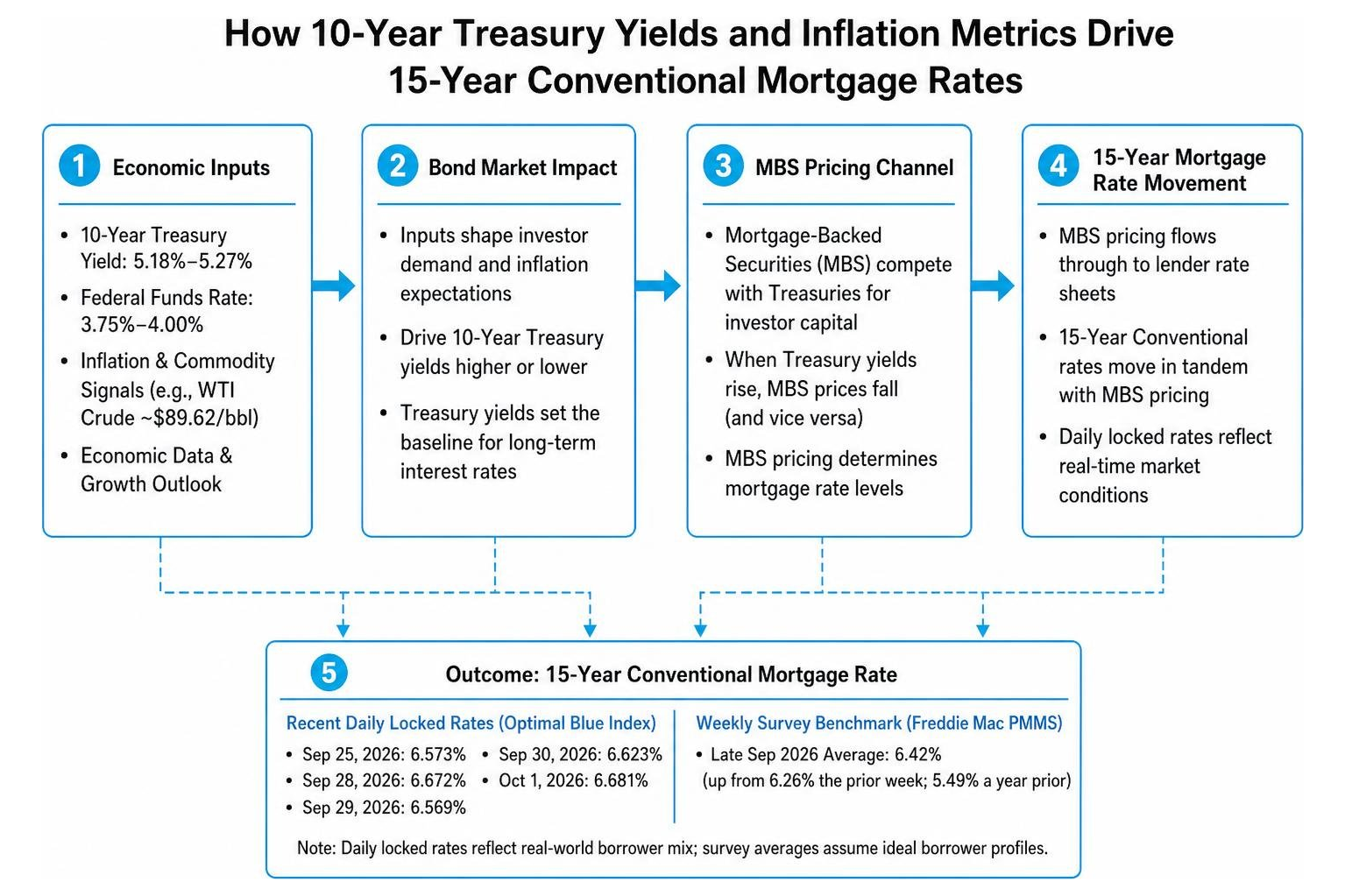
Key economic factors influencing October 2026 pricing include:
- Treasury Yield Pressure: The 10-year Treasury yield has hovered between 5.18% and 5.27%. When bond yields ease even slightly, downward pressure is applied to mortgage pricing.
- Federal Reserve Monetary Policy: With the target federal funds rate set in the 3.75%–4.00% range, lenders price loans according to the anticipated path of future central bank policy adjustments.
- Inflation & Commodity Signals: Headline consumer indexes alongside commodity pricing—such as WTI crude oil near $89.62 per barrel—play an active role in how lenders protect long-term yields against inflationary erosion.
- Expert Forecasts: Projections from major housing entities present a gradual cooling expectation. Fannie Mae models project conventional 30-year benchmarks easing to roughly 5.7% by late 2026 and early 2027, which would allow 15-year fixed loans to drift closer to the mid-to-high 5% range. The Mortgage Bankers Association (MBA) forecasts a slightly more conservative glide path toward the low 6% territory.
15-Year vs. 30-Year Fixed Mortgages: Financial Trade-Offs and Payment Math
Choosing between a 15-year and a 30-year mortgage comes down to a fundamental balance: immediate monthly cash-flow flexibility versus long-term lifetime interest savings.
A 15-year mortgage compresses the repayment cycle by 180 months. Because the repayment schedule is halved, a much larger portion of every monthly payment attacks the principal balance from day one, rather than servicing front-loaded interest charges.
Lifetime Interest Savings vs. Monthly Cash Flow Impact
To visualize the dollar impact, consider two common loan amounts—$300,000 and $400,000—evaluated at current market averages (6.782% for a 15-year term vs. 7.488% for a 30-year term).
| Loan Amount | Term | Interest Rate | Monthly Principal & Interest | Total Lifetime Interest | Total Cost of Loan |
|---|---|---|---|---|---|
| $300,000 | 15 Years | 6.782% | $2,660.85 | $178,952.92 | $478,952.92 |
| $300,000 | 30 Years | 7.488% | $2,094.74 | $454,107.01 | $754,107.01 |
| $400,000 | 15 Years | 6.782% | $3,547.80 | $238,603.90 | $638,603.90 |
| $400,000 | 30 Years | 7.488% | $2,792.99 | $605,476.02 | $1,005,476.02 |
Note: Calculations reflect principal and interest only. Actual housing payments will include property taxes, homeowner’s insurance, and applicable association dues.
On a $300,000 balance, choosing a 15-year mortgage requires roughly $566 more per month, but yields $275,154.09 in direct interest savings over the life of the loan. On a $400,000 balance, an additional $754 per month saves more than $366,872 in interest charges while cutting your debt obligations by 15 full years.
Comparing Shorter Loan Terms and Alternative Amortization
For borrowers seeking even more aggressive debt-reduction structures, an ultra-short term like a 10-year fixed mortgage can compress interest expenses further. However, ultra-short terms require substantial monthly income to satisfy underwriting guidelines.
If the mandatory higher monthly payment of a 15-year loan feels too restrictive for your household budget, alternative strategies can replicate portions of the benefit:
- Voluntary Principal Curtailment: Take out a 30-year fixed loan to keep mandatory overhead low, then voluntarily add extra principal each month.
- Bi-Weekly Payment Schedules: Paying half your monthly mortgage payment every two weeks results in 26 half-payments (13 full payments per year), trimming years off a traditional 30-year amortization schedule without contractual strain.
Qualification Standards and Loan Type Variations
Because a 15-year conventional mortgage carries higher monthly payments, lenders apply precise underwriting standards to ensure the obligation fits comfortably within your verified cash flow.
Qualifying Criteria to Secure the Best 15 Year Conventional Mortgage Rates
Securing the lowest available conventional rate tiers requires aligning several key credit profile metrics:
- Credit Score: While conforming guidelines permit conventional approvals starting at a 620 credit score, securing the best pricing adjustments generally requires a FICO score of 740 or higher (with optimal pricing at 780+).
- Debt-to-Income (DTI) Ratio: Lenders evaluate your total recurring monthly debt (housing payment + auto loans + student loans + credit cards) relative to gross monthly income. Most conventional programs cap DTI at 45%, though automated underwriting systems can approve up to 50% with strong compensating factors.
- Down Payment & Loan-to-Value (LTV): Conforming loans permit down payments as low as 3% to 5% for qualifying borrowers. However, putting down 20% eliminates Private Mortgage Insurance (PMI) and secures favorable Loan-Level Price Adjustments (LLPAs).
- Asset Reserves: Lenders like to see 2 to 6 months of total housing expenses in liquid reserves (checking, savings, non-retirement investments) after closing costs are paid.
Conventional vs. Government-Backed and Jumbo Loan Options
While conventional loans backed by Fannie Mae and Freddie Mac represent the standard, alternative loan programs serve specific buyer needs:
- FHA Loans: Borrowers with credit scores below 680 or lower down payment reserves often compare fha conventional loan rates to see which provides lower overall financing charges. FHA loans require upfront and annual mortgage insurance premiums regardless of term length.
- VA Loans: Eligible military service members and veterans can access 15-year fixed VA loans, which typically carry competitive rates and eliminate monthly mortgage insurance requirements entirely.
- Jumbo Loans: When borrowing above local conforming loan limits, reviewing guidelines for a jumbo loan vs conventional mortgage is essential. Jumbo 15-year options require larger cash reserves and pristine credit scores but carry competitive fixed pricing for luxury properties.
Strategies to Shop, Compare, and Lock the Best Mortgage Terms
Securing an optimal mortgage requires looking beyond surface-level marketing to evaluate complete loan costs side-by-side.
Evaluating Advertised Interest Rates vs. Loan APR
One common mistake is comparing only the headline “note rate” across lenders. The Annual Percentage Rate (APR) reflects the true annual cost of borrowing because it factors in the interest rate plus upfront finance charges, including origination fees, processing, underwriting, and discount points.
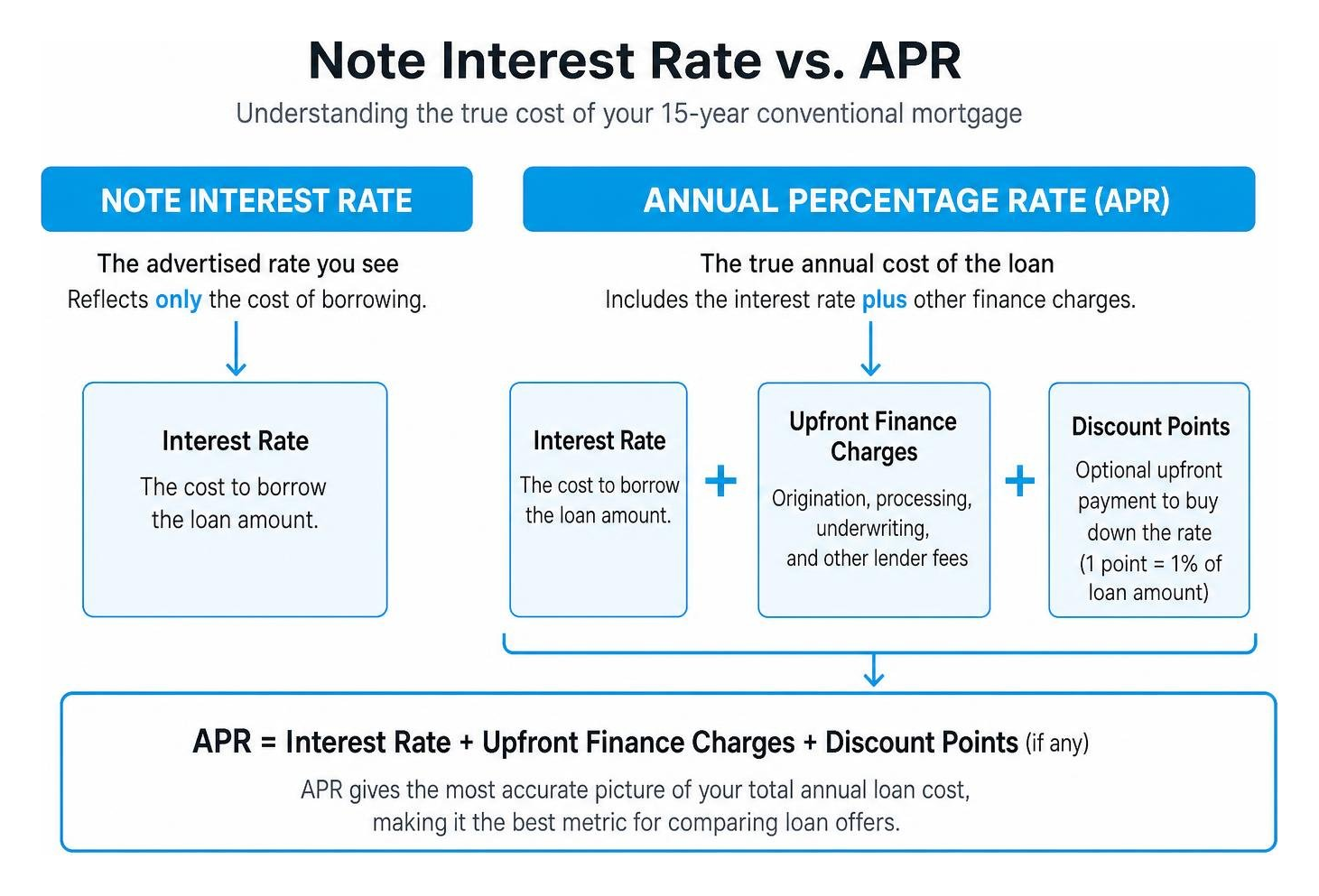
When an advertised rate appears substantially lower than market averages, examine the fine print. Lower rates often include purchased discount points—where 1 point equals 1% of the loan amount paid upfront at closing to buy down the rate. Always verify the APR and lender fee totals on Page 2, Section A & B of your official Loan Estimate.
Regional Rate Variations and Locking Windows
Mortgage pricing dynamics can vary by property location due to local property tax assessments, transfer fees, and title insurance structures.
For home buyers looking at property in Illinois, reviewing regional mortgage rates in Oak Brook, IL or the surrounding Chicago area illustrates how county-level tax distributions and local settlement costs shape net cash-to-close figures. We also regularly work with clients throughout Florida, where insurance costs and regional underwriting requirements influence loan structuring.
When you find a favorable rate, work with your mortgage broker on lock timing:
- Standard Rate Lock: Typically locks pricing for 30, 45, or 60 days while loan processing and appraisal underwriting are completed.
- Float-Down Option: Allows you to lock in today’s ceiling rate, with a one-time option to adjust downward if market benchmarks drop prior to closing.
For existing homeowners tracking current market movements, exploring our refinance mortgage resources will help determine whether adjusting your existing term delivers net positive savings.
Frequently Asked Questions About 15-Year Mortgages
Is a 15-year fixed mortgage suitable for first-time homebuyers?
It can be, provided your monthly income comfortably supports the higher payment without depleting your emergency savings. However, many first-time buyers opt for a 30-year fixed term to maximize purchasing power and maintain a financial buffer during initial homeownership.
Can I refinance an existing 30-year mortgage into a 15-year loan?
Yes. Refinancing into a 15-year loan is a popular strategy for homeowners who have already paid down several years of a 30-year mortgage and want to lock in a lower interest rate while accelerating their final payoff date. Conduct a break-even analysis to ensure closing costs are recovered through interest savings over your planned stay in the home.
How does paying discount points affect a 15-year conventional loan?
Discount points represent prepaid interest. Paying 1 point on a $300,000 loan costs $3,000 at closing and typically reduces your note rate by approximately 0.25%. Because a 15-year loan amortizes quickly, calculate your break-even period (upfront point cost divided by monthly payment savings) to ensure you will keep the loan long enough to realize a net financial benefit.
Conclusion
A 15-year conventional mortgage remains one of the most powerful wealth-building tools available to homeowners, trading higher monthly payments for hundreds of thousands of dollars in lifetime interest savings and rapid equity accumulation.
At Simply Financial Inc, we believe mortgage financing should be transparent and stress-free. Whether you are purchasing a home in Illinois or Florida, our team provides personalized loan comparisons to help you select the exact term, rate, and structure for your long-term goals.
Explore our fixed-rate mortgage solutions in Chicago or reach out to our team at 5632 W Lawrence Ave, Chicago, IL to review personalized Loan Estimates and lock in your rate today.