

What to Know About 20-Year Mortgage Rates
The average 20-year mortgage rate was 6.50% in July 2026. That is a benchmark, not a verified rate for today. A 20-year fixed loan often has a lower rate than a 30-year loan, but its monthly payment is higher because you pay it off faster. To find your best offer, compare quotes from several lenders on the same day, including the rate, APR, fees, and monthly payment.
I’m Peter Babjak of Simply Financial Inc. Since 2007, I’ve helped Chicago-area homebuyers navigate loans and refinancing, including how to compare 20 year mortgage interest rates with other fixed-term options.
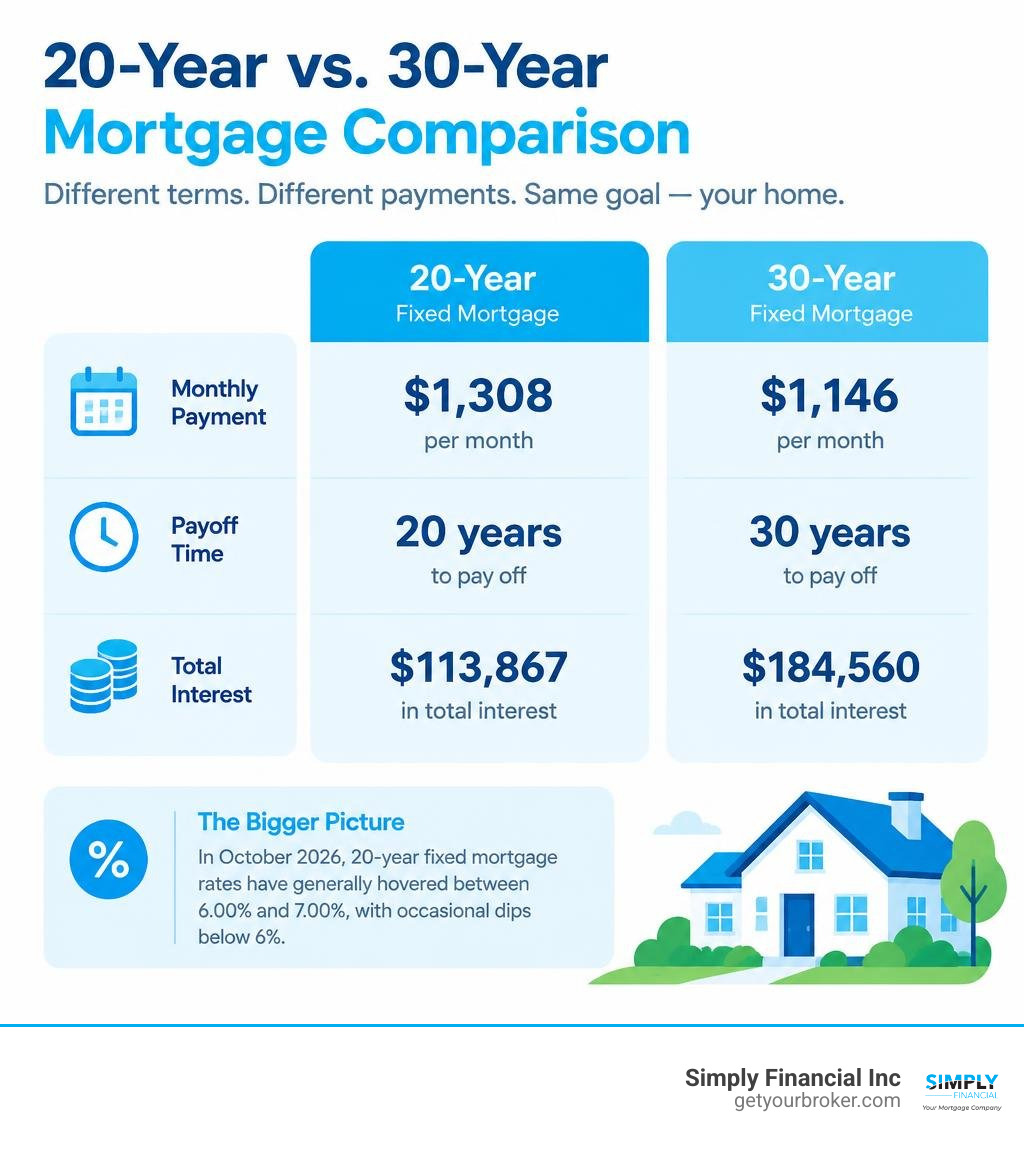
Current 20 Year Mortgage Interest Rates and Market Overview
Navigating the mortgage landscape in October 2026 requires understanding how broader macroeconomic benchmarks influence borrowing costs. Rates for 20-year fixed mortgages have generally hovered between 6.00% and 7.00% over recent quarters, punctuated by occasional short-lived dips below the 6% threshold.
While 30-year loans capture the majority of headline attention and 15-year terms appeal to aggressive savers, the 20-year fixed mortgage serves as a practical middle ground. Benchmark mortgage rates do not operate in a vacuum. Instead, they closely track movements in the bond market—specifically the 10-year U.S. Treasury yield. When bond investors demand higher returns due to inflation expectations or economic uncertainty, mortgage pricing across 15-, 20-, and 30-year terms shifts upward accordingly.
You can monitor broader market movements through Freddie Mac’s Primary Mortgage Market Survey to see how national averages fluctuate week to week. For borrowers in the Midwest, staying updated on Illinois mortgage and refinance rates for October 2026 offers local perspective on regional rate pricing.
Factors Driving 20-Year Mortgage Interest Rates in 2026
Several core economic forces influence the pricing of 20-year mortgages in 2026:
- Inflation Metrics: Persistent inflation exerts upward pressure on long-term lending rates. When consumer price indexes remain elevated, lenders require higher interest yields to protect their purchasing power over a two-decade span.
- Federal Reserve Monetary Policy: While the Fed does not set mortgage rates directly, changes to the federal funds rate alter the cost of short-term borrowing for financial institutions, sending ripple effects across the entire yield curve.
- U.S. Trade and Economic Policies: Shifts in trade agreements, tariffs, and global supply chain dynamics introduce volatility to bond markets, causing mortgage spreads to widen or narrow.
- Secondary Mortgage Market Demand: Most conventional home loans are bundled into Mortgage-Backed Securities (MBS). Investor appetite for 20-year paper directly dictates how competitively lenders can price these products.
Pros and Cons of a 20-Year Fixed Term
Before committing to a 20-year amortization schedule, weighing the structural advantages against the financial trade-offs provides clarity:
- Pros:
- Significant Interest Savings: Shaving a full decade off a standard 30-year term eliminates ten years of compounding interest charges.
- Lower Rates Than 30-Year Terms: Lenders assume less duration risk over 20 years, typically allowing for a lower interest rate compared to 30-year alternatives.
- Rapid Home Equity Buildup: A higher portion of each monthly payment goes directly toward reducing principal from day one.
- Predictable Budgeting: Fixed-rate structures guarantee that principal and interest payments remain unchanged over the entire life of the loan.
- Cons:
- Higher Monthly Payments: Compacting amortization into 240 months means each monthly obligation is noticeably larger than a 30-year loan for the exact same borrowing amount.
- Reduced Cash-Flow Flexibility: A larger mandatory housing payment leaves less discretionary income for other financial goals, investments, or unforeseen emergencies.
- Stricter Qualification Limits: Because the monthly payment is higher, your debt-to-income (DTI) ratio increases, which may restrict your maximum purchasing budget.
Comparing 20-Year Rates to 15-Year and 30-Year Mortgages
Choosing the right loan structure involves balancing total long-term borrowing costs against monthly cash-flow stability. To evaluate how fixed terms differ across structural timelines, explore our detailed 15-Year Mortgage Rates Guide 2026 alongside our broader Fixed Rate Mortgage Guide 2026.

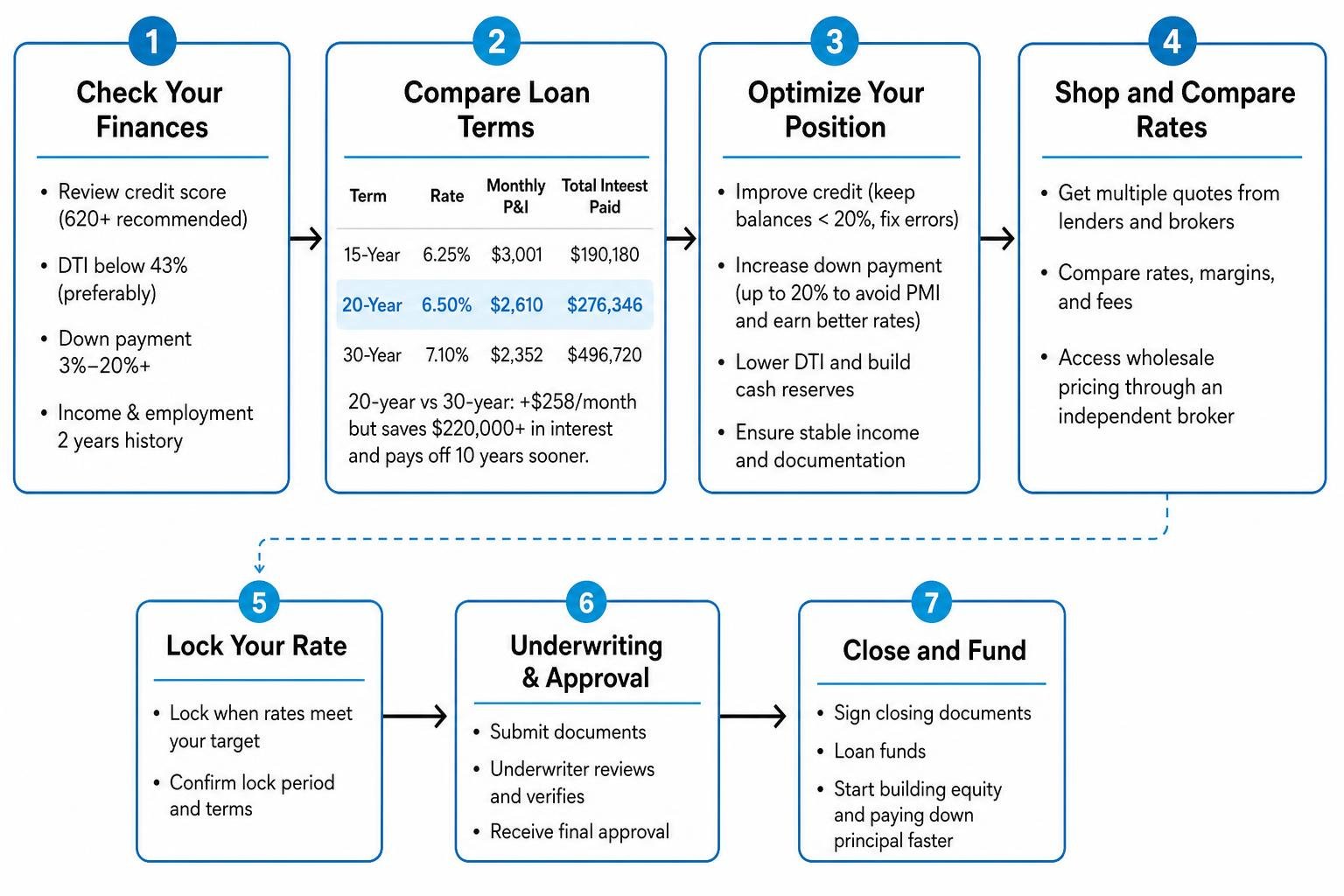
The table below illustrates how loan term length impacts monthly payments, interest rates, and total lifetime interest on a hypothetical $350,000 loan balance:
| Loan Term | Benchmark Rate | Monthly Payment (P&I) | Total Interest Paid | Total Cost of Loan |
|---|---|---|---|---|
| 15-Year Fixed | 6.25% | $3,001 | $190,180 | $540,180 |
| 20-Year Fixed | 6.50% | $2,610 | $276,346 | $626,346 |
| 30-Year Fixed | 7.10% | $2,352 | $496,720 | $846,720 |
Note: The figures above reflect principal and interest only. Actual housing payments will include property taxes, homeowner’s insurance, and applicable private mortgage insurance (PMI).
As shown above, choosing a 20-year term over a 30-year term on a $350,000 loan requires an additional $258 per month, but it saves more than $220,000 in total interest while making you debt-free ten years earlier. For a broader look at current options, you can Compare Current 20-Year Mortgage Rates to see how different lenders position their pricing.
Qualification Requirements for 20-Year Home Loans
Qualifying for a 20-year mortgage involves meeting specific financial criteria to satisfy underwriting standards.

Underwriting Guidelines Overview
- Credit Score Standards: Most conventional loan programs require a minimum credit score of 620. Borrowers seeking government-backed options can review Current Mortgage Rates for FHA Loans, where credit score minimums typically start at 580 for maximum financing.
- Debt-to-Income (DTI) Ratio: Lenders generally prefer a DTI ratio below 43%. However, automated underwriting systems may approve DTIs up to 50% for borrowers with compensating factors, such as strong credit scores, cash reserves, or significant residual income.
- Down Payment Rules: Conventional 20-year programs often allow down payments as low as 3% to 5% for qualified primary-residence buyers. FHA programs require 3.5% down, while eligible veterans and active-duty military personnel can access 20-year VA loans with zero down payment.
- Employment and Income Stability: Applicants must provide standard income documentation, including two years of consistent W-2s or tax returns, along with recent pay stubs and bank statements verifying asset availability.
Strategies to Secure Top Rates and Alternative Options
Securing a favorable rate on a 20-year fixed mortgage requires deliberate financial preparation. If your debt ratios or monthly budget make a 20-year term too restrictive, comparing options like Current Mortgage Rates FHA 30 Year Fixed allows you to keep payments manageable while maintaining the flexibility to make extra principal payments voluntarily.
How to Lock in the Lowest 20 Year Mortgage Interest Rates
- Optimize Your Credit Profile: Pay down revolving credit card balances below 20% of their limits prior to application, and dispute any reporting errors on your credit files.
- Increase Your Down Payment: Putting down 20% eliminates costly Private Mortgage Insurance (PMI) and places your loan in a lower risk tier, which often earns a direct rate discount from underwriters.
- Compare Multiple Independent Quotes: Rates, margins, and lender fees vary across wholesale and retail channels. Working with a dedicated mortgage broker gives you access to multiple wholesale pricing desks simultaneously.
- Evaluate Discount Points: If you plan to remain in your home long-term, purchasing discount points (prepaid interest at closing) can permanently reduce your note rate and lower your lifetime borrowing costs.
Frequently Asked Questions About 20-Year Mortgages
Is a 20-year mortgage better than a 30-year mortgage?
A 20-year mortgage is ideal for borrowers who want to pay off their home significantly faster and save hundreds of thousands of dollars in lifetime interest without taking on the aggressive payment schedule of a 15-year term. However, a 30-year loan offers lower required monthly payments, providing greater cash-flow security during unexpected life events.
What credit score is needed for a 20-year fixed loan?
Conventional 20-year fixed loans generally require a minimum FICO score of 620. FHA-backed loans permit credit scores down to 580 with a 3.5% down payment. Borrowers with scores of 740 and above typically qualify for the lowest available rates and best pricing tiers.
Can you refinance into a 20-year mortgage?
Yes. Refinancing into a 20-year mortgage is a popular strategy for homeowners who are several years into an existing 30-year term. It allows you to shorten your remaining loan term, lower your interest rate, and stay on track for a targeted payoff date without resetting your amortization clock back to 30 years.
Conclusion
A 20-year fixed mortgage balances fast equity growth with manageable monthly payments. By securing a term that cuts a decade off standard borrowing timelines, you can save substantially on cumulative interest charges while building clear wealth through real estate.
At Simply Financial Inc, we provide a seamless, expert-guided, stress-free lending experience tailored to your unique financial milestones. Whether you are buying a home or refinancing your existing balance in Illinois or Florida, explore our comprehensive fixed-rate mortgage options in Chicago or visit our office at 5632 W Lawrence Ave in Chicago, IL to find the perfect loan structure for your goals.