

What the APR on an FHA Loan Really Tells You
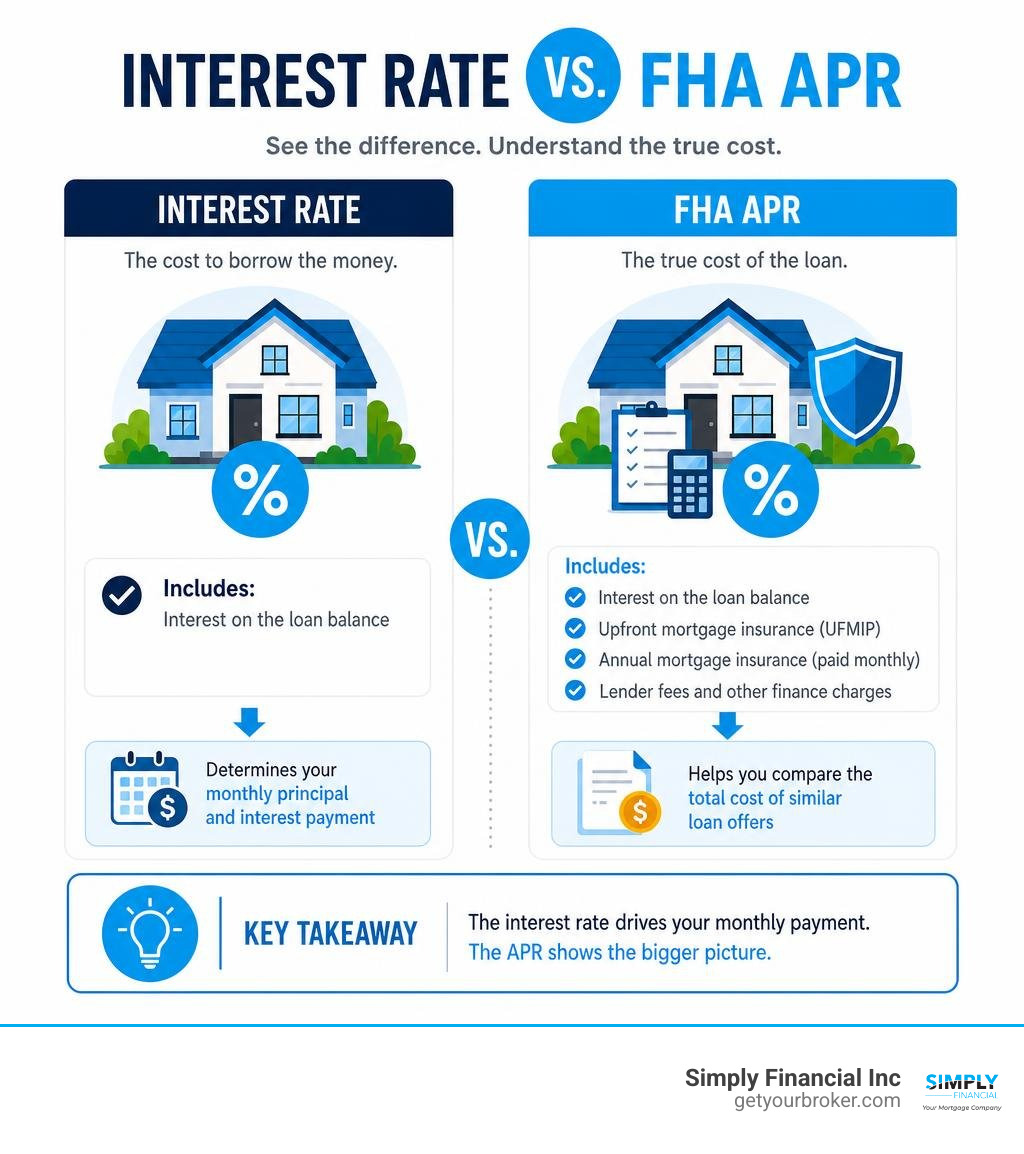
The apr on fha loan shows the estimated yearly cost of borrowing after the interest rate and certain lender and mortgage insurance charges are included. In short, the interest rate drives your monthly principal-and-interest payment, while APR gives a broader view of what the loan costs.
As of August 15, 2026, the national average 30-year FHA interest rate is 6.37%. Your APR may be higher because FHA loans generally include a 1.75% upfront mortgage insurance premium (UFMIP), annual mortgage insurance paid monthly, and lender-specific finance charges.
| Term | What it includes | Why it matters |
|---|---|---|
| Interest rate | Interest charged on the mortgage balance | Helps determine your principal-and-interest payment |
| APR | Interest rate plus certain prepaid finance charges and mortgage insurance costs | Helps you compare the real cost of similar loan offers |
APR is a useful comparison tool, but it is not a promise of your exact lifetime cost. It assumes you keep the mortgage for its stated term, so refinancing, selling, or paying the loan off early can change how those upfront costs work out in real life.
I’m Peter Babjak, a mortgage broker with Simply Financial Inc in Chicago. For more than 18 years, I have helped homebuyers and refinance clients understand the apr on fha loan offers they receive, so they can make sense of the rate, fees, and payment before closing.
Understanding the APR on FHA Loan Packages vs. Interest Rates
When you start evaluating government-backed home financing, it is easy to get confused by the two percentages posted side-by-side on your disclosures. The nominal interest rate gets all the headlines, but the Federal Truth in Lending Act requires lenders to disclose the Annual Percentage Rate (APR) to bring complete loan cost transparency to the table. At Simply Financial Inc, we believe that understanding the exact breakdown behind these numbers is the single most effective way to prevent overpaying for your mortgage.
Interest Rate vs. APR Defined
The nominal interest rate is the baseline percentage used to calculate the actual monthly principal and interest payment on your mortgage. If you borrow money at a 6.37% interest rate, that percentage directly dictates how much interest accrues on your principal balance each month.
The apr on fha loan packages, however, represents the effective annual borrowing cost expressed as a percentage. It incorporates the base note rate plus mandatory prepaid finance charges, origination fees, and mortgage insurance premiums. By bundling these upfront and ongoing charges into a single annualized rate, the APR gives you a clearer benchmark of what the financing costs over the full loan term.
Why FHA APR Is Higher Than Nominal Rates
It is completely normal for an FHA loan to feature a wider spread between its interest rate and its APR than you might see on standard conventional loans. In 2026, the average national FHA 30-year fixed note rate sits around 6.84%, up 32 basis points from 6.52% in 2025. However, the effective APR on that same loan might hover around 7.45% to 7.60%.
This spread exists primarily because government-backed financing mandates specialized insurance coverage to protect lenders against default. When you review our FHA Mortgage Rates Guide 2026, you will see that these mandatory fees—specifically mortgage insurance premiums and lender underwriting charges—are added directly into the official APR calculation formula. To get a quick baseline, buyers often Compare current FHA loan rates across regional and national lenders.
The Impact of FHA Mortgage Insurance Premiums on APR
Mortgage insurance is the engine that drives FHA lending. It enables home buyers in Illinois and Florida to purchase properties with low down payments and modest credit scores. However, because HUD guidelines enforce strict insurance obligations, these premiums directly inflate the apr on fha loan calculations. In fact, insurance premiums and upfront financing charges account for roughly 40% of the total effective borrowing expense over a 30-year term.
The APR on an FHA mortgage accounts for two separate insurance fees:
- Upfront Mortgage Insurance Premium (UFMIP): A non-refundable fee charged at closing, typically financed directly into the total loan amount.
- Annual Mortgage Insurance Premium (MIP): An ongoing fee divided into 12 monthly payments, added to your monthly escrow balance.
- Lender Origination and Admin Fees: Processing, underwriting, and document fees charged by the mortgage company.
- Discount Points: Optional upfront cash paid at closing to permanently lower your note rate.
Upfront Mortgage Insurance Premium (UFMIP)
In 2026, the mandatory Upfront Mortgage Insurance Premium (UFMIP) for standard FHA purchase loans is 1.75% of the base loan amount. For example, if you borrow $300,000 to acquire a home, your UFMIP comes out to $5,250.
Most borrowers choose to roll this $5,250 fee directly into their principal loan balance rather than paying it out-of-pocket at the closing table. Even though it is financed, federal regulations require this charge to be factored into the initial APR calculation as a prepaid finance fee. This single fee adds significant upward pressure on the reported APR. You can explore how this impacts loan limits and structural guidelines in our comprehensive FHA Home Loan Guide 2026.
Annual Mortgage Insurance Premium (MIP)
Beyond the upfront charge, FHA guidelines require an annual Mortgage Insurance Premium (MIP). For most 30-year fixed mortgages taken out with the minimum 3.5% down payment, the annual MIP rate in 2026 is 0.55% of the base loan balance. On a $300,000 mortgage, that adds approximately $137 per month to your escrow payment.
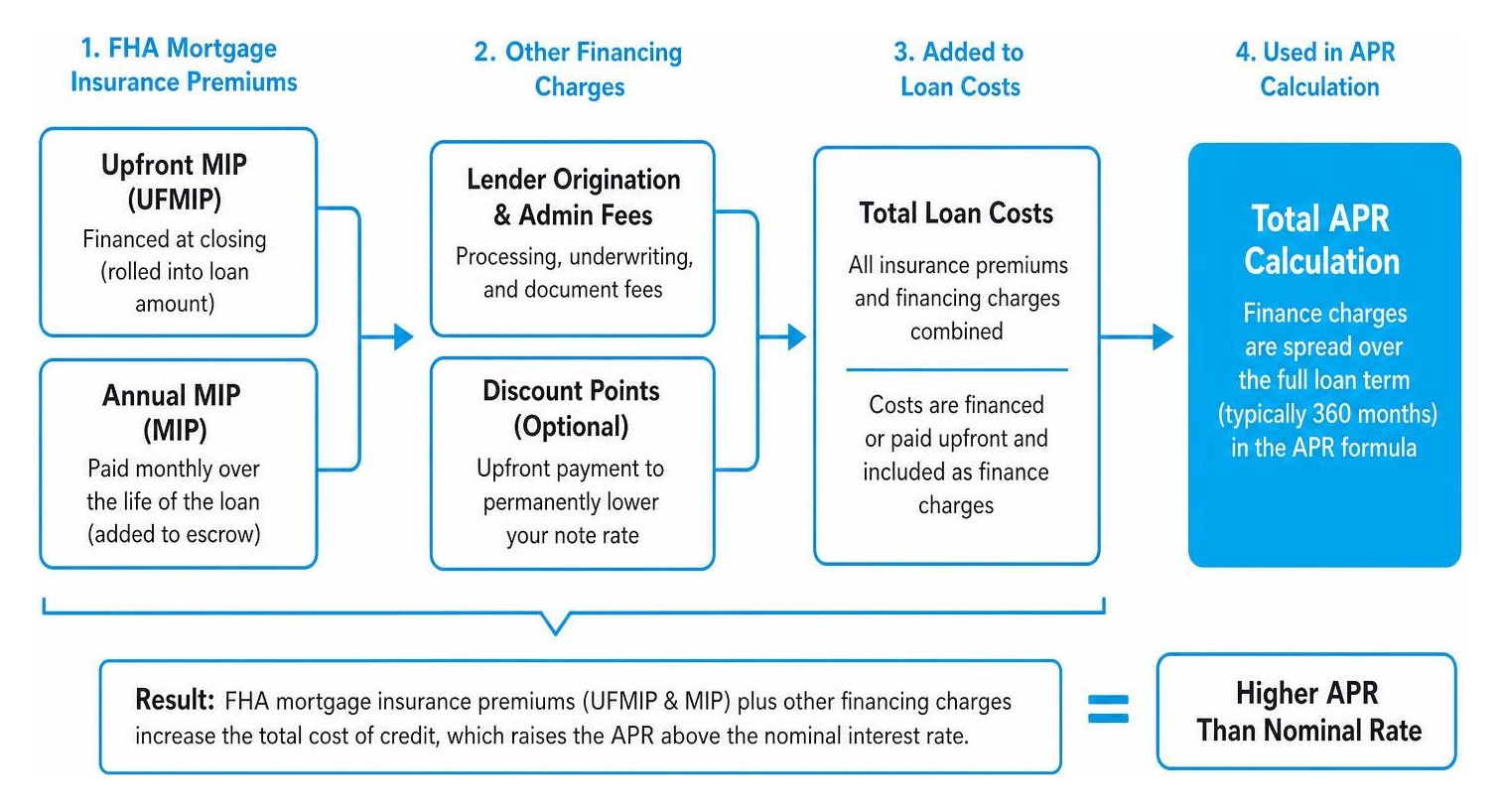
Crucially, under HUD rules established after June 2013, if you put down less than 10% at closing, this annual MIP remains on the loan for its entire 30-year lifespan. Because the legal APR formula assumes you will keep the loan for the full 360 months, paying 0.55% annually for 30 years significantly increases the calculated apr on fha loan disclosures. If you put down 10% or more, the annual MIP drops off after 11 years, which noticeably lowers the initial APR calculation.
Key Factors and Closing Costs Influencing FHA APR
While FHA rules dictate nationwide baseline insurance rates, individual borrower profiles and lender choices directly shift the final APR you receive on your Loan Estimate.
Core Factors Influencing the APR on FHA Loan Estimates
Several distinct borrower qualifications dictate where your rate and APR land:
- Credit Score Tiers: FHA guidelines technically permit credit scores down to 500 with a 10% down payment, and 580 for a 3.5% down payment. However, median FHA borrower credit scores hover around 642. Raising your credit score above 660 can lower your baseline note rate by 10 to 15 basis points per 20-point increase, directly lowering your APR.
- Down Payment Size: Increasing your down payment from the 3.5% minimum up to 5% or 10% provides immediate cost relief. Putting 5% down instead of 3.5% saves over $1,000 in upfront costs on average and unlocks lower risk tiers from lenders.
- Debt-to-Income (DTI) Ratios: Automated underwriting systems generally prefer total back-end DTI ratios under 43%, though strict maximum limits cap enforcement at 50%.
- Loan Amount vs. County Limits: In 2026, standard FHA loan floor limits sit at $541,287, while high-cost markets reach up to $1,249,125. You can check your local area’s exact baseline on the official HUD portal for FHA Mortgage Limits. To see how rates vary based on these factors, visit our FHA Home Loans Rates Guide 2026.
How Discount Points and Lender Fees Affect Costs
Closing costs represent pre-paid finance charges that alter your APR spread. Common items include:
- Mortgage Discount Points: Paying 1 discount point (1% of the loan amount) upfront lowers your note rate (typically by 0.25%). Because discount points are an upfront cost paid to lower interest over 30 years, they alter the APR spread based on how long you keep the loan.
- Origination and Processing Fees: Lenders charge administrative fees to underwrite and process your file. Higher origination charges drive your APR higher even if the note rate remains low.
- Tax and Flood Service Fees: Mandatory third-party administrative verification charges included in official finance charge disclosures.
For a detailed breakdown of local settlement costs in northern Illinois, check our guide on FHA Loan Closing Costs Chicago.
Comparing FHA Loans with Other Mortgage Options
When evaluating loan offers, putting FHA financing head-to-head against Conventional and VA options provides immediate clarity on overall borrowing costs.
| Loan Program | Average Note Rate (2026) | Typical Upfront Insurance / Fee | Ongoing Monthly Insurance | Calculated 30-Yr APR Spread |
|---|---|---|---|---|
| 30-Year Fixed FHA | 6.84% | 1.75% UFMIP | 0.55% Annual MIP (Lifetime) | High (+0.60% to +0.80% over note rate) |
| 30-Year Conventional | 6.42% | None (0%) | Private Mortgage Insurance (Drops at 80% LTV) | Moderate (+0.20% to +0.40% over note rate) |
| 30-Year VA Loan | 6.25% | 2.15% to 3.30% VA Funding Fee | None (0% Monthly Insurance) | Low to Moderate (+0.30% to +0.45%) |
How to Calculate and Compare the APR on FHA Loan Offers
To compare offers accurately, navigate directly to Page 3 of your official Federal Loan Estimate. Here, under “More Information About This Loan,” you will find the calculated APR alongside the Total Interest Percentage (TIP).
When comparing two different lenders:
- Ensure both loan estimates use the exact same loan amount and down payment percentage.
- Look out for lender overlays—extra credit or reserve rules added by individual banks that artificially boost fees.
- For specialized adjustable structures, brokers often utilize tools like an APR Calculator: APR on ARMs With No Negative Amortization to verify complex rate caps.
FHA vs. Conventional and VA Mortgages
As the table shows, a borrower holding a 6.84% note rate on an FHA loan pays about 42 basis points more in headline interest than a comparable conventional borrower at 6.42%. Furthermore, conventional loans allow Private Mortgage Insurance (PMI) to be cancelled automatically once you achieve 20% equity (80% LTV).
Because FHA mortgage insurance typically lasts for the entire loan term, conventional loans often yield a lower long-term APR for buyers with credit scores above 700 and at least 5% down. Conversely, eligible military personnel should almost always favor VA loans, which feature no monthly insurance whatsoever. For an up-to-the-minute look at current market pricing, review our analysis of the Best FHA Rates Today.
Frequently Asked Questions About FHA Loan APR
Is the APR on an FHA loan completely accurate for lifetime cost comparisons?
The reported apr on fha loan is mathematically accurate according to Truth in Lending guidelines, but it relies on one major assumption: that you will maintain the exact same mortgage for a full 30 years (360 months).
In reality, the national average lifespan of a residential mortgage is between 5 and 7 years due to life changes, job relocations, or rate refinances. Because heavy upfront charges—like the 1.75% UFMIP—are amortized over 30 years in the official APR formula, your effective annual cost will actually be higher if you sell or refinance after just 3 to 5 years. For deep educational background on these payoff trajectories, consult the FHA Loan Guide — Eligibility, MIP, Refinance Strategy .
Does the APR change if I refinance or pay off my FHA loan early?
The APR printed on your original closing documents does not retroactively change, but your actual realized cost of capital does. When you refinance or pay off an FHA loan early, you relinquish the unamortized value of the 1.75% upfront insurance fee you paid at closing.
However, paying off the loan eliminates all future monthly MIP payments (0.55% annually). If interest rates fall or your home equity increases, executing an FHA Cash Out Refinance or converting to a conventional mortgage is often the smartest financial move to eliminate ongoing MIP entirely.
Can I lower the APR on my FHA loan after closing?
You cannot change the APR on an existing, closed mortgage without modifying or replacing the loan contract. To secure a lower effective APR post-closing, you have three primary options:
- FHA Streamline Refinance: Allows you to reduce your note rate with minimal paperwork and no formal appraisal if market rates decline.
- Conventional Refinance: Once your credit score rises (typically to 680+) and your home equity reaches 20%, refinancing into a conventional loan completely eliminates FHA annual mortgage insurance.
- Accelerated Principal Payments: Making extra principal payments reduces the total interest paid over time, shortening your payoff timeline and cutting total borrowing costs.
Conclusion
Navigating the apr on fha loan quotes does not have to be confusing or stressful. While upfront mortgage insurance premiums and monthly MIP drive FHA APRs higher than nominal interest rates, FHA financing remains one of the most accessible pathways to homeownership for buyers in Illinois and Florida.
At Simply Financial Inc, our mission is to deliver a seamless, expert-guided, stress-free mortgage experience from pre-approval to closing. Located at 5632 W Lawrence Ave in Chicago, IL, our team works closely with you to compare loan estimates, evaluate lender fees, and craft a financing strategy tailored to your financial goals.
Ready to analyze your mortgage options with complete clarity? Check Current Mortgage Rates for FHA Loans and reach out to our team today to get personalized guidance for your home buying journey.