

Finding the Best FHA Rates Today
Finding the best fha rates today can feel like chasing a moving target in a volatile mortgage market.
To help you skip the confusion and see where you stand, here is a quick snapshot of FHA rates and key requirements as of July 2026:
| FHA Loan Metric | Current National Average (July 2026) |
|---|---|
| 30-Year Fixed FHA Purchase Rate | 6.27% |
| 30-Year Fixed FHA Refinance Rate | 6.36% |
| 52-Week FHA Rate Range | 5.62% (Low) to 6.40% (High) |
| Minimum Down Payment | 3.5% (with a credit score of 580+) |
| Upfront Mortgage Insurance (UFMIP) | 1.75% |
| Maximum Debt-to-Income (DTI) Ratio | 50% |
These figures change daily based on bond market shifts, inflation reports, and even oil price volatility. If you spot a rate that aligns with your monthly budget, locking it in early is often the best way to protect yourself from sudden market swings.
I am Peter Babjak, the founder of Simply Financial Inc. Since 2007, I have helped thousands of home buyers secure the best fha rates today while keeping the entire mortgage process simple, transparent, and completely stress-free.
Current Landscape: What Are the Best FHA Rates Today?
The FHA loan market in July 2026 has been marked by dynamic shifts. According to the latest market data, the national average 30-year FHA mortgage interest rate is holding at 6.27%, while the average 30-year FHA refinance interest rate sits slightly higher at 6.36%.
Daily trackers paint a highly precise picture of these movements. For instance, the Mortgage News Daily 30 Yr. FHA rate is recorded at 6.37%, reflecting a minor 0.03% dip from the previous day. Meanwhile, the Mortgage Bankers Association (MBA) weekly survey reports an average 30-year FHA rate of 6.34%, which typically comes paired with an average of 0.74 points. This highlights a critical rule of thumb for house hunting in Illinois and Florida: always look at both the interest rate and the associated points when comparing offers.
Over the past year, we have seen a 52-week range for FHA rates stretching from a low of 5.62% to a high of 6.40%. To put this in perspective, failing to shop around can be incredibly costly. Research shows that American homeowners pay an average of $3,656 more per year than necessary simply because they did not compare mortgage rates. To see how these averages stack up against current real-time quotes, you can review FHA loan rates | Bankrate | Compare rates today .
Understanding the Daily Volatility of the Best FHA Rates Today
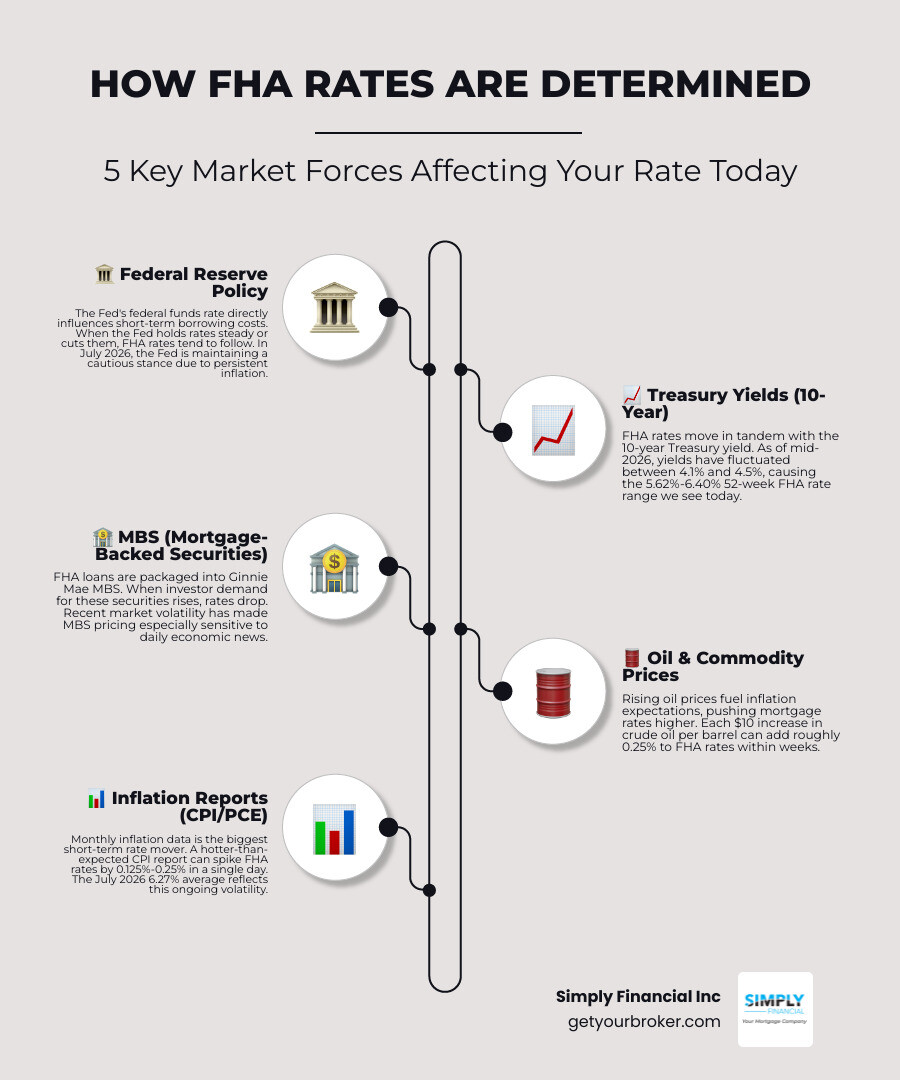
Have you ever wondered why mortgage rates can jump or slide on any given Tuesday? Many borrowers assume rates only move when the Federal Reserve makes an announcement. While the Fed certainly plays a massive role, daily FHA rate volatility is heavily driven by the bond market—specifically Mortgage-Backed Securities (MBS) and the 10-year Treasury bond yield, which acts as a direct leading indicator.
Interestingly, in 2026, we have observed a strong correlation between mortgage rate momentum and oil and gas price volatility. When energy prices climb, inflation fears rise, which puts upward pressure on bond yields and mortgage rates. Conversely, when oil prices ease, rates often recover modestly.
To visualize how these market forces dictate your daily quote, consider this simplified flow of cause and effect:
Understanding this relationship helps you time your rate lock. For example, if you are tracking Current Mortgage Rates for FHA Loans and notice a dip following a drop in global oil prices, it may be the perfect window to contact us and lock in your rate before the next Federal Reserve meeting.
FHA vs. Conventional, VA, and USDA Loans
When shopping for a home in Chicago, IL, or across the sunny regions of Florida, it is vital to compare all your options. FHA loans are famously lenient, but they are not the only mortgage product on the shelf.
Here is how FHA loans compare to Conventional, VA, and USDA loans in the current July 2026 rate environment:
| Loan Feature | FHA Loans | Conventional Loans | VA Loans | USDA Loans |
|---|---|---|---|---|
| Typical 30-Yr Rate | ~6.27% – 6.37% | ~6.42% – 6.81% | ~5.99% – 6.25% | ~6.10% – 6.30% |
| Min. Down Payment | 3.5% | 3% | 0% | 0% |
| Min. Credit Score | 580 (500 with 10% down) | 620 | No official limit (often 580-620) | 640 (for automated underwriting) |
| Mortgage Insurance | Upfront (1.75%) & Annual | Monthly PMI (if <20% down) | None (Funding Fee applies) | Upfront & Annual Fees |
| DTI Limit (2026) | Tightened to 50% | Typically 45% – 50% | Flexible | Typically 41% (flexible with overlays) |
While FHA rates are running lower than conventional 30-year fixed rates by roughly 44 basis points in certain daily indexes (e.g., FHA at 6.37% vs. Conventional at 6.81%), some lender portfolios show FHA rates at 6.84% compared to 6.42% for highly qualified conventional buyers. This discrepancy occurs because FHA loans carry mandatory mortgage insurance that must be factored into the overall Annual Percentage Rate (APR).
To explore the full suite of programs available for your specific scenario, check out our comprehensive guide on Mortgage Loan Options.
How to Secure the Best FHA Rates Today Compared to Conventional Options
If you find yourself qualifying for both an FHA loan and a conventional loan, which path should you take?
As a general rule, a conventional loan is superior if you can manage a higher credit score (660+) and a down payment of 10% or more. This is because conventional private mortgage insurance (PMI) can eventually be cancelled once you reach 20% equity, and you will completely avoid the FHA’s hefty upfront premium.
However, if you have a lower credit score or a higher debt-to-income ratio, the FHA loan remains an incredibly powerful tool. It provides a lower barrier to entry, allowing you to secure a highly competitive interest rate that would otherwise be out of reach on a conventional path. To dive deeper into the mechanics of fixed-rate terms, take a look at our Fixed Rate Mortgage Guide 2026.
Key FHA Loan Requirements and Costs in 2026
While FHA loans are highly accessible, they are not free from strict regulatory guidelines. In 2026, several policy adjustments have narrowed the qualification window for borrowers.
First, the FHA upfront mortgage insurance premium (UFMIP) sits at 1.75% of the base loan amount. This is the highest rate we have seen since 2015, driven largely by the FHA’s claim loss ratio hitting 0.84% in late 2025. For a $300,000 home purchase with a 3.5% down payment, this translates to $5,250 in upfront insurance that is typically rolled directly into your total loan balance, plus an annual premium of roughly 0.55% broken down into your monthly payments.
Second, the maximum debt-to-income (DTI) ratio has tightened to 50% in 2026, down from the more lenient 52% allowed in 2025. This means a household earning $6,000 gross monthly is capped at $3,000 in total monthly debt obligations (including the new mortgage, credit cards, student loans, and auto financing).
For a complete breakdown of how these changes impact your purchasing power, read the FHA Loan Requirements and Rates 2026 – Mortgage Data Index .
Specialized FHA Programs and Property Standards
FHA loans are not just for standard single-family suburban homes. There are specialized programs designed to fit unique local property markets in Illinois and Florida:
- FHA 203(k) Rehabilitation Loans: Perfect for buying a fixer-upper in Chicago’s historic neighborhoods. This program allows you to bundle the home purchase price and the costs of necessary renovations into a single mortgage. Learn more about this option via our FHA 203k Loan Multifamily guide.
- Property and Appraisal Standards: FHA appraisals are notoriously thorough. The property must meet 18 specific safety, security, and structural standards. Common fail items include missing handrails, outdated HVAC systems, peeling paint in pre-1978 homes, and lack of GFCI outlets in kitchens and bathrooms.
- Asset and Reserve Guidelines: In 2026, most FHA borrowers must show verified cash reserves equal to at least 2 months of mortgage payments. If you are using gifted funds from a family member to cover your down payment, the rules get stricter: the donor must provide a signed gift letter alongside 2 months of their own bank statements, and the borrower’s reserve requirement may increase to 3 months of verified cash reserves.
To map out your homebuying journey from start to finish, refer to our comprehensive FHA Home Loan Guide 2026.
Strategies to Secure the Lowest FHA Interest Rate
Getting the best fha rates today requires a proactive approach. You do not have to simply accept the first rate a lender quotes you.
To position yourself for the absolute lowest possible rate, implement these expert strategies:
- Boost Your Credit Score: While the FHA technically allows scores down to 500 (with a 10% down payment), aiming for a score of 660 or higher will dramatically lower your interest rate. On average, your rate drops by 10 to 15 basis points for every 20-point jump in your credit score.
- Keep Credit Card Balances Low: Keep your revolving debt utilization below 30% of your limits for at least 3 to 6 months before applying.
- Increase Your Down Payment: Moving from the minimum 3.5% down payment to 5% or 10% reduces the lender’s risk, which can translate directly into a lower interest rate offer and lower monthly mortgage insurance costs.
- Get Pre-Approved Early: Securing a pre-approval allows you to lock in a favorable rate for up to 45 days, shielding you from sudden market spikes while you shop. To get started, read our guide on Mortgage Pre-Approval.
Frequently Asked Questions about FHA Loans
Can I remove FHA mortgage insurance without refinancing?
For the vast majority of modern FHA borrowers, the answer is no. If you put down the minimum 3.5%, the annual mortgage insurance premium (MIP) remains on the loan for its entire 30-year life. The only exception is if you make a down payment of 10% or more at the time of purchase, in which case the MIP can be removed after 11 years. For most homeowners, the most practical way to eliminate FHA mortgage insurance is to pay the loan down until they have 20% equity and then refinance into a conventional mortgage. You can read more about how this works in our dedicated guide on the FHA Loan.
How do gifted funds affect my FHA loan reserve requirements?
While the FHA gladly permits family members to gift you the 3.5% down payment, doing so flags your file for slightly stricter underwriting. To offset the risk of having “zero skin in the game” at closing, FHA guidelines in 2026 typically require you to hold 3 months of verified cash reserves in your account, compared to the standard 2 months required for borrowers using their own saved funds.
What is the outlook for FHA rates in late 2026?
The outlook for the remainder of 2026 hinges entirely on inflation data and the Federal Reserve’s monetary policy. If inflation continues to cool, we expect FHA rates to stabilize or drift downward toward the high 5% range. However, trying to time the market perfectly is usually a “fool’s errand.” If a home fits your current budget and long-term family plans, it is wiser to buy now and refinance later if rates drop, rather than risk being priced out by rising home values.
Conclusion
Navigating the mortgage market to secure the best fha rates today does not have to be an overwhelming chore. By understanding how daily market forces impact your rate, keeping an eye on tighter 2026 guidelines, and preparing your credit profile ahead of time, you can walk into your closing with absolute confidence.
At Simply Financial Inc, we are dedicated to providing a seamless, expert-guided, and entirely stress-free mortgage experience. Whether you are searching for your very first home in Chicago or looking to purchase a property in Florida, our team is here to help you secure the best loan terms available.
Ready to see what rates you qualify for? Compare current FHA rates today and let us guide you home.