

Why a Commercial Loan for a Rental Property Could Be Your Most Important Financial Decision
Securing a commercial loan for a rental property is one of the most powerful moves a real estate investor can make — but it works very differently from a standard home mortgage. Here’s what you need to know at a glance:
Quick Answer: How to Get a Commercial Loan for a Rental Property
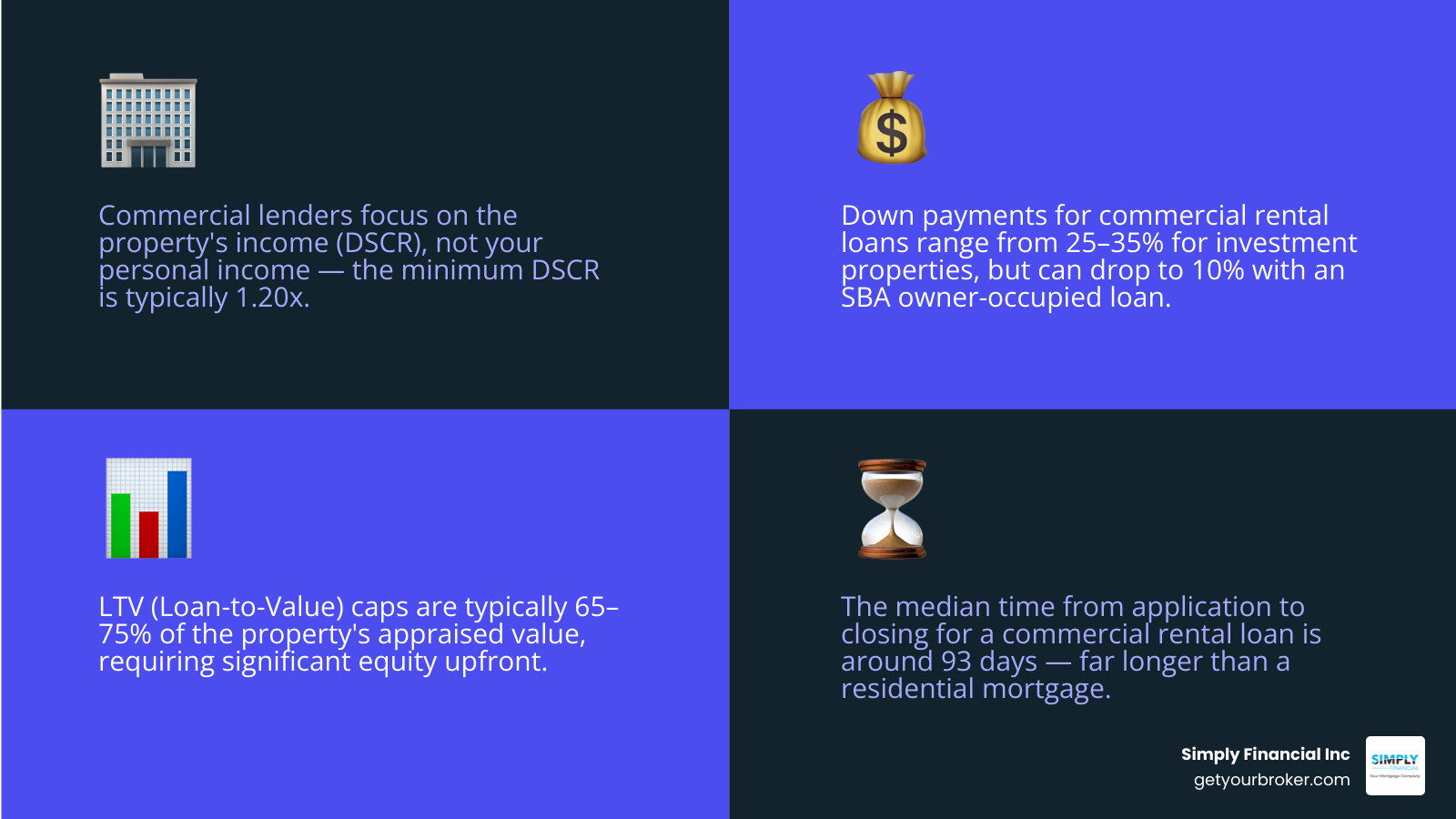
- Check your DSCR — most lenders require a minimum of 1.20x (property income must cover debt payments by at least 20%)
- Prepare your down payment — expect 25–35% for investment properties, or as low as 10% for SBA owner-occupied loans
- Know your LTV — lenders typically cap financing at 65–75% of the property’s appraised value
- Choose the right loan type — conventional commercial mortgage, SBA 504/7(a), or bridge loan depending on your situation
- Gather your documents — rent rolls, operating statements, tax returns, and a business plan
- Apply and close — the median timeline from application to closing is around 93 days
Unlike a residential mortgage, commercial lenders focus heavily on what the property earns, not just what you earn. That distinction changes everything — from how your loan is sized to how long it takes to close.
I’m Peter Babjak, founder of Simply Financial Inc, a Chicago-based mortgage brokerage with over 18 years of experience helping investors navigate complex financing — including securing the right commercial loan for a rental property across Chicago and the surrounding suburbs. Whether you’re buying your first multi-family building or expanding an existing portfolio, the sections below walk you through every step of the process.
What is a Commercial Loan for a Rental Property?

At its core, a commercial loan for a rental property is a mortgage loan secured by a lien on an income-producing commercial property rather than a primary residential home. While a consumer mortgage helps an individual or family buy a home to live in, commercial real estate loans are made to business entities (like LLCs, LPs, or corporations) specifically for business purposes.
These loans are designed for properties that generate revenue, such as multi-family apartment complexes (typically 5 or more units), mixed-use buildings, retail strip malls, industrial warehouses, and office spaces. When you apply for a commercial loan, the lender is not just analyzing your personal paycheck; they are evaluating the property as its own self-sustaining business.
Commercial vs. Residential Mortgages
If you have only ever taken out a residential mortgage, stepping into the commercial lending arena can feel like entering a different country where they speak a similar but noticeably distinct language. Here are the primary differences you need to know:
- The Borrower: Residential mortgages are almost always issued to individuals. Commercial loans, however, are typically issued to business entities (such as an LLC). This allows multiple partners to hold ownership and shields personal assets from direct liability.
- Loan Terms: Residential mortgages are famous for their 30-year fixed-rate terms. In contrast, commercial loans feature much shorter loan terms — typically ranging from 3, 5, 10, or up to 15 years. While the repayment schedule might be calculated over a 25- or 30-year amortization period, the actual loan term is shorter, usually ending with a “balloon payment” where the remaining balance must be paid off or refinanced.
- Interest Rates: Because commercial loans are considered higher-risk, illiquid assets without an organized secondary market, their interest rates are generally higher than residential rates. In the current July 2026 market, conventional commercial interest rates typically range from 5.49% to 8.80% for investment properties, depending on the property type, location, and borrower profile.
- Underwriting Focus: Residential underwriting revolves around your personal Debt-to-Income (DTI) ratio, personal tax returns, and W-2 statements. Commercial lenders rarely calculate personal DTI. Instead, they focus on the property’s Net Operating Income (NOI) and its ability to cover its own mortgage payments.
To explore the full spectrum of personal and business financing structures we offer, check out our comprehensive guide to Mortgage Loan Options.
Types of Commercial Loans for Rental Properties
Choosing the wrong loan type is one of the most expensive mistakes an investor can make. In commercial real estate, there is no “one-size-fits-all” solution. The right choice depends on whether you plan to occupy part of the building, rent it out entirely, or perform major renovations.
| Loan Type | Typical Down Payment | Typical Term Length | Best Used For |
|---|---|---|---|
| Traditional Commercial Mortgage | 25% – 35% | 5 to 15 years | Stabilized, income-producing properties (multifamily, retail, office) |
| SBA 504 / 7(a) Loans | 10% – 15% | 10 to 25 years | Mixed-use or commercial properties where your business occupies at least 51% |
| Commercial Bridge Loans | 20% – 30% | 6 months to 3 years | Properties needing rapid closing, rehab, or lease-up before permanent financing |
Traditional Commercial Mortgages
A conventional commercial mortgage is a loan provided by a traditional financial institution, such as a commercial bank, credit union, or specialized commercial lender. It is secured by a first lien position on the rental property.
These loans are the bread and butter of the commercial real estate world. They are best suited for stabilized, income-producing properties that already have a steady stream of tenants and documented historical cash flow. Because conventional loans are not backed by any government agency, lenders enforce strict underwriting standards, requiring strong property financials and experienced sponsors.
If you are looking to purchase a multi-family property or a commercial asset to build long-term wealth, our Investment Property Loan Guide 2026 provides a deep dive into structuring these conventional deals.
SBA 504 and 7(a) Loans
The U.S. Small Business Administration (SBA) offers loan programs that can be utilized to buy commercial real estate. However, there is a major catch: the property must be owner-occupied. You can review the SBA’s official overview of 504 loans for more details on how the program supports eligible owner-occupied real estate and major fixed assets.
To qualify for an SBA 504 or 7(a) loan, your business must occupy at least 51% of the property’s total square footage. This means you cannot use an SBA loan to buy a pure buy-to-let apartment building. However, if you are a business owner buying a mixed-use building in Chicago or Florida, and your business operates on the ground floor while you rent out the upper-floor apartments, an SBA loan is an incredibly attractive option.
- SBA 504 Loan: This program is structured using two separate loans. Typically, a conventional bank provides a first mortgage covering 50% of the project cost, a Certified Development Company (CDC) provides a second mortgage backed by the SBA covering up to 40%, and the borrower contributes a low down payment of just 10%. The CDC debenture portion offers an incredibly stable, fixed rate in the mid-6% range, locked for 25 years on a fully amortizing basis.
- SBA 7(a) Loan: This is a more flexible program often used for acquiring real estate combined with business working capital or equipment.
For investors focusing strictly on residential multi-family properties (1 to 4 units) who want to compare government-backed options, our FHA Investment Property Loan Guide 2026 is a valuable resource.
Commercial Bridge Loans
What happens if you find a fantastic commercial property that is currently vacant, run-down, or needs a major face-lift? A traditional bank will not finance it because it lacks the cash flow to cover a monthly mortgage.
This is where commercial bridge loans come in. Bridge loans are short-term financing solutions designed to “bridge the gap” between the initial purchase (or renovation phase) and permanent, long-term financing.
- Duration: Typically 6 months to 3 years.
- Use Case: Buying an underperforming asset, renovating the units to increase rents, and transitioning the property to a conventional mortgage once it is stabilized and profitable.
- Exit Strategy: Lenders will require a clear exit strategy – usually refinancing into a permanent commercial mortgage or selling the property.
Key Qualification and Underwriting Requirements

Commercial underwriting is a highly analytical process. Lenders want to ensure that the asset you are buying can comfortably withstand economic downturns, tenant vacancies, and routine maintenance without defaulting on the debt.
Understanding DSCR and NOI for a Commercial Loan for a Rental Property
The absolute most important metric in securing a commercial loan for a rental property is the Debt Service Coverage Ratio (DSCR), which is directly derived from the property’s Net Operating Income (NOI).
To calculate NOI, you subtract all operating expenses (property taxes, insurance, maintenance, property management, utilities, and vacancy reserves) from the gross rental income. Personal expenses and your mortgage payment (debt service) are not included in operating expenses.
$$\text{Net Operating Income (NOI)} = \text{Gross Rental Income} – \text{Operating Expenses}$$
Once you have the annual NOI, you calculate the DSCR by dividing the NOI by the annual mortgage principal and interest payments:
$$\text{DSCR} = \frac{\text{Net Operating Income (NOI)}}{\text{Annual Debt Service}}$$
Lenders typically require a minimum DSCR of 1.20x to 1.30x for investment commercial real estate loans. This means the property’s net income must exceed the mortgage payments by at least 20% to 30%, providing a safety cushion. If your DSCR is too low, the lender will “size down” the loan, meaning they will require you to bring a larger down payment to reduce the monthly debt service.
Additionally, lenders will often apply a “rent haircut.” If your property’s current rents are aggressively above the local market average, the lender will adjust those figures down to market rates during their underwriting to protect themselves against future tenant turnover. They will also require you to establish reserves — typically 6 to 12 months of debt service held in a liquid escrow account at closing.
By focusing on cash-flow-based underwriting, investors can often secure financing based on the strength of the asset itself rather than relying solely on personal tax returns.
LTV Ratios and Down Payments
Unlike residential loans where you can sometimes put down as little as 3% to 5%, commercial loans require significant “skin in the game.”
The maximum Loan-to-Value (LTV) ratio for conventional commercial investment property loans is typically capped at 75%. This means you must be prepared to make a down payment of 25% to 35% of the property’s appraised value or purchase price (whichever is lower).
Lenders also look for “hard cash equity” (money directly out of your business or personal bank accounts, rather than secondary financing or seller carrying back debt) and post-closing liquidity (the cash you have left over after paying the down payment and closing costs).
Understanding these technical underwriting parameters is crucial when structuring conventional commercial assets to ensure you meet the lender’s strict criteria.
Credit Scores and Liquidity
Even though the property’s cash flow is the star of the show, your personal and business credit profiles still play a supporting role:
- Personal Credit Score: Most commercial lenders require a minimum personal FICO score of 660, though scores of 700 or higher are preferred to secure the most competitive interest rates and terms.
- Business Credit: Lenders may pull business credit profiles from bureaus like Dun & Bradstreet (looking for a PAYDEX score of 80+) or Experian Business.
- FICO SBSS: For SBA-backed loans, a specialized FICO Small Business Scoring Service (SBSS) score is used to pre-screen applicants. A minimum score of 140 to 160 is typically required.
Comparing Owner-Occupied vs. Investment Property Loans
Deciding whether to pursue an owner-occupied commercial loan or a pure investment property loan is a critical strategic decision.
- Owner-Occupied Loans: If your business will occupy at least 51% of the building, you unlock access to SBA financing. This means a dramatically lower down payment (often just 10%), longer amortization periods (up to 25 years fully amortizing), and highly competitive fixed interest rates. The downside is that you cannot use this path if your primary goal is to lease out the entire building to third-party tenants.
- Investment Property Loans: If you plan to rent out 100% of the space to generate passive rental income, you must use an investment commercial loan. While these require larger down payments (25% to 35%) and have stricter LTV limits (typically 75%), they offer incredible flexibility. You can buy multi-family buildings, retail centers, or industrial parks, and hold them under an LLC to protect your personal assets.
If you are looking to acquire or refinance a local multi-family building in the Chicagoland area, our dedicated guide on Chicago Investment Property outlines regional market trends and specific localized strategies.
Common Pitfalls to Avoid in Commercial Real Estate Financing
Navigating the commercial mortgage market can be tricky. Here are the most common mistakes we see investors make — and how you can avoid them:
- Becoming Overleveraged: It is tempting to borrow as much as a lender will give you. However, unexpected repair costs, sudden tenant vacancies, or late-paying tenants can quickly turn a highly leveraged property into a cash-draining liability. Always maintain a healthy cash reserve.
- Ignoring Prepayment Penalties: Commercial loans almost always include prepayment penalties. These are designed to protect the lender’s yield if you pay off the loan early. The two most common structures are:
- Yield Maintenance: A complex mathematical formula that charges you a penalty equal to the present value of the interest the lender will lose over the remainder of the loan term.
- Declining/Step-Down: A simpler structure, such as a “5-4-3-2-1%” penalty, which decreases by 1% each year of the loan.
- Failing to Plan for Balloon Payments: Because commercial loans have short terms (e.g., 5 or 10 years) but longer amortization schedules, you will owe a massive balloon payment at the end of the term. You must begin the refinancing or sale process at least one year before the loan matures to avoid default.
- Misunderstanding Personal Guarantees: Many commercial loans are “recourse” debt, meaning you must sign a personal guarantee. If the business defaults on the loan, the lender can seize your personal assets (like your home or personal bank accounts) to recover their losses. Look for “non-recourse” debt (typically available on larger deals over $2 million) or ensure you understand the “springing recourse” (bad boy carve-outs) provisions in your contract.
Understanding these complex loan features beforehand will help you avoid costly surprises down the road and protect your investment portfolio.
Step-by-Step Application Process for a Commercial Loan for a Rental Property
Securing commercial financing is a marathon, not a sprint. The median processing time from application to closing is approximately 93 days. Following a structured process will keep your deal on track.
Step 1: Financial Self-Assessment
Before talking to a lender, review your personal and business financial health. Calculate your liquid net worth, check your personal credit scores, and ensure you have the cash required for a 25% to 35% down payment plus closing costs and reserves.
Step 2: Prepare a Detailed Business Plan
Commercial lenders invest in business plans, not just properties. Prepare a professional package that includes:
- Detailed property description and photos.
- Current rent rolls and historical operating statements (2 to 3 years of P&L statements).
- Pro forma projections showing expected rental income and expenses.
- Your background and experience as a real estate investor or property manager.
Step 3: Choose the Right Lender and Program
Partnering with an experienced brokerage like Simply Financial Inc allows you to compare options from traditional banks, credit unions, and private commercial lenders to find the best match for your specific scenario.
If you are looking for local expertise in the Illinois market, our team at Mortgage Lender Chicago IL can guide you through the regional lending landscape.
Step 4: Submit Your Formal Application
Once you select a lending program, you will submit a formal loan application along with your document package. This initiates the underwriting process, where the lender will verify all financial data, run credit checks, and order a commercial property appraisal (which typically costs between $1,000 and $10,000 depending on the size of the project).
Step 5: Underwriting and Approval
The lender’s underwriting department will review the appraisal, environmental reports, and lease agreements. They will calculate the final DSCR and LTV to approve the loan size and interest rate.
Step 6: Close the Deal
Once approved, you will review and sign the final closing documents, wire your down payment and closing costs, and officially take ownership of your new rental property.
Frequently Asked Questions about Commercial Rental Loans
What is the minimum down payment for a commercial rental loan?
For a standard investment property commercial loan, lenders typically require a down payment of 25% to 35% (corresponding to a 65% to 75% LTV). If the property is owner-occupied and qualifies for an SBA 504 loan, the down payment can be as low as 10%.
Can I get a commercial loan under an LLC?
Yes! In fact, most commercial lenders prefer or even require that the property be held under an LLC, corporation, or partnership. This is known as entity vesting. It helps protect your personal assets and allows for clean partnership structures. For smaller or mid-sized commercial loans, the lender will still require a personal guarantee from the primary owners of the LLC.
How long does it take to close a commercial real estate loan?
The median processing time from application to closing is approximately 93 days (roughly 3 months). This is significantly longer than a standard residential loan because commercial appraisals, environmental assessments, and legal reviews of tenant leases take substantial time.
Conclusion
Securing a commercial loan for a rental property is a sophisticated financial move that can unlock massive wealth-building opportunities, passive income, and valuable tax benefits. However, because commercial lending is highly analytical and deeply focused on property-level cash flow, navigating the process alone can feel overwhelming.
At Simply Financial Inc, we believe that real estate investing should be exciting, not stressful. Our mission is to deliver a seamless, expert-guided, and stress-free mortgage experience. Whether you are looking to purchase a multi-family building in Chicago, refinance a retail center in Florida, or expand your commercial portfolio, we are here to help you size, structure, and secure the perfect loan.
Ready to take the next step? Contact Us Chicago Mortgage Lender today to speak directly with an experienced commercial lending expert, or visit our pillar page to Secure Your Next Chicago Investment Property. Let’s build your portfolio together!