

Key Conditions for FHA Loan Approval in 2026
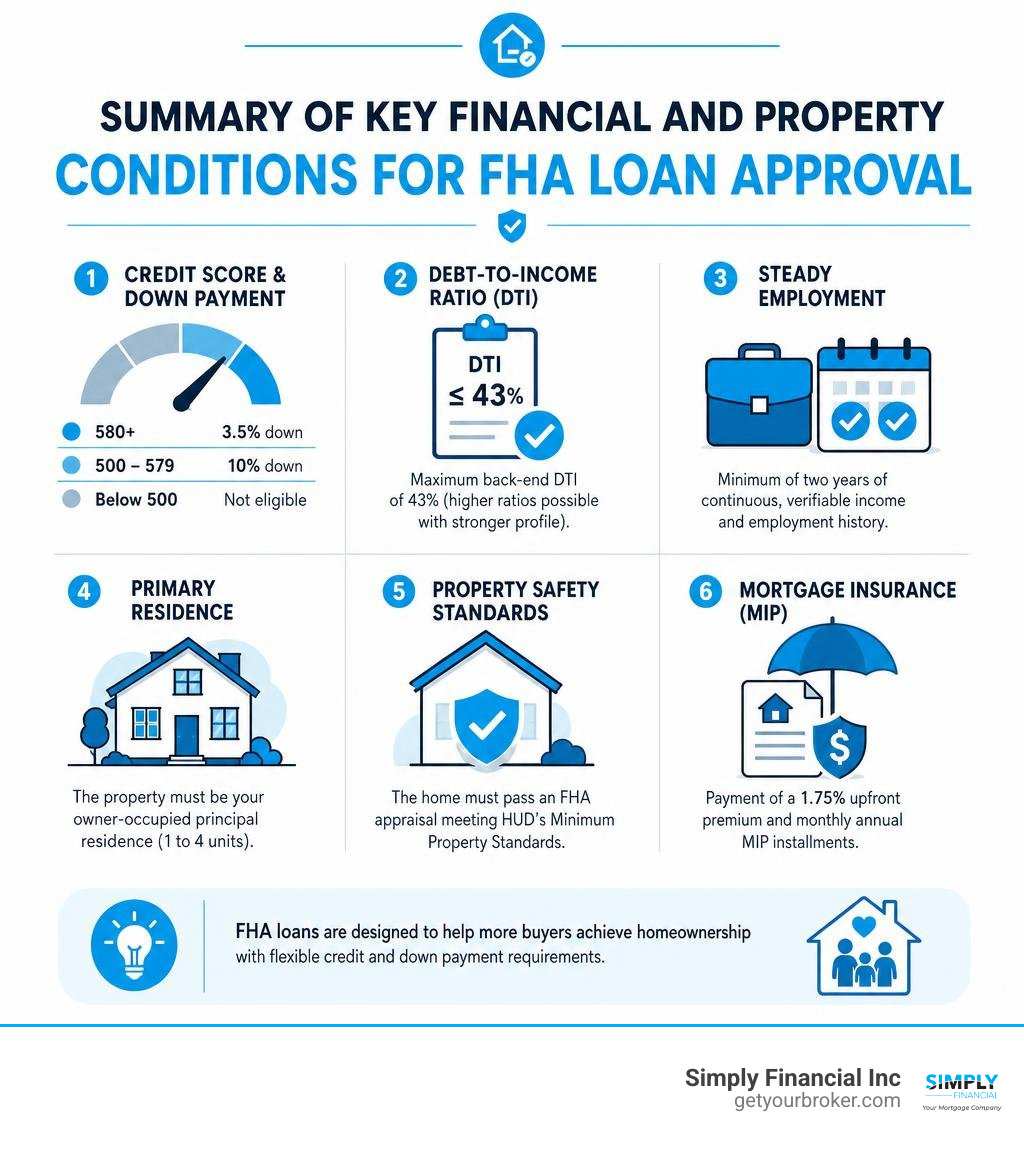
To qualify for an FHA-insured mortgage, you must meet specific borrower and property criteria set by the Federal Housing Administration. The core conditions for fha loan approval include:
- Credit Score and Down Payment: A minimum 580 FICO score allows for a 3.5% down payment. Scores between 500 and 579 require 10% down. Scores below 500 are ineligible.
- Debt-to-Income (DTI) Ratio: A standard maximum back-end DTI of 43%, though automated underwriting or strong compensating factors can allow higher ratios.
- Steady Employment: A minimum of two years of continuous, verifiable income and employment history.
- Primary Residence: The property must serve as your owner-occupied principal residence (1 to 4 units).
- Property Safety Standards: The home must pass an FHA appraisal meeting HUD’s Minimum Property Standards for safety, security, and structural soundness.
- Mortgage Insurance (MIP): Mandatory payment of a 1.75% upfront premium alongside monthly annual MIP installments.
Getting approved does not require perfect credit or deep wealth. The FHA program exists specifically to give everyday buyers a clear path to homeownership without predatory terms.
I’m Peter Babjak, founder of Simply Financial Inc, where I have spent over 18 years helping buyers navigate the essential conditions for FHA loan approval. Below, we will break down each requirement step-by-step so you can prepare your finances and secure your loan without unnecessary stress.
Core Borrower Conditions for FHA Loan Approval
When we evaluate your mortgage application under Federal Housing Administration (FHA) guidelines, we review your overall financial profile using the “Four Cs of Credit”: credit history, capacity to repay, cash assets, and collateral. Underwriters do not expect flawless credit records, but they do require clear evidence that you can comfortably manage your monthly obligations.
Credit Score and Down Payment Thresholds
Your credit score directly dictates your minimum required down payment. The Department of Housing and Urban Development (HUD) outlines these specific parameters in Section A. Borrower Eligibility Requirements:
- 580 or Higher: You qualify for maximum financing with a 3.5% down payment (up to a 96.5% Loan-to-Value ratio).
- 500 to 579: You can qualify with a 10% down payment (a maximum 90% Loan-to-Value ratio).
- Below 500: Borrowers are not eligible for FHA-insured financing under standard guidelines.
When reviewing multiple credit scores, underwriters look at your “decision credit score.” If you have three scores reported from Equifax, Experian, and TransUnion, the lender uses the median score. If you have two scores, the lower of the two is used. For borrowers who have limited traditional credit lines, we can often establish an alternative credit history using 12 months of on-time payments for utilities, cell phone plans, and rental housing. Understanding the exact Credit Needed for FHA Loan helps you plan your savings strategy well ahead of closing.
Debt-to-Income (DTI) Ratios and Compensating Factors
Your Debt-to-Income (DTI) ratio measures how much of your gross monthly income goes toward existing debts plus your projected new mortgage payment. Under standard FHA underwriting benchmarks:
- Front-End Ratio (Housing): 31% maximum (housing costs alone, including principal, interest, taxes, and insurance).
- Back-End Ratio (Total Debt): 43% maximum (housing costs plus revolving debt, auto loans, student loans, and other fixed payments).
While 43% serves as the baseline benchmark, an automated underwriting system (AUS) like Desktop Underwriter (DU) can approve back-end ratios nearing 45% to 50% when supported by strong compensating factors. These factors include:
- Substantial verified cash reserves remaining after closing (such as 3 to 6 months of mortgage payments in savings).
- A minimal increase in your monthly housing expense compared to what you currently pay in rent.
- Significant secondary or residual income that is not formally counted toward qualifying income.
- A demonstrated history of conservative credit usage and high disposable income.
Employment Verification and Income Documentation
FHA guidelines require borrowers to establish a minimum of two consecutive years of steady employment and verifiable income. Stability is what matters most here:
- W-2 Employees: You will need your two most recent W-2 forms, federal tax returns from the last two years, and 30 days of consecutive pay stubs reflecting year-to-date earnings.
- Self-Employed Borrowers: You must present two full years of signed personal and business federal tax returns (including 1040s, 1120s, or 1065s with all schedules), plus a year-to-date Profit and Loss (P&L) statement.
- Career Changes: Changing jobs within the same field or advancing your career does not disqualify you. Even entering the workforce after completing full-time education or military service satisfies the two-year requirement when supported by transcripts or discharge records.
- Non-English Documents: If any income or asset documentation is in a foreign language, FHA rules require complete, certified English translations.
Financial and Underwriting Guidelines for Prospective Buyers
Beyond your monthly income, FHA underwriters conduct a thorough assessment of your liquid assets and credit event history.
Financial and Asset Conditions for FHA Loan Approval
Here is an overview of the core financial benchmarks for FHA financing:
| Qualifying Metric | FICO 580+ Tier | FICO 500–579 Tier | Manual Underwriting Exception |
|---|---|---|---|
| Minimum Down Payment | 3.5% of purchase price | 10.0% of purchase price | Varies based on compensating factors |
| Standard Back-End DTI | 43% | 43% | Up to 40% (manual) / 50% (AUS approved) |
| Occupancy Requirement | Primary residence only | Primary residence only | Primary residence only |
| Down Payment Gift Funds | 100% permitted | 100% permitted | 100% permitted with gift letter |
Under FHA rules, you are not forced to source your down payment entirely from personal savings. You can utilize gift funds from immediate family members, employers, labor unions, or recognized charitable housing organizations. The donor must provide a signed gift letter stating that the funds are a true gift with no expectation of repayment, accompanied by bank statements proving the donor had the funds to give.
Down Payment Assistance (DPA) programs from state or local housing authorities can also be combined with FHA financing to cover both the down payment and out-of-pocket expenses. Reviewing your estimated FHA Cash to Close early on ensures you have accounted for prepaid items, escrow reserves, and loan setup fees.
Mortgage Insurance Premiums (Upfront and Annual MIP)
FHA loans require two forms of mortgage insurance, which protect lenders against default and allow for flexible qualification guidelines:
- Upfront Mortgage Insurance Premium (UFMIP): Equal to 1.75% of the base loan amount. This fee is almost always financed directly into your total loan balance rather than paid in cash at closing.
- Annual Mortgage Insurance Premium (Annual MIP): Calculated as a percentage of your remaining loan balance and divided into 12 monthly payments added to your mortgage bill. Depending on the loan term, balance, and original Loan-to-Value (LTV), annual MIP generally ranges from 0.80% to 1.05% (80 to 105 basis points).
The duration of your Annual MIP depends on your starting down payment:
- Down Payment Under 10% (LTV > 90%): You pay Annual MIP for the entire life of the mortgage.
- Down Payment of 10% or Greater (LTV ≤ 90%): Annual MIP automatically cancels after 11 years.
For a detailed look at how these premiums factor into overall borrowing costs, explore our FHA Home Loan Guide 2026.
CAIVRS Screening, Bankruptcies, and Foreclosures
Every borrower applying for an FHA loan is screened through CAIVRS (Credit Alert Interactive Verification Reporting System), the federal government’s shared database of delinquent debts. If you have an outstanding federal tax lien or are in default on a federal student loan, you cannot receive approval until the debt is paid in full or you have established a documented, verified repayment plan with on-time payments.
If you have experienced major credit setbacks in the past, FHA guidelines outline explicit recovery timelines:
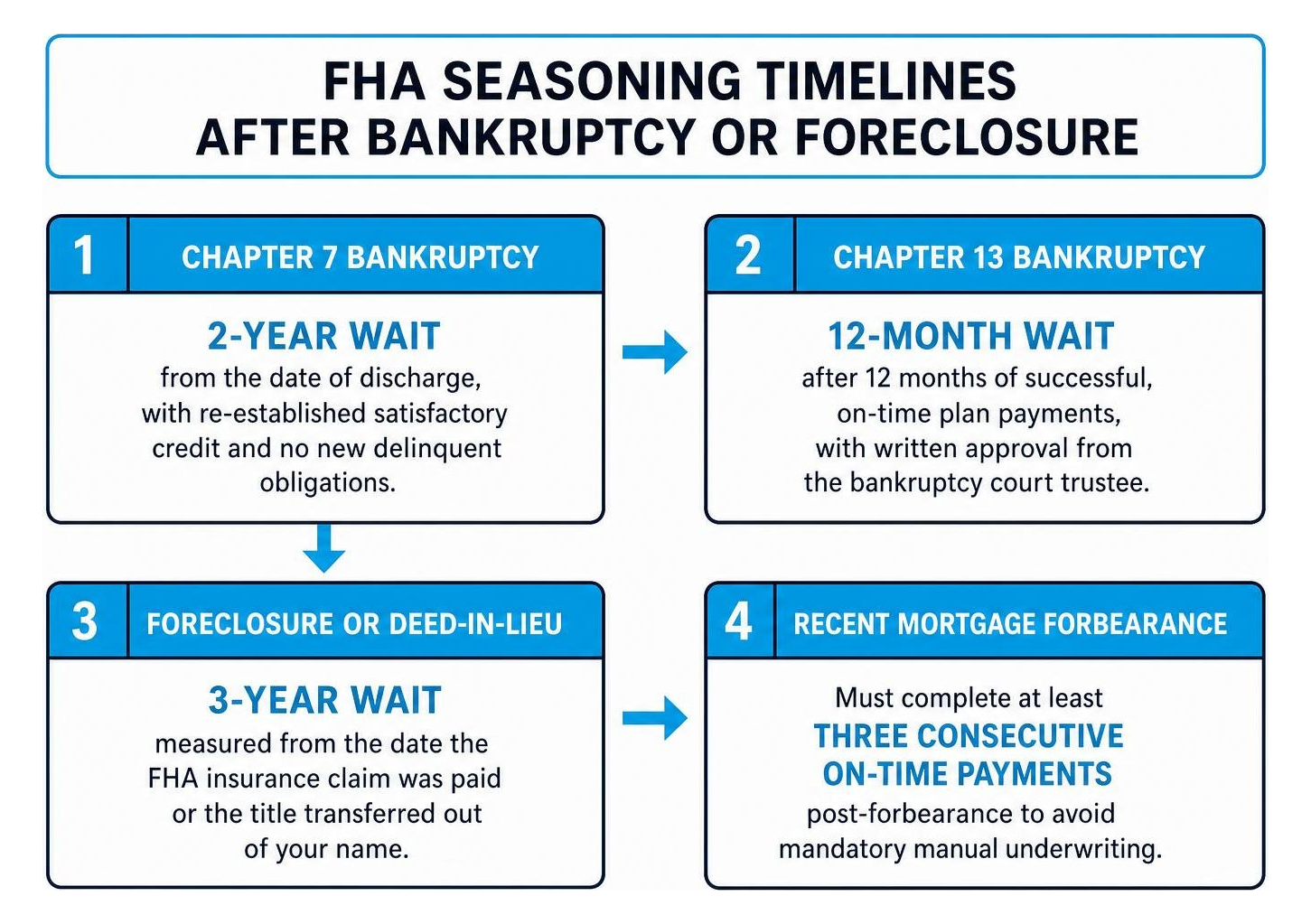
- Chapter 7 Bankruptcy: You must wait a minimum of 2 years from the date of discharge, provided you have re-established satisfactory credit or refrained from incurring new delinquent obligations. If you are exploring future equity options, you can review our guide on FHA Cash Out Refinance After Chapter 7.
- Chapter 13 Bankruptcy: You can qualify after 12 months of successful, on-time plan payments, provided you obtain written approval from the bankruptcy court trustee.
- Foreclosure or Deed-in-Lieu: A mandatory 3-year waiting period applies, measured from the date the FHA insurance claim was paid or the title transferred out of your name.
- Recent Mortgage Forbearance: If you entered a forbearance plan, you must complete at least three consecutive monthly on-time payments post-forbearance to avoid mandatory manual underwriting.
Property Eligibility and Appraisal Standards

An FHA loan does not just qualify the buyer; it must also qualify the home. Under HUD guidelines, the property serves as collateral for the loan, meaning it must be safe, structurally sound, and sanitary.
Property and Appraisal Conditions for FHA Loan Approval
An FHA appraisal is more comprehensive than a standard conventional appraisal because the appraiser performs both a valuation and a safety inspection. To satisfy HUD’s Minimum Property Standards (MPS), detailed in HUD Handbook 4150.2 Property Appraisal and Valuation, the property must meet the following criteria:
- Structural Soundness: Foundations, roofs, and exterior walls must be structurally intact. The roof must have at least two years of remaining physical life.
- Lead-Based Paint Remediation: For any home built before 1978, peeling, chipping, or flaking paint on interior or exterior surfaces is strictly prohibited. Defective paint must be scraped, primed, and repainted before final loan endorsement.
- Working Mechanical Systems: The heating system must be capable of keeping living areas at a comfortable temperature (at least 50°F in areas subject to freezing). Electrical panels must be operational without exposed wiring.
- Potable Water and Sanitation: The home must have continuous hot and cold running water, functioning toilets, and an approved sewage disposal system. Water systems served by mechanical chlorinators, springs, lakes, or rivers are ineligible.
- Safe Access and Drainage: The property must have adequate exterior grading to divert water away from foundation walls and provide safe, all-weather vehicular access.
If an appraisal flags minor repairs, the seller can complete them prior to closing, verified by a Compliance Inspection Report (Form HUD-92051). If winter weather prevents exterior painting or paving, the lender can establish an escrow holdback (Form HUD-92300) allowing up to six months to finish the work post-closing. A standard FHA Loan gives buyers peace of mind knowing the home has been vetted for physical safety.
Eligible Property Types: Multi-Unit, Condos, and Manufactured Homes
FHA financing is versatile and supports several primary residence housing structures:
- 1-to-4 Unit Properties: You can purchase a duplex, triplex, or four-unit residential building with as little as 3.5% down, provided you occupy one of the units as your primary residence. Projected rental income from the remaining units can help you qualify for the mortgage. For properties needing updates, an FHA 203k Loan Multifamily lets you finance both the purchase and renovation costs into a single loan.
- Condominiums: Condominiums must either be located within a HUD-approved condominium development or receive single-unit approval (often called “spot approval”) from an FHA-approved lender.
- Manufactured Housing: Factory-built homes are eligible if built after June 15, 1976, attached to a permanent foundation, measuring at least 400 square feet, and classified as real estate. You can secure an FHA Loan for Mobile Home and Land under standard single-family guidelines.
- Mixed-Use Properties: Mixed-use buildings are allowed as long as the non-residential commercial use does not exceed 25% of the total floor area and does not interfere with the residential character of the home.
2026 FHA Loan Limits: Standard Floors and High-Cost Ceilings
FHA loan limits are updated each calendar year based on nationwide home price indices. The baseline national floor is calculated at 65% of the conforming loan limit, while the high-cost ceiling reaches 150%.
For 2026, the standard FHA loan limits for single-family and multi-unit properties are:
| Property Units | 2026 Baseline Floor (Low-Cost Areas) | 2026 High-Cost Ceiling (Metropolitan Areas) |
|---|---|---|
| 1-Unit (Single Family) | $541,287 | $1,249,125 |
| 2-Unit (Duplex) | $693,050 | $1,599,375 |
| 3-Unit (Triplex) | $837,725 | $1,933,200 |
| 4-Unit (Four-Plex) | $1,041,125 | $2,402,625 |
These limits vary by county. In standard-cost areas across Illinois and Florida, base loan limits apply, while competitive metropolitan markets receive adjusted ceilings reflecting higher median sales prices, as outlined in FHA Loan Requirements and Guidelines.
Citizenship, Legal Residency, and Special Underwriting Rules
Underwriting standards are uniform across household configurations, but specific legal and marital rules apply when verifying residency status and debts.
Lawful Residency and Work Authorization Requirements
You do not need to be a U.S. citizen to obtain an FHA mortgage. However, you must establish legal residency and authorization to work in the United States:
- Social Security Number: All borrowing parties must possess a valid Social Security Number. Cards stamped “Not Valid for Employment” cannot be accepted without supporting documentation.
- Permanent Resident Aliens: Lawful permanent residents must provide a valid Permanent Resident Alien Card (Green Card Form I-551) to receive the same underwriting terms as U.S. citizens.
- Non-Permanent Resident Aliens: Eligible non-permanent residents must present an active USCIS Employment Authorization Document (EAD, Form I-766) and demonstrate a likelihood of continued renewal.
- Refugees and Asylees: Individuals granted refugee or asylee status by USCIS are automatically eligible to work and qualify for FHA financing without needing a separate EAD card.
Community Property States and Non-Purchasing Spouse Debts
If you are married and purchasing a home located in a community property state (such as Arizona, California, Idaho, Louisiana, Nevada, New Mexico, Texas, Washington, or Wisconsin), specific underwriting guidelines apply to your transaction:
- Debt Inclusion: The monthly debts of your non-purchasing spouse (auto loans, revolving credit, student debt) must be factored into your qualifying DTI ratio, even if they are not listed on the mortgage note.
- Credit Score Protection: While the non-purchasing spouse’s debts impact qualifying ratios, their personal credit score cannot be used as grounds to deny the loan.
- Non-Community Property States: If you purchase a primary residence in states like Illinois or Florida without community property statutes, your non-purchasing spouse’s individual debts are entirely excluded from your qualification file.
Frequently Asked Questions About FHA Approval Conditions
Can I qualify for an FHA loan with a credit score below 580?
Yes. If your decision credit score falls between 500 and 579, you can still qualify for an FHA-insured mortgage, but you must make a minimum down payment of 10% (capping your Loan-to-Value ratio at 90%). Scores below 500 are ineligible for FHA financing.
How long is the mandatory waiting period after a bankruptcy or foreclosure?
The standard seasoning periods are:
- Chapter 7 Bankruptcy: 2 years from the date of final discharge.
- Chapter 13 Bankruptcy: 12 months of on-time plan payments with bankruptcy trustee approval.
- Foreclosure: 3 years from the date the FHA insurance claim was paid or title transferred.
What is the maximum debt-to-income (DTI) ratio allowed for FHA loan approval?
The benchmark DTI ceiling is 43% (comprising a 31% housing ratio and a 43% total debt ratio). However, when files are processed through an Automated Underwriting System (AUS) with compensating factors—such as cash reserves or a history of conservative credit use—approvals can reach 45% to 50%.
Conclusion
Understanding the necessary conditions for FHA financing gives you a decisive advantage when shopping for your next home. From meeting minimum credit score tiers to navigating appraisal guidelines and debt ratios, knowing what underwriters evaluate allows you to prepare your documentation with total clarity.
At Simply Financial Inc, we are committed to making your home loan experience transparent, structured, and stress-free. Whether you are purchasing a single-family house, a multi-unit property, or a condo, our team provides the expert guidance needed to secure your approval efficiently.
Explore your financing options today by reviewing our tailored Mortgage Loan Options: FHA Loan Chicago to take the next step toward confident homeownership.