

Understanding Home Loan Insurance: Types and Coverage Models
When evaluating coverage, confusion often arises because the term “home loan insurance” refers to two entirely different financial products: coverage that protects your family versus coverage that protects the lender. The cost of home loan insurance varies widely by type: mortgage protection life insurance typically averages $40 to $150 per month, while conventional private mortgage insurance generally ranges from 0.46% to 1.50% of the loan amount annually depending on credit and loan-to-value. FHA mortgage insurance adds a 1.75% upfront premium plus an annual premium, currently around 0.55%.
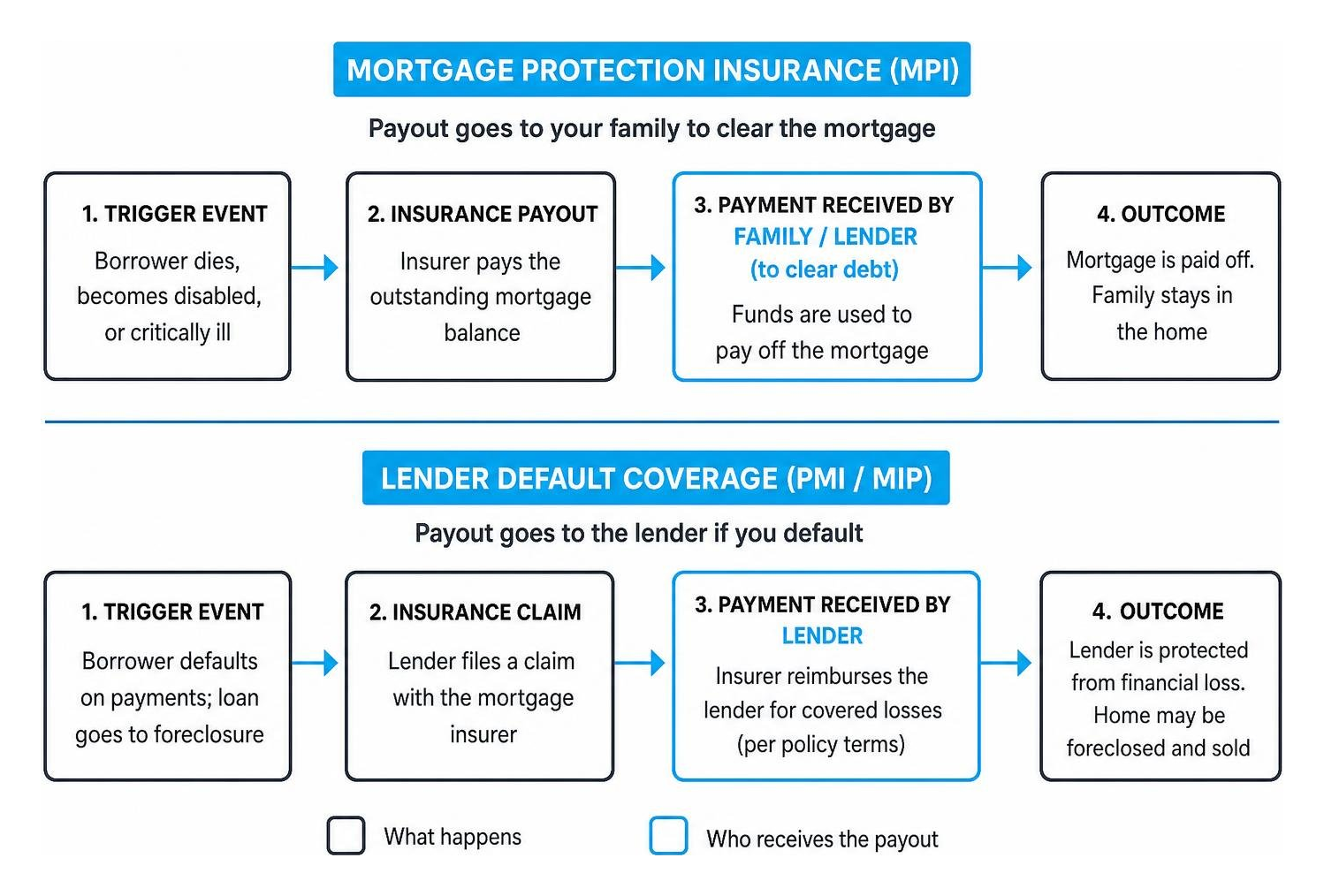
The first category consists of borrower-focused protection policies—often called Mortgage Protection Insurance (MPI) or credit life cover. If the policyholder passes away, becomes critically ill, or suffers total disability during the loan term, the policy pays out to clear or service the remaining mortgage balance.
The second category encompasses lender-focused default policies, such as Private Mortgage Insurance (PMI) on conventional loans or Mortgage Insurance Premiums (MIP) on government-backed options. These policies do not protect your household; they protect the financial institution if you stop making payments and the property goes into foreclosure.
| Policy Type | Primary Beneficiary | What Triggers a Payout? | Typical Cost Structure | Mandatory by Law? |
|---|---|---|---|---|
| Mortgage Protection Life Insurance (MPI) | Homeowner’s family or lender (to clear debt) | Borrower’s death, disability, or terminal illness | Flat monthly premium ($40–$150/mo) | No (Completely optional) |
| Private Mortgage Insurance (PMI) | The Mortgage Lender | Borrower default / loan foreclosure | 0.46%–1.50% of loan balance annually | Yes, for conventional loans with <20% down |
| FHA Mortgage Insurance (MIP) | The Mortgage Lender (HUD) | Borrower default / loan foreclosure | 1.75% upfront + 0.55% annual premium | Yes, mandatory on all FHA mortgages |
| Standalone Term Life Insurance | Chosen personal beneficiaries | Death of the insured within the term | Fixed level premium ($20–$50/mo) | No (Completely optional) |
Mortgage Protection Insurance vs. Lender Default Coverage (PMI & LMI)
Understanding who gets paid is the most important distinction when shopping for mortgage coverage. If you put down less than 20% on a conventional home loan, lenders require default indemnification. This requirement guarantees the institution will not lose its initial investment if the home’s resale value fails to cover the unpaid principal during a foreclosure. Reviewing current mortgage insurance rates helps clarify how credit scores and loan-to-value tiers dictate these lender-protection fees.
In contrast, consumer mortgage life policies are designed to keep your family in their home. Rather than shielding an institution’s balance sheet, a mortgage life policy provides funds directly to satisfy the outstanding mortgage debt upon the borrower’s death. International frameworks use similar lender-protection models, such as the mechanisms detailed in this Lenders Mortgage Insurance Guide, but the core dynamic remains unchanged: default insurance defends the bank, while life protection defends your dependents.
Decreasing Balance vs. Level Term Life Coverage
Borrower-focused policies generally follow one of two coverage models:
- Decreasing-Balance (Reducing Cover) Plans: These policies mirror your mortgage amortization schedule. As you pay down your loan balance, your total coverage amount declines proportionately. However, the monthly premium typically stays identical from year one to year thirty.
- Level-Term Life Plans: Under a level-term policy, your coverage amount remains completely flat throughout the entire policy term (for instance, $400,000 of coverage for 30 years). If a payout occurs in year twenty-five—when your mortgage balance might only be $50,000—your beneficiaries receive the full $400,000 payout. They can clear the remaining $50,000 balance and use the remaining $350,000 for living expenses, college funds, or estate planning.
Primary Factors That Determine the Cost of Home Loan Insurance
The premium you pay for mortgage coverage depends on specific risk variables evaluated during underwriting.
Age, Health, and Smoking Status Impact
For mortgage life protection, age serves as the baseline actuarial metric:
- Age Brackets: Every five years of age typically adds 35% to 50% to your monthly premium. A policy that costs a 30-year-old $45 per month can easily cost a 50-year-old over $130 per month for the same coverage tier.
- Tobacco Rating: Tobacco use is one of the heaviest pricing penalties in the insurance industry. Smokers pay roughly 2 to 3 times more than non-smokers across all age brackets. Quitting tobacco for at least 12 consecutive months allows policyholders to request re-underwriting at non-smoker rates.
- Underwriting Class: Bank-sold mortgage insurance frequently relies on “simplified issue” underwriting—asking a few basic health questions with no medical exam. While convenient, this pooled risk structure drives up base pricing for healthy applicants compared to fully medically underwritten policies.
Loan Amount, Loan-to-Value (LTV), and Policy Term Length
For lender-focused PMI and FHA coverage, financial metrics supersede personal health metrics:
- Loan Amount and LTV: Borrowing 95% of a property’s value presents higher risk to a lender than borrowing 85%. Consequently, higher LTV ratios carry higher annual premium percentages.
- Credit Score Tiers: For conventional PMI, a borrower with a 760+ credit score might pay a rate as low as 0.19% to 0.40% annually, whereas a borrower with a 640 credit score could see rates exceed 1.40%.
- Loan Term Length: A 30-year amortization schedule pays down equity much slower than shorter terms. Homeowners using 15-year fixed loan terms build equity faster and benefit from lower annual insurance premiums. For additional program details on standard government options, refer to our comprehensive FHA home loan guide for 2026.
Comparing Insurance Options: Bank-Bundled Plans vs. Independent Term Policies
When closing a loan, buyers are often offered an optional, bundled insurance package by the lending institution. While packaging this protection into the loan paperwork is convenient, it is rarely the most economical route.
| Feature | Bank-Bundled Mortgage Life Policy | Independent Level Term Life Policy |
|---|---|---|
| Benefit Structure | Decreases as the mortgage balance drops | Remains fixed for the full term |
| Monthly Premium | Fixed ($55–$95/month on $300k debt) | Fixed ($22–$32/month on $300k debt) |
| Beneficiary | Lender (automatically receives balance) | Chosen personal beneficiaries |
| Portability | Non-portable; terminates if you refinance | Portable; stays with you across any home/lender |
| Medical Underwriting | Simplified (higher base pricing) | Fully underwritten (lower base pricing) |
Average Monthly Cost of Home Loan Insurance in 2026
Data from recent market metrics, including this Mortgage Life Insurance Cost Analysis, highlights that standard mortgage life protection averages between $40 and $150 per month across typical loan sizes.
For a 35-year-old male non-smoker insuring a $300,000 mortgage over a 30-year period:
- Mortgage Life Insurance: $55 to $85 per month (total 30-year outlay: $19,800 to $30,600 for a diminishing payout).
- 30-Year Level Term Life ($300k): $22 to $32 per month (total 30-year outlay: $7,920 to $11,520 for a fixed $300,000 payout).
The 72% Price Gap: Direct Online Policies vs. Financed Bank Bundles
Direct-to-consumer insurance channels avoid substantial distribution markups. Market studies, such as this Online vs Bank Insurance Comparison, show up to a 72% cost difference between direct standalone policies and bank-sold credit covers.
This pricing gap is driven by three main factors:
- Commission Margins: Bank-bundled policies include origination and distributor commissions wrapped directly into the product pricing.
- Group vs. Individual Structure: Group underwriting pools unvetted, higher-risk applicants together, forcing healthy borrowers to subsidize higher claims. Direct individual policies reward clean medical histories with lower base rates.
- Financing Markups: When a bank adds a lump-sum single premium directly to your loan principal, you pay mortgage interest on that insurance premium for decades.
True Financial Impact: Capitalized Premiums, Amortization, and Cancellation Rules
The true financial impact of home loan insurance often depends on how the premium is paid rather than just the initial sticker price.

The Compounding Interest Cost of Financing Premiums
When mortgage default insurance or single-premium mortgage life policies are added directly to the loan principal—known as “capitalizing” the premium—the total outgo increases significantly due to compounding interest.
As illustrated in practical underwriting models and resources like the CMHC Premium Calculator Guide, adding a $10,000 premium to a 30-year mortgage at a 6.5% interest rate does not cost just $10,000. Over 30 years, that financed premium accrues an extra $12,754 in interest alone, bringing the true cost of that policy to $22,754.
Paying premiums monthly from cash flow or securing an independent policy completely avoids this long-term interest burden.
Cancellation Thresholds, Refinancing, and Refund Eligibility
For conventional default coverage (PMI), federal protections offer clear exit points:
- Borrower-Requested Cancellation (80% LTV): Under the Homeowners Protection Act, you can formally request PMI cancellation once your loan principal drops to 80% of the home’s original appraised value, provided your payments are current.
- Automatic Termination (78% LTV): Lenders are legally required to drop borrower-paid PMI automatically once the loan reaches 78% LTV based on the original amortization schedule.
- Removal via Appreciation: If local home values increase or you complete substantial renovations, you can pay for a new appraisal to verify that your loan balance is under 80% of current market value, allowing early PMI removal.
- Refinancing Considerations: When refinancing a mortgage that carries bundled or capitalized life insurance, the old policy simply terminates, often without a refund of past premiums. Standalone term policies remain fully active regardless of how many times you refinance or switch lenders.
Practical Strategies to Lower Your Premium Outlay
Taking a proactive approach before and during your loan application helps keep insurance costs manageable.
How to Reduce the Overall Cost of Home Loan Insurance
- Opt for Standalone Level Term Coverage: Instead of buying a decreasing-balance bank policy at loan closing, purchase a medically underwritten term life policy through an independent broker.
- Pay Premiums Monthly or Annually in Cash: Never roll lump-sum insurance premiums into your loan balance. Paying out of pocket avoids decades of compounding mortgage interest.
- Improve Your Credit Profile Before Applying: For conventional PMI, raising your credit score from 680 to 760+ can cut your annual monthly insurance premium by more than half.
- Target 12 Months Nicotine-Free: If you currently use tobacco, quitting for a full calendar year qualifies you for standard non-smoker life rates, reducing insurance outlays by 50% to 65%.
Alternative Loan Programs and Down Payment Thresholds
Structuring your loan correctly from day one is the most effective way to manage or avoid default insurance:
- The 20% Down Solution: Accumulating a 20% equity position on a conventional purchase eliminates the need for PMI entirely.
- Program Selection: If you have limited down payment funds, compare conventional financing with FHA loan guidelines. While FHA loans carry mandatory annual MIP for the life of the loan when putting down less than 10%, conventional PMI cancels automatically as equity builds.
Frequently Asked Questions About Home Loan Insurance Costs
Is home loan life insurance mandatory for mortgage approval?
No. Mortgage protection life insurance is strictly optional. While lenders may require default coverage (such as PMI or FHA MIP) when down payments are below 20%, they cannot legally condition your loan approval on purchasing optional credit life insurance.
Does mortgage protection insurance decrease in premium as the loan balance drops?
No. Under standard decreasing-balance mortgage protection plans, your monthly premium remains unchanged over the life of the policy, even as the underlying mortgage balance—and potential insurance payout—steadily declines toward zero.
Can I cancel my home loan insurance if I refinance or pay off early?
Yes. Standalone life policies can be canceled or adjusted at any time without penalty. For conventional PMI, refinancing into a new loan with at least 20% equity eliminates the requirement entirely. Financed lump-sum bank policies generally do not offer pro-rata refunds on early loan payoffs.
Conclusion
Understanding the difference between lender-mandated default coverage and optional mortgage life protection gives you the leverage to make informed financial decisions. Avoiding capitalized premiums, checking credit scoring thresholds, and choosing independent level term insurance over bundled bank plans can save you thousands of dollars throughout your homeownership journey.
At Simply Financial Inc, our team guides you through every step of the mortgage process, ensuring your loan structure matches your long-term financial goals. To explore your options, evaluate your long-term financing costs with our FHA mortgage insurance cost guide today.