

What Credit Is Needed for an FHA Loan?
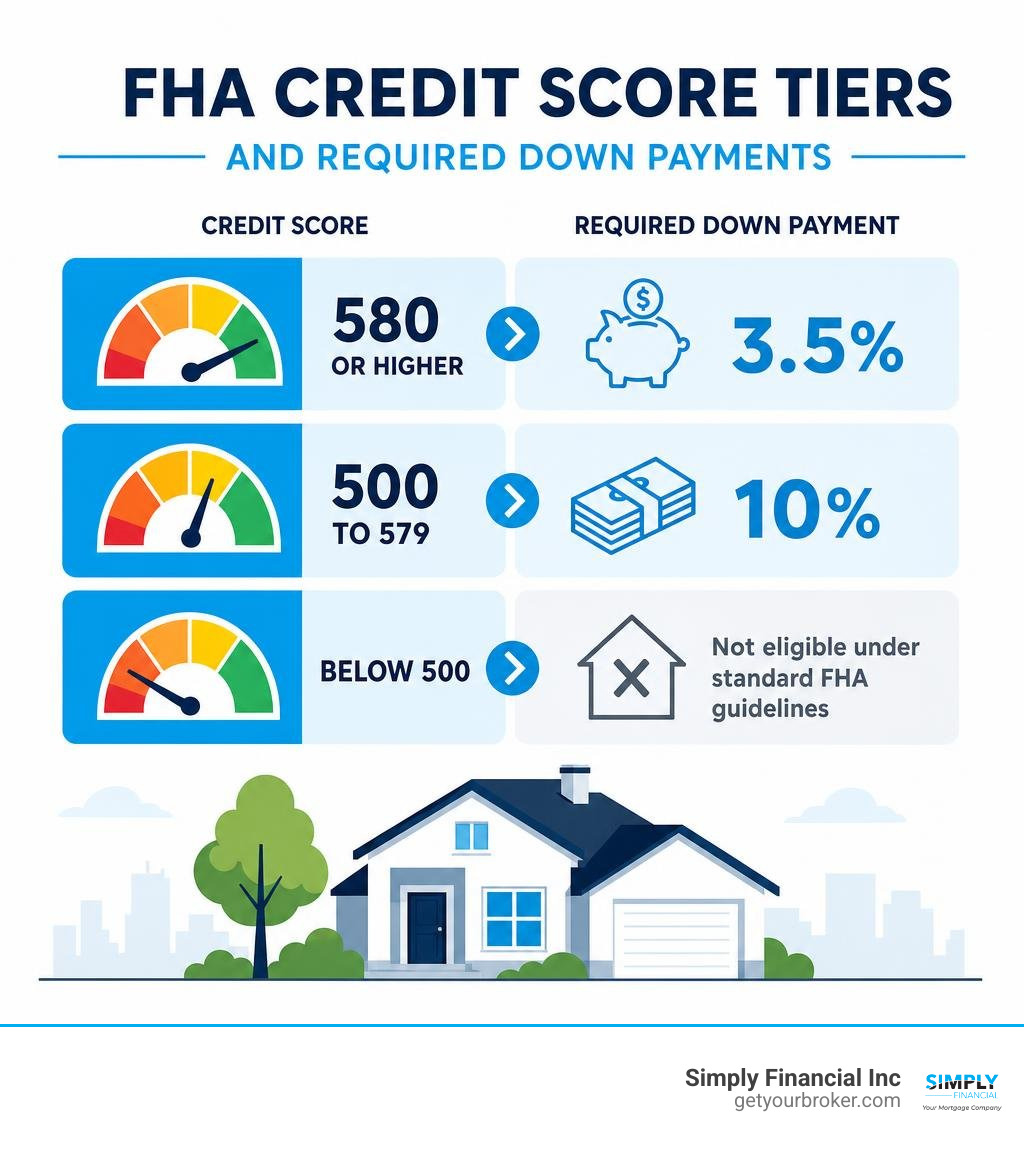
The credit needed for FHA loan approval can be as low as a 500 FICO score under FHA rules, but the score affects how much you must put down.
| Credit score | FHA minimum down payment |
|---|---|
| 580 or higher | 3.5% |
| 500 to 579 | 10% |
| Below 500 | Not eligible under standard FHA guidelines |
For example, on a $300,000 home, a 580 score could mean a $10,500 down payment. A score from 500 to 579 could mean $30,000 down. These are FHA’s national baseline rules, not a promise of approval: many private FHA-approved lenders set their own higher credit-score standards.
Credit is only one part of the decision. Lenders also review your income, monthly debts, job history, cash to close, and whether the home meets FHA safety and property standards. FHA loans can be more forgiving than many conventional mortgages, but they still require clear proof that the payment fits your budget.
I’m Peter Babjak, a mortgage broker with Simply Financial Inc in Chicago, where we have helped homebuyers navigate the credit needed for FHA loan financing, pre-qualification, and refinancing since 2007. This guide breaks down what lenders review so you can approach the process with fewer surprises.
Minimum Credit Needed for FHA Loan Approval in 2026
When evaluating the credit needed for FHA loan qualification in 2026, the Federal Housing Administration (FHA) sets official score cutoffs that dictate your required down payment. The fundamental line in the sand is a FICO score of 580.
If your score is 580 or higher, you qualify for the FHA’s signature benefit: a low 3.5% down payment. However, if your credit score falls between 500 and 579, you are not automatically locked out of homeownership. Instead, HUD guidelines require a 10% down payment to offset the lender’s risk. Scores below 500 fall outside standard federal underwriting parameters.
To understand how this dynamic impacts your out-of-pocket savings, take a look at the down payment math across standard home purchase prices:
| Home Purchase Price | 580+ Credit Score (3.5% Down) | 500-579 Credit Score (10% Down) | Down Payment Difference |
|---|---|---|---|
| $200,000 | $7,000 | $20,000 | $13,000 |
| $300,000 | $10,500 | $30,000 | $19,500 |
| $400,000 | $14,000 | $40,000 | $26,000 |
As you can see, crossing the 580 credit threshold can save you tens of thousands of dollars in upfront cash. You can review the full breakdown of official government policy via Official FHA Credit Requirements.
Understanding Lender Overlays vs. FHA Minimums
While the federal government establishes these baseline rules, you must also understand “lender overlays.” An overlay is an additional, stricter standard imposed by an individual private mortgage lender or bank above HUD’s baseline rules.
Even though HUD accepts scores down to 500, many mortgage lenders set internal minimum credit score requirements of 620 or 640. Why? Lenders assume financial risk when originating loans, and higher credit score requirements protect them against potential defaults.
If your score sits between 500 and 619, you need a lender that works directly with manual underwriting rules rather than relying solely on automated approval systems. Direct Endorsement underwriters at specialized mortgage brokerages can evaluate manual underwriting applications, looking at compensating factors like steady employment and cash reserves. To learn more about navigating these requirements, read our FHA Home Loan Guide 2026.
FHA Streamline Refinance Credit Flexibility
If you already hold an FHA mortgage, the credit score rules become significantly more flexible through the FHA Streamline Refinance program. This program is designed to help existing FHA homeowners lower their monthly payments or interest rates with minimal friction.
Under standard FHA Streamline guidelines, lenders often grant credit pull exemptions and appraisal waivers. In many cases, you won’t need a full credit check or a new home valuation, provided you have maintained a clean 12-month payment history on your existing FHA mortgage. For updated rate trends and refinancing guidelines, visit our FHA Mortgage Rates Guide 2026.
Beyond Credit: Full FHA Loan Eligibility Requirements

A qualifying credit score is necessary, but it is only one piece of the underwriting puzzle. Lenders review your complete financial picture to ensure you have the capacity to repay the debt.
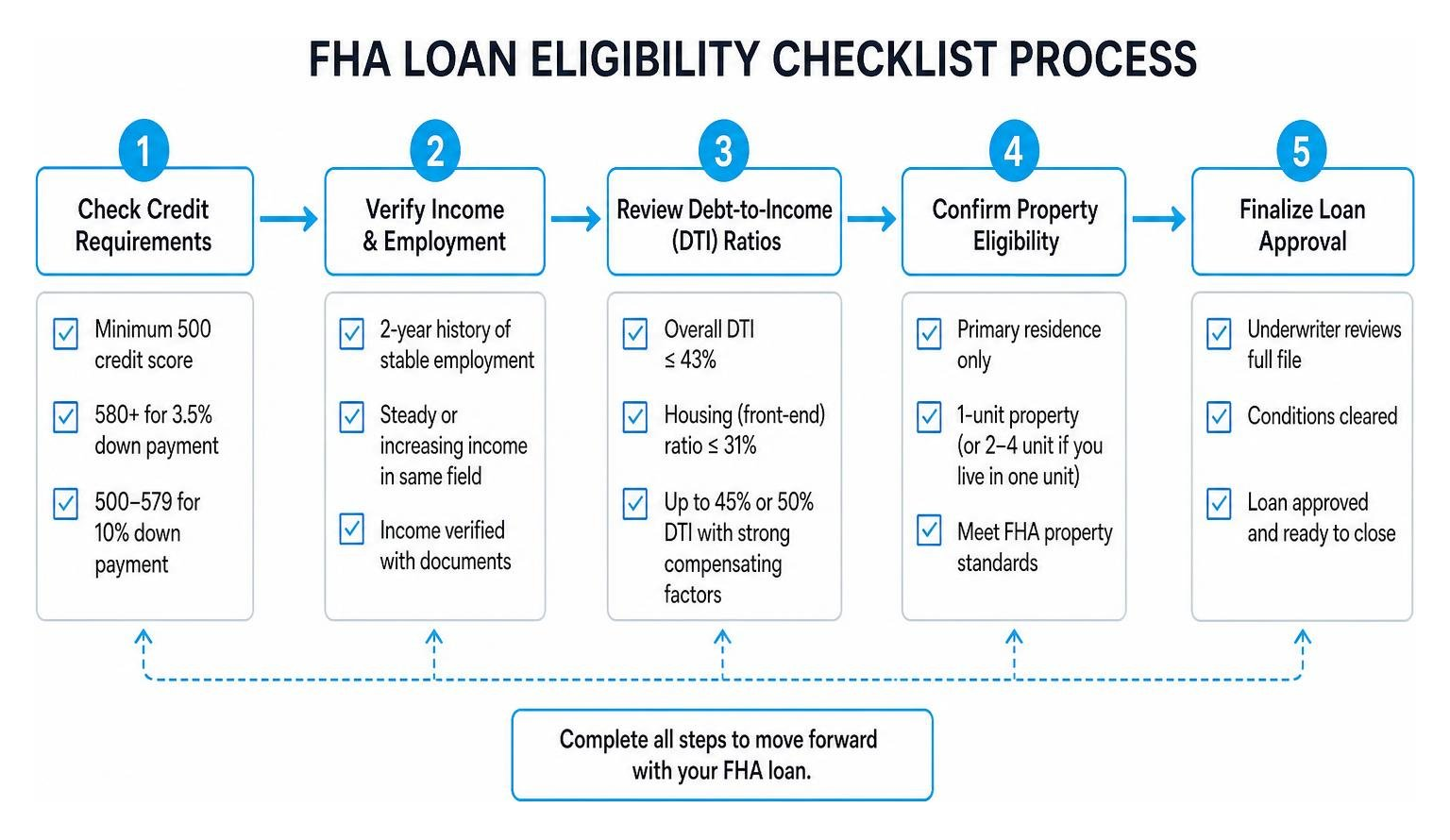
When applying for an FHA loan in 2026, underwriters evaluate these primary financial and property benchmarks:
- Debt-to-Income (DTI) Ratios: Your DTI ratio measures your total monthly debt obligations against your gross monthly income. FHA guidelines generally cap your overall DTI at 43%. Additionally, underwriters prefer a “front-end” housing ratio (your proposed monthly mortgage payment including principal, interest, taxes, and insurance) of no more than 31%. Exceptions up to 45% or 50% overall DTI can be approved if you have strong compensating factors, such as high cash reserves or verified non-taxable income.
- Employment Verification: You must show a consistent 2-year history of stable employment and income. While you don’t need to have worked for the same employer for two full years, your job history should demonstrate steady or increasing earnings in the same industry or field.
- Primary Residence Rule: FHA loans are strictly reserved for primary residences. You cannot use an FHA loan to buy a vacation home, second home, or investment property (though you can purchase a 2- to 4-unit property with an FHA loan if you live in one of the units).
- Property Safety Standards: The home must undergo an appraisal by an FHA-certified appraiser to ensure it meets minimum property standards for safety, security, and structural soundness. Issues like peeling lead paint, broken windows, or faulty roofs must be repaired prior to closing.
- 2026 FHA Loan Limits: Federal loan caps vary by county. In 2026, the baseline “floor” limit for single-family homes in low-cost areas is approximately $498,257, while high-cost markets feature a “ceiling” of up to $1,149,825.
- FHA Mortgage Insurance Premiums (MIP): FHA borrowers pay two types of mortgage insurance:
- Upfront MIP: A one-time charge equal to 1.75% of your total loan amount, which is almost always financed directly into your base loan balance.
- Annual MIP: An ongoing yearly fee divided into 12 monthly payments. Depending on your loan term, base amount, and down payment, annual MIP generally ranges between 0.40% and 0.75%.
For a thorough overview of federal regulations, check out the FHA Loan Requirements Overview and start your application through our Mortgage Pre-Approval portal.
HUD 4155.1 Credit Documentation Standards
Mortgage lenders do not use arbitrary guidelines when reviewing your loan application. They follow official HUD guidelines, specifically outlined in HUD Handbook 4155.1. Under these regulations, underwriters evaluate what is known as the “Four Cs of Credit”:
- Credit History: Evaluating past payment performance, open credit lines, public records, and derogatory remarks.
- Capacity to Repay: Analyzing income stability, tax filings, and debt ratios to ensure long-term affordability.
- Cash Assets to Close: Verifying liquid funds needed for the down payment, closing costs, and required escrow reserves.
- Collateral: Ensuring the home’s appraised value supports the mortgage balance.
Under the Fair Credit Reporting Act (FCRA) and Equal Credit Opportunity Act (ECOA), if a lender turns down your application, they are legally required to issue a formal Adverse Action notice outlining the specific reasons for rejection. You can review the exact regulatory text in the HUD Handbook 4155.1 Credit Analysis Guidelines.
FHA Guidelines for Special Credit Scenarios: No Credit, Bankruptcy, and Foreclosure
One of the greatest benefits of an FHA mortgage is its flexibility when addressing past financial setbacks or a limited credit background.
Buying a Home with No Credit History
If you don’t have a traditional FICO credit score, HUD guidelines allow lenders to build a “non-traditional credit profile.” To qualify, you must provide documentation for at least two substitute credit lines showing a 12-month history of on-time payments. Acceptable sources include:
- Rental payment history verified by institutional property managers or canceled checks.
- Electric, gas, water, or trash utility bills.
- Cell phone and internet service accounts.
- Automobile or renter’s insurance payment records.
To learn how to start building your score from scratch, read our guide on How to Establish First Time Credit.
Federal Debt Screening (CAIVRS)
Before approving your application, lenders run your information through CAIVRS (Credit Alert Interactive Voice Response System). CAIVRS checks whether you have defaulted on federal debt, including student loans, government-backed mortgages, or SBA loans. If you have an active federal default, you must resolve the debt or set up a verified repayment schedule before proceeding.
Bankruptcy and Foreclosure Waiting Periods
Past major derogatory credit events do not mean permanent exclusion from homeownership. FHA outlines clear waiting periods:
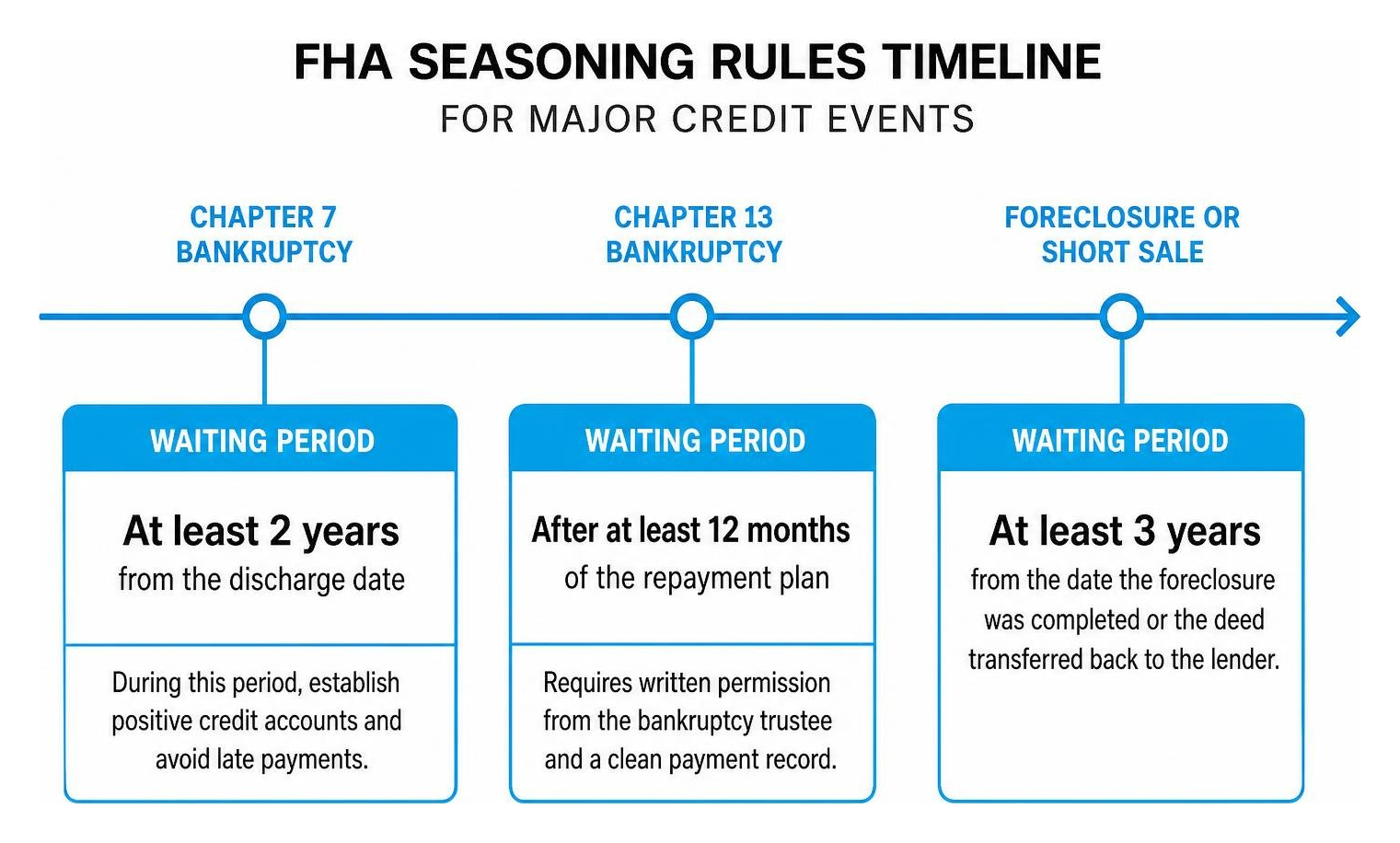
- Chapter 7 Bankruptcy: You must wait at least 2 years from the discharge date. During this seasoning period, you must establish positive credit accounts and avoid late payments.
- Chapter 13 Bankruptcy: You can apply after successfully completing at least 12 months of your court-mandated repayment plan, provided you receive written permission from the bankruptcy trustee and maintain a clean payment record.
- Foreclosure or Short Sale: You must wait a minimum of 3 years from the date the foreclosure was completed or the deed transferred back to the lender.
Assessing the Credit Needed for FHA Loan vs. Conventional, VA, and USDA Options
Choosing the right home loan requires comparing FHA terms against competing mortgage products. Here is how FHA credit rules stack up against alternative loan types:
- Conventional Loans: Typically require a minimum credit score of 620. If your score is above 720, conventional financing often offers lower rates and lower private mortgage insurance (PMI) rates than FHA. Unlike FHA mortgage insurance, conventional PMI can be canceled once you achieve 20% home equity.
- VA Loans: Guaranteed by the Department of Veterans Affairs for eligible military service members, veterans, and surviving spouses. VA loans feature a 0% down payment requirement. While the VA sets no official minimum credit score, most lenders set internal overlays around 580 to 620.
- USDA Loans: Backed by the U.S. Department of Agriculture for rural and suburban properties. USDA loans also offer 0% down payment financing, but generally require a minimum credit score of 640 for automated underwriting approval.
Here is a side-by-side comparison of the core loan characteristics:
- FHA Loans: 500 minimum credit score (10% down) or 580 (3.5% down); mandatory Upfront & Annual MIP; 43% standard DTI cap; flexible credit seasoning.
- Conventional Loans: 620 minimum credit score; 3% to 5% minimum down payment; private mortgage insurance (cancellable); stricter DTI rules (typically 36%-45%).
- VA Loans: No government score floor (lender overlays apply); 0% down payment; no ongoing monthly mortgage insurance (funding fee applies); reserved for military members.
- USDA Loans: 640 minimum score for automated approval; 0% down payment; location and income restrictions apply; lower annual guarantee fees.
To explore all your financing routes, check our Mortgage Loan Options Guide 2026 and look into 100% Financing Home Loans First Time Buyer options.
Strategies to Achieve the Credit Needed for FHA Loan Approval
If your credit score sits just below the 580 benchmark, taking proactive steps over a 3- to 6-month period can lift your score into the lowest down payment tier.
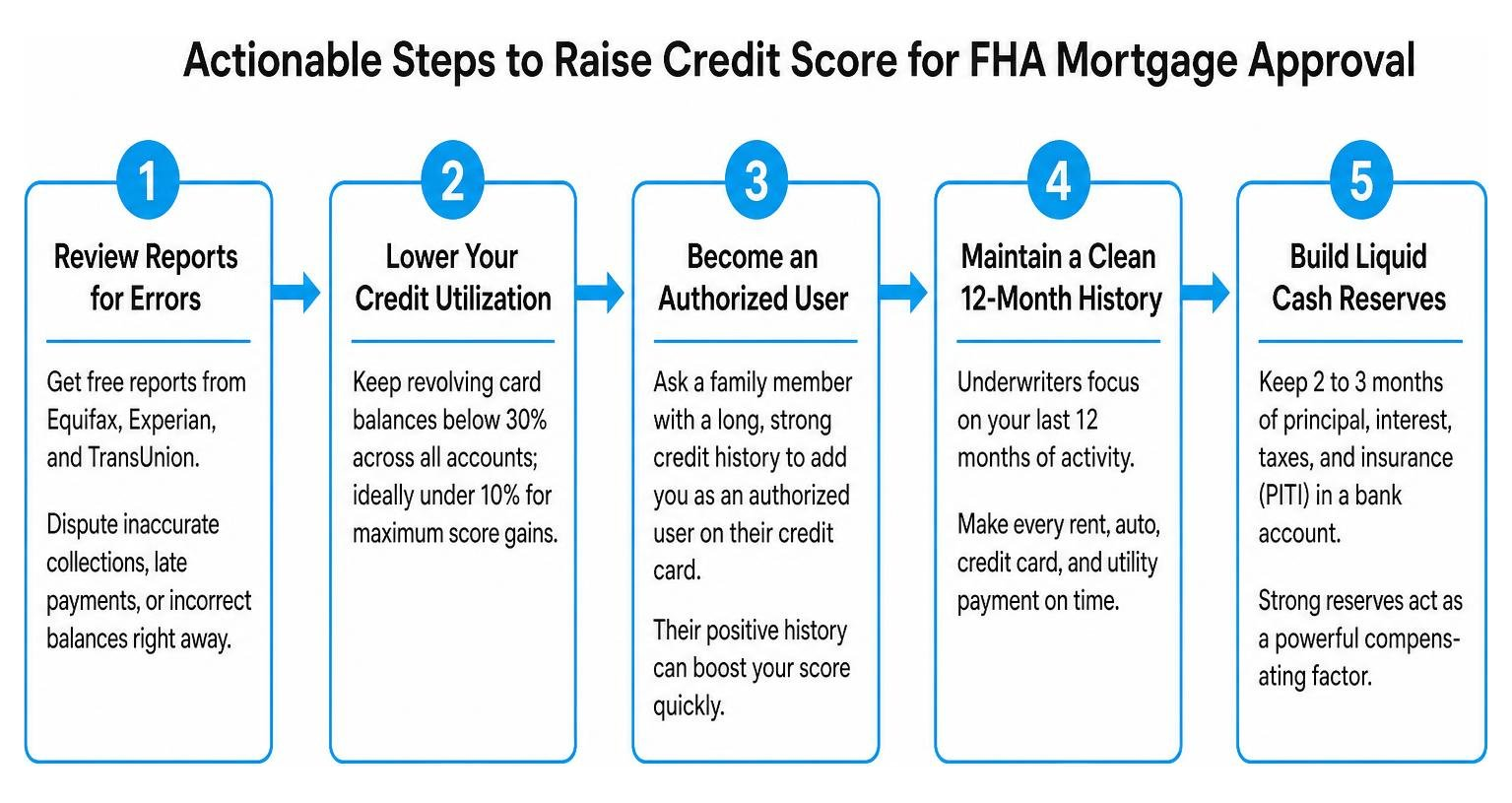
- Review Reports for Errors: Obtain your free credit reports from all three major bureaus (Equifax, Experian, and TransUnion). Studies show that roughly one in three credit reports contains errors. Dispute inaccurate collection accounts, late payments, or incorrect account balances immediately.
- Lower Your Credit Utilization: Your credit utilization ratio (revolving credit balance divided by total credit limits) accounts for 30% of your FICO score. Keep revolving card balances below 30% across all individual accounts, ideally pushing them under 10% for maximum point increases.
- Become an Authorized User: Ask a family member with a long, pristine credit history to add you as an authorized user on an established credit card. Their positive credit history will report on your credit profile, giving your score a quick lift.
- Maintain a Clean 12-Month History: Underwriters place immense weight on your last 12 months of activity. Make every single rent, auto, credit card, and utility payment on time.
- Build Liquid Cash Reserves: Even if cash reserves are not explicitly mandated for all FHA loans, having 2 to 3 months of principal, interest, taxes, and insurance (PITI) sitting in a bank account acts as a powerful compensating factor during underwriting.
For personalized steps on improving your credit profile, review Credit Analysis for FHA Qualification and begin your journey with our Pre-Qualify Chicago Mortgage Pre-Approval tool.
Frequently Asked Questions About FHA Credit Requirements
Can I get an FHA loan with a credit score under 500?
No. Under official HUD rules, a 500 FICO score is the absolute minimum floor for FHA mortgage insurance eligibility. If your score falls below 500, you cannot qualify for a standard FHA loan. In this situation, you will need to focus on resolving collections, paying down credit card balances, or addressing credit report errors to raise your score to at least 500 before applying.
What is the minimum down payment for an FHA loan with a 580 credit score?
With a 580 credit score, your minimum down payment requirement is exactly 3.5% of the sales price. For example, if you purchase a home in Chicago or Florida for $300,000, your 3.5% down payment equals $10,500. By contrast, if your score were 570, you would have to provide a 10% down payment ($30,000), meaning a 580 score saves you $19,500 upfront.
How long after a Chapter 7 bankruptcy can I apply for an FHA loan?
The standard waiting period following a Chapter 7 bankruptcy discharge is 2 years. The clock starts on the official discharge date listed on your court paperwork, not the initial filing date. During those two years, you must show that you have managed your finances responsibly, built clean post-bankruptcy credit accounts, and avoided late payments.
Conclusion
Navigating the credit needed for fha loan approval does not have to be stressful. Whether you are aiming for the 580 score needed for a 3.5% down payment or evaluating how to qualify with alternative credit records, FHA mortgages remain one of the most accessible paths to homeownership in 2026.
At Simply Financial Inc, located at 5632 W Lawrence Ave in Chicago, IL, we specialize in delivering a seamless, expert-guided, and stress-free mortgage experience across Illinois and Florida. Our team helps you evaluate lender overlays, review your credit profile, and secure the best terms available for your unique financial situation.
Ready to take the next step toward owning your home? Connect with our expert team today to Explore FHA Mortgage Solutions and get pre-approved!