

Compare Current 30-Year FHA Mortgage Rates Before You Lock
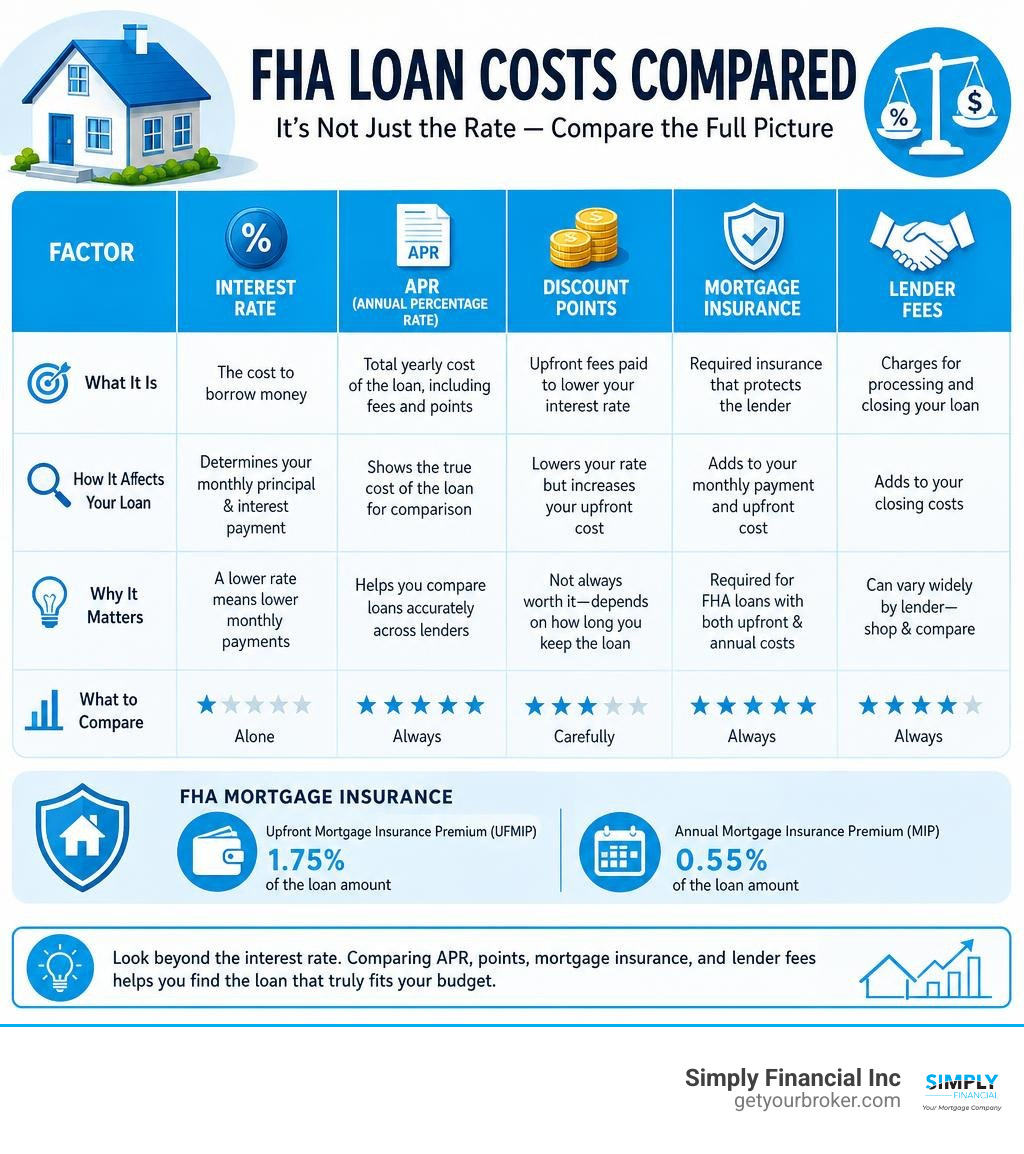
The average 30-year fixed FHA mortgage rate is 6.43% as of August 20, 2026. To find the best offer, compare at least three Loan Estimates and look at the APR, lender fees, discount points, and monthly FHA mortgage insurance – not the interest rate alone.
FHA rates can vary widely by lender and borrower profile. One advertised offer may show a lower rate because it includes points paid at closing. For example, a 5.748% APR offer may require 1.881 points, which adds a meaningful upfront cost. The 52-week range for 30-year FHA rates has been 5.62% to 6.40%, so small daily moves matter less than choosing a loan you can afford and comparing its full cost.
An FHA loan can still be a strong fit for buyers with limited down payment savings or credit scores below conventional-loan standards. But its 1.75% upfront mortgage insurance premium and 0.55% annual premium make careful comparison essential.
I am Peter Babjak, a mortgage broker with Simply Financial Inc in Chicago, helping homebuyers and homeowners navigate current mortgage rates FHA 30 year fixed and refinancing choices since 2007. My goal is to make rate comparisons, paperwork, and loan decisions easier to understand before you commit.
Current Mortgage Rates FHA 30 Year Fixed and 2026 Market Dynamics

Navigating the mortgage market in August 2026 requires understanding how daily economic data impacts borrowing costs. Benchmark data from the 30-Year Fixed Rate FHA Mortgage Index shows government-backed loan rates hovering near 6.43%. While individual quotes change throughout the day, tracking overall movement helps buyers identify competitive pricing windows.
Mortgage rates do not move in a vacuum. They are heavily influenced by the 10-year Treasury bond yield and broader economic inflation trends. When inflation data runs hot or the bond market experiences downward pressure on mortgage-backed securities (MBS), lenders raise mortgage pricing to preserve yields. Conversely, cooling economic indicators provide breathing room for rate relief. If you are tracking FHA loan rates today, looking at daily index movement rather than promotional teaser rates provides a clearer view of the lending environment.
Historical Context for Current Mortgage Rates FHA 30 Year Fixed
Looking back provides valuable perspective for buyers feeling uncertain about current rate levels. According to daily FHA index trends sourced from nationwide rate-lock pricing engines, today’s 6.43% average is slightly lower than the 6.49% benchmark recorded one year ago.
Over the long term, the historical benchmark for 30-year fixed FHA financing sits near 5.06%. While current rates are above that long-term baseline, they have stabilized within a manageable band compared to recent market peaks. Intraday volatility often occurs when major economic announcements or Treasury bond auctions take place. However, lenders frequently adjust pricing back to fundamental levels once initial market reactions subside.
Purchase vs. Refinance 30-Year FHA Interest Rates
Refinancing an existing mortgage carries slightly different pricing dynamics than securing a purchase loan. The national average 30-year FHA refinance rate stands at 6.57%, compared to 6.43% for purchase transactions.
This pricing gap exists because lenders price refinance loans with specific risk-based adjustments depending on transaction structure:
- Rate-and-Term Refinances: Designed to lower your monthly interest rate or adjust loan duration. Pricing generally remains very close to standard purchase benchmarks.
- Cash-Out Refinances: Involve taking equity out of the property. Lenders view higher loan-to-value (LTV) cash extractions as carrying elevated risk, which often translates into slightly higher interest rates or additional discount points.
Securing the best FHA rates today requires matching your refinancing goals with the right program guidelines to avoid unnecessary fees.
Comparing 30-Year FHA Rates to Conventional, VA, and USDA Loans
Choosing the best mortgage program involves evaluating not just the headline interest rate, but also upfront funding fees, monthly mortgage insurance, and down payment requirements.
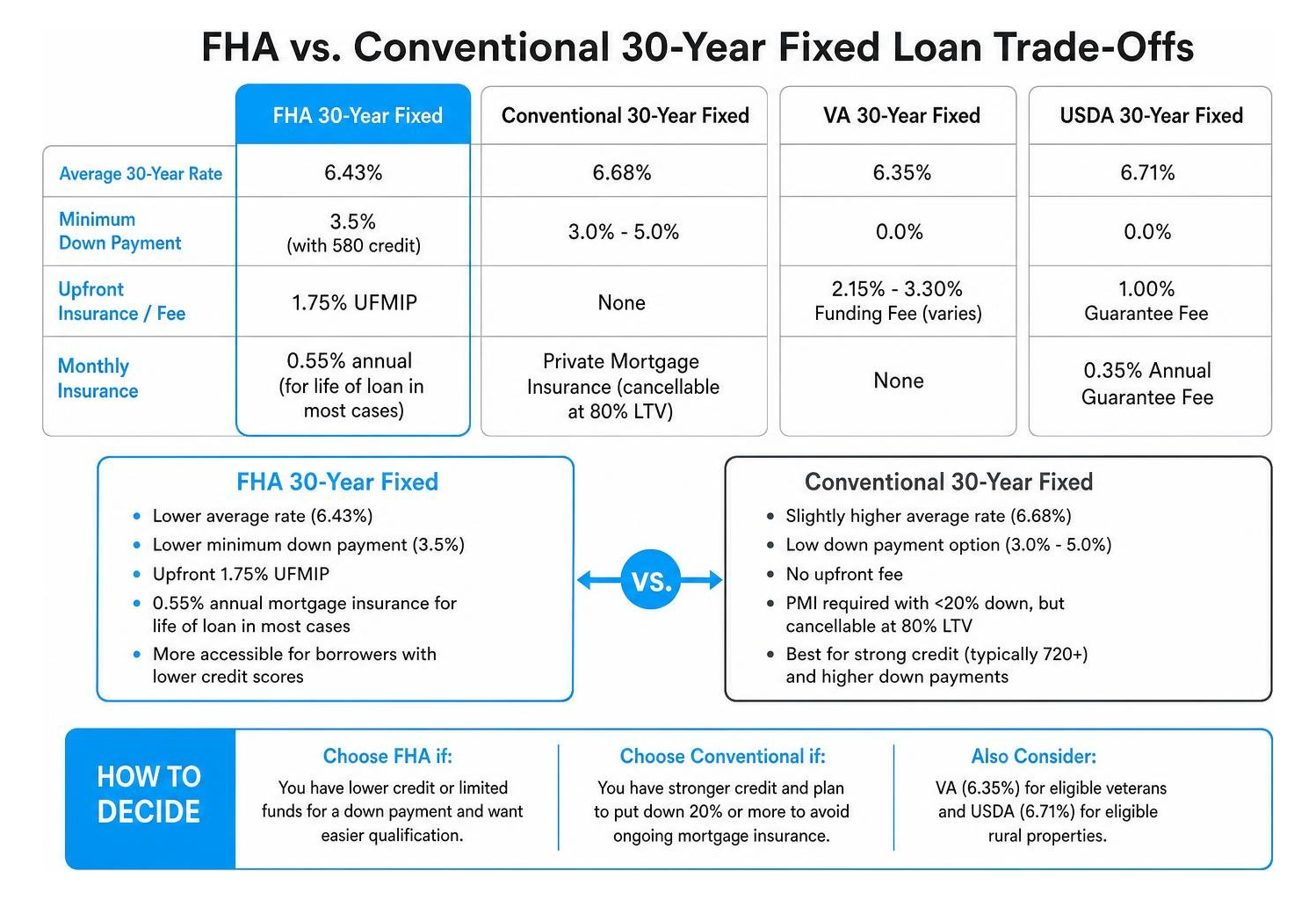
| Loan Program | Average 30-Year Rate | Minimum Down Payment | Upfront Insurance / Fee | Monthly Insurance |
|---|---|---|---|---|
| FHA 30-Year Fixed | 6.43% | 3.5% (with 580 credit) | 1.75% UFMIP | 0.55% annual (for life of loan in most cases) |
| Conventional 30-Year Fixed | 6.68% | 3.0% – 5.0% | None | Private Mortgage Insurance (cancellable at 80% LTV) |
| VA 30-Year Fixed | 6.35% | 0.0% | 2.15% – 3.30% Funding Fee (varies) | None |
| USDA 30-Year Fixed | 6.71% | 0.0% | 1.00% Guarantee Fee | 0.35% Annual Guarantee Fee |
For a comprehensive evaluation of financing programs, our mortgage loan options guide 2026 and fixed rate mortgage guide 2026 offer in-depth comparisons tailored to your financial goals.
FHA vs. Conventional 30-Year Fixed Financing
While conventional loans show an average rate of 6.68% compared to FHA’s 6.43%, the nominal rate is only part of the equation. Conventional financing allows borrowers with strong credit scores (typically 720+) and at least 20% down to avoid Private Mortgage Insurance (PMI) altogether. Even with a smaller down payment, conventional PMI automatically terminates once the borrower reaches 20% equity (80% LTV).
FHA loans, by contrast, carry mandatory mortgage insurance premiums regardless of equity buildup when putting down the minimum 3.5%. For borrowers with credit scores below 680, FHA remains significantly more affordable monthly because conventional risk-based pricing adjustments increase conventional rates and PMI costs sharply for lower credit tiers.
Government-Backed Alternatives: VA and USDA Mortgages
Eligible military service members, veterans, and surviving spouses can access VA home loans, which currently average 6.35%. VA loans require zero down payment and charge no monthly mortgage insurance, utilizing a one-time funding fee instead.
USDA mortgages, averaging 6.71%, provide 100% financing for designated rural and suburban properties. USDA financing incorporates a 1.00% upfront guarantee fee and a low 0.35% annual fee, making it an attractive low-down-payment alternative for properties in eligible geographic areas across Illinois and Florida.
2026 FHA Loan Guidelines, Insurance Costs, and Underwriting Rules

Securing approval for an FHA mortgage requires meeting established underwriting standards set by the Federal Housing Administration. Key details regarding eligibility rules are detailed in 2026 FHA loan requirements and rate data alongside our dedicated FHA home loan guide 2026.
Understanding Upfront and Annual Mortgage Insurance Premiums (MIP)
FHA financing requires two distinct mortgage insurance components:
- Upfront Mortgage Insurance Premium (UFMIP): Set at 1.75% of the base loan amount. On a $300,000 home loan, this equals $5,250. Most borrowers choose to finance this fee directly into the total loan amount rather than paying it out of pocket at closing.
- Annual Mortgage Insurance Premium (AMIP): Calculated at 0.55% of the base loan balance annually, divided into 12 equal monthly payments. On a $300,000 mortgage, this adds approximately $137.50 to your monthly housing expense in year one.
Because mortgage insurance represents a substantial portion of overall borrowing costs over a 30-year amortization schedule, factoring these premiums into your affordability calculations is essential.
Credit Score Thresholds, Down Payment, and DTI Caps
Underwriting guidelines for FHA loans maintain specific baseline requirements:
- Credit Score & Down Payment: A minimum credit score of 580 qualifies for the maximum 96.5% financing (3.5% down payment). Scores between 500 and 579 require a 10% down payment.
- Debt-to-Income (DTI) Limits: The maximum standard DTI cap in 2026 is 50%, reflecting a tighter standard than the historical 52% to 57% allowances used in prior years.
- Down Payment Gifts: Down payment funds can come entirely from family gifts, provided the donor submits a signed gift letter and two months of bank statements verifying no repayment obligation.
- Property Appraisal Standards: FHA appraisals evaluate both market value and strict minimum property standards (MPS) covering safety, structural integrity, and sanitation.
Actionable Strategies to Secure Competitive Loan Pricing
Securing the best possible pricing on a government-backed mortgage requires proactive financial management before submitting an application:
- Optimize Credit Scores Before Applying: Boosting your score above 640 or 680 can reduce lender-specific interest rate adjustments by 0.125% to 0.250%.
- Evaluate Discount Points Carefully: Paying discount points upfront reduces your ongoing interest rate. Ensure your planned stay in the home exceeds the break-even point before buying down the rate.
- Compare APR Over Nominal Rates: The Annual Percentage Rate reflects the true cost of borrowing, incorporating lender origination charges, upfront MIP, and processing fees.
- Secure a Formal Pre-Approval: Obtaining a complete mortgage pre-approval rather than a simple pre-qualification allows you to lock in competitive pricing quickly when market conditions are favorable.
- Explore Diverse Programs: Work with an experienced broker to explore how an FHA loan compares against alternative programs based on your complete asset profile.
How to Shop for Current Mortgage Rates FHA 30 Year Fixed
When shopping lenders in Chicago, elsewhere in Illinois, or across Florida, always request a standardized Loan Estimate from each provider. Review Section A (origination charges) carefully to verify that an advertised low rate is not artificially subsidized by excessive underwriting charges or mandatory discount points. Additionally, ask your broker about float-down options that protect your rate while allowing you to capitalize on potential market dips before closing.
Frequently Asked Questions About 30-Year Fixed FHA Rates
What is the current average interest rate for a 30-year fixed FHA loan?
As of August 20, 2026, the national average 30-year fixed FHA mortgage interest rate is 6.43%. Individual rates vary based on credit profile, loan amount, down payment size, and whether discount points are paid at closing.
Can FHA mortgage insurance be canceled on a 30-year fixed mortgage?
For borrowers putting down the minimum 3.5%, annual FHA mortgage insurance remains for the life of the loan. If you put down 10% or more at purchase, MIP cancels automatically after 11 years. Otherwise, removing mortgage insurance requires refinancing into a conventional loan once your equity reaches at least 20%.
Is an FHA 30-year fixed loan better than a conventional loan in 2026?
An FHA loan is typically the superior choice for borrowers with credit scores below 680 or higher debt-to-income ratios, as conventional loans impose steep risk-based fee adjustments on those profiles. However, borrowers with excellent credit (720+) and larger down payments usually save more over time with conventional financing due to cancellable private mortgage insurance.
Conclusion: Securing the Best 30-Year FHA Mortgage Terms
Understanding the components that determine your mortgage rate—from Treasury yield movements to upfront and monthly mortgage insurance—puts you in control of your home buying journey. At Simply Financial Inc, we are dedicated to delivering a seamless, expert-guided, stress-free mortgage experience from pre-approval through closing.
Whether you are purchasing a first home in Chicago, Illinois or relocating to Florida, our team provides personalized loan evaluations to ensure you secure the most competitive terms available. Contact us today to compare current mortgage rates for FHA loans and find the right financing structure for your budget.