

How Discount Points on a VA Loan Can Lower Your Mortgage Rate
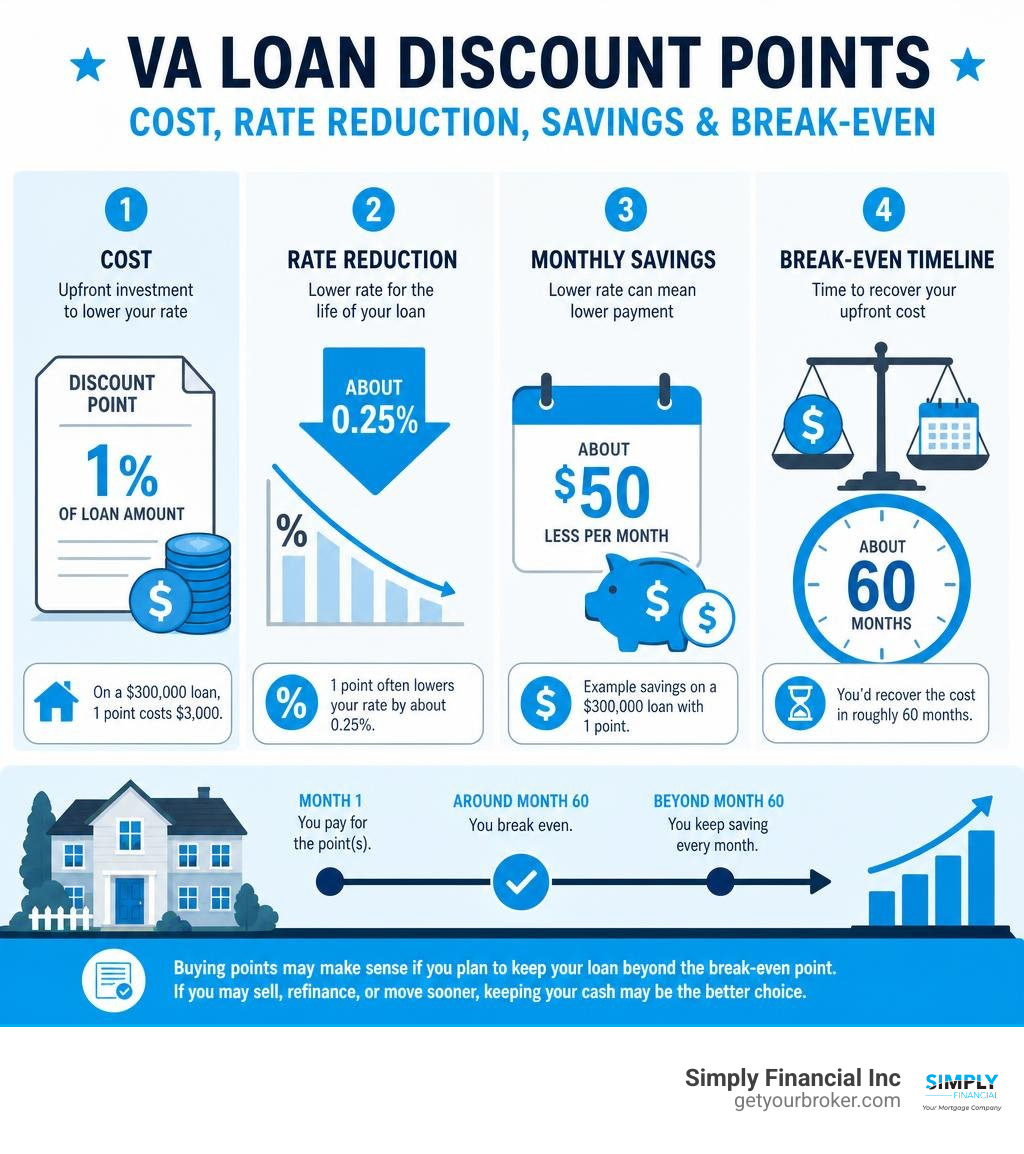
Discount points on a VA loan are optional upfront fees that lower your interest rate for the life of the mortgage. One point costs 1% of the loan amount and often lowers the rate by about 0.25%, though the exact pricing depends on the lender and market conditions.
For example, on a $300,000 VA loan, one point costs $3,000. If it reduces your principal-and-interest payment by about $50 per month, you would recover that cost in roughly 60 months. Buying points may make sense if you expect to keep the loan beyond that break-even point. If you may sell, refinance, or receive PCS orders sooner, keeping the upfront cash can be the better choice.
The VA does not set point prices or mortgage rates, so compare Loan Estimates from more than one lender. Also, discount points are separate from lender origination charges, and the rules differ for purchase loans, VA cash-out refinances, and IRRRL streamline refinances.
I’m Peter Babjak, and I’ve helped Chicago-area homebuyers navigate mortgage choices since founding Simply Financial Inc in 2007. In this guide, I’ll make the costs, rules, and break-even math for discount points on a VA loan easier to evaluate before you commit.
How Discount Points on a VA Loan Work to Lower Your Rate

When you explore financing through the Department of Veterans Affairs (VA) home loan program, you benefit from flexible terms such as zero down payment requirements and the absence of monthly private mortgage insurance (PMI). However, managing the ongoing interest expense is key to keeping your long-term housing costs low. Securing competitive VA loan rates can make a massive difference in your total interest expense over time.
Discount points represent a form of prepaid interest. By paying an upfront fee at closing, you permanently reduce the note rate on your mortgage for the entire loan term.
Here is the general formula:
- Cost: 1 discount point = 1% of the total loan amount.
- Rate Reduction: 1 discount point typically reduces your mortgage interest rate by approximately 0.25% (25 basis points).
For instance, on a $400,000 mortgage, 1 discount point costs $4,000. If your lender’s base rate is 6.50%, purchasing 1 point could bring your rate down to 6.25%. If you purchase 2 points ($8,000), your rate might drop to 6.00%.
Because private mortgage lenders set their own rate sheets based on market conditions, the exact rate reduction per point can vary.
Origination Points vs. Discount Points and the 1% Fee Cap
Many homebuyers confuse discount points with origination points or lender origination fees. While both are measured in “points” (percentages of the loan amount), they serve entirely different purposes under federal regulations.
- Origination Points / Fees: These are fees charged by the lender to cover the administrative, processing, and underwriting costs of creating the mortgage.
- Discount Points: These are optional fees paid directly to buy down the interest rate.
Federal regulations under 38 CFR 36.4313 strictly cap the flat origination fee a lender can charge on a VA loan at 1% of the loan amount. This protection ensures military borrowers are not burdened with excessive administrative markups.
As outlined in the official VA Home Loan Guaranty Buyer’s Guide, discount points sit outside the 1% origination fee cap. Because discount points represent a direct, voluntary trade-off for a lower ongoing interest rate rather than lender administrative overhead, you are free to purchase discount points even if the lender charges a full 1% origination fee.
Calculating the Break-Even Timeline for Discount Points on a VA Loan
Buying points requires paying money today to save money each month. The central mathematical question every borrower must answer is: How long will it take for the monthly payment savings to equal the upfront cost of the points?
This time frame is known as your break-even timeline.
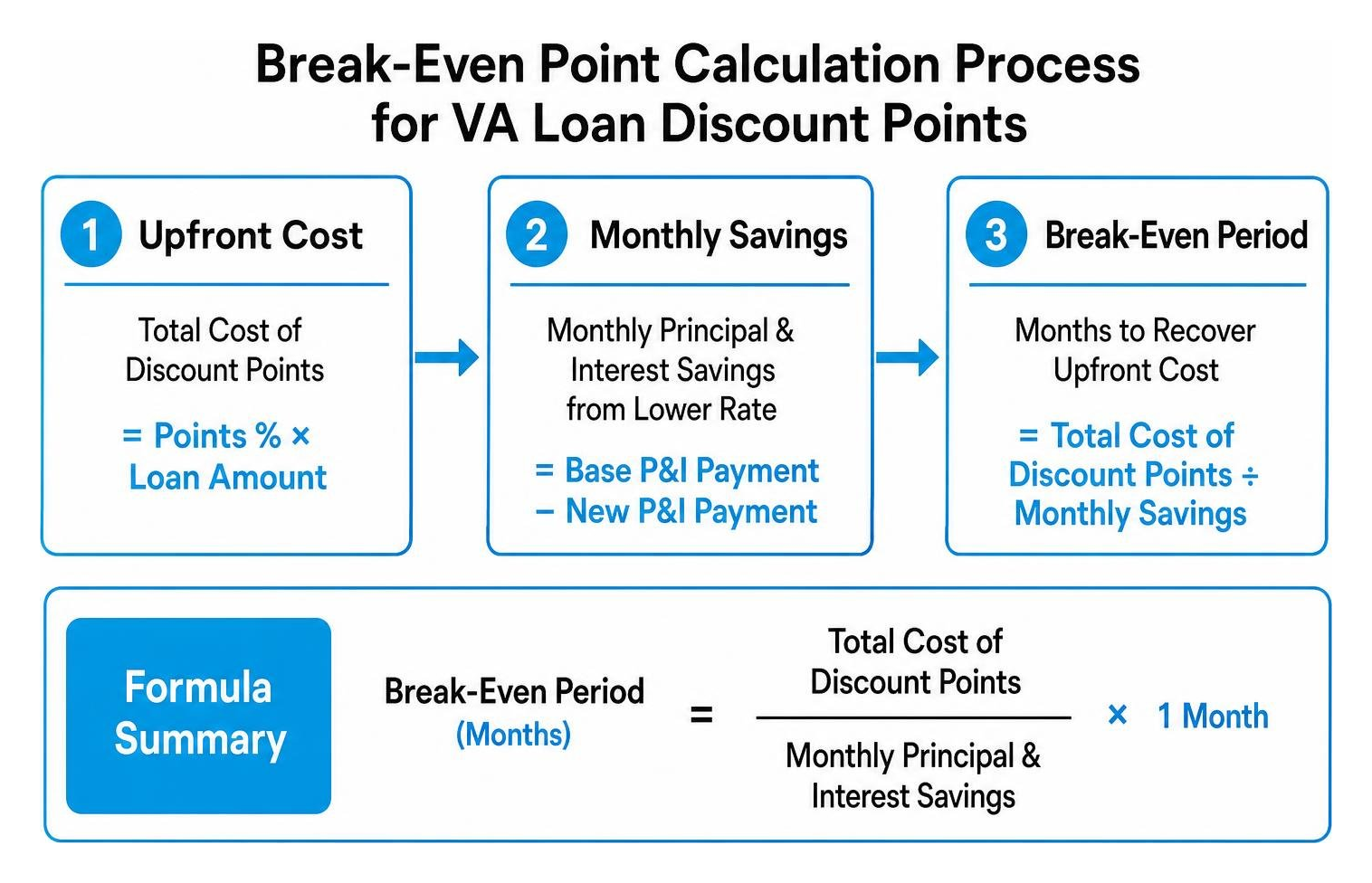
The formula to calculate the break-even point is simple:
$$\text{Break-Even Period (Months)} = \frac{\text{Total Cost of Discount Points}}{\text{Monthly Principal & Interest Savings}}$$
Let us walk through an example. Suppose you secure a $300,000 30-year fixed VA loan at a base rate of 6.50%. Your monthly principal and interest payment would be roughly $1,896.
If you purchase 1 discount point for $3,000, your interest rate drops to 6.25%, reducing your monthly payment to $1,847.
- Calculate Monthly Savings: $\$1,896 – \$1,847 = \$49\text{ saved per month}$ (roughly $50/month).
- Calculate Break-Even in Months: $\$3,000 / \$49 = 61.2\text{ months}$ (about 5.1 years).
If you remain in the property and keep this mortgage for more than 61 months, every subsequent month delivers pure interest savings. Over the full 30-year span, investing that $3,000 upfront saves more than $17,600 in total interest payments!
| Loan Amount | Base Rate (Payment) | Discounted Rate (-0.25%) | Point Cost (1%) | Monthly Savings | Break-Even Point |
|---|---|---|---|---|---|
| $200,000 | 6.50% ($1,264/mo) | 6.25% ($1,231/mo) | $2,000 | $33/mo | 60.6 months (~5.0 yrs) |
| $300,000 | 6.50% ($1,896/mo) | 6.25% ($1,847/mo) | $3,000 | $49/mo | 61.2 months (~5.1 yrs) |
| $400,000 | 6.50% ($2,528/mo) | 6.25% ($2,463/mo) | $4,000 | $65/mo | 61.5 months (~5.1 yrs) |
| $500,000 | 6.50% ($3,160/mo) | 6.25% ($3,079/mo) | $5,000 | $81/mo | 61.7 months (~5.1 yrs) |
Rules for Financing Points, Seller Concessions, and Refinancing

VA loans provide clear borrower protections, but they also have strict rules governing closing costs, fee structures, and whether upfront costs can be added to the loan balance. Whether you are buying an existing property or working with VA construction loans lenders, knowing how discount points can be funded is essential.
Rolling Points into Purchases, Cash-Out Loans, and IRRRL Streamlines
Can you finance discount points directly into your VA loan balance? The answer depends entirely on the type of VA loan transaction you are completing:
- VA Purchase Loans: You cannot finance discount points into a standard VA purchase loan balance. On a purchase, the only closing cost permitted to be rolled into the loan amount is the mandatory VA funding fee. All other closing costs, including discount points, must be paid in cash at the closing table or covered via seller credits.
- VA Cash-Out Refinances: On VA cash out refinance loans, you can use your accumulated home equity to cover closing costs and discount points, provided the total loan balance does not exceed the maximum allowable loan-to-value (LTV) limits set by the lender.
- VA Interest Rate Reduction Refinance Loans (IRRRL): On a streamline refinance (IRRRL), federal regulations permit borrowers to roll closing costs directly into the loan amount. However, as detailed in legal guides like VA Loan Points: How They Work and What They Cost – LegalClarity, strict statutory limits apply:
- You can roll a maximum of 2 discount points into the new IRRRL loan amount.
- The entire refinancing transaction must satisfy the VA 36-month recoupment rule, meaning all closing costs, fees, and financed points must be completely recovered through monthly payment savings within 36 months of closing.
Seller-Paid Points and the VA 4% Concession Cap
One of the most effective strategies for military homebuyers is negotiating for the home seller to cover closing costs. However, you must navigate the VA 4% seller concession cap correctly.
The VA establishes a maximum limit of 4% of the established reasonable property value (or purchase price, whichever is lower) on total seller concessions. But here is the critical distinction that many buyers and real estate agents miss:
Normal discount points and standard closing costs DO NOT count toward the 4% seller concession limit.
Under VA underwriting guidelines:
- Standard Closing Costs (No 4% Cap Limit): Customary closing costs, lender fees, title insurance, recording fees, and reasonable discount points paid by the seller to bring the interest rate down to market level are considered normal closing costs and are exempt from the 4% concession cap.
- Seller Concessions (Subject to the 4% Cap): Items classified as concessions include the seller paying off buyer credit card or car debt, prepaying property taxes and hazard insurance, gifting appliances, or paying the VA funding fee.
This means you can negotiate for the seller to pay standard closing costs and discount points, while still utilizing up to 4% in seller concessions for other allowable items.
Permanent Discount Points vs. Temporary Buydowns
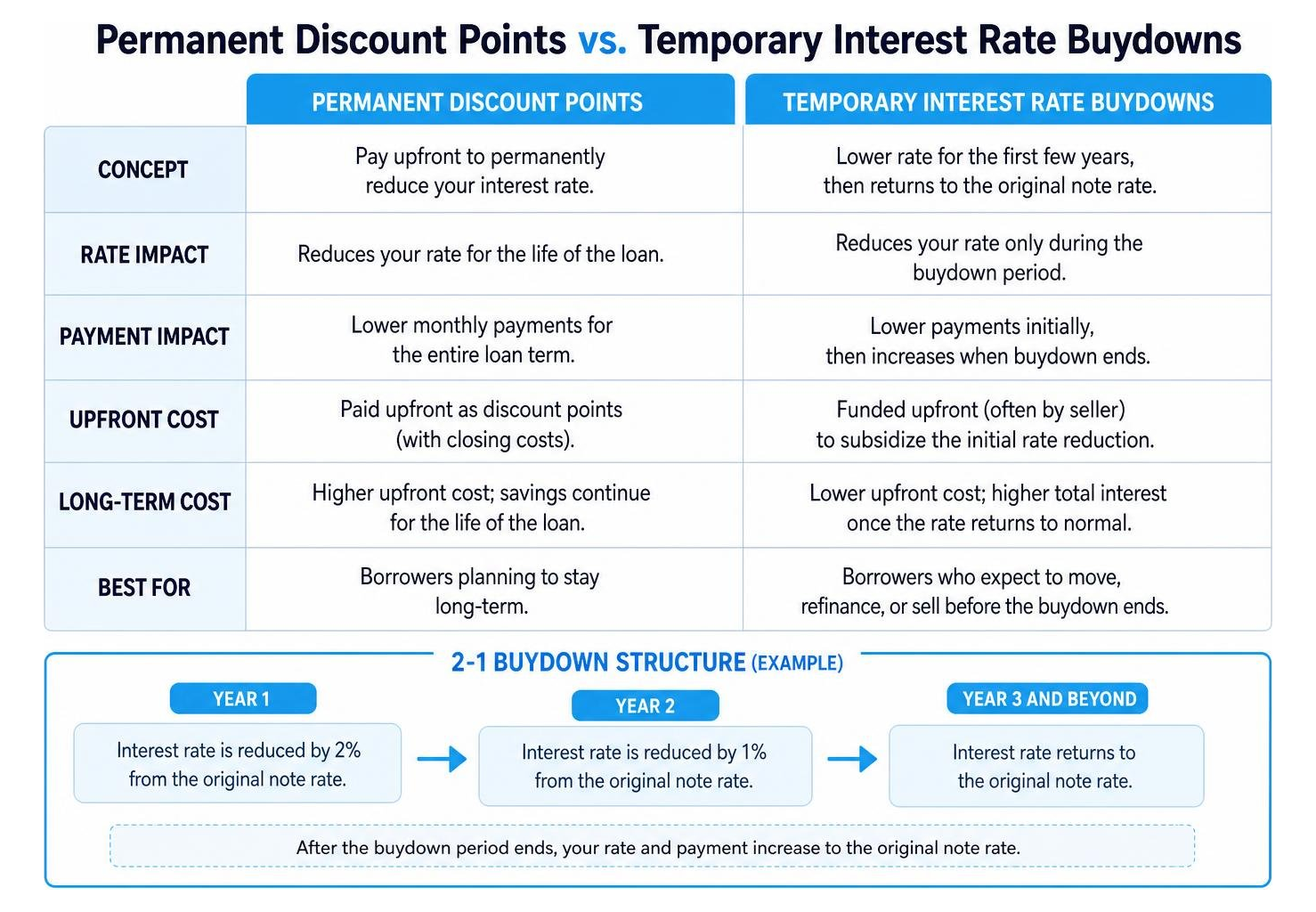
When structuring your mortgage, you have the option between a permanent interest rate buydown (traditional discount points) and a temporary buydown (such as a 2-1 or 1-0 buydown). Both options reduce your interest rate, but they function in fundamentally different ways.
To understand how permanent interest rate strategies fit into broader home financing, reviewing our fixed rate mortgage guide 2026 can provide valuable perspective on long-term amortization planning.
2-1 Buydown Structure vs. Permanent Rate Reductions
A temporary buydown lowers your interest rate during the initial years of the loan, after which the rate returns to the original note rate.
In a classic 2-1 buydown:
- Year 1: The interest rate is reduced by 2.00% below the permanent note rate.
- Year 2: The interest rate is reduced by 1.00% below the permanent note rate.
- Years 3–30: The loan adjusts to the full permanent note rate for the remainder of the term.
The difference in monthly payments during years one and two is subsidized by a dedicated escrow account funded upfront at closing (often paid by a seller or homebuilder as a sales incentive).
When Paying for Discount Points Makes Financial Sense
Paying upfront cash for discount points is an investment decision. It is not always the best move for every veteran or military family. Before committing funds, compare your options across different loan structures. You can review current alternatives in our mortgage loan options guide 2026 or explore how conventional and government rates compare to current mortgage rates for FHA loans.
Before making a decision, secure your mortgage pre-approval early so your broker can run accurate, real-time rate comparisons.
Buying Points Makes Sense If:
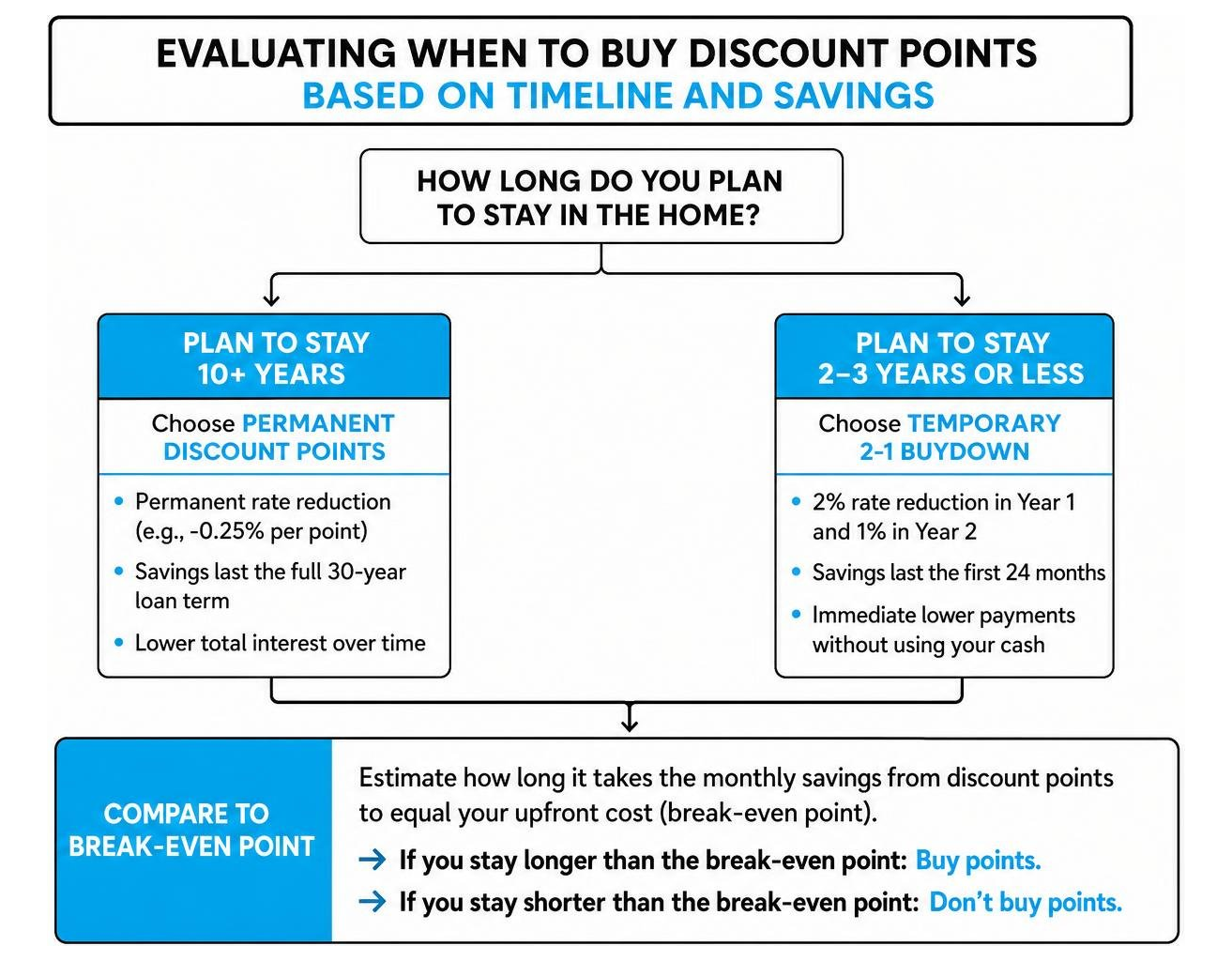
- You Plan to Stay Long-Term: You intend to keep the home and maintain the mortgage well past the break-even threshold (typically 5+ years).
- You Have Excess Liquid Reserves: You have sufficient cash savings remaining after closing to handle home maintenance, emergencies, and living expenses.
- The Seller Is Paying: You negotiated seller credits that cover closing costs and points, allowing you to secure a lower monthly payment with zero out-of-pocket point expense.
- You Want Lower Monthly Debt Ratios: Lowering the note rate reduces your fixed monthly payment, making your ongoing housing budget more manageable.
Buying Points Does NOT Make Sense If:
- You Expect to Move or Refinance Soon: If you sell the home or refinance within three to four years, you will lose money on the upfront investment because you won’t have reached the break-even point.
- Cash-to-Close Is Tight: Depleting your emergency savings just to buy down an interest rate leaves you vulnerable to unexpected home repairs.
- Market Rates Are Expected to Drop: If mortgage interest rates are projected to decrease in the near future, you may refinance anyway, rendering your upfront point investment unrecouped.
Analyzing Military Timelines and PCS Relocation Factors
For active-duty service members, the likelihood of receiving Permanent Change of Station (PCS) orders is a critical consideration.
If you are an active-duty military family stationed in areas like Great Lakes Naval Station in Illinois or MacDill Air Force Base in Florida, you must carefully evaluate your service horizon:
- If your rotation schedule or service commitment suggests a mandatory PCS move within 2 to 4 years, paying out of pocket for permanent discount points is rarely advisable.
- On a $350,000 loan, spending $3,500 on 1 point to save $55 per month requires roughly 64 months (over 5 years) to break even. If you receive PCS orders after 36 months, you will have saved only $1,980 in monthly payments—leaving you at a net loss of $1,520.
In such cases, keeping cash in liquid savings or negotiating a temporary seller-paid buydown is typically a much smarter financial decision.
Frequently Asked Questions About VA Loan Points
Can discount points be rolled into a VA purchase loan?
No. Under Department of Veterans Affairs guidelines, closing costs and discount points cannot be financed into a VA purchase loan balance. The only fee eligible to be rolled into a purchase loan is the one-time VA funding fee. All discount points on a purchase transaction must be paid in cash at closing or funded through negotiated seller credits.
How many discount points can you buy on a VA mortgage?
While federal regulations do not establish a strict statutory ceiling on the number of discount points a veteran can purchase on a purchase loan, most mortgage lenders cap point purchases at 3 to 4 discount points. Beyond 2 or 3 points, borrowers typically experience diminishing returns on rate reductions, making larger point investments financially inefficient. On a VA IRRRL streamline refinance, the law caps financed discount points at a maximum of 2 points.
Do seller-paid discount points count against the 4% concession limit?
No. Standard discount points and customary closing costs paid by the seller do not count toward the VA’s 4% seller concession cap. The 4% concession cap applies only to non-standard allowances, such as the seller paying off buyer debts, prepaying hazard insurance, or covering the VA funding fee.
Conclusion
Securing the best possible terms on your VA home loan requires balancing upfront closing costs against long-term interest savings. While buying discount points can significantly lower your monthly mortgage payments and save tens of thousands of dollars over the life of your loan, it is effective only when your housing timeline extends comfortably beyond your break-even horizon.
At Simply Financial Inc, we are committed to helping military service members, veterans, and their families make confident, fully informed mortgage decisions. Whether you are purchasing your first home, refinancing an existing property, or evaluating whether discount points fit your personal budget, our team provides transparent, expert-guided solutions.
If you are buying or refinancing in Illinois or Florida, consult with a VA loan Chicago and regional lending specialist at Simply Financial Inc today to review personalized rate buydown calculations tailored to your financial goals.