

Current Landscape: Comparing FHA 15 Yr Rates vs. 30-Year Terms
As of September 2026, benchmark national averages for 15-year fixed FHA mortgages sit around 6.23% with an APR of 6.33%, while 30-year fixed FHA loans average about 6.55% with an APR of 6.60%. On a $300,000 loan, the 15-year term saves more than $220,000 in lifetime interest compared with the 30-year term, though the monthly principal and interest payment is roughly $663 higher. FHA loans remain a cornerstone of accessible home financing because they are backed by the Federal Housing Administration. This government guarantee reduces risk for lenders, allowing us to offer competitive pricing even if you do not have a flawless credit history.
In the current market, shorter amortization schedules provide a noticeable rate discount compared to traditional 30-year mortgages. Let’s look at how benchmark terms stack up against current mortgage rates for 30-year fixed FHA loans:
| Metric / Loan Feature | 15-Year Fixed FHA Loan | 30-Year Fixed FHA Loan |
|---|---|---|
| National Average Note Rate | 6.23% | 6.55% |
| Average APR | 6.33% | 6.60% |
| Monthly Principal & Interest ($300k Loan) | ~$2,569 | ~$1,906 |
| Total Lifetime Interest Paid ($300k Loan) | ~$162,400 | ~$386,200 |
| Annual MIP Range | 0.15% – 0.40% | 0.50% – 0.55% |
| Upfront MIP | 1.75% | 1.75% |
| Payoff Horizon | 180 months | 360 months |
The difference in the interest rate—often between 0.30% and 0.50%—might look modest at first glance. However, because the loan term is halved, your principal reduction begins immediately at an accelerated pace. For broader context on how these pricing patterns have shifted over time, see historical FHA loan rate trends.
How FHA 15 Yr Rates Compare to VA Loans
Both FHA and VA loans are government-backed options, but they serve different borrower profiles. VA loans, available exclusively to eligible veterans, active-duty service members, and surviving spouses, require zero down payment and carry no ongoing monthly mortgage insurance.
While VA loans generally have competitive interest rates due to their federal backing, FHA 15-year loans shine in credit flexibility. Borrowers working on rebuilding credit often find that FHA guidelines offer a clearer path to approval. Although FHA financing requires an upfront and annual Mortgage Insurance Premium (MIP), a 15-year FHA loan drastically cuts ongoing annual insurance costs compared to a 30-year term, narrowing the lifetime cost gap between FHA and VA products.
Total Interest Savings and Amortization Differences
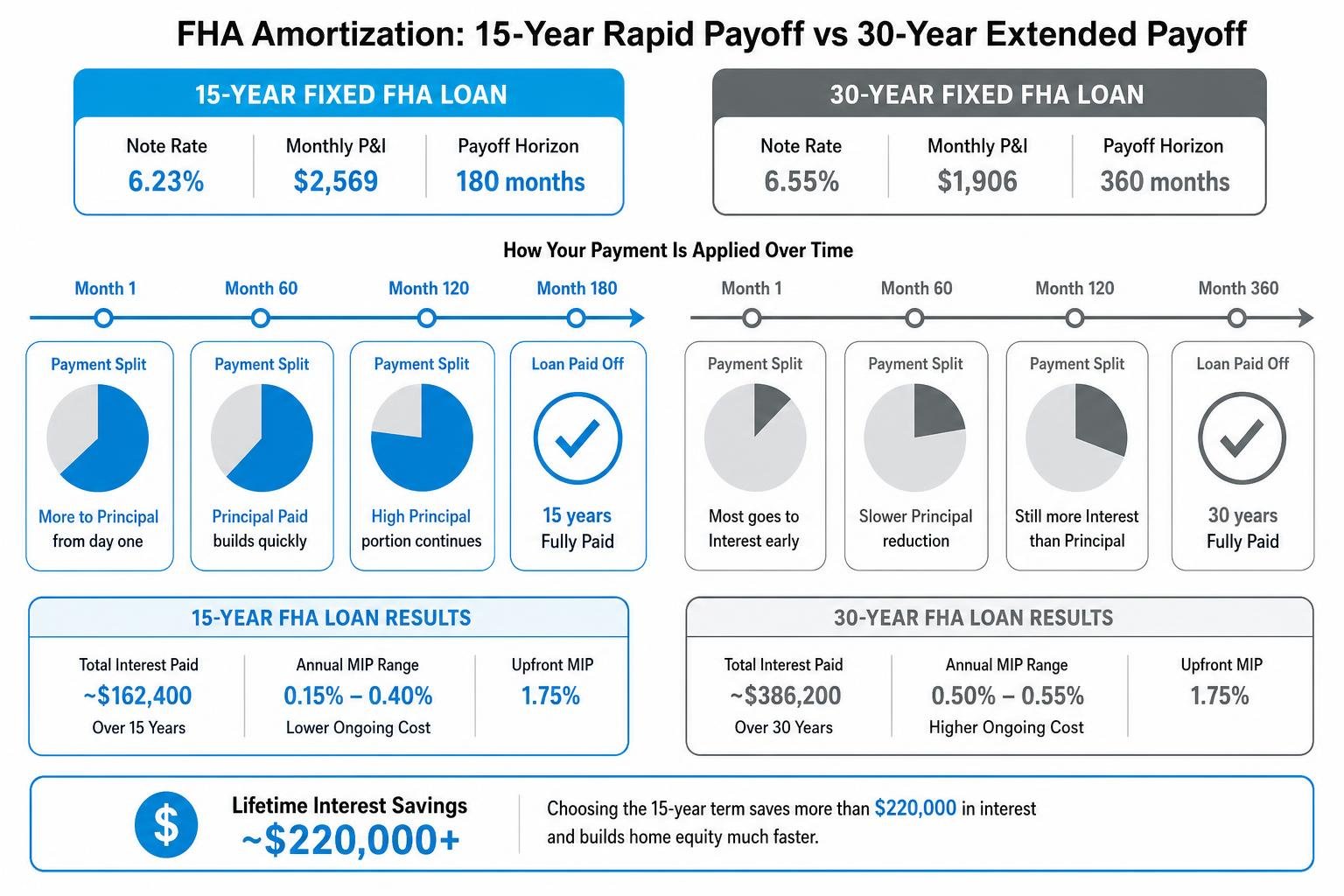
The primary reason borrowers choose a 15-year loan is the dramatic reduction in lifetime interest. In a standard 30-year amortization schedule, the vast majority of your early monthly payments goes toward interest rather than paying down the actual balance.
On a $300,000 mortgage at benchmark rates:
- A 30-year FHA loan at 6.55% results in approximately $386,200 in total interest over three decades.
- A 15-year FHA loan at 6.23% results in approximately $162,400 in total interest over 15 years.
Choosing the shorter term yields lifetime savings of more than $220,000 in pure interest. Furthermore, because each monthly payment allocates a much higher percentage directly to the principal balance from month one, your home equity builds rapidly.
Factors Influencing 15-Year FHA Mortgage Pricing
Mortgage interest rates are not set arbitrarily. They fluctuate constantly based on a combination of broader economic forces, lender operations, and individual risk factors. Keeping an eye on historical FHA loan rate trends helps illustrate how market sentiment shifts borrowing costs over time.
Macroeconomic Drivers: Treasury Yields, Inflation, and Fed Policy
Fixed mortgage rates are tied closely to the bond market, specifically mortgage-backed securities (MBS) and 10-year Treasury yields. When inflation heats up, bond investors demand higher returns, which pushes yields upward and drives mortgage rates higher.
While the Federal Reserve does not set fixed consumer mortgage rates directly, its monetary policy decisions and Federal Open Market Committee (FOMC) statements heavily influence investor expectations. For example, when Treasury yields spike or global energy costs surge, the resulting inflation concerns put upward pressure on fixed financing. When markets anticipate economic stabilization, yields level off, keeping shorter-term borrowing costs competitive.
How Borrower Credit Scores Impact FHA 15 Yr Rates
Your credit profile is the primary factor determining the specific rate quote you receive from a lender. Underwriting models evaluate your credit score, loan-to-value (LTV) ratio, and debt-to-income (DTI) ratio to measure risk:
- Scores 680 and above: Receive the most competitive pricing, lowest lender fees, and smoothest underwriting pathways.
- Scores 580 to 679: Qualify for the minimum 3.5% down payment with standard competitive pricing.
- Scores 500 to 579: Remain eligible under statutory FHA guidelines, though lenders typically require a 10% down payment and may apply risk-based pricing adjustments.
Improving your credit score by even 20 or 30 points before locking in a rate can lower your APR and save thousands of dollars over the life of the loan.
FHA Mortgage Insurance Premium (MIP) Rules for 15-Year Terms
Every FHA loan includes two types of mortgage insurance: Upfront MIP (UFMIP) and Annual MIP. Understanding how these fees function is critical when calculating the APR on an FHA loan to measure total borrowing costs.
Upfront vs. Annual MIP Reductions on Shorter Loans
The Upfront MIP is standard across almost all FHA forward mortgages at 1.75% of the base loan amount. This fee can be paid in cash at closing, but most borrowers roll it directly into the total financing amount.
Where the 15-year FHA loan provides major savings is in the Annual MIP:
- 30-Year FHA Loan (LTV > 95%): Annual MIP is 0.55% of the loan balance.
- 15-Year FHA Loan (LTV > 90%): Annual MIP is only 0.40%.
- 15-Year FHA Loan (LTV ≤ 90%): Annual MIP drops down to 0.15%.
For example, on a $300,000 loan with a 10% down payment, an annual MIP of 0.15% costs only $37.50 per month, compared to roughly $137.50 per month on a 30-year term. In addition, if you put down at least 10% on a 15-year FHA loan, the annual MIP automatically cancels after 11 years, rather than lasting for the entire life of the loan.
Evaluating the Trade-Offs: Is a 15-Year FHA Loan Right for You?

Deciding between a 15-year and 30-year mortgage is an exercise in balancing current cash flow with future financial freedom. While the long-term savings are clear, the higher mandatory monthly payment requires solid budgeting. Reviewing a comprehensive FHA home loan guide for 2026 can help clarify your broader home financing strategy.
Ideal Borrower Profiles for 15-Year Financing
A 15-year fixed FHA loan is particularly well-suited for:
- Refinance Candidates: Homeowners who have already paid down several years of a 30-year mortgage and want to shorten their term to clear their debt sooner.
- Buyers with Stable Income and Modest Credit: Borrowers whose credit scores make standard 15-year programs costly, but whose steady cash flow easily supports a higher monthly payment.
- Pre-Retirement Planners: Buyers looking to eliminate housing debt before entering retirement.
- Fast-Equity Builders: Homeowners who plan to use their equity for future investments, business ventures, or college tuition.
Monthly Cash Flow vs. Rapid Equity Building
The primary risk of a 15-year loan is payment rigidity. If unexpected expenses arise—such as medical bills or job transitions—the higher monthly mortgage payment cannot be temporarily reduced.
Before committing to a 15-year term, ensure that your total monthly housing obligation (principal, interest, taxes, homeowners insurance, and MIP) leaves ample room for emergency savings, daily living expenses, and retirement contributions.
How to Shop and Compare 15-Year FHA Loan Offers
Finding the right loan requires looking beyond headline interest rates. To ensure you are securing the best FHA rates today, follow these steps:
- Request Official Loan Estimates: Collect estimates from multiple lenders on the same day so market fluctuations do not skew comparisons.
- Scrutinize Box A (Origination Charges): Identify what lenders charge for underwriting, processing, and discount points.
- Compare APR Over Note Rate: The Annual Percentage Rate reflects the true cost of credit, including interest, points, lender fees, and upfront/annual MIP.
- Time Your Rate Lock: When you find a competitive quote that fits your budget, lock it in to protect against short-term market volatility.
Frequently Asked Questions About 15-Year FHA Mortgages
What is the average rate on a 15-year FHA mortgage today?
As of September 2026, benchmark national averages for a 15-year fixed FHA mortgage sit around 6.23% with an APR of 6.33%. Individual quotes vary based on credit profile, loan amount, and discount points.
Can I remove MIP early on a 15-year FHA loan?
If you put down 10% or more at purchase, your annual MIP automatically drops off after 11 years. If you put down less than 10%, annual MIP remains for the life of the loan. However, once you build sufficient equity (typically 20%), you can explore refinancing options to eliminate mortgage insurance entirely.
What minimum credit score is needed to qualify for a 15-year FHA loan?
The baseline credit score requirement for an FHA loan with a 3.5% down payment is 580. Borrowers with scores between 500 and 579 may still qualify with a 10% down payment, subject to lender underwriting approval.
Conclusion
A 15-year fixed FHA mortgage is a reliable tool for building wealth, offering lower interest rates, reduced MIP pricing, and substantial lifetime interest savings.
At Simply Financial Inc, we help homeowners across Illinois and Florida navigate their financing options with confidence. Whether you are buying your first home in Chicago or refinancing an existing property, our team provides personalized guidance to ensure a seamless, stress-free experience. When you are ready to evaluate your options, check current mortgage rates for FHA loans and let us help you find the right fit for your financial goals.