

FHA Cash Out Refi Max LTV: The Quick Answer
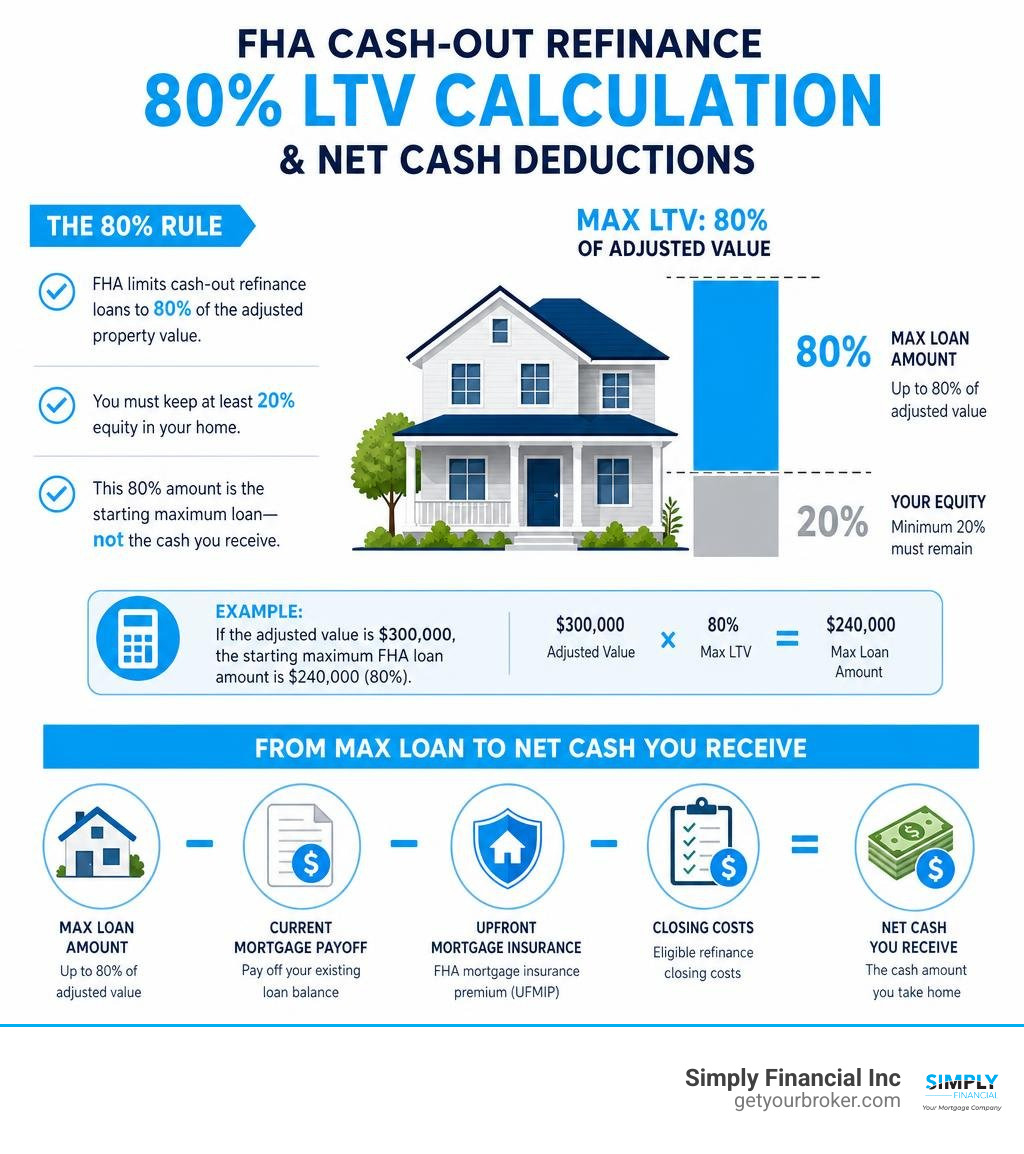
The fha cash out refi max ltv is 80% of your home’s adjusted value. In simple terms, FHA generally requires you to leave at least 20% equity in the home after refinancing.
| FHA cash-out rule | What it means |
|---|---|
| Maximum LTV and CLTV | 80% of the adjusted property value |
| Main property requirement | Your owner-occupied primary residence |
| Cash you receive | Maximum new loan, minus your current mortgage payoff, upfront mortgage insurance, and closing costs |
| Other limit to check | Your county’s FHA loan limit can lower the maximum loan amount |
For example, if the adjusted value is $300,000, the starting maximum FHA loan amount is $240,000. That does not mean you receive $240,000 in cash. The lender must first pay off your existing mortgage and deduct eligible refinance costs.
The 80% limit has applied to FHA case numbers assigned on or after September 1, 2019. HUD lowered it from 85% to help borrowers keep a stronger equity cushion and to reduce risk to the FHA insurance fund.
I am Peter Babjak of Simply Financial Inc, and for more than 18 years I have helped Chicago-area borrowers make sense of refinance options, equity calculations, and the paperwork behind the fha cash out refi max ltv. Next, let’s look at what the 80% rule really measures and why the appraised value is not always the number FHA uses.
Understanding FHA Cash Out Refi Max LTV Limits and Guidelines
When homeowners explore tapping into their accumulated equity, understanding loan-to-value (LTV) limits is the single most critical step. Loan-to-value represents the relationship between your total mortgage amount and the total appraised value of your property.
To learn more about baseline rules, review Max FHA Cash-Out LTV: The 80% Cap and Eligibility Rules – LegalClarity. At Simply Financial Inc, we guide homeowners through these calculations daily to ensure there are no surprises at the closing table.
What is the FHA Cash Out Refi Max LTV Cap?
The maximum LTV and combined loan-to-value (CLTV) ratio for an FHA cash-out refinance is strictly capped at 80% of the property’s adjusted value. Combined LTV accounts for all active mortgages or subordinate liens attached to the home, including second mortgages or home equity loans.
An essential rule to keep in mind is that FHA cash-out refinances are strictly reserved for primary owner-occupied residences. You cannot execute an FHA cash-out refinance on a second home, vacation home, or investment property. Furthermore, HUD defines the “adjusted value” differently depending on how long you have owned the property:
- Owned 12 Months or Longer: The adjusted value is simply the current appraised value determined by an FHA-approved roster appraiser.
- Owned Less Than 12 Months: The adjusted value is the lesser of the current appraised value or the original purchase price plus documented costs of permanent improvements made after purchase.
If you are exploring an FHA Cash-Out Refinance, calculating your adjusted value accurately sets the ceiling for your maximum potential borrowing limit.
Historical Shifts in Max LTV Rules
The strict 80% LTV cap has not always been the benchmark. Historically, HUD permitted higher leverage options for homeowners. Prior to 2009, borrowers could execute an FHA cash-out refinance up to 95% LTV. In the wake of the subprime mortgage crisis, HUD reduced the ceiling to 85% to stabilize loan default rates.
In August 2019, HUD published Mortgagee Letter 2019-11, which formally reduced the maximum LTV and CLTV ratio from 85% to 80% for all case numbers assigned on or after September 1, 2019.
Why did HUD make this change? Between FY 2013 and FY 2018, the number of FHA cash-out refinance endorsements surged by 250.47%—growing from 43,052 to 150,883 loans. HUD recognized that high-LTV cash-out refinancing placed substantial default risk on the Mutual Mortgage Insurance (MMI) Fund. By reducing the maximum allowable cash-out LTV to 80%, HUD built a mandatory 20% equity cushion into every loan, lowering loss severity in default scenarios while promoting sustainable equity preservation. For additional context on this historical shift, read HUD Reduces Maximum LTV for FHA Cash-Out Refinance Loans.
Calculating Adjusted Value and Net Cash Proceeds
Understanding your maximum gross loan limit is only half the battle. Many borrowers assume that if their home is worth $300,000 and they owe $150,000, an 80% LTV cap yields $90,000 in liquid cash. However, mandatory fee deductions and payoff requirements change the final numbers significantly.
How County Loan Limits Impact Your Maximum Loan
Even if your property’s adjusted value supports a high loan amount under the 80% rule, your maximum cash-out loan cannot exceed the local FHA single-family loan limits set by HUD each calendar year.
HUD establishes floor and ceiling limits based on median home prices in each county:
- Low-Cost Areas (Floor): Standard statutory limit for single-family homes across many non-metropolitan counties.
- High-Cost Areas (Ceiling): Designed for higher-cost housing markets where median values far exceed national averages.
In 2026, single-family FHA loan limits nationwide range from $541,287 in lower-cost areas up to $1,249,125 in high-cost metropolitan markets. For a deeper breakdown of current regional limits, consult our FHA Home Loan Guide 2026.
If 80% of your home’s value exceeds your county’s maximum FHA loan limit, your total loan amount will be capped at the county limit regardless of your home’s appraised equity.
Calculating Net Proceeds After Cash Out Deductions
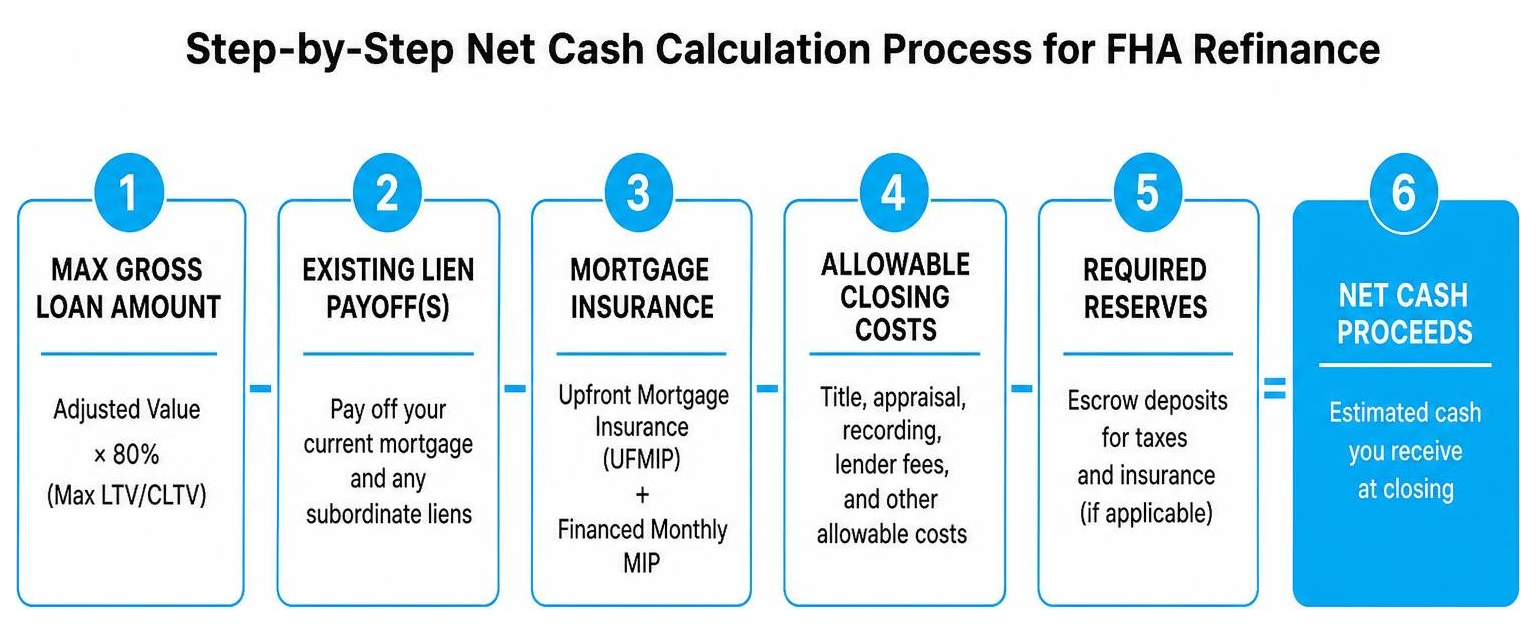
To find out how much cash you actually take home at closing, you must subtract all transaction expenses from your gross maximum loan amount. These deductions typically include:
- Existing Mortgage Payoff: Clearing your current balance and any outstanding interest.
- Upfront Mortgage Insurance Premium (UFMIP): FHA requires a mandatory 1.75% upfront fee on cash-out refinances, which is financed directly into the base loan or paid in cash.
- Closing Costs and Prepaid Expenses: Title fees, escrow deposits, lender processing charges, and state taxes (typically 2% to 5% of the total loan amount).
Here is a side-by-side comparison illustrating gross equity versus net cash in hand for a typical home valued at $300,000 with a $150,000 existing mortgage balance:
| Calculation Step | Mathematical Breakdown | Running Total |
|---|---|---|
| Appraised Property Value | Professional FHA Appraisal | $300,000 |
| Gross Max Loan Amount (80% LTV) | $300,000 × 0.80 | $240,000 |
| Existing Mortgage Payoff | Subtract Current Loan Balance | -$150,000 |
| Gross Available Equity | $240,000 – $150,000 | $90,000 |
| Upfront MIP (1.75%) | 1.75% of Base Loan ($240,000 × 0.0175) | -$4,200 |
| Closing Costs & Prepaids (Est. 3%) | Lender, Title, Settlement, Escrows | -$7,200 |
| Actual Net Cash to Borrower | Final Cash Proceeds at Closing | $78,600 |
As demonstrated above, standard required deductions convert $90,000 in gross equity into approximately $78,600 of liquid net proceeds.
Eligibility Criteria and Property Specific Rules

Qualifying for an fha cash out refi max ltv involves meeting strict federal underwriting guidelines alongside standard financial benchmarks.
Credit Score, DTI, and Occupancy Standards
To maintain eligibility for an FHA cash-out refinance, borrowers and properties must satisfy several core conditions:
- 12-Month Primary Occupancy: You must have owned and occupied the property as your primary residence for a minimum of 12 consecutive months prior to application. (An exception exists for inherited properties where the heir has occupied the home as their primary residence since inheriting it).
- Flawless 12-Month Payment History: You must be completely current on your mortgage and have made all payments within the month due for the preceding 12 months. Mortgages with fewer than 6 months of payment history are automatically ineligible for cash-out refinancing.
- Credit Score Thresholds: HUD’s official minimum credit score floor for cash-out refinances is 580. However, individual mortgage lenders frequently apply “lender overlays,” establishing minimum credit score benchmarks between 600 and 620.
- Debt-to-Income (DTI) Ratios: Standard baseline DTI requirements cap housing expenses at 31% of gross monthly income and total monthly debt obligations at 43%. Automated Underwriting System (AUS) approvals may allow higher DTI ratios if strong compensating factors (such as cash reserves) exist.
To explore real-time rate options based on your credit profile, visit our FHA Mortgage Rates Guide 2026.
Property Restrictions for Multi-Unit and Manufactured Homes
FHA underwriting applies specialized constraints based on property configuration:
- 3-to-4 Unit Properties: Multi-family homes are subject to the FHA Self-Sufficiency Test. This test requires that net rental income generated by all units (including the borrower’s unit using fair market rental estimates) exceeds the total monthly mortgage payment (PITI). Furthermore, borrowers refinancing 3-to-4 unit properties must retain at least 3 months of full principal, interest, taxes, and insurance payments in liquid reserves post-closing.
- Manufactured Housing: While FHA guidelines permit cash-out refinances on eligible permanently affixed manufactured homes, many secondary market investors enforce lower maximum LTV caps or stricter credit overlays compared to single-family stick-built properties.
- Section 247 Hawaiian Homelands Exception: HUD specifically exempts single-family mortgage insurance under Section 247 of the National Housing Act (Hawaiian Homelands) from the 80% LTV cap, preserving historical high-LTV eligibility standards for those unique properties.
Comparing FHA vs. Conventional Cash-Out Refinances
Choosing between an FHA cash-out refinance and a conventional loan backed by Fannie Mae or Freddie Mac depends heavily on your credit profile, property unit count, and financial goals.
Comparing FHA Cash Out Refi Max LTV to Fannie Mae Limits
While both standard FHA guidelines and Fannie Mae conventional rules cap maximum cash-out LTVs at 80% for single-unit primary residences, key structural differences exist across property types and secondary financing rules:
| Refinance Parameter | FHA Cash-Out Refinance | Fannie Mae Conventional Cash-Out |
|---|---|---|
| 1-Unit Primary Residence Max LTV | 80% LTV / 80% CLTV | 80% LTV / 80% CLTV |
| 2-to-4 Unit Primary Max LTV | 80% LTV | 75% LTV |
| Second Homes & Investment Properties | Ineligible | 75% (Second Homes) / 70%-75% (Investment) |
| Manufactured Housing Max LTV | 80% (Subject to overlays) | 65% LTV |
| Non-Occupant Co-Borrowers | Not permitted to qualify | Permitted under conventional underwriting |
| Minimum Credit Score Floor | 580 (Lenders often require 600-620) | 620 minimum (680+ recommended) |
As shown, borrowers with 2-to-4 unit primary residences can access up to 80% LTV under FHA guidelines compared to only 75% under Fannie Mae standards. To review full financing structures, browse our Mortgage Loan Options.
Mortgage Insurance, Appraisals, and Tax Implications
Beyond loan limits, three primary operational factors separate FHA cash-out refinances from conventional alternatives:
1. Ongoing Mortgage Insurance Premiums (MIP)
Every FHA cash-out refinance carries both an Upfront MIP (1.75%) and an Annual MIP. For 30-year cash-out refinances at or below the standard loan threshold, the annual MIP rate is 0.50% (or 0.70% for jumbo-sized base loans). Because your starting LTV is capped at 80% (which is at or below the 90% LTV threshold), FHA guidelines automatically cancel annual MIP after 11 years of on-time payments, rather than requiring insurance for the full 30-year life of the loan.
2. FHA Appraisal Safety & Health Standards
An FHA appraisal is more comprehensive than a conventional appraisal. In addition to establishing fair market value, the appraiser must inspect the home against HUD Minimum Property Standards (MPS) to ensure safety, security, and structural integrity. Issues like peeling lead-based paint, missing handrails, or faulty heating systems must be repaired prior to loan funding.
3. Tax Deductibility under IRS Publication 936
Under current tax regulations, mortgage interest is only fully tax-deductible on loan proceeds used specifically to buy, build, or substantially improve your primary residence (qualified residence debt). If you use cash-out funds to consolidate high-interest credit card debt, buy a vehicle, or fund personal expenses, the interest paid on that portion of the cash loan is not tax-deductible. Always consult a qualified tax professional regarding IRS Publication 936 compliance.
Frequently Asked Questions
What is the current maximum LTV for an FHA cash-out refinance?
The current maximum LTV and combined CLTV limit for an FHA cash-out refinance is 80% of the property’s adjusted value. This limit was established under HUD Mortgagee Letter 2019-11 and applies to all owner-occupied primary residences.
How long do I have to pay annual MIP on an FHA cash-out refinance?
Because an FHA cash-out refinance is capped at an 80% starting LTV—which falls at or below 90% LTV—your monthly annual Mortgage Insurance Premium (MIP) automatically terminates after 11 years, provided payments remain current.
Can non-occupant co-borrowers help me qualify for an FHA cash-out refinance?
No. FHA guidelines strictly prohibit adding non-occupant co-borrowers to meet credit underwriting standards on cash-out refinances. Every co-borrower listed on an FHA cash-out refinance loan must actively occupy the home as their principal residence.
Conclusion
Navigating the fha cash out refi max ltv rules does not have to be confusing. While the 80% cap sets a clear boundary on how much total equity you can leverage, calculating net proceeds requires factoring in existing loan balances, regional county limits, upfront MIP, and closing costs.
At Simply Financial Inc, our mission is to deliver a seamless, expert-guided, stress-free mortgage experience. Whether you are refinancing in Illinois, Florida, or right here in our hometown near 5632 W Lawrence Ave in Chicago, IL, our dedicated team will help you evaluate your property value, optimize your loan structure, and access your home equity with complete clarity.
Ready to explore your maximum home equity options? Learn more about our specialized loan programs by visiting our comprehensive FHA Loan portal or contact our mortgage specialists today!