

Can You Get an FHA Cash-Out Refinance After Chapter 13 Bankruptcy?
Yes — an FHA cash-out refinance after Chapter 13 bankruptcy is possible, and in many cases, you can qualify sooner than you think.
Here’s a quick summary of how it works:
| Your Situation | Can You Qualify? | Key Requirements |
|---|---|---|
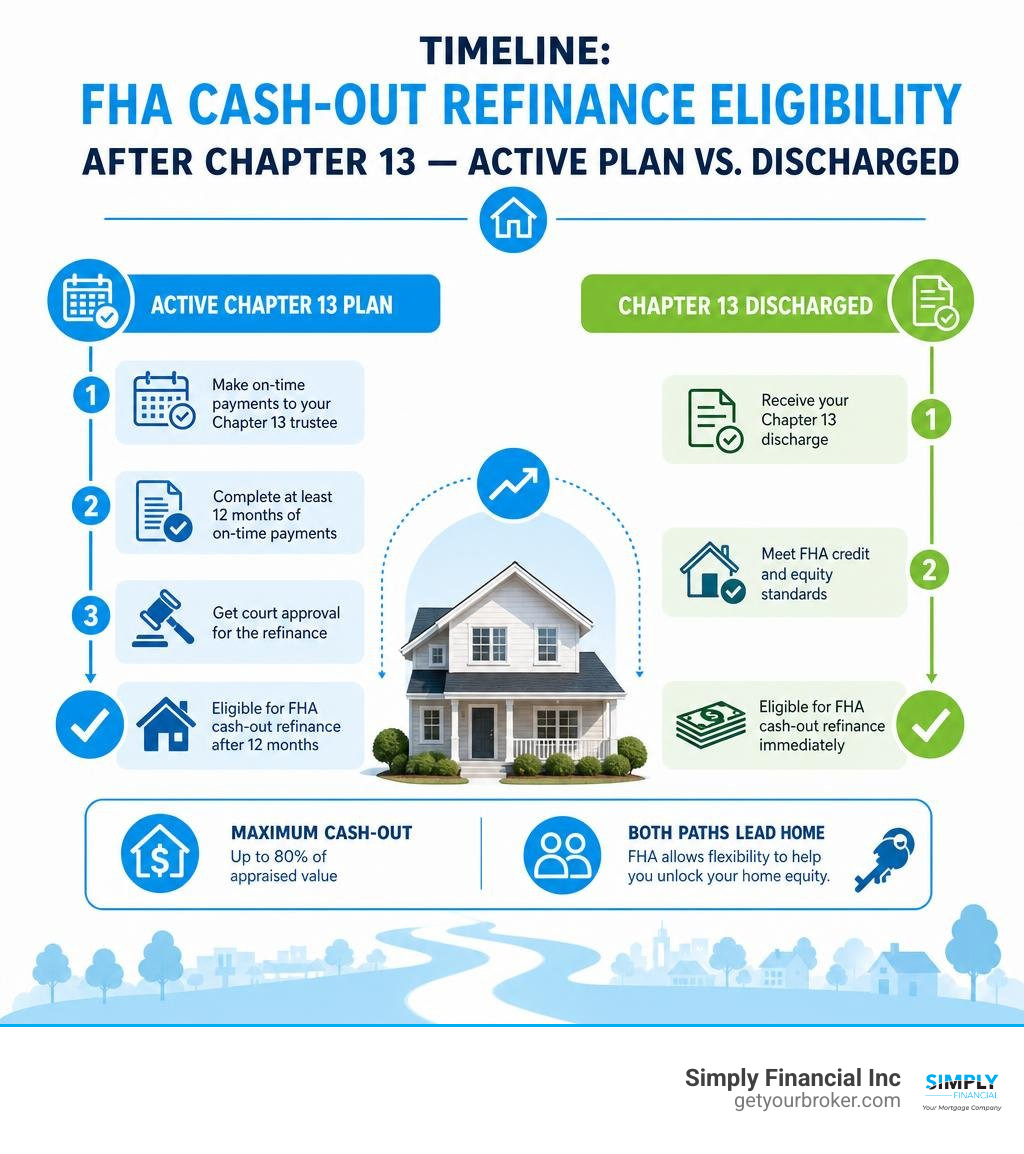
| Chapter 13 discharged | Yes, immediately | Meet FHA credit and equity standards |
| Still in active Chapter 13 plan | Yes, after 12 months | On-time trustee payments + court approval |
| Maximum cash-out | Up to 80% of appraised value | Applies in both scenarios |
Most people believe bankruptcy means a long wait before they can touch their home equity. That’s simply not true for Chapter 13. Unlike Chapter 7 — which carries a two-year waiting period — Chapter 13 has no mandatory waiting period after discharge under FHA guidelines. And even if you’re still actively paying your plan, you may already be eligible.
I’m Peter Babjak, founder of Simply Financial Inc., a Chicago-area mortgage broker with over 18 years of experience helping borrowers navigate complex loan situations — including FHA cash-out refinances after Chapter 13. I’ve guided many clients through this exact process and I’ll walk you through everything you need to know.
FHA Cash Out Refinance After Chapter 13: Rules and Requirements
Navigating bankruptcy is tough enough without the mortgage industry speaking in riddles. Fortunately, Federal Housing Administration (FHA) underwriting standards are noticeably more forgiving than conventional lending guidelines when it comes to past financial distress.
When you apply for an fha cash out refinance after chapter 13, HUD (the U.S. Department of Housing and Urban Development) sets baseline rules, though individual lenders may add their own extra requirements, known as lender overlays. The core concept behind FHA guidelines is evaluating your re-established credit consistency rather than penalizing you endlessly for past struggles.
To understand official HUD guidelines regarding bankruptcy eligibility, you can review the FHA FAQ Bankruptcy Eligibility guidelines directly. In short, FHA differentiates heavily between Chapter 7 (liquidation) and Chapter 13 (wage earner reorganization). Because Chapter 13 involves restructuring and paying back debts through a court-approved repayment plan, underwriters view it far more favorably.
Applying for an FHA Cash Out Refinance After Chapter 13 Discharge
If your Chapter 13 bankruptcy has already been officially discharged by the court, we have great news: there is zero mandatory FHA waiting period post-discharge. You do not need to wait two years, one year, or even six months. In theory, you could apply 1 day after your official bankruptcy discharge document is stamped by the court clerk.
However, keep in mind how underwriting decisions are rendered:
- Automated Underwriting System (AUS): If your credit score has recovered sufficiently and your file receives an “Approve/Eligible” rating from FHA’s automated system, the loan can proceed through streamlined processing.
- Manual Underwriting: If the automated system issues a “Refer” status, your file transitions to manual underwriting. In manual underwriting, human loan officers examine your full history, requiring proof that all bankruptcy payments were made on time, your mortgage history is spotless, and you have re-established positive credit tradelines.
When you’re pulling equity out of your home, an FHA Cash-Out Refinance allows you to tap into up to 80% of your property’s total market value. Whether you plan to consolidate high-interest consumer debt, fund home improvements, or build a emergency cash buffer in 2026, an official discharge puts you in a prime position to execute this refinance.
Qualifying for an FHA Cash Out Refinance After Chapter 13 During Active Repayment
What if your Chapter 13 plan is still active and you haven’t received a final discharge yet? Can you still get an fha cash out refinance after chapter 13 filing?
The answer is yes. FHA rules explicitly permit refinancing while actively enrolled in a Chapter 13 repayment plan, provided you satisfy two critical conditions:
- 12-Month Payment Seasoning: You must have completed at least 12 consecutive months of your Chapter 13 payout plan. Every single payment to the bankruptcy trustee during those 12 months must have been paid strictly on time (never 30 days or more late).
- Written Trustee or Court Permission: You must obtain formal written authorization from the Chapter 13 bankruptcy court or trustee authorizing you to incur new mortgage debt and complete the refinancing transaction.
For comprehensive insight on mortgage regulations during active debt restoration, check out FHA Loan Rules for Borrowers After Filing Bankruptcy.
Credit, Equity, and Debt-to-Income Guidelines

Qualifying for an fha cash out refinance after chapter 13 requires meeting standard FHA financial benchmarks alongside bankruptcy-specific seasoning standards. Underwriters evaluate your credit profile, home equity, and debt ratios to ensure the new loan is sustainable.
Maximum Loan-to-Value (LTV) and Equity Limits
The maximum Loan-to-Value (LTV) ratio for any FHA cash-out refinance is capped at 80% of your home’s appraised value. This requirement applies whether your Chapter 13 is fully discharged or still active.
For example, if your home appraises for $400,000, your maximum combined loan amount (including closing costs and prepaid items rolled into the mortgage) cannot exceed $320,000 ($400,000 × 0.80). The remaining 20% ($80,000) represents mandatory equity that must remain untouched in the property.
Here is how the cash-out refinance framework compares between an active plan and a completed discharge:
| Criteria | Active Chapter 13 Plan | Discharged Chapter 13 |
|---|---|---|
| FHA Waiting Period | 12 months of plan payments required | 0 days (Immediate after discharge) |
| Trustee / Court Approval | Mandatory (Motion to Incur Debt) | Not Required |
| Payment History Requirement | 0 late payments to trustee in 12 months | 0 late mortgage payments in 12 months |
| Max Loan-to-Value (LTV) | 80% of Appraised Value | 80% of Appraised Value |
| Underwriting Type | Manual Underwriting typical | Automated (AUS) or Manual Underwriting |
| Max Debt-to-Income (DTI) | Typically 31/43% (up to 40-50% with compensating factors) | Up to 43-50% depending on underwriting |
Minimum Credit Score and Debt-to-Income (DTI) Standards
To execute an fha cash out refinance after chapter 13, you must satisfy both HUD’s baseline criteria and specific lender overlays:
- Credit Score: FHA rules permit cash-out refinancing with a minimum credit score of 580. However, because post-bankruptcy cash-out transactions often require manual underwriting, many mortgage lenders enforce an internal overlay requiring a score of 620 or 640.
- Debt-to-Income (DTI) Ratio: Standard manual underwriting targets a front-end housing ratio of 31% (monthly housing costs divided by gross monthly income) and a back-end total DTI of 43%. If you possess strong compensating factors — such as verified cash reserves post-closing, minimal debt usage, or stable income longevity — DTIs up to 45% or 50% can be approved.
If you are looking to boost your score prior to applying, practical credit improvement tactics can be explored in our guide on Mortgage Tips.
Essential Documentation and Trustee Approval

Preparation is everything when applying for an fha cash out refinance after chapter 13. Missing paperwork is the single biggest cause of transaction delays.
Securing Bankruptcy Trustee Consent and Court Motion
If you are in an active Chapter 13 plan, you cannot take on new debt or modify real estate financing without court permission. Here is the process to secure trustee approval:
- Get Pre-Approved with a Lender: We construct a full loan application, execute an appraisal, and draft a preliminary Closing Disclosure (or Fee Worksheet) showing the exact loan terms, interest rate, new monthly payment, and cash-out amount.
- Contact Your Bankruptcy Attorney: You hand the preliminary loan package to your bankruptcy attorney.
- File a Motion to Incur Debt: Your attorney files a formal motion with the bankruptcy court requesting authorization to refinance.
- Trustee & Judge Review: The trustee and judge evaluate whether the refinance harms your ability to complete your repayment plan. If the refinance lowers your mortgage payment or uses cash-out funds to pay off the Chapter 13 plan entirely, judges almost always grant approval within 14 to 30 days.
To see how this fits into overall local lending procedures in Illinois or Florida, explore our step-by-step breakdown of the Chicago Mortgage Process.
Crafting an Effective Letter of Explanation
Underwriters will require a signed, detailed Letter of Explanation (LOE) detailing the circumstances that forced your original Chapter 13 filing.
An effective LOE should clearly address three core elements:
- The Primary Trigger: Explain the initial event (e.g., medical emergency, temporary loss of employment, sudden divorce, business disruption) that led to the bankruptcy.
- Temporary Nature: Clarify how the event was beyond your control and is now resolved.
- Re-Established Financial Health: Explain how your household finances have stabilized, highlighting your perfect trustee payment track record and disciplined budgeting.
For additional structural tips on loan paperwork, review our comprehensive FHA Home Loan Guide 2026.
Step-by-Step Refinancing Process
Here is the step-by-step roadmap to successfully closing an fha cash out refinance after chapter 13:
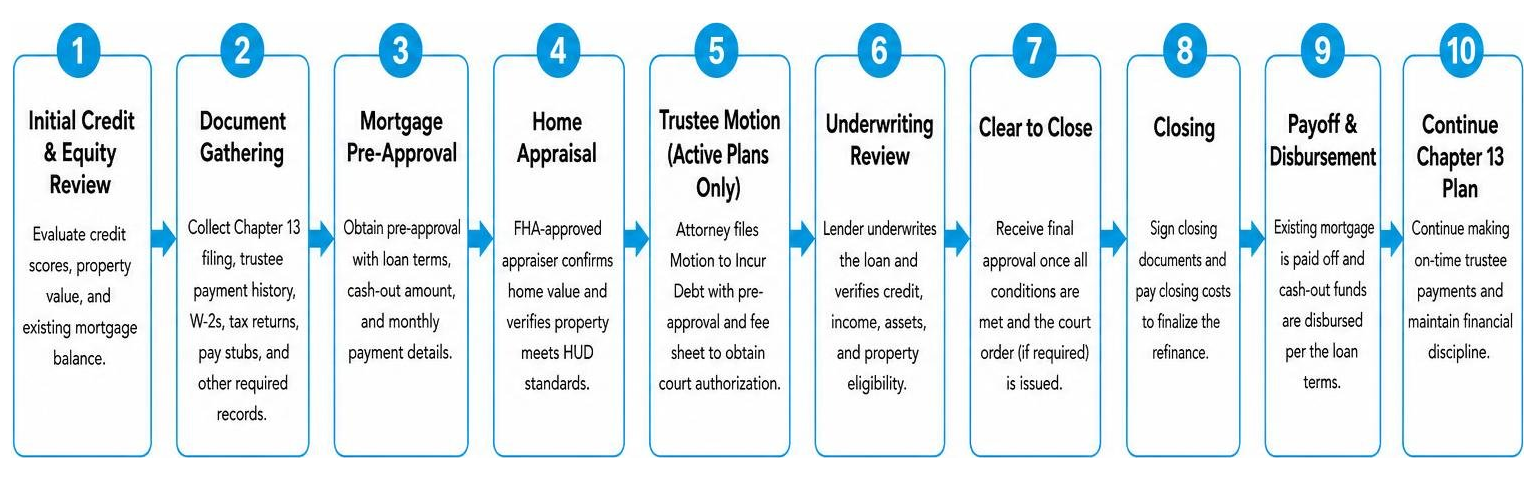
- Initial Credit & Equity Review: Contact our team at Simply Financial Inc. to evaluate your credit scores, estimated property value, and existing mortgage balance.
- Document Gathering: Collect your Chapter 13 filing petition, schedules, payment history ledger from the trustee, W-2s, tax returns, and recent pay stubs.
- Mortgage Pre-Approval: Obtain an official Mortgage Pre-Approval outlining your proposed loan balance, cash-out proceeds, and monthly payments.
- Home Appraisal: An FHA-approved appraiser performs an evaluation of your home to confirm its market value and verify the property satisfies HUD minimum property standards.
- Trustee Motion (Active Plans Only): Your attorney files the Motion to Incur Debt using the loan pre-approval and fee sheet, securing court order authorization.
- Underwriting Submission: The complete application package—including trustee payment verification, letter of explanation, and court order—is reviewed by an FHA underwriter.
- Loan Closing & Cash Distribution: Sign final loan documents. After the mandatory 3-day rescission period for primary residences, funds are disbursed, paying off your old mortgage, settling court liabilities if applicable, and distributing your remaining cash equity.
Frequently Asked Questions about Refinancing After Chapter 13
Is there a waiting period for an FHA cash-out refinance after Chapter 13 discharge?
No. There is no FHA-mandated waiting period following a Chapter 13 bankruptcy discharge. You are eligible to apply immediately once the court issues your discharge document, provided you satisfy standard FHA credit, income, and 80% LTV equity requirements. If your credit profile requires manual underwriting, the underwriter will verify that your mortgage payment history over the past 12 months was free of late payments.
Can you do an FHA cash-out refinance while still in Chapter 13 bankruptcy?
Yes. You can complete an fha cash out refinance after chapter 13 filing while your plan remains active, provided you have completed at least 12 consecutive months of on-time payments to the bankruptcy trustee and have obtained formal written approval from the court or trustee (via a Motion to Incur Debt).
What is the maximum LTV allowed on an FHA cash-out refinance after bankruptcy?
The maximum Loan-to-Value (LTV) ratio is 80% of the home’s appraised value. For example, on a property valued at $300,000, your total new mortgage loan amount cannot exceed $240,000.
Conclusion
A Chapter 13 bankruptcy filing is not a permanent financial roadblock—it is a tool that allows hardworking homeowners to reorganize and regain control of their financial future. Whether your plan was discharged recently or you are currently 12 months into an active repayment schedule, pulling cash out of your home equity through an fha cash out refinance after chapter 13 can help you consolidate debts, complete major home repairs, or establish long-term financial peace of mind.
At Simply Financial Inc., located right here at 5632 W Lawrence Ave in Chicago, IL, we specialize in delivering expert-guided, stress-free mortgage solutions across Illinois and Florida. We understand the nuances of bankruptcy underwriting and work directly alongside you and your attorney every step of the way.
Ready to see how much equity you can access? Explore FHA Loan Options with our experienced team today or reach out to schedule your personalized consultation!