

FHA Cash-Out Refinance After Chapter 7: Your Starting Point
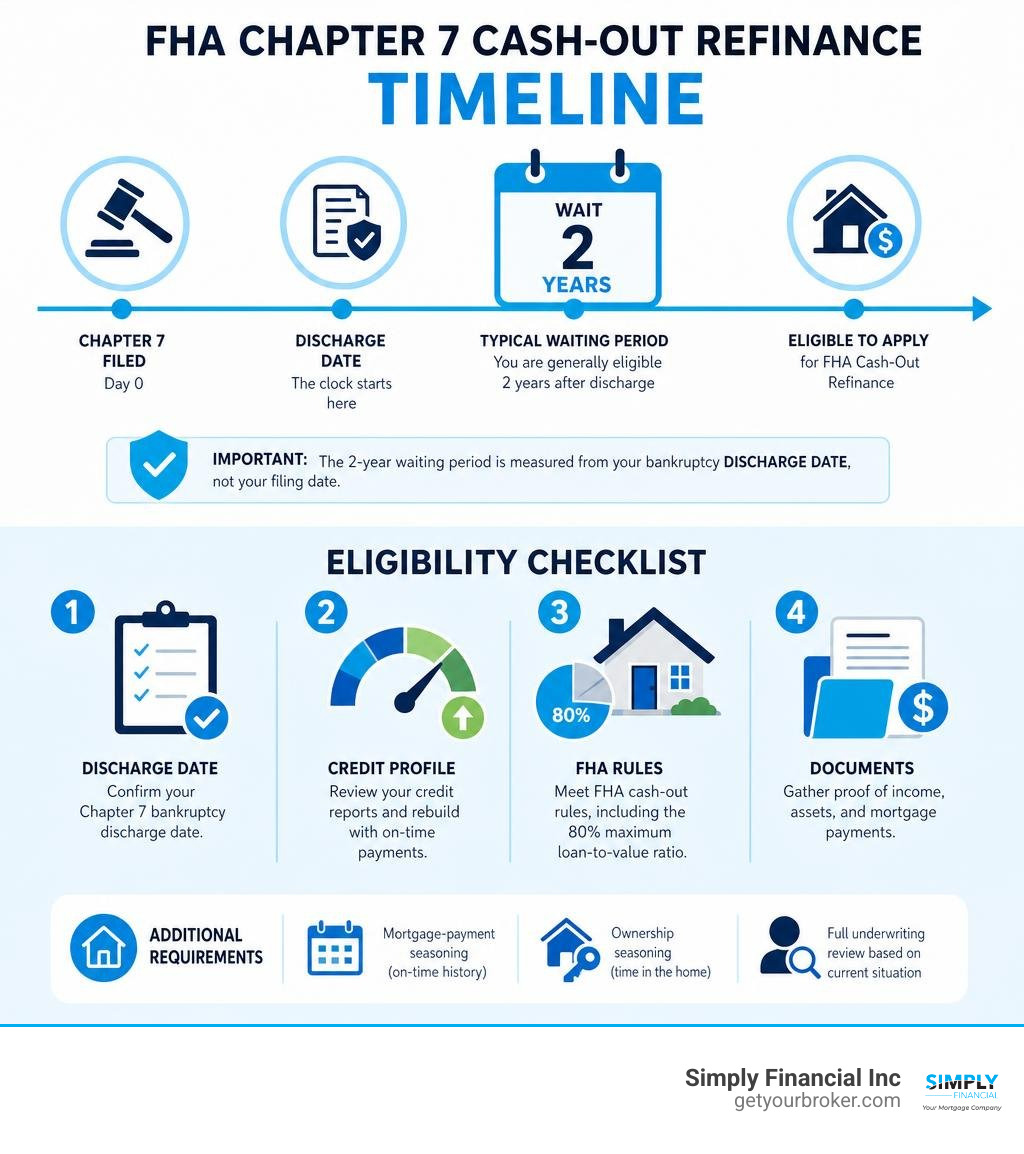
You may qualify for an FHA cash-out refinance after Chapter 7 once you are generally two years past your bankruptcy discharge date – not your filing date. You also need enough equity, typically leaving at least 20% in the home, a qualifying credit profile and income, and the required mortgage-payment and ownership seasoning.
Start by checking these four items:
- Confirm the date your Chapter 7 bankruptcy was discharged.
- Review your credit reports and rebuild a record of on-time payments.
- Verify that you meet FHA cash-out rules, including the usual 80% maximum loan-to-value ratio.
- Gather proof of income, assets, and mortgage payments – especially if you kept the home but did not reaffirm the mortgage.
A standard FHA refinance also commonly uses the two-year Chapter 7 waiting period, but cash-out refinances face additional equity, seasoning, and underwriting review because you are borrowing against your home. In limited cases, documented extenuating circumstances may support a shorter waiting period, but this is not automatic.
I am Peter Babjak, and as a mortgage broker with Simply Financial Inc since 2007, I help Chicago-area homeowners make sense of refinance paperwork, credit recovery, and FHA cash-out refinance after Chapter 7 eligibility. The sections below explain the timeline, documents, and practical steps to prepare before you apply.
Waiting Periods for an FHA Cash-Out Refinance After Chapter 7

Filing a Chapter 7 liquidation bankruptcy wipes out unsecured debts, providing a much-needed financial reset. However, when it comes to borrowing against your home equity later, federal guidelines establish mandatory cooling-off intervals. Understanding How does a bankruptcy affect a borrower’s eligibility for an FHA mortgage begins with distinguishing between your bankruptcy filing date and your official court discharge date.
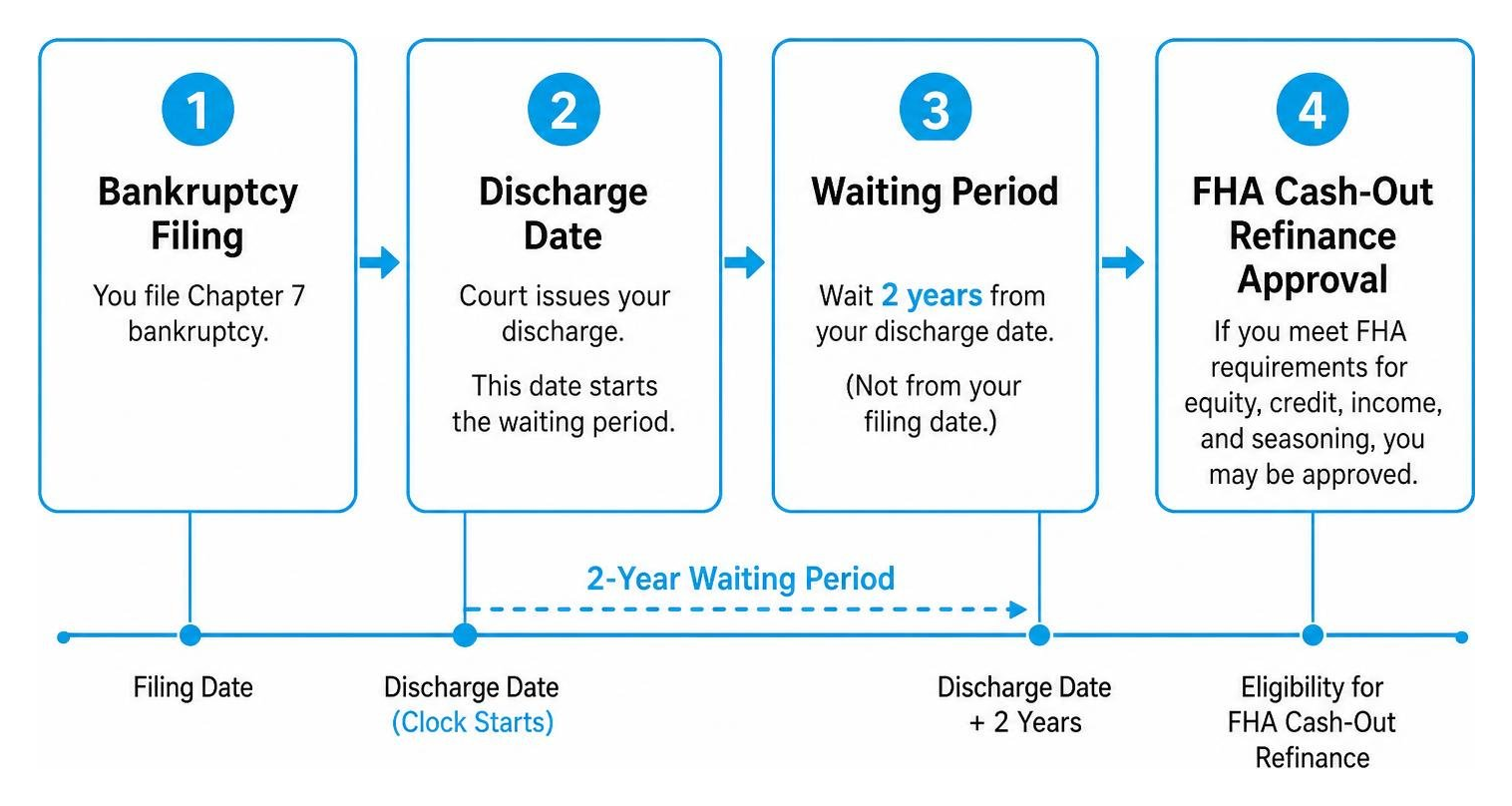
The clock for your waiting period starts on the day the bankruptcy judge signs your discharge order, not the day your attorney submitted your bankruptcy petition. According to HUD Handbook 4000.1, the Federal Housing Administration enforces a mandatory waiting period before you can tap home equity using an FHA loan program.
Standard 2-Year Discharge Rule vs. Conventional 4-Year Rule
Government-backed financing is significantly more forgiving than conventional lending after a bankruptcy. While an fha loan requires a 2-year waiting period from the Chapter 7 discharge date, conventional mortgages governed by Fannie Mae and Freddie Mac require a full 4-year wait.
| Loan Program | Chapter 7 Waiting Period (Standard) | Chapter 7 Waiting Period (Extenuating Circumstances) | Standard Maximum Loan-to-Value (LTV) |
|---|---|---|---|
| FHA Cash-Out Refinance | 2 Years from Discharge | 12 Months from Discharge | 80% |
| Conventional Cash-Out | 4 Years from Discharge | 2 Years from Discharge | 80% |
| VA Cash-Out Refinance | 2 Years from Discharge | 12 Months (Case-by-case) | Up to 90%–100% |
| USDA Cash-Out Refinance | N/A (No cash-out offered) | N/A | N/A |
As shown in the comparison, selecting an FHA mortgage cuts your waiting timeline in half compared to conventional programs, enabling you to access your accrued home equity two years earlier.
Extenuating Circumstances for a 12-Month Exception
HUD guidelines allow an exception that reduces the Chapter 7 waiting period from 24 months down to 12 months. However, this exception is not granted simply because life got complicated. To qualify, you must prove that the bankruptcy was caused by documented extenuating circumstances beyond your control, such as:
- A catastrophic medical emergency or serious illness affecting you or a primary earner.
- An involuntary, sudden job loss or permanent employer closure.
- The death of a household wage earner resulting in a severe drop in household income.
Divorce or standard financial mismanagement does not meet HUD’s threshold. You must submit written documentation proving the crisis occurred, that it led directly to the bankruptcy, and that you have exhibited stable, responsible financial management since the event. Legal and financial experts reviewing Can You Refinance Your Mortgage After Bankruptcy? emphasize that lenders scrutinize these hardship letters closely during underwriting.
Cash-Out Refinance vs. Rate-and-Term and Streamline Rules
All refinances are not evaluated equally by mortgage underwriters. An fha cash out refinance involves extracting liquid cash from your property, which increases your overall debt obligation and introduces higher risk to the lender.
By contrast, rate-and-term transactions or FHA Streamline refinances serve to lower monthly payments or improve loan stability. For borrowers who already hold an FHA loan and preserved their mortgage through bankruptcy, an FHA Streamline refinance may be pursued as early as 12 months post-discharge provided every mortgage installment was paid on time. If your past filing was a reorganization rather than a liquidation, explore the specific criteria for an fha cash out refinance after chapter 13 where court permission rules apply.
Core Underwriting and Property Eligibility Rules

Securing approval for an FHA cash-out refinance involves more than waiting out the calendar. Lenders must verify credit performance, debt ratios, and property equity before approving a new loan balance.
Minimum Credit Score and DTI for an FHA Cash-Out Refinance After Chapter 7
Under basic HUD rules, an applicant can technically qualify for standard FHA financing with a score as low as 500 (with a 10% down payment) or 580 (with 3.5% down). However, evaluating the exact credit needed for fha loan products with cash-out features reveals higher benchmarks.
- Credit Score Targets: Most wholesale and retail lenders set an overlay requiring a minimum 580 to 620 credit score for an FHA cash-out transaction post-bankruptcy. Aiming for a 640 score significantly widens your available options.
- Debt-to-Income (DTI) Ratios: The standard maximum DTI ratio for an FHA refinance is 43%. While automated underwriting systems (AUS) can approve ratios up to 45% to 50% with strong compensating factors, post-bankruptcy manual underwriting typically caps front-end housing costs at 31% and back-end total debt at 43%.
- Current Rate Environments: Review our updated fha home loans rates guide 2026 to evaluate how prevailing interest rates influence your projected debt ratios and monthly payments.
Maximum LTV Limits and Mortgage Seasoning
FHA limits cash-out equity extraction strictly to protect homeowners and the insurance fund.
- Maximum Loan-to-Value: Under standard guidelines, the fha cash out refi max ltv is 80% of your property’s current appraised market value. You must retain at least 20% equity in the property after financing your existing balance and closing costs.
- Owner-Occupancy and Property Seasoning: The subject property must be your principal residence. You must have owned and occupied the property for at least 12 months prior to the refinance application date.
- Payment Seasoning: You must have a clean 12-month track record on your existing mortgage, meaning zero 30-day late payments within the past 12 consecutive months. Additionally, at least 6 months must have elapsed since your last refinance closing date.
Navigating Reaffirmed vs. Non-Reaffirmed Mortgages
When filing Chapter 7, homeowners who keep their houses face a choice: sign a formal reaffirmation agreement or continue paying without reaffirming.
- Reaffirmed Mortgages: You signed an agreement remaining personally liable for the debt. The mortgage servicer continues reporting your on-time payments to Experian, Equifax, and TransUnion, directly building your credit score.
- Non-Reaffirmed Mortgages: The bankruptcy discharged your personal liability, but the lender retains its lien on the physical home. Because personal liability was eliminated, lenders typically report the account on credit bureaus with a $0 balance and a status of “Discharged in Bankruptcy.”
Documenting Non-Reaffirmed Mortgage Payments
If you did not reaffirm your mortgage, your credit report will not display your post-bankruptcy payment history. Underwriters cannot verify on-time housing payments through an automated credit report pull. You must prove your 12 to 24-month payment history manually:
- 12 to 24 consecutive months of official bank statements showing payments cleared directly to the servicer.
- 12 to 24 months of front-and-back canceled checks.
- An official, manual year-end mortgage payment ledger or Year-End Escrow Analysis directly from your mortgage servicer.
- Direct written Verification of Mortgage (VOM) completed and signed by the loan servicer.
Manual Underwriting and Compensating Factors
Post-bankruptcy cash-out applications often generate a “Refer” result from the Automated Underwriting System, requiring human manual underwriting. Manual underwriting evaluates your loan based on HUD’s specific compensating factors:
- Documented Cash Reserves: Maintaining 1 to 3 months of total mortgage payments (principal, interest, taxes, insurance) in verified reserve accounts after closing.
- Minimal Payment Shock: Demonstrating that your new mortgage payment will not exceed your previous housing expense by more than $100 or 5%.
- Residual Income: Documenting adequate discretionary income remaining each month after all recurring debts and living expenses are covered.
How to Apply and Risks to Consider
A cash-out refinance alters your long-term balance sheet. Proper preparation ensures you extract equity responsibly without destabilizing your finances.
Steps to Prepare for an FHA Cash-Out Refinance After Chapter 7
- Obtain Official Bankruptcy Records: Secure your Chapter 7 Schedule of Debts, Petition, and Bankruptcy Court Discharge Order.
- Audit All Three Credit Reports: Verify that all pre-bankruptcy unsecured debts show a $0 balance and reflect discharged status rather than open/delinquent.
- Rebuild New Positive Tradelines: Establish 2 to 3 new revolving or installment accounts (such as a secured credit card on autopay) immediately following discharge. Keep utilization under 10%.
- Gather Housing History: Compile your canceled checks or bank statements proving flawless mortgage payment performance.
- Track Market Rates and Program Terms: Use our fha mortgage rates guide 2026 to model total interest expenses and determine whether restructuring your loan balance meets your long-term wealth goals.
Downside Risks and Cost Considerations
Borrowers should carefully evaluate the costs associated with an FHA cash-out transaction:
- Upfront and Annual MIP: FHA loans require a 1.75% Upfront Mortgage Insurance Premium (UFMIP) added to your loan balance, alongside an ongoing annual Mortgage Insurance Premium (typically 0.55% of the loan amount) paid monthly.
- Higher Total Debt: Cashing out equity resets your amortization schedule and increases your overall principal balance.
- Equity Depletion: Tapping up to 80% LTV leaves a smaller cushion if home values fluctuate, reducing your flexibility if you need to sell unexpectedly.
Frequently Asked Questions About Post-Bankruptcy FHA Refinancing
Can I do an FHA cash-out refinance if I did not reaffirm my mortgage during Chapter 7?
Yes. Non-reaffirmation does not disqualify you from an FHA cash-out refinance. Because the mortgage servicer does not report your monthly payments to credit bureaus, your loan file must be manually underwritten. You must provide 12 consecutive months of bank statements or canceled checks proving zero late payments.
How does mortgage seasoning differ from the Chapter 7 waiting period?
The Chapter 7 waiting period measures the time elapsed since your bankruptcy discharge date (standard 2 years). Mortgage seasoning measures the length of time you have owned your home (minimum 12 months) and the payment consistency on your current mortgage (minimum 12 months of on-time payments with no 30-day delinquencies). Both requirements operate on separate tracks and must be satisfied concurrently.
Can extenuating circumstances shorten the cash-out waiting period to one year?
Yes, under HUD guidelines, an underwriter can approve an FHA loan 12 months after a Chapter 7 discharge if the bankruptcy was triggered by an unavoidable, catastrophic event such as severe medical disability or involuntary job termination. The borrower must fully document the cause and prove sustained financial stability since the discharge.
Conclusion
A Chapter 7 discharge is a legal tool designed to give you a fresh financial start, not a permanent barrier to leveraging your home equity. By observing the standard 2-year waiting period, establishing clean credit tradelines, maintaining flawless mortgage payment history, and adhering to the 80% maximum LTV limit, you can successfully access your home’s equity.
At Simply Financial Inc, our team specializes in guiding homeowners through post-bankruptcy lending rules. Whether you are located near our Chicago office at 5632 W Lawrence Ave or exploring refinancing across Illinois and Florida, we deliver a seamless, expert-guided, stress-free mortgage experience. Contact us today to review your discharge timeline and build a clear plan for your next fha loan.