

How an FHA Cash-Out Refinance Can Unlock Your Home’s Equity
An FHA cash-out refinance lets you replace your existing mortgage with a larger FHA-backed loan — and pocket the difference as cash.
Here’s the quick version of how it works:
- You borrow more than you owe on your home and receive the extra amount as a lump sum
- Maximum loan amount: up to 80% of your home’s appraised value
- Minimum credit score: 500 (though most lenders require higher)
- Minimum occupancy: you must have lived in the home as your primary residence for at least 12 months
- Payment history: zero late payments in the 12 months before applying
- No restrictions on how you use the cash — home renovations, debt consolidation, emergency savings, and more are all fair game
Example: Your home is appraised at $300,000. At 80% LTV, you can borrow up to $240,000. If you currently owe $200,000, you could receive up to $40,000 in cash (before closing costs).
This option is especially useful for homeowners who have lower credit scores and wouldn’t qualify for a conventional cash-out refinance.
I’m Peter Babjak, founder of Simply Financial Inc — a Chicago-based mortgage broker with over 18 years of experience helping homeowners navigate the FHA cash-out refinance process and find the right loan for their situation. In this guide, I’ll walk you through everything you need to know, from eligibility to costs to how to apply.
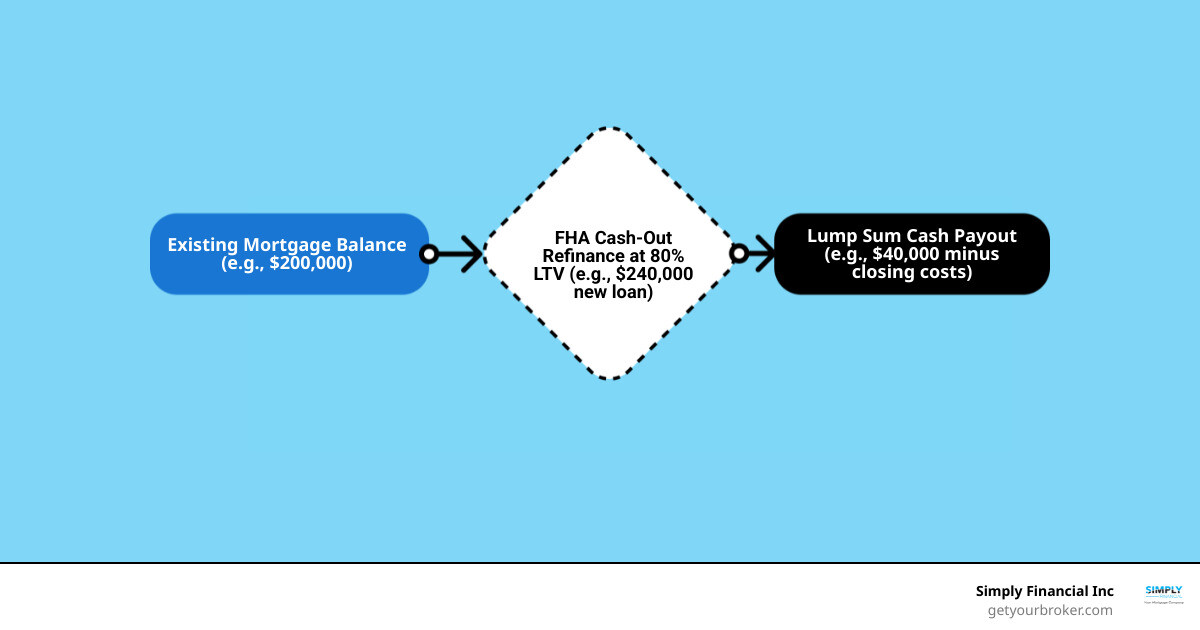
What is an FHA Cash Out Refinance and How Does It Work?
If you are looking to tap into some of the equity in your home, an fha cash out refinance could help you accomplish your goal. Backed by the Federal Housing Administration, this mortgage option allows you to replace your existing home loan with a brand-new mortgage that has a higher principal balance than what you currently owe. The difference between the two loans is paid out to you as a lump sum of cash at closing.
To qualify for an FHA cash-out refinance, you must use the property as your primary residence. This program is not available for investment properties or second homes.
One of the greatest benefits of this program is its flexibility. As outlined in this FHA Cash-Out Refinance Guide, you do not need to have an existing FHA loan to qualify. If you currently have a conventional loan, a USDA loan, or even a VA loan, you can refinance it into an FHA cash-out loan. You can even refinance a home that you own free and clear (meaning you have no outstanding mortgage balance).
Furthermore, there are absolutely no restrictions on how you use the cash you receive. Whether you want to fund a major home renovation, pay off high-interest credit card debt, or build a financial safety net, the choice is entirely yours.
To learn more about the baseline program itself, you can check out our detailed guide on the standard FHA Loan.
Eligibility Requirements and Equity Limits
To protect against risk, the FHA sets strict guidelines regarding how much equity you can pull out and who qualifies for the loan. The most critical rule is the loan-to-value (LTV) limit.
Understanding the 80% LTV Limit
For an fha cash out refinance, the maximum loan-to-value ratio is capped at 80% of the home’s appraised value. This means you must maintain at least 20% equity in your home after the transaction is complete.
Note: You may find older government documents, such as the historical Section B. Maximum Mortgage Amounts on No Cash Out/Cash Out Refinance Transactions, that reference an 85% LTV limit. However, HUD officially lowered the maximum cash-out LTV to 80% to align with conventional cash-out limits and manage market risk.
Properties Owned Less Than 12 Months
If you have owned your home for less than a year, the calculation is slightly different. For properties owned less than 12 months, the maximum loan amount is limited to the lesser of:
- 85% of the current appraised value, or
- 85% of the original sales price.
Because of this restriction, most homeowners choose to wait until they have crossed the 12-month ownership mark to get the maximum benefit from their home’s appreciation.
Before proceeding, it is also essential to check your debt-to-income (DTI) ratio. Lenders will evaluate your monthly debt payments against your gross monthly income to ensure you can comfortably afford the new mortgage payment. To see how current market conditions might affect your new monthly payment, take a look at the Current Mortgage Rates for FHA Loans.
Credit Score and Payment History Requirements for an FHA Cash Out Refinance
While the FHA is known for having incredibly flexible credit requirements, a cash-out refinance is viewed as a higher-risk transaction than a standard rate-and-term refinance.
- Minimum Credit Score: Officially, FHA guidelines permit credit scores as low as 500 for cash-out refinancing. However, individual mortgage lenders often impose their own stricter rules, known as “lender overlays.” In practice, most lenders require a minimum credit score of 580 or higher to approve an FHA cash-out loan.
- Mortgage Payment History: Your payment history is one of the most critical factors. To qualify, you must have a perfect payment record on your current mortgage for the past year. Specifically, you must have zero late payments in the 12 months preceding your application. If you have been delinquent or in arrears within the last year, you will be ineligible for a cash-out transaction.
For a deeper dive into credit benchmarks and how overlays work, read through our FHA Home Loan Guide 2026.
Occupancy and Property Ownership Rules
The FHA has rigid rules surrounding who must live in the property and how long they must have owned it.
- Primary Residence Only: The property must be your owner-occupied principal residence. Investment properties, rental homes, and vacation homes do not qualify.
- 12-Month Rule: You must have owned and occupied the property as your primary residence for at least 12 months prior to the FHA case number assignment date.
- The Inheritance Exception: There is one major exception to the 12-month occupancy rule. If you acquired the property via inheritance within the past 12 months, you can bypass the 12-month waiting period, provided you have occupied the home as your primary residence since inheriting it and can fully document the transfer of ownership.
- No Non-Occupant Co-Borrowers: Unlike a purchase loan where a parent or relative can act as a non-occupant co-signer to help you qualify, the FHA strictly prohibits non-occupant co-borrowers on cash-out refinances. Any co-borrower on the loan must also live in the home.
- Multi-Unit Properties: If you own a 3-to-4 unit property, you can still apply for an FHA cash-out loan if you live in one of the units. However, the property must pass a specific “self-sufficiency test” (where the rental income covers the mortgage payment), and you must hold at least 3 months of mortgage payments in reserve after closing.
For more technical details on these occupancy standards, you can refer to the HUD Archives: HOC Reference Guide — Refinances (Page 2-19).
FHA vs. Conventional Cash-Out Refinance
When deciding how to tap into your home equity, it is highly beneficial to compare an FHA cash-out refinance with a conventional cash-out refinance. Both allow you to borrow up to 80% of your home’s value, but they differ significantly in credit requirements and mortgage insurance costs.
| Feature | FHA Cash-Out Refinance | Conventional Cash-Out Refinance |
|---|---|---|
| Minimum Credit Score | 500 (580+ preferred by most lenders) | Typically 620 to 680 |
| Maximum LTV Ratio | 80% | 80% |
| Upfront Mortgage Insurance | Yes (1.75% of the loan amount) | No |
| Annual Mortgage Insurance | Yes (0.45% to 1.05%, usually for life) | No (PMI is not required if LTV is 80% or less) |
| Debt-to-Income (DTI) Limits | More flexible (often up to 50% or higher) | Stricter (typically capped at 45%) |
| Assumability | Yes (can be transferred to a future buyer) | No |
If you have excellent credit (above 680) and a low debt-to-income ratio, a conventional cash-out refinance is usually the more cost-effective choice because it does not require upfront or annual mortgage insurance premiums when borrowing at an 80% LTV.
However, if your credit score has taken a few hits or you have a higher DTI, the FHA option provides a vital path to accessing your money. To explore all your refinancing pathways, check out our comprehensive list of Mortgage Loan Options.
Costs, Alternatives, and How to Apply
Refinancing a home is not free. When planning your cash-out refinance, you must factor in the closing costs and mortgage insurance fees that will be deducted from your cash proceeds.
The True Cost of an FHA Cash-Out Loan
- Closing Costs: Standard closing costs for an FHA cash-out refinance usually range from 2% to 6% of the total loan amount. These cover lender fees, title insurance, escrow fees, and the home appraisal.
- Upfront Mortgage Insurance Premium (UFMIP): The FHA requires a one-time upfront premium of 1.75% of the total loan amount. This fee is automatically added to your loan balance.
- Annual Mortgage Insurance Premium (MIP): You will also pay an annual MIP, which is divided by 12 and added to your monthly payments. This fee typically ranges from 0.45% to 1.05% of the loan balance.
- The Lifetime MIP Rule: Unlike conventional loans where private mortgage insurance (PMI) can be removed once you reach 20% equity, FHA mortgage insurance on a cash-out loan remains for the entire life of the loan. The only way to get rid of it later is to refinance into a conventional loan once your credit or financial standing improves.
Alternatives to FHA Cash-Out Refinancing
If you already have a very low interest rate on your primary mortgage, replacing it entirely with a new cash-out loan might not make financial sense. Instead, consider these alternatives:
- Home Equity Line of Credit (HELOC) or Home Equity Loan: These allow you to leave your first mortgage untouched and take out a second mortgage to access your equity.
- FHA Streamline Refinance: If you just want to lower your interest rate or monthly payment without taking cash out, an FHA Streamline Refinance requires no appraisal and minimal paperwork. That “no-cash-out” refinances limit your cash back at closing to a maximum of $500.
How to Apply Step-by-Step
If you are ready to move forward, the application process is straightforward:
- Get Pre-Approved: Start by securing a Mortgage Pre-Approval to verify your credit score, income, and approximate home equity.
- Gather Your Documents: You will need to provide financial paperwork, including recent pay stubs, W-2 forms, tax returns, and bank statements.
- Schedule the Appraisal: Your lender will order an appraisal from an FHA-approved appraiser to determine the current fair market value of your home.
- Underwriting and Closing: Once the underwriter approves your file, you will sign the final documents. After a mandatory three-day right of rescission period, the cash will be wired directly to your bank account.
Frequently Asked Questions about FHA Cash-Out Refinancing
Can I get an FHA cash-out refinance if I don’t currently have an FHA loan?
Yes, absolutely! You do not need to have an existing FHA loan to qualify for an FHA cash-out refinance. You can transition from a conventional loan, a VA loan, a USDA loan, or even refinance a home that you currently own free and clear.
What are the restrictions on using the cash from an FHA cash out refinance?
There are zero restrictions on how you spend the proceeds. Many homeowners use the funds for high-impact home improvements, high-interest debt consolidation, medical bills, or setting up an emergency fund.
Can I remove the mortgage insurance premium from an FHA cash-out loan?
For most FHA cash-out loans, the mortgage insurance premium (MIP) remains on the loan for its entire duration. The only way to remove the MIP is to eventually refinance the FHA loan into a conventional mortgage once you have built up sufficient equity and have the credit score required to qualify.
Conclusion
An fha cash out refinance is an incredibly powerful financial tool, particularly for homeowners in Illinois and Florida who want to leverage their home’s equity but need more flexible credit and income guidelines than conventional loans allow.
At Simply Financial Inc, we are committed to making your refinancing journey as smooth and stress-free as possible. From our office at 5632 W Lawrence Ave Chicago IL, our experienced team provides the personalized, expert guidance you need to navigate FHA regulations and secure the best possible terms.
If you are a homeowner in Chicago or anywhere across Illinois and Florida, let us help you unlock your home’s potential. Explore our specialized FHA Loan Chicago solutions, or Contact Us Chicago Mortgage Lender today to get started!