

How Much FHA Cash to Close Should You Plan For?
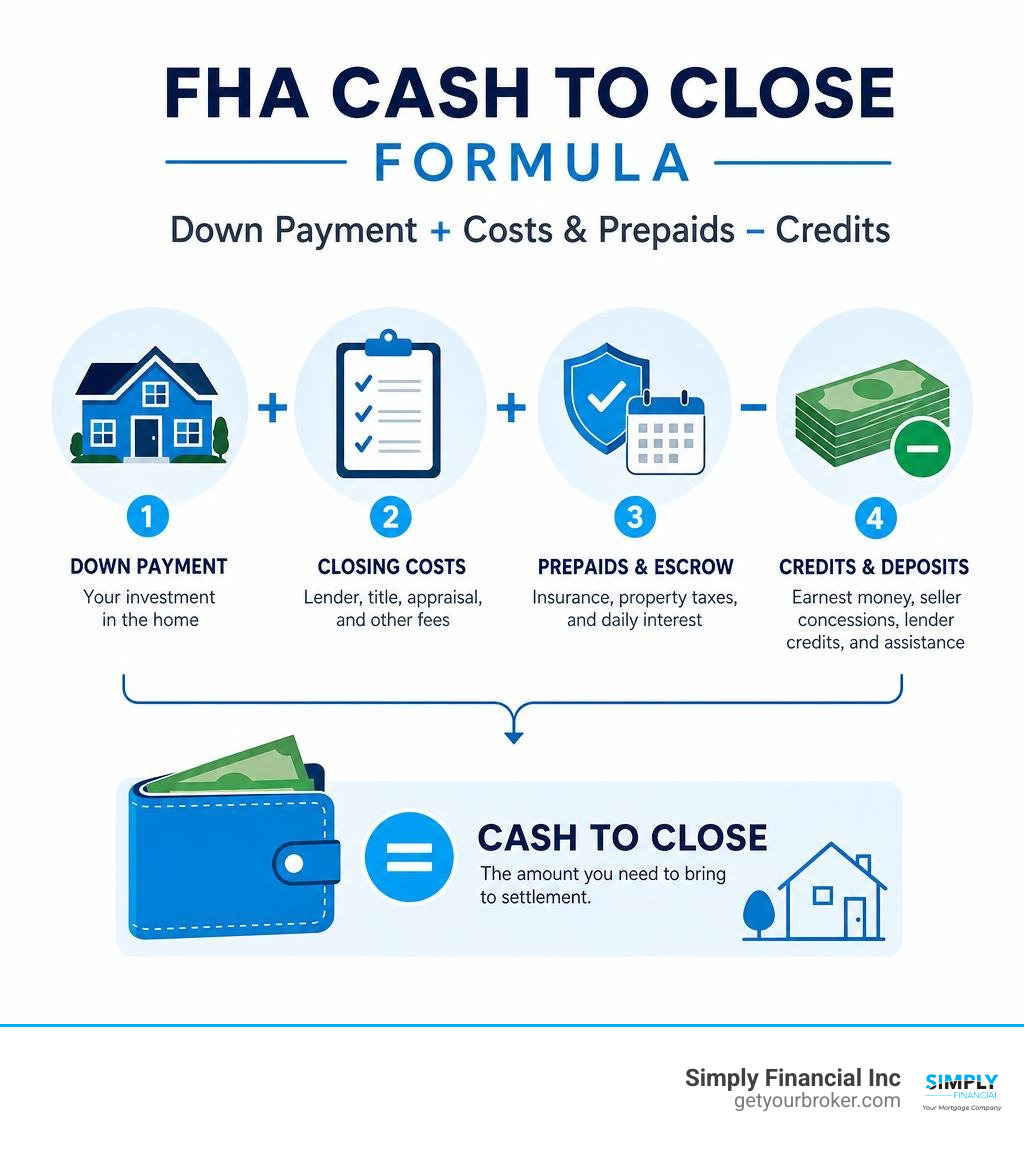
FHA cash to close is the final amount you need to bring to settlement after adding your down payment, closing costs, and prepaid expenses, then subtracting credits such as earnest money and seller-paid costs.
| Cash-to-close component | What it means |
|---|---|
| Down payment | Usually at least 3.5% of the home’s purchase price for an FHA loan |
| Closing costs | Lender, title, appraisal, and other transaction fees, often about 2% to 5% of the price |
| Prepaids and escrow | Upfront homeowners insurance, property taxes, and daily mortgage interest |
| Less credits and deposits | Earnest money, seller concessions, lender credits, and eligible assistance |
FHA closing costs and the down payment are not the same thing. Your down payment is your required investment in the home. Closing costs pay for the loan and purchase process. The FHA upfront mortgage insurance premium is 1.75% of the base loan amount, but many buyers finance it into the mortgage instead of paying it in cash at closing.
The exact number appears on your Closing Disclosure, which your lender must provide at least three business days before closing. Until then, a clear estimate helps you plan without last-minute stress.
I am Peter Babjak of Simply Financial Inc. After more than 18 years helping Chicago-area buyers navigate home loans, I help clients understand their fha cash to close early, so the final numbers are easier to review and prepare for.
Understanding FHA Cash to Close: Down Payment vs. Closing Costs
When buying a home with an FHA Loan, many first-time buyers confuse the down payment with the total cash required on closing day. However, under HUD 4000.1 rules (the official FHA Single-Family Housing Policy Handbook), closing costs paid at settlement do not count toward reducing your mandatory minimum down payment.
The minimum down payment for an FHA mortgage is 3.5% of the purchase price (assuming your credit score is 580 or higher). Meanwhile, closing costs are administrative, legal, and third-party fees charged to process your mortgage and transfer the title.
To determine your total fha cash to close, we calculate your net out-of-pocket obligation using a simple math equation:
Total Cash to Close = Minimum Down Payment + Gross Closing Costs + Prepaid Items & Escrow Reserves – (Earnest Money Deposit + Seller Concessions + Lender Credits + Assistance Grants)
Understanding these distinctions is essential for proper budgeting according to official FHA Loans and Cash-To-Close Guidelines. The table below demonstrates how these components combine on a sample $300,000 home purchase in Illinois or Florida:
| Expense Category | Percentage / Description | Sample Calculation ($300,000 Home Price) |
|---|---|---|
| Minimum Down Payment | 3.5% of purchase price | $10,500 |
| Estimated Closing Costs | 3.0% average (lender, title, appraisal) | $9,000 |
| Prepaid Escrow Items | Taxes, 1 yr hazard insurance, per diem interest | $3,500 |
| Gross Total Before Credits | Sum of down payment + costs + prepaids | $23,000 |
| Less Earnest Money Deposit | Paid upon initial contract acceptance | -$3,000 |
| Less Seller Concessions | Negotiated seller credit toward costs (3%) | -$9,000 |
| Net Cash to Close Required | Final amount wired or remitted at settlement | $11,000 |
Line-Item Breakdown of FHA Closing Expenses
Gross closing costs typically range between 2% and 5% of your home’s total purchase price. On an FHA transaction, these charges fall into three distinct categories: lender fees, third-party services, and prepaids.
- Lender Fees and Origination Charges: Lenders charge processing, underwriting, and origination fees to cover administration and loan evaluation. On FHA loans, origination fees must be fair, customary, and reasonable.
- Third-Party Services: These are services provided by independent entities that you or the lender order during escrow:
- Appraisal Fee: Pays a certified HUD-approved appraiser to verify the property’s market value and safety condition (typically $450 to $700).
- Credit Report & Automated Underwriting System (AUS) Fees: Actual costs incurred to pulled credit and process loan risk files.
- Title Search and Title Insurance: Title fees protect both lender and owner interests against ownership disputes or hidden liens. While title insurance isn’t strictly mandated by FHA regulations, lenders require a loan policy to convey clear, marketable title.
- Prepaid Expenses and Escrow Deposits: Prepaids are not traditional transaction fees, but rather advance payments for continuous homeownership costs. These include per diem daily mortgage interest calculated from closing day through the end of the month, a full 12-month hazard insurance policy premium paid upfront, and initial escrow reserves for upcoming county property taxes.
To review regional fee breakdowns, see our guide on FHA Loan Closing Costs Chicago.
How UFMIP Impacts Your FHA Cash to Close
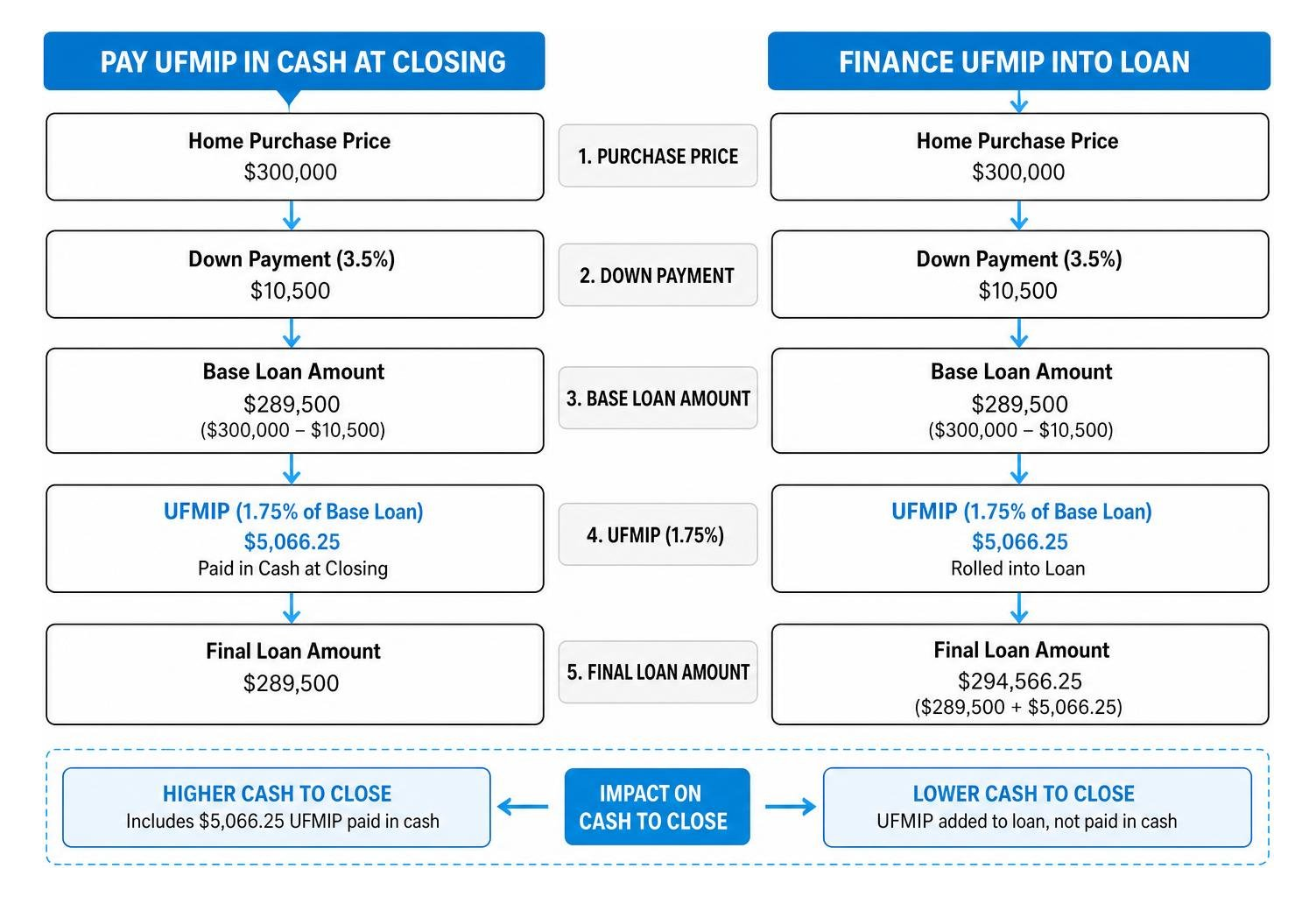
Every FHA loan includes a mandatory Up-Front Mortgage Insurance Premium (UFMIP) set at 1.75% of your base loan amount. For instance, if you purchase a home for $300,000 and make a 3.5% down payment ($10,500), your base loan amount is $289,500. The 1.75% UFMIP equals $5,066.25.
Borrowers have two options for handling the UFMIP:
- Pay UFMIP in Cash at Closing: Paying cash keeps your total loan principal lower, but directly increases your out-of-pocket fha cash to close by $5,066.25.
- Finance UFMIP into the Loan Principal: Over 95% of FHA borrowers choose to roll the 1.75% UFMIP into their final mortgage loan balance. Doing so increases your base loan amount to $294,566.25 ($289,500 base + $5,066.25 UFMIP).
Financing the UFMIP reduces your immediate out-of-pocket cash requirements on settlement day without altering your required 3.5% minimum down payment. You can read more about mortgage insurance structuring in the Bankrate FHA Closing Costs Guide.
How to Reduce Your Upfront Mortgage Costs

If your estimated fha cash to close figure seems daunting, there are several approved strategies under FHA guidelines to significantly lower your out-of-pocket expense before coming to the settlement table.
Utilizing Seller Concessions and Credits
One of the greatest advantages of an FHA mortgage is that HUD allows sellers to contribute up to 6% of the home’s purchase price toward buyer closing costs, prepaids, and discount points through seller concessions.
On a $300,000 purchase, a 6% seller concession equals up to $18,000 in closing assistance. However, there are two crucial rules governing seller credits:
- Closing Costs Only: Seller concessions can strictly cover allowable closing costs, prepaid escrow items, and discount points. Seller credits can never be applied toward the 3.5% minimum down payment.
- No Excess Cash Back: Seller contributions cannot exceed actual closing costs and prepaids. Any unused seller concessions revert to the seller; you cannot collect the difference as cash back.
Additionally, your initial earnest money deposit (the check written when signing the purchase agreement) is credited directly against your final cash to close total on page 3 of your Closing Disclosure.
Sourcing Gift Funds and Down Payment Assistance
If you lack sufficient liquid savings to cover both your 3.5% down payment and remaining closing fees, FHA rules allow 100% of your required cash at closing to come from allowable gift funds or down payment assistance (DPA) programs.
- Acceptable Gift Donors: Under HUD regulations, gift funds can be accepted from family members, close personal friends with a documented interest in the buyer, employers, labor unions, or charitable organizations. Donors cannot have any financial interest in the sale (sellers, real estate brokers, and builders are strictly prohibited from providing gift funds).
- Gift Letter Documentation: Every gift requires a signed gift letter specifying the dollar amount, donor contact information, relationship to the buyer, and a clear statement that no repayment is expected or implied.
- Down Payment Assistance Grants: State Housing Finance Agencies (HFAs), such as IHDA in Illinois or Florida Housing, provide local grants and second mortgages that assist first-time buyers with cash to close obligations.
- Prohibited Funding Sources: FHA guidelines strictly forbid using credit card cash advances, personal lines of credit, or payday loans to fund your down payment or closing costs.
For a complete breakdown of low-down-payment options and state grants, explore our Ultimate Low Down Payment Guide 2026.
Verifying and Transferring Funds for FHA Settlement
Mortgage lenders are required by federal anti-money laundering laws and HUD guidelines to verify that all money brought to settlement originates from acceptable, seasoned, and documented liquid assets.
When preparing for loan approval through the Chicago Mortgage Process, we examine your standard bank accounts (checking, savings, money market, or brokerage accounts) covering the most recent 60 consecutive days (two full bank statement cycles).
- Large Deposit Sourcing: A “large deposit” is defined as any single deposit that exceeds 50% of your total monthly gross qualifying income. Any large deposit appearing on your bank statements within the last 60 days must be fully documented with paper trails (e.g., bill of sale for a vehicle, tax refund check copy, insurance payout documentation). Unverified cash deposits (“mattress money”) cannot be used for fha cash to close.
Reading the Closing Disclosure and Understanding Fee Tolerances
At least three business days prior to your scheduled loan settlement, your lender must deliver your final Closing Disclosure (CD). Page 3 of the Closing Disclosure contains the official “Calculating Cash to Close” table, comparing your initial Loan Estimate (LE) costs to final settlement figures.
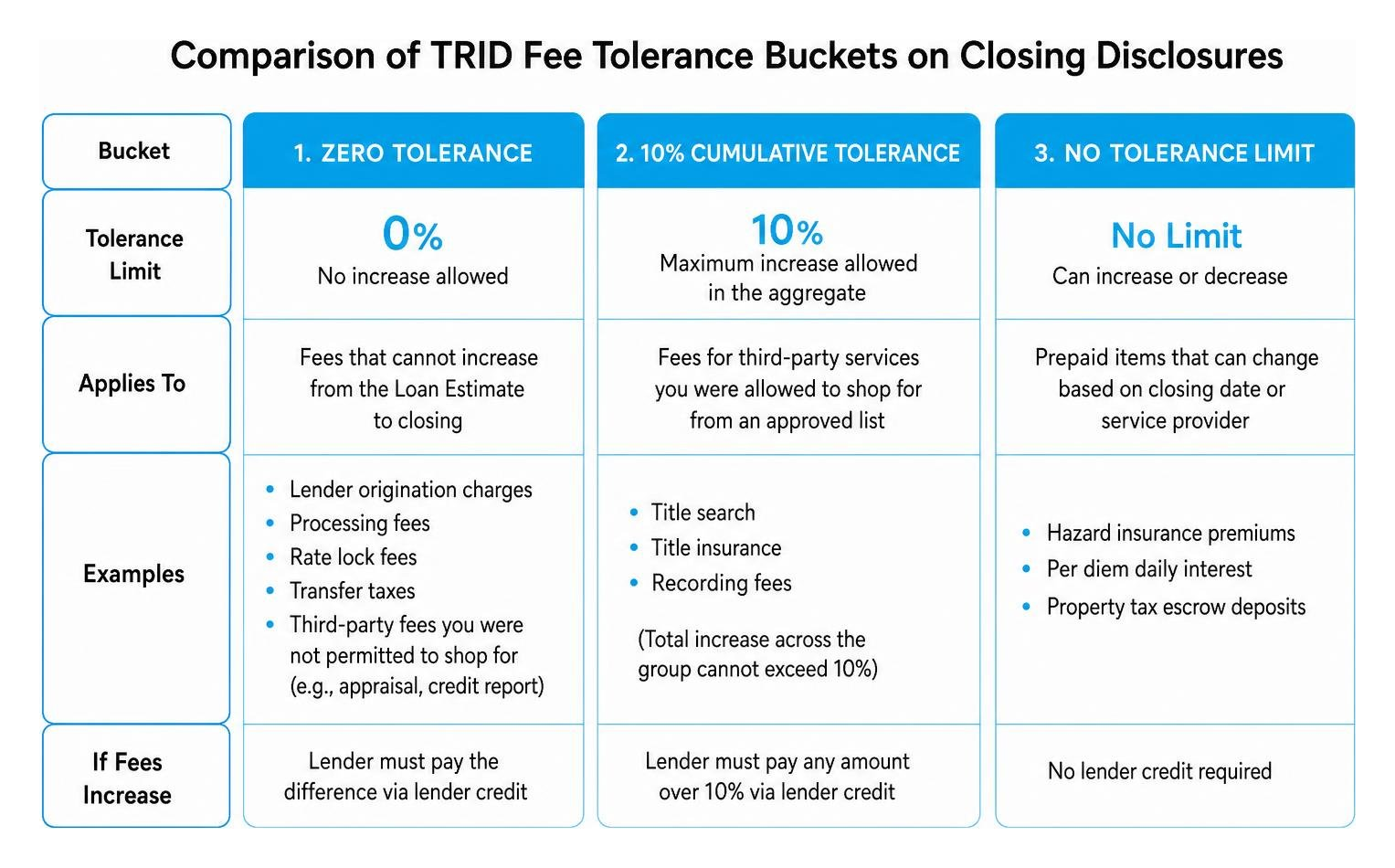
Federal rules under TRID and HUD Handbook 4155.2 Section 6.A protect borrowers by establishing strict fee tolerance thresholds that limit how much costs can increase:
- Zero Tolerance Bucket: Fees that cannot increase at all from the initial Loan Estimate to closing include lender origination charges, processing fees, rate lock fees, transfer taxes, and third-party fees for services you were not permitted to shop for (such as the appraisal and credit report). If these fees increase, the lender must pay the difference by issuing a lender credit.
- 10% Cumulative Tolerance Bucket: Fees for third-party services that you were allowed to shop for from an approved list (such as title search, title insurance, and recording fees) cannot increase by more than 10% in total aggregate across the entire group.
- No Tolerance Limit: Prepaid items (hazard insurance, per diem daily interest, property tax escrow deposits) can change based on the closing date or chosen insurance carrier without statutory limits.
Safe Payment Methods to Avoid Wire Fraud on Your FHA Cash to Close
On closing day, you must deliver your exact fha cash to close funds to the title company or settlement agent. Standard personal checks, cash, and credit cards are never accepted for closing balances.
Acceptable payment methods usually include:
- Bank Wire Transfer: Direct electronic funds transfer from your bank to the title company’s escrow trust account (recommended for speed and reliability).
- Cashier’s Check: An official bank-issued check drawn against bank funds for amounts up to local title company thresholds.
Wire Fraud Prevention Rules
Real estate wire fraud is a serious industry risk. Criminals attempt to hack email communications and send fake wiring instructions with fraudulent account details. Protect your funds by following these mandatory steps:
- Independent Phone Verification: Before initiating any wire transfer with your bank, call your title company or settlement officer using an independently verified telephone number (obtained from their official website, not from an unverified email signature).
- Confirm Details Line-by-Line: Verbally verify the routing number, escrow account number, and beneficiary account name over the phone before authorizing your bank to release funds.
- Obtain Federal Reference Number: Immediately after authorizing a wire, request the Federal Reference Number (Fed Number) from your bank to track and confirm receipt with your settlement agent.
Frequently Asked Questions About FHA Closing Costs
Can FHA closing costs be rolled into the mortgage loan?
Unlike the 1.75% Up-Front Mortgage Insurance Premium (UFMIP), standard third-party closing costs and prepaid expenses cannot be directly added onto your base mortgage loan balance on a purchase transaction. However, you can offset closing costs by negotiating up to 6% in seller concessions or choosing a slightly higher interest rate in exchange for a lender credit applied directly toward your settlement fees. On FHA rate-and-term or cash-out refinances, allowable closing costs can be rolled into the new loan balance provided loan-to-value limits are met.
How is earnest money credited toward my cash to close?
Your earnest money deposit—the initial good-faith deposit paid when your sales contract is accepted—is placed in an escrow trust account. At closing, the full amount of your earnest money deposit is listed on Page 3 of your Closing Disclosure as an upfront credit. It directly reduces the remaining cash balance you must wire on closing day dollar-for-dollar.
What documents are required to prove my cash to close source?
To satisfy FHA underwriting and anti-money laundering standards, you must provide:
- Two consecutive months of complete official bank statements (all pages included).
- Fully executed gift letters and donor bank transfer receipts if using gift funds.
- Documented proof of origin for any single deposit exceeding 50% of your gross monthly qualifying income.
- Copies of canceled earnest money checks accompanied by corresponding bank statements showing the funds cleared your account.
Conclusion: Planning Your FHA Home Purchase
Accurately calculating and preparing your fha cash to close prevents unexpected financial delays and ensures a seamless homebuying experience. By separating your required 3.5% down payment from closing fees, leveraging up to 6% in allowable seller concessions, utilizing eligible gift funds, and verifying fee tolerances on your Closing Disclosure, you can navigate your closing day with complete confidence.
At Simply Financial Inc, our goal is to deliver a transparent, expert-guided, and stress-free mortgage experience across Illinois and Florida. If you are ready to review your loan options or build a custom closing budget, Explore FHA Chicago Mortgage Options with our experienced team today!