

What Is an FHA Home Loan? (Quick Answer)
An fha home loan is a mortgage backed by the Federal Housing Administration that lets you buy a home with a lower credit score and a smaller down payment than most conventional loans require.
Here’s what you need to know at a glance:
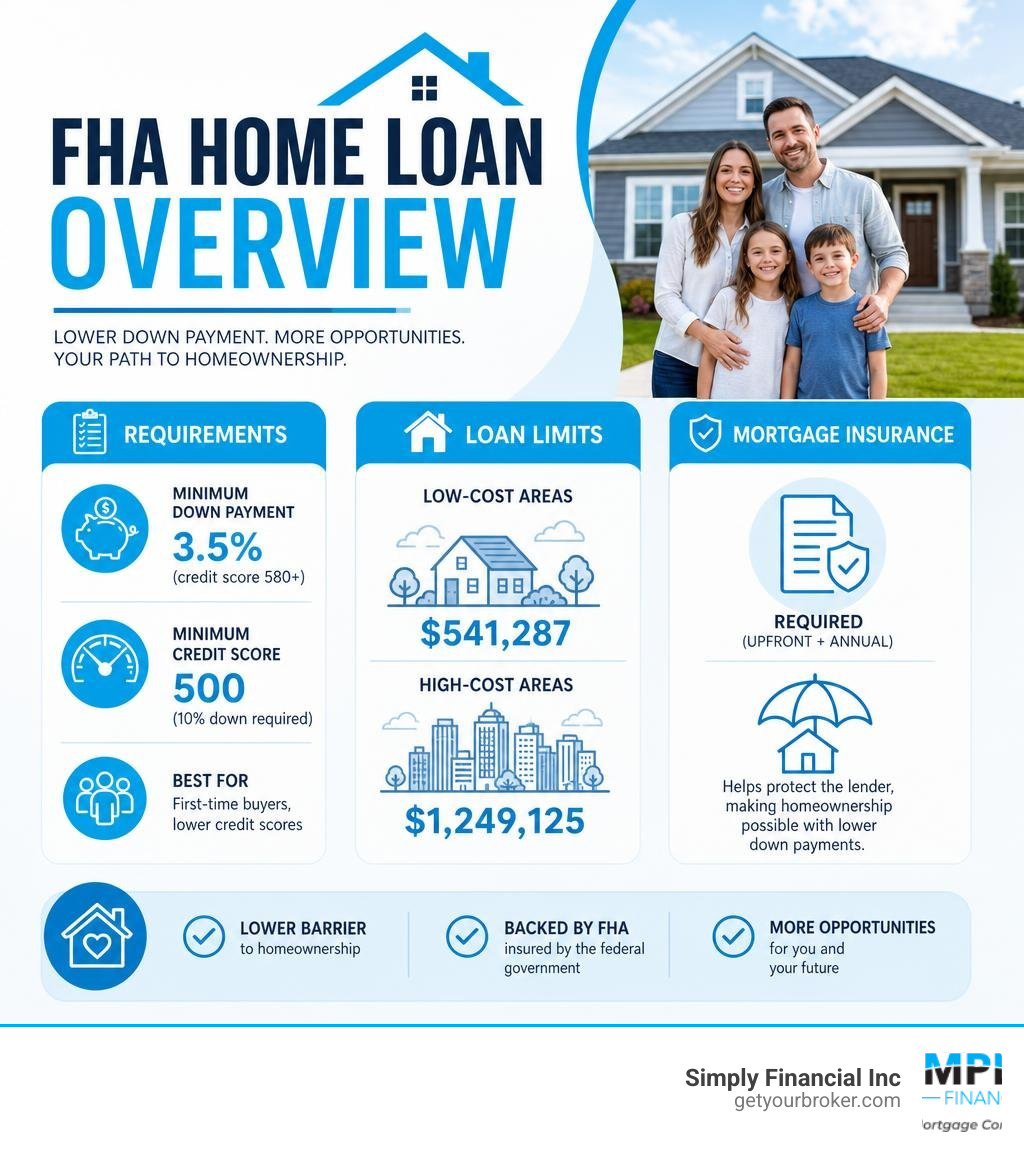
| Feature | FHA Loan |
|---|---|
| Minimum down payment | 3.5% (credit score 580+) |
| Minimum credit score | 500 (10% down required) |
| Max loan limit (low-cost areas) | $541,287 |
| Max loan limit (high-cost areas) | $1,249,125 |
| Mortgage insurance | Required (upfront + annual) |
| Best for | First-time buyers, lower credit scores |
Buying a home is one of the biggest financial steps you’ll ever take. But for many people, the two biggest roadblocks are the same: not enough saved for a down payment and a credit score that isn’t perfect.
That’s exactly the gap FHA loans were designed to fill. Since 1934, the Federal Housing Administration has helped millions of Americans become homeowners by insuring loans — which means lenders take on less risk and can offer you better terms, even if your finances aren’t flawless.
Whether you’re buying your first home or working through past credit challenges, understanding how FHA loans work can open doors you didn’t know were available to you.
I’m Peter Babjak, founder of Simply Financial Inc and a Chicago-based mortgage broker with over 18 years of experience helping homebuyers navigate the fha home loan process from pre-qualification to closing. In this guide, I’ll walk you through everything you need to know — clearly and without the jargon.
What is an FHA Home Loan and How Does It Work?
An fha home loan is not actually issued by the government. Instead, it is a mortgage provided by private, FHA-approved lenders—like us at Simply Financial Inc—and backed by the Federal Housing Administration (FHA), which is a part of the U.S. Department of Housing and Urban Development (HUD).
Because the federal government insures these loans against default, lenders are protected if a borrower falls behind on payments. This safety net allows mortgage brokers and banks to offer more lenient qualification requirements, lower down payments, and highly competitive interest rates.
FHA loans are primarily designed for owner-occupied, single-family homes and multi-unit residential properties (up to four units), provided you plan to live in one of the units as your primary residence. You can learn more about how the federal government supports these programs on the official Loans | HUD.gov portal, or explore our specialized resources on the FHA Loan page.
History of the FHA Program
To truly appreciate the fha home loan, it helps to look back at its origins. The Federal Housing Administration was established in 1934 during the height of the Great Depression. At that time, the American housing market was in ruins. Homeownership was a luxury reserved for the wealthy; typical mortgages required down payments of up to 50% and had short terms of just five to ten years, ending with a massive balloon payment.
The FHA revolutionized the industry by introducing long-term, fully amortizing mortgages with low down payments. Over the decades, the program was integrated into HUD and became the bedrock of single-family mortgage insurance in the United States, helping millions of families build generational wealth.
FHA vs. Conventional Mortgages
When deciding on a mortgage, the choice often comes down to an FHA loan versus a conventional loan (which is not backed by the government but rather guaranteed by Fannie Mae or Freddie Mac).
Here is a side-by-side comparison to help you understand the differences:
| Feature | FHA Loan | Conventional Loan |
|---|---|---|
| Minimum Credit Score | 500 (with 10% down) or 580 (with 3.5% down) | Typically 620 |
| Minimum Down Payment | 3.5% | 3% (for highly qualified first-time buyers) or 5% |
| Debt-to-Income (DTI) Limit | Up to 43% (sometimes higher with compensating factors) | Typically 43% to 45% |
| Mortgage Insurance | Required for all loans (upfront and annual) | Required only if down payment is under 20% |
| Property Standards | Strict HUD guidelines focusing on safety and soundness | Standard appraisal guidelines |
While conventional loans are excellent for buyers with strong credit scores and larger down payments, FHA loans offer unmatched down payment flexibility and credit requirements for buyers who need a bit of breathing room. You can compare all of your financing pathways in detail through our comprehensive guide to Mortgage Loan Options.
Core Eligibility Requirements for Borrowers

Qualifying for an fha home loan is generally much easier than qualifying for a conventional mortgage, but you still must meet several baseline financial standards. Lenders will evaluate your credit history, employment stability, debt load, and down payment sources.
Credit Score and Down Payment Rules
The FHA utilizes a tiered system that connects your credit score directly to your minimum down payment requirement:
- Credit Score of 580 or Higher: You qualify for the maximum financing option, which requires a down payment of just 3.5%.
- Credit Score of 500 to 579: You can still qualify for an FHA loan, but you must make a down payment of at least 10%.
If your score is below 500, you will not be eligible for FHA financing. However, because FHA rates remain remarkably stable even for lower credit tiers, you can secure an affordable monthly payment once you cross the 580 threshold. Check out the Current Mortgage Rates for FHA Loans to see how your credit score might impact your potential interest rate.
Depending on where you live, state-level guidelines and local programs can also influence your loan journey. Whether you are shopping for a home in Florida or buying in Illinois, understanding the local requirements can help you prepare for a successful closing.
Debt-to-Income (DTI) Ratio Limits
Your Debt-to-Income (DTI) ratio compares your recurring monthly debt payments against your gross monthly income.
There are two ratios lenders look at:
- Front-End Ratio (Housing DTI): The percentage of your gross income that goes toward your future mortgage payment (including principal, interest, taxes, home insurance, and mortgage insurance). This should ideally be under 31%.
- Back-End Ratio (Total DTI): The percentage of your gross income that goes toward all recurring monthly debts (mortgage, car loans, student loans, credit cards, etc.). The standard FHA limit is 43%.
But the FHA is known for its student debt flexibility and willingness to accept higher DTI limits—sometimes up to 50% or more—if you have strong “compensating factors.” These factors include having a large cash reserve after closing, a minimal increase in your monthly housing payment (low payment shock), or a strong secondary income stream that isn’t officially counted in the loan application.
FHA Loan Limits and Property Standards in 2026

Because FHA loans are designed to support affordable housing, HUD places limits on the maximum amount you can borrow. These limits are updated annually and vary widely by county to account for local real estate markets.
2026 FHA Home Loan Limits by Location
For the year 2026, the FHA has established the following baseline loan limits for one-unit properties:
- Low-Cost Areas (Floor): The maximum loan limit is $541,287.
- High-Cost Areas (Ceiling): In expensive markets, the limit climbs up to $1,249,125.
If you are looking to purchase in Illinois, local limits will depend heavily on your specific county. For example, buyers in Chicago will find that the limits accommodate the competitive Cook County market. You can search for limits in any U.S. county directly via the official FHA and Housing Resources | HUD.gov portal.
HUD Property Condition and Appraisal Standards
To qualify for an fha home loan, the property you buy must meet strict safety, security, and soundness standards. During the buying process, an FHA-approved appraiser will visit the home to perform a dual-purpose valuation: they will determine the market value of the property and perform a basic safety inspection.
Unlike a standard conventional appraisal, the FHA appraisal looks closely at specific quality-of-life and safety items, such as:
- No peeling or chipping lead-based paint (especially in homes built before 1978).
- Fully functional heating, electrical, and plumbing systems.
- A structurally sound roof that does not leak and has at least two years of remaining life.
- Proper ventilation in crawlspaces and attics.
- No active pest infestations or structural damage.
If the appraiser identifies any safety hazards, these issues must be repaired before the loan can close. It is highly recommended that you still order an independent, comprehensive home inspection, as an FHA appraisal is not a guarantee of a home’s perfect health—it is simply a check to ensure the property meets basic HUD standards.
Understanding FHA Mortgage Insurance (UFMIP and MIP)
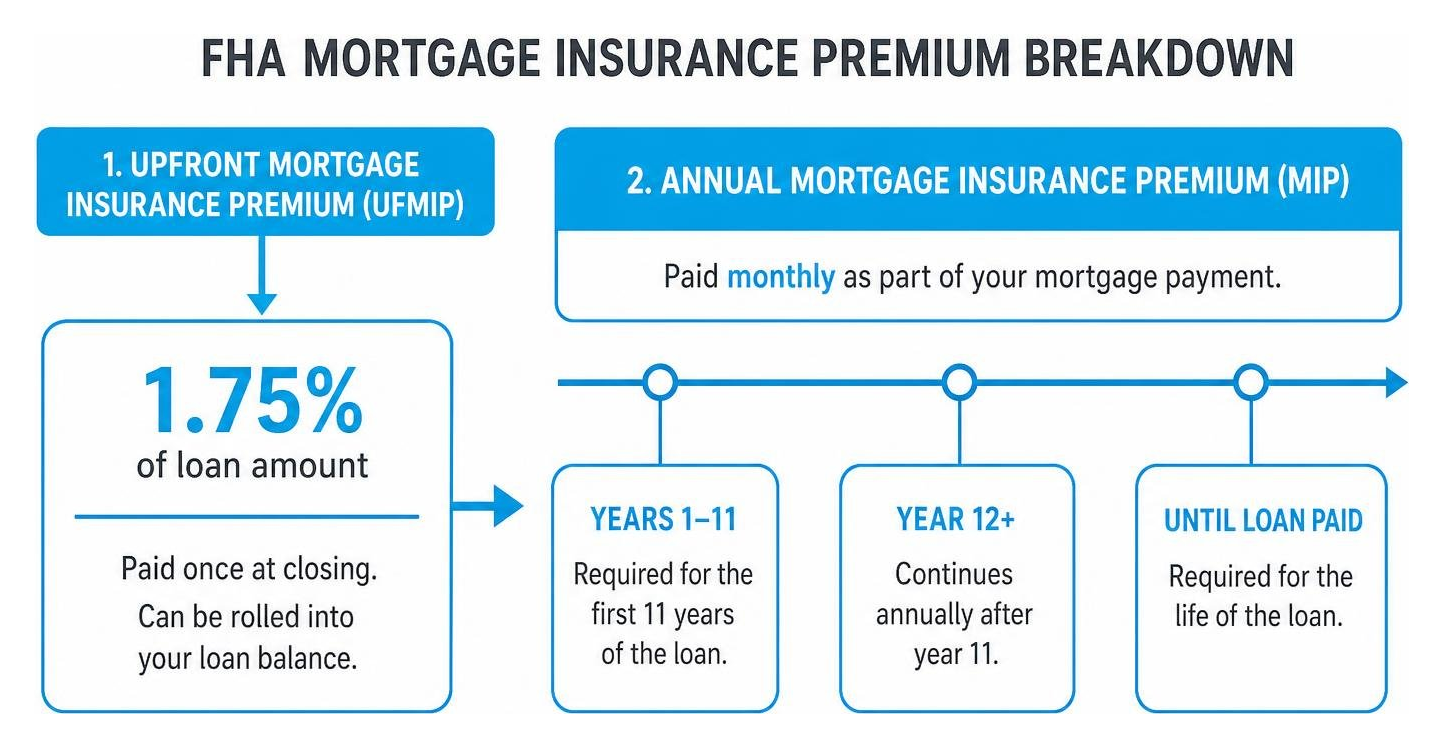
Because FHA loans allow for low down payments and relaxed credit requirements, the FHA requires borrowers to pay mortgage insurance. This insurance protects the lender if you default on your loan. FHA mortgage insurance consists of two separate parts.
Upfront Mortgage Insurance Premium (UFMIP)
The Upfront Mortgage Insurance Premium (UFMIP) is equal to 1.75% of your total loan amount.
For example, if you borrow $300,000, your UFMIP will be $5,250. You do not have to pay this out of pocket at closing; the FHA allows you to roll this entire fee directly into your loan balance, though doing so will slightly increase your monthly payment and overall loan amount.
Annual Mortgage Insurance Premium (MIP) Duration
In addition to the upfront premium, you will pay an annual Mortgage Insurance Premium (MIP). This premium is divided by 12 and added to your monthly mortgage payment. For most borrowers, the annual MIP ranges from 0.45% to 1.05% of the loan amount, depending on the loan size, your down payment, and the term of your loan (15 vs. 30 years).
How long do you have to pay this monthly insurance? It depends on your initial down payment:
- Down Payment of Less Than 10%: You must pay the annual MIP for the entire life of the loan. The only way to get rid of it is to refinance into a conventional loan once you have built up 20% equity in your home.
- Down Payment of 10% or More: The annual MIP will automatically drop off after 11 years.
Types of FHA Loans Available to Buyers
The FHA program is highly versatile, offering several specialized loan products designed to meet different homebuying, renovating, and refinancing goals. If you’re looking for advanced strategies, you can also read our FHA Investment Property Loan Guide 2026.
FHA Purchase and 203(k) Renovation Loans
The standard FHA purchase loan is the go-to option for buying a move-in ready home. But what if you find a property in a great neighborhood that needs major repairs?
That’s where the FHA 203(k) Renovation Loan comes in. This program allows you to purchase a fixer-upper and roll the costs of repairs, structural upgrades, and cosmetic renovations directly into a single, convenient mortgage. This saves you from having to take out high-interest personal loans or credit cards to fund construction after closing.
FHA Streamline Refinance and Cash-Out Options
If you already have an FHA loan, refinancing can help you lower your interest rate or tap into your equity:
- FHA Streamline Refinance: This is one of the fastest refinance options in the industry. It requires minimal paperwork, no income verification, no credit check, and usually no appraisal. To qualify, you must have a history of on-time mortgage payments (no 30-day late payments in the last 6 months) and have held your current loan for at least 210 days.
- FHA Cash-Out Refinance: This option allows you to refinance your existing mortgage and pull out cash from your accumulated home equity to pay off high-interest debt, fund home improvements, or cover major life expenses.
Special Programs for Seniors and Manufactured Homes
The FHA also provides unique safety nets and housing solutions for specific groups:
- Home Equity Conversion Mortgage (HECM): This is the FHA’s reverse mortgage program. It allows seniors aged 62 or older who own their homes outright (or have substantial equity) to convert a portion of their equity into tax-free cash, helping them cover retirement and living costs without monthly mortgage payments.
- Manufactured and Mobile Home Loans: The FHA provides financing options for factory-built housing, including programs for homes situated in mobile home parks as well as those permanently attached to land you own.
How to Apply and Find Local Assistance
Applying for an fha home loan is a straightforward process, but working with an experienced local broker makes all the difference in ensuring a seamless, stress-free transaction.
Step-by-Step Guide to Applying for an FHA Home Loan
- Gather Your Financial Documentation: Before reaching out to a lender, organize your proof of income and assets. You will typically need:
- Your two most recent federal tax returns and W-2 forms.
- Your last 30 days of consecutive pay stubs.
- Your last two months of bank statements showing the source of your down payment.
- A valid government-issued ID.
- Get Pre-Approved: Contact us to review your financial profile. You can easily start the process online via our Pre-Qualify Chicago Mortgage Pre-Approval form.
- Shop for a Home: Once you have your pre-approval letter in hand, you can confidently shop for homes within your budget. If you are looking in the Chicago area, you can search for eligible properties using resources like Fha Approved – Chicago IL Real Estate – 89 Homes For Sale | Zillow to find homes that are ready for FHA financing.
- Complete the Appraisal and Underwriting: Once your offer is accepted, we will order the FHA appraisal and submit your complete file to underwriting for final approval.
- Close on Your Home: Sign your final loan documents, pay your remaining closing costs, and get your keys!
State and Local Down Payment Assistance Programs
You do not have to save up your entire down payment alone. State housing finance agencies offer down payment assistance (DPA) programs that can be combined with an FHA loan, often in the form of forgivable grants or low-interest second mortgages.
- Illinois Buyers: The Illinois Housing Development Authority (IHDA) offers excellent programs that provide thousands of dollars in down payment assistance. Learn how to secure these funds by visiting the guide on Getting An IHDA Loan .
- Florida Buyers: The Florida Housing Finance Corporation offers similar first-time homebuyer grants and down payment assistance programs that pair perfectly with FHA loans to minimize your out-of-pocket costs at closing.
Frequently Asked Questions about FHA Loans
Can I use an FHA loan to buy an investment property?
Yes, but with an important catch: the property must serve as your primary residence. You cannot use an FHA loan to buy a pure investment property that you plan to rent out while living elsewhere. However, you can buy a multi-family property (up to 4 units), live in one of the units, and rent out the other 3 to cover your mortgage payment. This strategy is commonly known as “house hacking.”
How long do I have to pay FHA mortgage insurance?
If you put down less than 10%, you will pay annual mortgage insurance for the entire life of the loan. If you put down 10% or more, the mortgage insurance will be removed automatically after 11 years. That you can refinance your FHA loan into a conventional loan once your home’s value rises and you reach 20% equity, which will eliminate your monthly mortgage insurance entirely.
Is it harder to qualify for an FHA loan than a conventional loan?
Generally, no. It is actually much easier to qualify for an FHA loan from a credit and income perspective. The only area where FHA loans are slightly stricter is the property appraisal, as HUD requires the home to meet specific safety and structural integrity standards before the loan can close.
Conclusion
The fha home loan remains one of the most powerful and accessible financial tools for making homeownership a reality. Whether you are a first-time buyer in Chicago, looking to settle down in the suburbs of Illinois, or purchasing a home in Florida, the FHA program offers the flexibility, low down payments, and competitive rates you need to achieve your goals.
At Simply Financial Inc, we believe that securing a mortgage shouldn’t be a stressful, confusing process. Our team is dedicated to providing an expert-guided, seamless, and completely stress-free experience from your first phone call to the day you receive your keys.
Ready to take the first step toward your new home? Let’s discuss your options. Visit our FHA Loan Chicago page, stop by our Chicago office located at 5632 W Lawrence Ave Chicago IL, or contact us today to get pre-approved!