

FHA Home Loans Rates: A Quick 2026 Overview
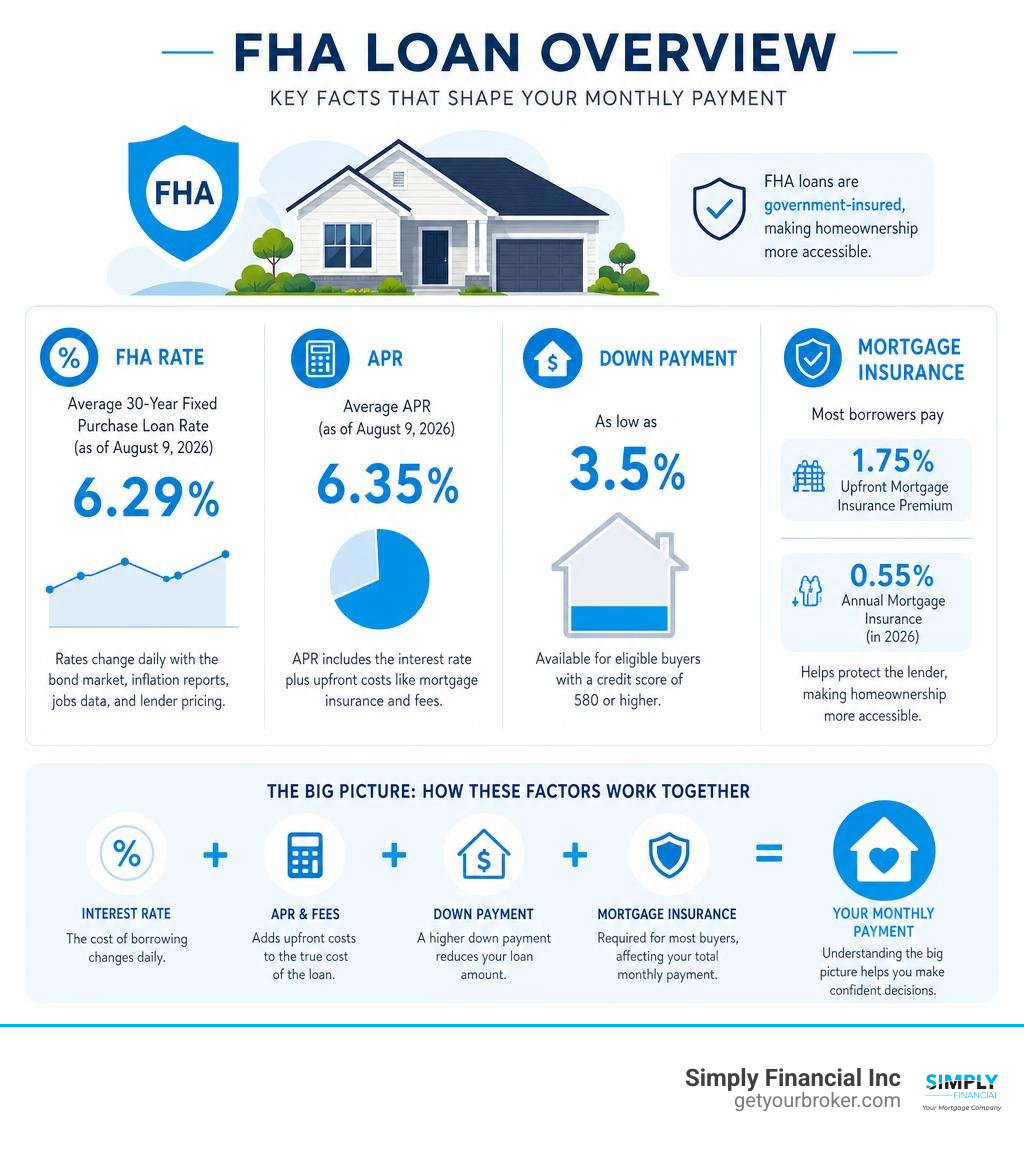
FHA home loans rates average about 6.29% for a 30-year fixed purchase loan as of August 9, 2026, with an average APR of 6.35%. FHA rates can be lower than conventional mortgage rates because the loan is government-insured, but FHA mortgage insurance can make the total cost higher.
| Loan type | Average 30-year fixed rate | What to know |
|---|---|---|
| FHA purchase loan | 6.29% | Lower down payment and flexible credit rules, but mortgage insurance applies |
| Conventional loan | About 6.56% | May cost less over time for buyers with strong credit and enough equity |
| VA loan | About 6.08% | Often the lowest rate option for eligible veterans and service members |
Rates change daily with the bond market, inflation reports, jobs data, and lender pricing. Your own offer will also depend on your credit score, down payment, debt-to-income ratio, loan amount, property location, and whether you pay discount points.
An FHA loan may let eligible buyers purchase with as little as 3.5% down with a credit score of 580 or higher. But it is important to look past the advertised rate: most borrowers also pay a 1.75% upfront mortgage insurance premium and annual mortgage insurance, commonly 0.55% in 2026.
I am Peter Babjak, and through Simply Financial Inc, I have helped Chicago-area buyers and homeowners navigate fha home loans rates, refinancing, and pre-qualification since 2007. In this guide, I will break down the rate, qualification rules, insurance costs, and practical choices that shape what an FHA loan really costs.
Understanding FHA Home Loans Rates and How They Work
To make sense of fha home loans rates, it helps to understand how the broader mortgage market determines interest rates every single day. Mortgage interest rates do not move in a vacuum, nor are they set directly by the Federal Reserve. Instead, mortgage pricing is tied directly to mortgage-backed securities (MBS) and benchmark 10-year Treasury yields.
When macroeconomic indicators shift—such as monthly Consumer Price Index (CPI) releases or monthly non-farm payroll reports—bond market investors re-evaluate economic growth and inflation expectations. If a jobs report comes in weaker than expected, bond markets often rally. Higher demand for bonds drives bond prices up and yields down, which typically pushes mortgage rates lower. Conversely, persistent inflation erodes bond yields, causing mortgage rates to tick upward.
Because Federal Housing Administration (FHA) loans carry an explicit guarantee from the federal government, mortgage-backed securities backed by FHA mortgages present minimal default risk to secondary market investors. This government backing allows lenders to offer lower headline benchmark interest rates on FHA financing than on conventional loans with similar risk parameters.
How Current FHA Home Loans Rates Compare to Conventional Mortgages
When comparing borrowing options, many home buyers notice that FHA baseline rates sit below conventional fixed mortgage rates. In August 2026, average 30-year fixed FHA rates trade around 6.29% (with standard weekly variations between 6.02% and 6.43%), whereas conventional 30-year fixed mortgages average approximately 6.56%.
To understand these figures in real-time, you can check Mortgage Rates Today, August 10, 2026 alongside our dedicated portal for Current Mortgage Rates for FHA Loans.
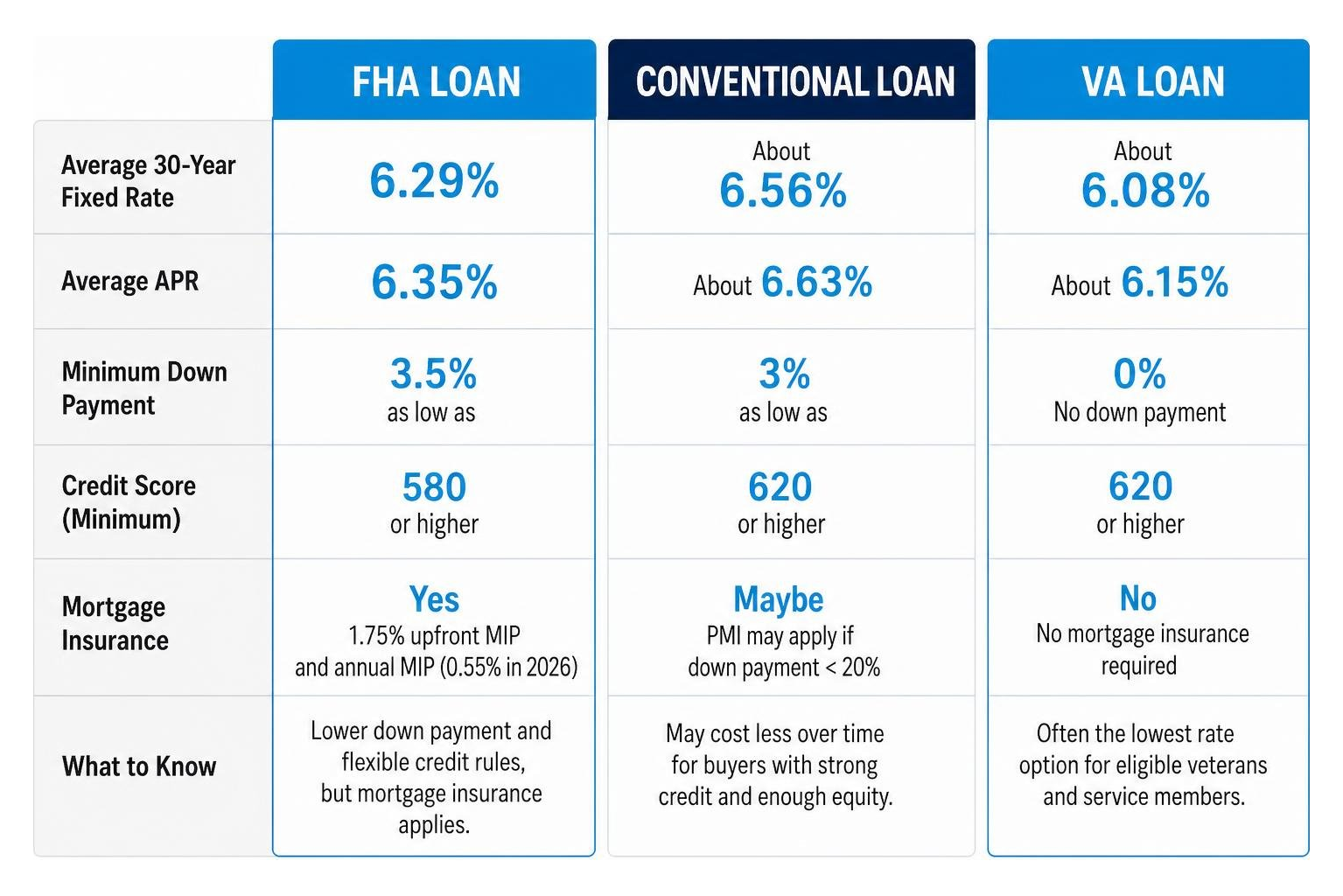
Below is a breakdown comparing standard 30-year mortgage products in 2026:
| Feature / Term | FHA 30-Year Fixed | Conventional 30-Year Fixed | VA 30-Year Fixed |
|---|---|---|---|
| Average Interest Rate | 6.29% | 6.56% | 6.08% |
| Typical Average APR | 6.35% – 6.77% | 6.60% | 6.31% |
| Minimum Down Payment | 3.5% (580+ credit) | 3% to 5% | 0% |
| Upfront Mortgage Insurance | 1.75% UFMIP | None | Funding fee (1.25% – 3.3%) |
| Ongoing Mortgage Insurance | 0.55% annual MIP | Private MI (cancelable) | None |
| Max Debt-to-Income (DTI) | 50% strict lender cap | 45% – 50% | Flexible with strong automated underwriting |
While the headline rate on an FHA loan is consistently lower, conventional loans often prove less expensive over the long run for buyers who can make larger down payments, because private mortgage insurance (PMI) drops off once you achieve 20% equity.
Interest Rate vs APR in FHA Loans
One of the most frequent points of confusion for prospective homebuyers is the difference between the note interest rate and the Annual Percentage Rate (APR).
- Interest Rate (Note Rate): The percentage charge applied to your principal balance each month to calculate your monthly interest charge.
- Annual Percentage Rate (APR): The broader calculation reflecting the total annualized cost of borrowing, including the baseline interest rate, lender origination fees, discount points, and required upfront and ongoing FHA mortgage insurance premiums.
Because FHA loans require a mandatory 1.75% Upfront Mortgage Insurance Premium (UFMIP)—which is generally financed directly into your base loan balance—the APR on an FHA loan can be significantly higher than its advertised headline interest rate. For instance, an FHA loan quoted at a 6.02% headline rate might feature an APR of 6.77% once all insurance premiums and origination costs are factored in. When shopping across multiple lenders, always compare loan quotes using the APR to accurately evaluate the total cost of credit.
Key Factors Affecting FHA Loan Costs and Mortgage Insurance
Understanding the true price tag of an FHA mortgage requires looking beyond standard principal and interest payments. FHA loans feature a distinct two-part mortgage insurance structure designed to protect lenders against loan defaults.
- Upfront Mortgage Insurance Premium (UFMIP): Set at 1.75% of the base loan amount for standard purchases in 2026. On a $300,000 baseline mortgage, this adds an immediate $5,250 fee. While this fee can be paid in cash at closing, nearly all borrowers choose to roll it into their total loan balance, bringing the starting loan amount to $305,250.
- Annual Mortgage Insurance Premium (MIP): Paid in monthly installments as part of your overall escrow payment. For standard 30-year purchase loans with a 3.5% down payment, the annual MIP rate in 2026 is 0.55% of the outstanding loan balance. On a $300,000 base loan, this amounts to roughly $1,650 annually, or $137.50 per month.
For detailed guidelines on mortgage insurance rules and closing charges, review the comprehensive guide on FHA Loan Requirements and Rates 2026 as well as our localized overview of FHA Loan Closing Costs Chicago.
Unlike conventional private mortgage insurance, which can be removed when you pay down your loan to 80% of the home’s value, FHA annual MIP stays active for the entire 30-year term if you put down less than 10%. If you make a down payment of 10% or more at closing, annual MIP drops off after 11 years.
FHA Loan Requirements and Eligibility Criteria
While FHA loan rules are known for flexibility, qualification standards in 2026 have adapted to shifting economic conditions. Here is what we evaluate when qualifying borrowers:
- Credit Score Minimums: The official FHA floor is a 500 FICO score with a 10% down payment. However, to qualify for the popular 3.5% low down payment tier, you must have a credit score of 580 or higher. The median FHA borrower credit score currently sits at 642.
- Debt-to-Income (DTI) Ratios: FHA guidelines previously allowed automated underwriting exceptions for DTI ratios up to 57%. In 2026, most lenders enforce a strict cap of 50% back-end DTI. This means your total monthly obligations—including house payment, credit cards, auto loans, and student loans—cannot exceed 50% of your gross monthly income.
- Cash Reserves: Most FHA lenders now require verified cash liquid reserves equal to at least 2 months of mortgage payments sitting in your bank account after closing costs and down payments are covered.
- Waiting Periods After Financial Hardships:
- Chapter 7 Bankruptcy: 2-year waiting period from discharge date.
- Chapter 13 Bankruptcy: 1-year waiting period with documented, satisfactory plan payments and court approval.
- Foreclosure: 3-year waiting period from the date the foreclosure sale was completed.
To explore exact underwriting parameters for buyers in Illinois and Florida, see our complete FHA Home Loan Guide 2026.
FHA Property Limits and Appraisal Requirements
FHA loans are intended primarily for owner-occupied, primary residences. You cannot utilize standard FHA financing to acquire pure real estate investment properties or non-occupant vacation homes. However, you can buy a multi-unit property (up to 4 units) with an FHA loan as long as you live in one of the units as your primary residence.
For detailed strategies on utilizing FHA financing for multi-family real estate, check out our insights on FHA 203k Loan Multifamily and the FHA Investment Property Loan Guide 2026.
FHA lending limits are established yearly based on regional housing price indices:
- Standard Low-Cost County Limits: The baseline single-family FHA loan limit floor in standard-cost markets sits at $498,257.
- High-Cost Area Ceilings: In high-cost housing markets, single-family limits extend up to $1,149,825.
- Multi-Unit Caps: Limits increase significantly for 2-unit, 3-unit, and 4-unit residential properties.
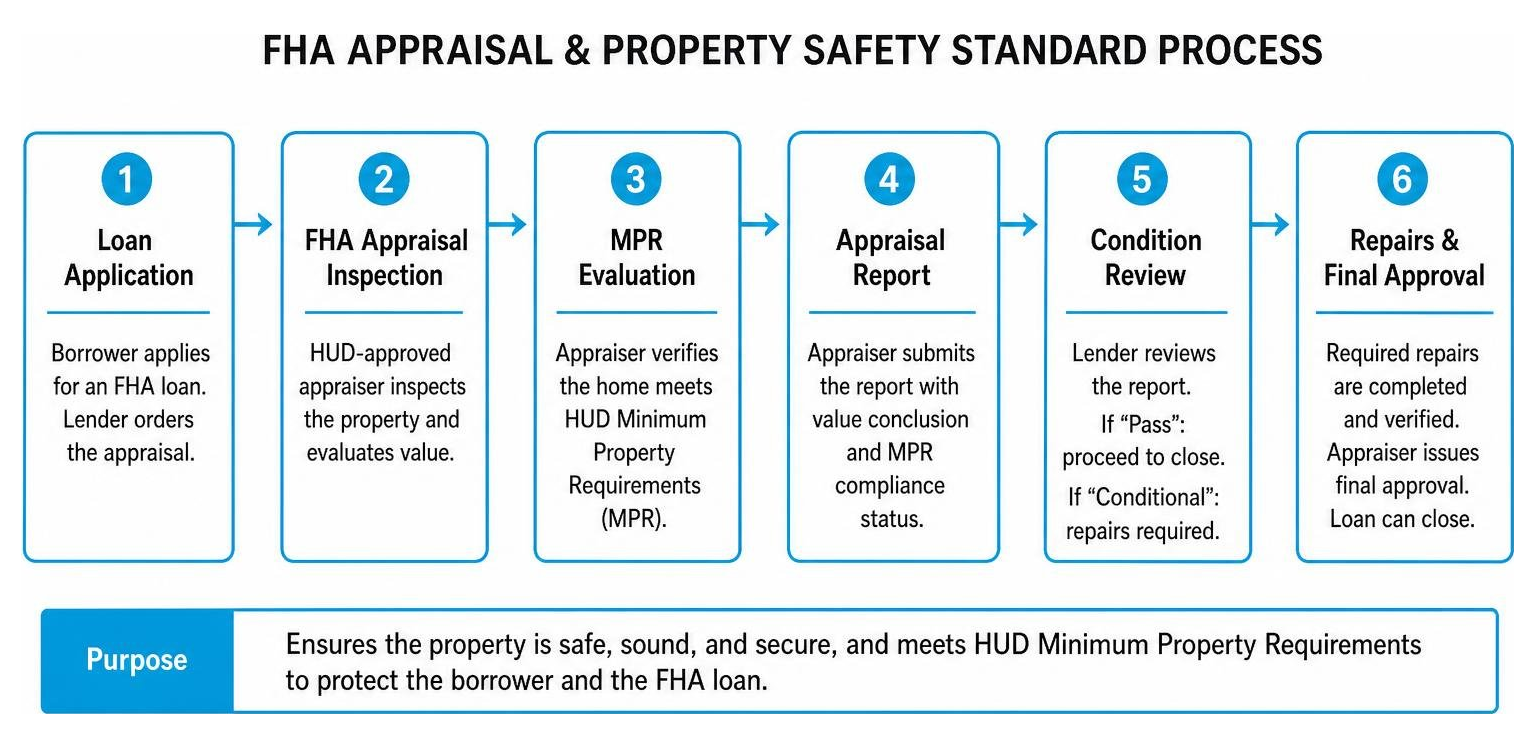
FHA property appraisal guidelines prioritize buyer safety and structural integrity. Property appraisers verify that homes meet HUD Minimum Property Requirements (MPR). In 2026, roughly 22% of FHA appraisal inspections result in “conditional” notices, requiring sellers or buyers to complete specific repairs—such as peeling paint remediation, roof repairs, or electrical updates—prior to final loan closing.
Pros, Cons, and Refinancing Options for FHA Borrowers
Before committing to an FHA mortgage, it helps to weigh the clear advantages against potential drawbacks:
Pros:
- Accessible Down Payments: Purchase a home with as little as 3.5% down.
- Flexible Credit Approvals: Qualify with lower credit scores than standard conventional loans require.
- Assumable Mortgages: FHA loans are fully assumable by future qualified buyers, allowing you to pass along your low interest rate if you sell your home later.
- Gift Funds Allowed: 100% of your down payment and closing costs can come from approved family gifts.
Cons:
- Permanent Mortgage Insurance: MIP stays active for the lifetime of the loan unless you put down 10% or more (11-year removal) or refinance.
- Upfront Insurance Surcharge: The 1.75% UFMIP adds directly to your starting debt burden.
- Stricter Property Appraisals: Strict safety guidelines can make some seller contracts more challenging to negotiate.
For homeowners who already hold an FHA loan, refinancing offers a way to lower monthly costs when market rates adjust downward.
- FHA Streamline Refinance: Allows existing FHA borrowers to reduce their interest rate with minimal documentation, no income re-verification, and often no new appraisal required.
- FHA Cash-Out Refinance: Lets you replace your current loan with a new FHA mortgage up to 80% loan-to-value (LTV), allowing you to extract built-up home equity for debt consolidation or home improvements.
To learn more about equity extraction options, visit our dedicated breakdown on the FHA Cash-Out Refinance and review our updated FHA Mortgage Rates Guide 2026.
Tips for Securing the Best FHA Home Loans Rates
Getting the best possible rate quote on your loan involves strategic preparation. Here is how we recommend preparing before submitting your formal mortgage application:
- Optimize Your Credit Score: While FHA accepts scores down to 580, raising your credit score above 640 or 660 eliminates pricing surcharges and lowers your quoted rate by 10 to 15 basis points. On a $300,000 mortgage, moving from a 620 score to a 750 score can save approximately $286 every month.
- Increase Your Down Payment to 5%: Pushing your down payment from the 3.5% minimum up to 5% lowers the lender’s risk tier, unlocking lower interest rate tiers and reducing total debt balance.
- Document Liquid Reserve Funds: Showing 2 to 3 months of principal, interest, taxes, and insurance (PITI) sitting in a liquid account improves automated underwriting approval scores.
- Compare Multiple Loan Estimates: Rates and origination charges vary significantly between lenders. Comparing formal Loan Estimates on the same day allows you to evaluate rate quotes side by side.
- Consider Discount Points: Paying optional discount points at closing lets you purchase a lower interest rate for the lifetime of the loan. One discount point costs 1% of your loan amount and typically lowers your rate by 0.25%.
To track current baseline pricing strategies, explore our guide on Best FHA Rates Today.
Frequently Asked Questions About FHA Mortgage Rates
What credit score do I need to get the best FHA interest rate?
While you can secure an FHA loan approval with a credit score of 580 (or 500 with 10% down), reaching a credit score of 660 or higher generally unlocks the best tier of fha home loans rates. Higher credit scores reduce lender risk overlays, lowering origination charges and securing lower interest rates.
How long is the waiting period for an FHA loan after bankruptcy or foreclosure?
FHA guidelines establish clear waiting periods following major credit events:
- Chapter 7 Bankruptcy: 2 years from the discharge date.
- Chapter 13 Bankruptcy: 1 year from the start of the payout plan, provided all court-ordered payments were made on time and you receive written permission from the bankruptcy court trustee.
- Foreclosure: 3 years from the date the deed or foreclosure sale was officially transferred out of your name.
Can FHA mortgage insurance ever be removed?
If you put down less than 10% at the time of purchase, FHA annual mortgage insurance premium (MIP) cannot be removed and remains active for the full 30-year term of the loan. The primary way to eliminate annual MIP is to refinance your FHA loan into a conventional loan once your home reaches 20% equity (80% LTV). If you put down 10% or more at purchase, annual MIP automatically terminates after 11 years.
Conclusion
Navigating fha home loans rates requires evaluating the complete financial picture—weighing low baseline interest rates and accessible 3.5% down payment options against upfront and ongoing mortgage insurance premiums. While conventional mortgages can be cheaper long-term for buyers with high credit scores and large down payments, FHA financing remains an excellent tool for purchasing a home sooner.
At Simply Financial Inc, we guide buyers through every phase of the home buying process across Chicago, Illinois, and Florida. Whether you are looking to pre-qualify for a purchase, lock in a competitive interest rate, or streamline refinance your current mortgage, our team is ready to help you find the right solution for your goals.
For personalized assistance and complete program guidelines, explore our main FHA Loan Guide or contact our team today to review custom loan quotes.