

FHA Home Mortgage Rates: What to Compare Before You Apply
As of August 29, 2026, the national average 30-year FHA mortgage rate is 6.40%. That can be lower than a comparable conventional rate for buyers with credit scores below 700, but the interest rate is only part of the cost. FHA loans also include a 1.75% upfront mortgage insurance premium and ongoing monthly mortgage insurance.
Before choosing an FHA loan, compare:
- The note rate and APR: APR better reflects mortgage insurance and lender fees.
- Your credit score and down payment: FHA allows 3.5% down with a 580+ score; conventional financing may cost less for borrowers with stronger credit.
- How long you expect to own the home: With less than 10% down, FHA annual MIP generally lasts for the life of the loan.
- At least three Loan Estimates: Rates, points, and origination fees can vary widely by lender.
FHA financing can be a practical entry point for buyers with limited savings or imperfect credit. Still, a lower rate does not always mean a lower long-term cost, especially when mortgage insurance is included.
I am Peter Babjak, a mortgage professional with Simply Financial Inc in Chicago, where I have helped homebuyers navigate FHA home mortgage rates, pre-qualification, and refinancing since 2007. Next, we will look at where FHA rates stand today and what is moving them.
Understanding Current FHA Home Mortgage Rates and Market Trends
Mortgage pricing changes daily, reflecting broader economic signals, inflation data, and capital market movements. In late August 2026, the 30-year fixed FHA benchmark is averaging 6.40%, while the 15-year fixed FHA loan sits at roughly 5.75%, and standard 5/1 adjustable-rate mortgages (ARMs) hover near 5.50%.
These government-backed rates do not fluctuate based on arbitrary decisions made by the Federal Housing Administration. The FHA does not lend money directly to consumers or set mortgage rates. Instead, private lenders originate these loans, which are packaged into mortgage-backed securities (MBS) guaranteed by Ginnie Mae. Because Ginnie Mae carries the full faith and credit of the U.S. government, investors accept lower yields on these bonds compared to standard Fannie Mae or Freddie Mac conventional pools.
Understanding how these secondary market forces shape pricing helps buyers find the right loan program for their budget. You can review detailed market mechanics in our FHA Mortgage Rates Guide 2026.
How Credit Scores Impact FHA Home Mortgage Rates
While the FHA establishes minimum baseline criteria—such as a 580 FICO score for a 3.5% down payment and 500 for a 10% down payment—individual lenders add risk adjustments called overlays. In 2026, the median credit score for an approved FHA borrower rose to 642, up from 618 in 2022, highlighting tighter risk assessments.
A borrower with a 620 credit score may see an interest rate quote 0.25% to 0.40% higher than a borrower with a 680 credit score. Lenders also enforce strict payment history guidelines; applicants at the 580 threshold generally need 12 to 24 consecutive months of on-time housing payments. Tracking the best FHA rates today across multiple lenders ensures you avoid unnecessary risk surcharges on your interest rate.
Macroeconomic Drivers Behind 2026 Rate Movements
Fixed mortgage rates track the yield on the 10-year U.S. Treasury bond rather than the Federal Reserve’s short-term federal funds rate. When economic reports indicate sticky inflation or strong wage growth, Treasury yields climb, pulling 30-year mortgage rates upward.
Recent shifts in underwriting standards have also influenced the market, as documented in the 2026 FHA rate data. With lenders adjusting to narrower profit margins and strict debt-to-income caps, secondary market spreads have remained slightly elevated, making accurate loan comparisons essential for prospective buyers.
FHA vs Conventional, VA, and USDA Loans: 2026 Rate & Cost Comparison
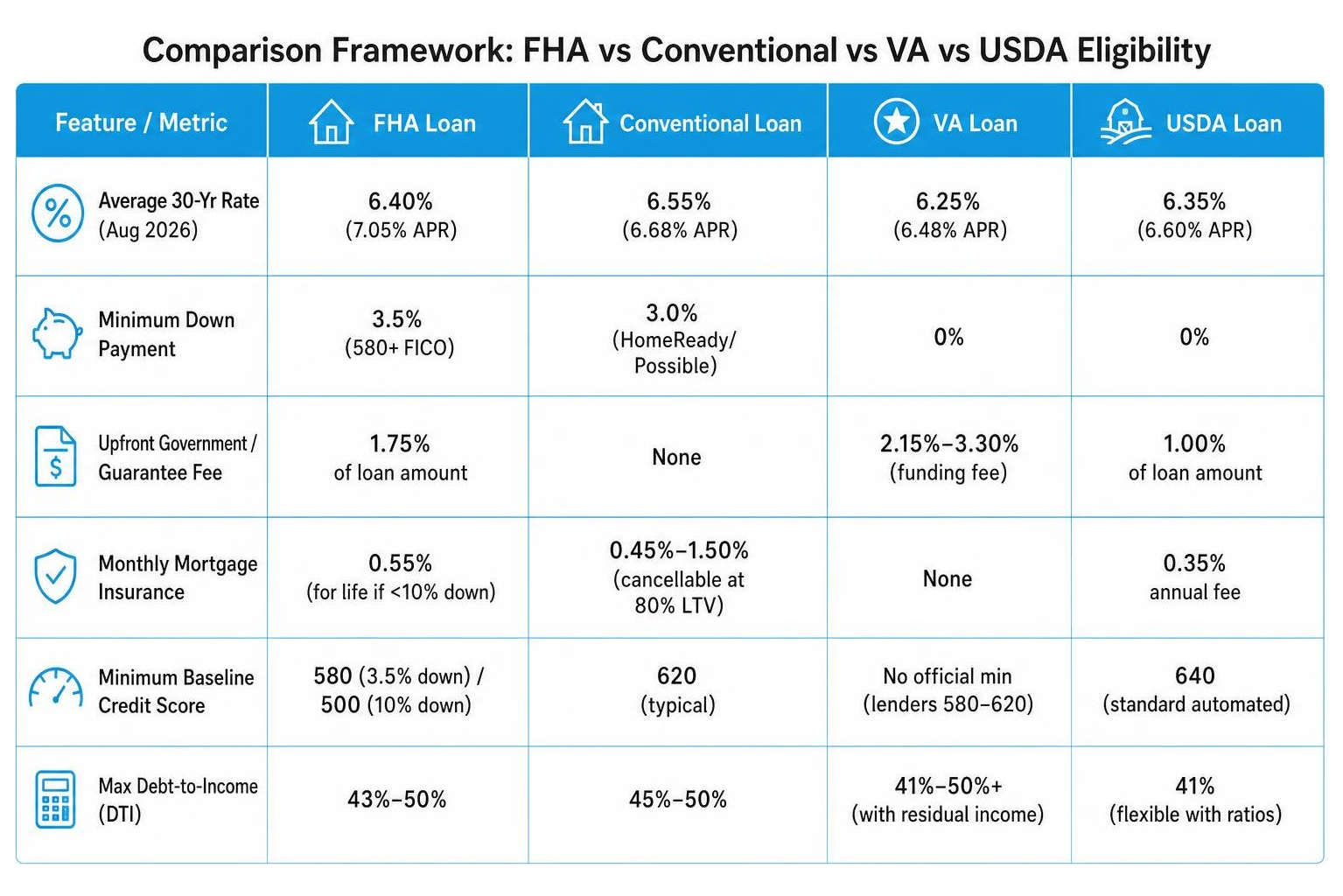
When shopping for a mortgage, comparing program terms side by side clarifies which financing structure fits your immediate down payment capacity and long-term financial plans.
| Feature / Metric | FHA Loan | Conventional Loan | VA Loan | USDA Loan |
|---|---|---|---|---|
| Average 30-Yr Rate (Aug 2026) | 6.40% (7.05% APR) | 6.55% (6.68% APR) | 6.25% (6.48% APR) | 6.35% (6.60% APR) |
| Minimum Down Payment | 3.5% (580+ FICO) | 3.0% (HomeReady/Possible) | 0% | 0% |
| Upfront Government / Guarantee Fee | 1.75% of loan amount | None | 2.15%–3.30% (funding fee) | 1.00% of loan amount |
| Monthly Mortgage Insurance | 0.55% (for life if <10% down) | 0.45%–1.50% (cancellable at 80% LTV) | None | 0.35% annual fee |
| Minimum Baseline Credit Score | 580 (3.5% down) / 500 (10% down) | 620 (typical) | No official min (lenders 580–620) | 640 (standard automated) |
| Max Debt-to-Income (DTI) | 43%–50% | 45%–50% | 41%–50%+ (with residual income) | 41% (flexible with ratios) |
To see how daily market movements affect monthly payments, check our tracking on Current Mortgage Rates FHA 30 Year Fixed.
FHA vs. Conventional: The True Cost of Borrowing
A common homebuyer mistake is focusing solely on the headline interest rate. For a borrower with a 640 credit score, an FHA loan might offer an initial note rate of 6.30% compared to a conventional rate of 6.55%. That initial rate discount can look attractive on paper, but a comprehensive FHA vs Conventional cost analysis reveals a different dynamic over time.

Under the Homeowners Protection Act of 1998, conventional Private Mortgage Insurance (PMI) cancels automatically once your loan balance reaches 78% of the original purchase price (or at 80% via written request). In contrast, FHA annual Mortgage Insurance Premiums (MIP) remain for the entire 30-year term if you put down less than 10%.
On a $400,000 purchase with 3.5% down, lifetime FHA mortgage insurance can exceed $60,000 over the life of the loan. A conventional loan with 3% to 5% down incurs roughly $12,000 to $18,000 in cancellable PMI before dropping off. If your credit score is 680 or higher and you plan to stay in the property for more than seven years, conventional financing usually delivers lower total borrowing costs.
FHA vs. Government Backed VA and USDA Mortgages
If you have military service history or are purchasing in an eligible suburban or rural area, alternative government-backed programs can offer distinct advantages:
- VA Loans: Available to qualifying active-duty service members, veterans, and surviving spouses. They require 0% down and charge no monthly mortgage insurance, making them one of the most affordable government programs available.
- USDA Loans: Designed for low-to-moderate-income buyers purchasing properties in designated rural zones. Like VA financing, USDA loans offer 0% down options, paired with a low 1.00% upfront guarantee fee and a 0.35% annual monthly fee.
The True Cost: Mortgage Insurance Premiums and APR Mechanics
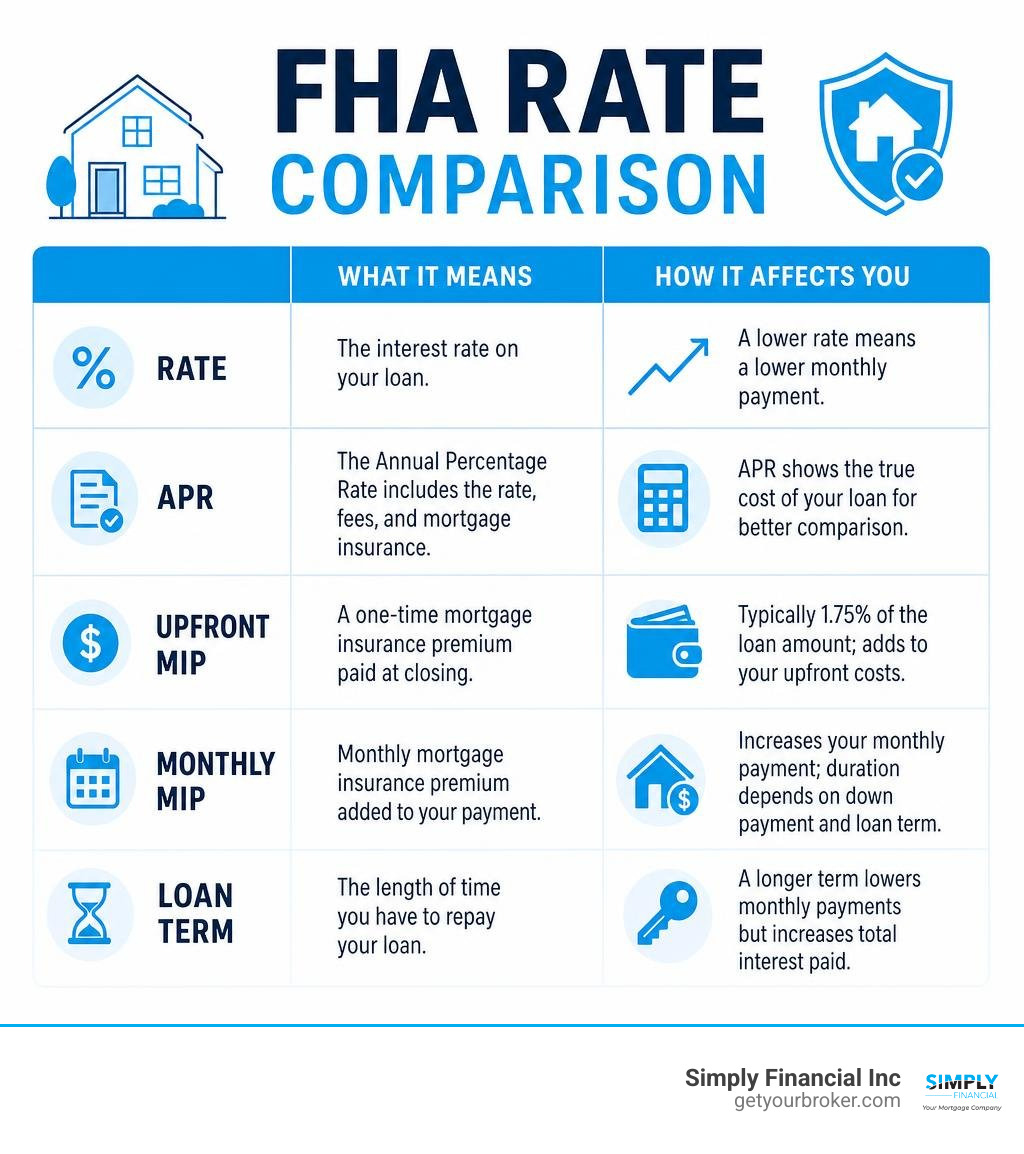
FHA borrowing costs are split into two mandatory insurance layers: the Upfront Mortgage Insurance Premium (UFMIP) and the Annual Mortgage Insurance Premium (MIP). Together, these charges protect lenders against default and enable flexible qualification guidelines, but they also increase total financing expenses. Understanding the APR on FHA loan helps you see how these fees translate into an effective yearly borrowing cost.
Upfront MIP vs. Annual MIP Calculations
- Upfront Mortgage Insurance Premium (UFMIP): Set at 1.75% of the base loan amount. On a $300,000 loan, this adds $5,250 to your balance at closing. Most buyers finance this fee directly into their total loan balance, which means paying interest on that $5,250 over the full 30-year amortization schedule.
- Annual Mortgage Insurance Premium (MIP): For most borrowers taking a 30-year fixed loan with 3.5% down, the annual cost is 0.55% of the remaining principal balance, divided into 12 monthly installments. On a $300,000 balance, that equals approximately $137.50 per month in addition to principal, interest, taxes, and homeowners insurance.
For a deeper breakdown of daily quotes and fees across loan sizes, explore current FHA mortgage data.
Decoding APR vs Note Rates on Government Mortgages
The nominal note rate determines your basic monthly principal and interest payment. However, the Annual Percentage Rate (APR) incorporates the 1.75% UFMIP, ongoing monthly MIP, and mandatory lender closing costs into a single annualized figure.
When evaluating FHA loan rates today, a loan with an advertised 6.375% note rate will often carry an effective APR of 7.05% or higher. Comparing APRs across lenders provides a clearer picture of actual loan pricing than interest rates alone.
2026 FHA Qualification Guidelines and Loan Limits
Every year, the Department of Housing and Urban Development (HUD) adjusts baseline FHA loan limits based on changes in median home prices. For 2026, single-family residential limits range from a low-cost floor of $541,287 up to a high-cost ceiling of $1,249,125.

Multi-unit properties carry higher borrowing limits, making them a common choice for house-hacking strategies:
- 2-Unit Properties: $693,050 (floor) up to $1,599,125 (ceiling)
- 3-Unit Properties: $837,725 (floor) up to $1,932,850 (ceiling)
- 4-Unit Properties: $1,041,125 (floor) up to $2,402,125 (ceiling)
To review county-specific limit schedules for your target market, consult our FHA Home Loans Rates Guide 2026.
Debt-to-Income Caps and Cash Reserve Mandates
HUD guidelines set standard front-end housing expense limits at 31% and back-end total debt limits at 43%. While automated underwriting systems (AUS) previously approved DTIs above 50%, most lenders in 2026 cap back-end DTI ratios at 50%, even with strong compensating factors.
Additionally, lenders typically require verified cash reserves equal to at least 2 months of total mortgage payments (principal, interest, taxes, and insurance) remaining after closing costs are paid. If your down payment is funded through family gifts, underwriting guidelines often require an additional reserve month (3 months total) to confirm post-closing financial stability.
Property Appraisal Standards and Safety Checks
FHA appraisals require properties to meet specific Minimum Property Standards (MPS) regarding safety, security, and structural soundness. The appraiser inspects for issues such as peeling lead-based paint, aging roof surfaces, functional HVAC systems, working handrails, and properly grounded GFCI outlets.
In 2026, approximately 22% of FHA appraisals received a “conditional” status requiring repairs prior to final loan approval, compared to 16% in 2024. Sellers must complete these repairs and pass a re-inspection before the transaction can close.
Step-by-Step Guide to Lock the Best Financing Terms
Finding the right loan terms requires preparation well before submitting an official application. Following a structured process helps ensure you receive competitive pricing from prospective lenders:
- Pull and Clean Credit Reports: Check all three credit bureaus for reporting errors or outdated collections 3 to 6 months before applying.
- Optimize Revolving Balances: Pay down credit card balances so total utilization falls below 30% on each individual card.
- Compare Down Payment Options: Evaluate whether putting down 5% instead of 3.5% provides lower interest rate pricing and reduced upfront costs.
- Gather Required Documents: Collect 2 years of W-2s, 30 days of pay stubs, and 60 days of complete bank statements to expedite underwriting.
- Request Multiple Loan Estimates: Apply with at least three lenders to compare origination fees, discount points, and rate locks.
- Time Your Rate Lock: Secure a 30- to 45-day rate lock once your purchase contract is accepted to protect against market fluctuations.
Strategies to Secure the Lowest FHA Home Mortgage Rates
Borrowers can often improve pricing by 10 to 15 basis points for every 20-point increase in their FICO score. If you have extra cash reserves, putting down 5% instead of 3.5% can lower your loan pricing adjustments while saving upfront insurance costs.
When evaluating discount points, calculate your break-even horizon. Paying $3,000 upfront to lower your rate by 0.25% saves roughly $50 per month on a $300,000 loan, requiring five years of homeownership to recover the initial cost. If you plan to move or refinance sooner, paying points may not be cost-effective.
When to Consider an FHA Streamline Refinance
Homeowners with an existing FHA loan can use the FHA Streamline Refinance program to lower their interest rate with minimal documentation. In late August 2026, streamline refinance rates are averaging around 6.25%.
The primary requirement is demonstrating a clear “Net Tangible Benefit,” which HUD defines as a minimum 0.50% reduction in your combined principal, interest, and monthly MIP rate. The program generally requires no new appraisal, no income documentation, and no standard credit check, simplifying the refinancing process for qualifying borrowers.
Frequently Asked Questions About FHA Mortgage Rates
Can FHA mortgage insurance be removed once equity reaches 20%?
No. Unlike conventional loans, where Private Mortgage Insurance (PMI) is removed once equity reaches 20% to 22%, FHA annual MIP remains for the life of the loan if you put down less than 10%. To remove FHA mortgage insurance, homeowners typically refinance into a conventional loan once their property reaches 20% equity and their credit score meets conventional guidelines.
What minimum credit score is needed to qualify for an FHA loan in 2026?
HUD guidelines permit credit scores as low as 580 with a 3.5% down payment, and between 500 and 579 with a 10% down payment. However, individual mortgage lenders frequently add overlays requiring a minimum score of 620 to 640 for automated underwriting approval. Applicants with scores near 580 must show a clean 12- to 24-month payment history without late payments.
Why are FHA interest rates often lower than conventional rates?
FHA loans are insured against default by the federal government and pooled into Ginnie Mae securities. This backing reduces credit risk for secondary market investors, allowing lenders to offer lower baseline note rates compared to conventional loans. However, mandatory upfront (1.75%) and monthly (0.55%) mortgage insurance premiums increase the effective APR, making the total cost comparable to or higher than conventional options for high-credit borrowers.
Conclusion
Choosing the right mortgage program involves balancing your available cash, credit profile, and ownership horizon. While FHA loans provide accessible entry criteria and competitive initial note rates, the long-term impact of mandatory mortgage insurance makes it essential to evaluate your complete borrowing costs.
At Simply Financial Inc, our goal is to guide you through loan options with transparent pricing and dependable underwriting support. Contact our mortgage team or explore current mortgage rates for FHA loans to review your personalized financing scenarios today.