

Understanding FHA Loan Credit Gaps and Underwriting Standards
You can overcome FHA loan credit gaps by providing a documented letter of explanation for any pause in credit usage, re-establishing at least 6 to 12 months of on-time tradelines, and using non-traditional credit such as rent or utility payments when your file goes through manual underwriting. Securing government-backed financing begins with understanding how the Department of Housing and Urban Development (HUD) evaluates risk. Through various federal loan assistance programs, HUD provides insurance backing to lenders, enabling them to extend financing to borrowers with non-traditional credit histories or past employment disruptions.
Under baseline HUD guidelines, the minimum credit score threshold sits at 580 to qualify for the standard 3.5% down payment. Borrowers with scores between 500 and 579 can still qualify, provided they put down at least 10%. However, understanding the essential FHA loan credit facts means recognizing that credit scores only tell part of the story. Underwriters examine the continuity of your credit profile—looking for dormant tradelines, periods without active reporting, or gaps in your payment history.
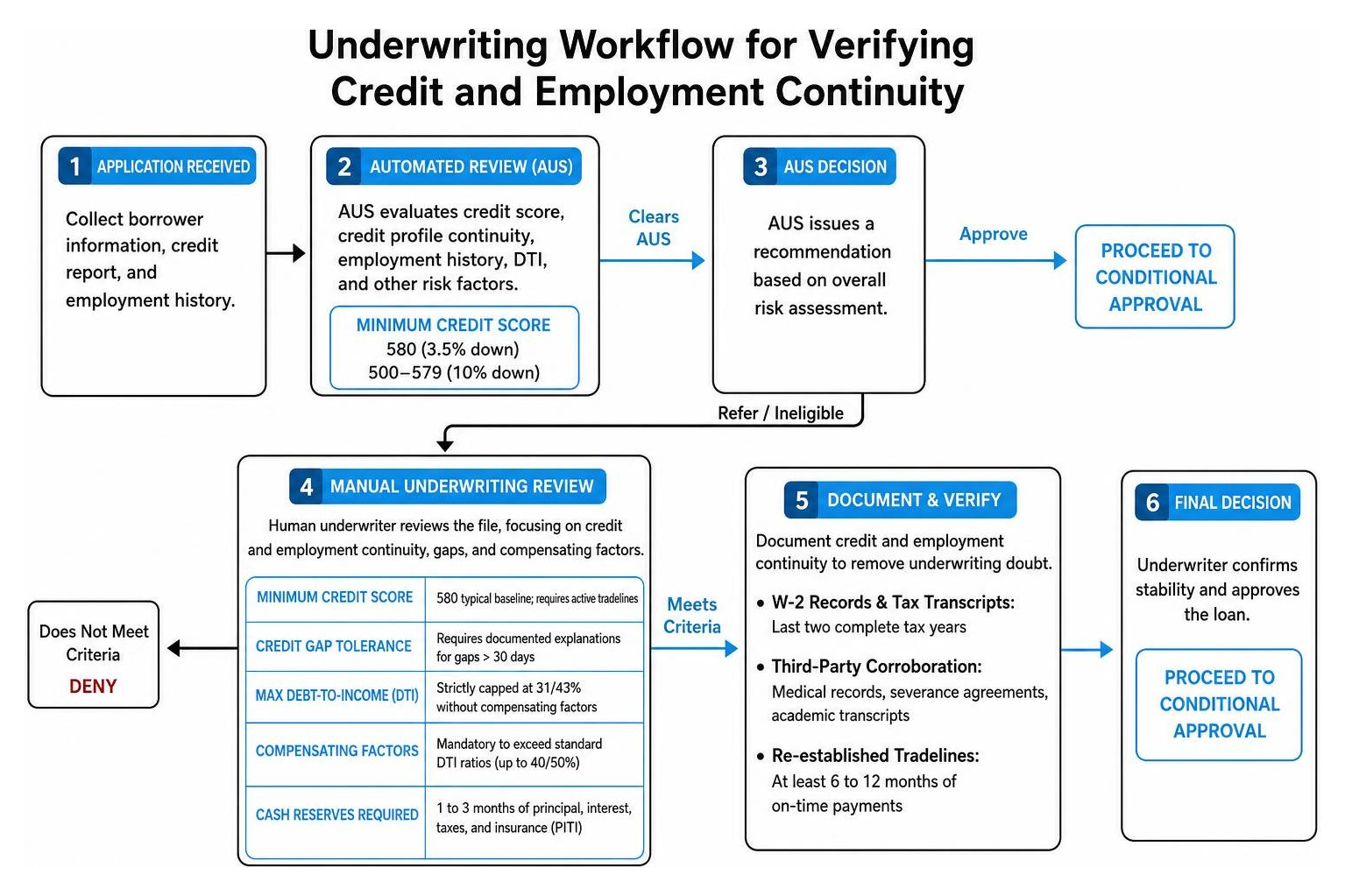
When automated underwriting systems (AUS) flag inconsistencies, your loan file transitions to manual underwriting. In manual underwriting, human underwriters apply strict evaluation criteria to assess whether your financial profile demonstrates genuine stability.
| Underwriting Category | Automated Underwriting System (AUS) | Manual Underwriting Criteria |
|---|---|---|
| Minimum Credit Score | 580 (3.5% down) / 500–579 (10% down) | 580 typical baseline; requires active tradelines |
| Credit Gap Tolerance | System algorithms evaluate overall risk score | Requires documented explanations for gaps > 30 days |
| Max Debt-to-Income (DTI) | Determined by AUS findings (often up to 45–50%) | Strictly capped at 31/43% without compensating factors |
| Compensating Factors | Optional; weighed by algorithm | Mandatory to exceed standard DTI ratios (up to 40/50%) |
| Cash Reserves Required | Determined by AUS (frequently 0–1 month) | 1 to 3 months of principal, interest, taxes, and insurance (PITI) |
Many lending institutions also enforce “lender overlays”—internal rules stricter than HUD’s baseline requirements. While HUD may permit manual underwriting for thin credit files, an individual lender might require a minimum 620 credit score or continuous 12-month tradeline histories. We help borrowers navigate these differences so their applications are submitted to the right programs from the start.
Documenting FHA Loan Credit Gaps for Underwriting Approval
When an underwriter identifies a pause in your credit usage or an extended break in employment, clear paper documentation is the best way to satisfy the file. A well-constructed Letter of Explanation (LOE) forms the core of your response.
Your LOE must be factual, concise, and backed by verifiable documentation:
- W-2 Records and Tax Transcripts: Provide the last two complete tax years to establish baseline earning stability.
- Third-Party Corroboration: Include medical records for health-related pauses, severance agreements for corporate downsizings, or academic transcripts for educational pursuits.
- Re-established Tradelines: Show at least 6 to 12 months of on-time payments following the disruption to demonstrate recovered financial stability.
Satisfying the standard conditions for FHA loan approval requires eliminating underwriting doubt. Clear documentation demonstrates that past disruptions were temporary, unavoidable, and are unlikely to recur.
How Gaps in Employment History Impact Credit Stability
Employment stability directly influences credit health. Underwriters review your full two-year work history, scrutinizing any disruption that exceeds 30 calendar days.
A break in employment often coincides with diminished credit activity or minor credit score dips. Underwriters do not expect robotic perfection; instead, they assess your overall income trajectory. If you changed positions for career advancement, higher compensation, or better benefits within the same industry, underwriters view the move favorably.
Providing your most recent 30 consecutive days of pay stubs confirms that your return to work is secure and your current earnings support ongoing debt obligations.
Navigating Specific Career and Credit Disruptions
Life transitions frequently cause breaks in work and credit history. Whether you are re-entering the workforce, transitioning out of active-duty military service, or changing career sectors entirely, FHA guidelines provide flexible pathways to qualification.
As outlined in the NAR overview of FHA loan requirements, government-backed lending programs are specifically structured to accommodate diverse employment patterns that conventional loans often reject.
Returning to Work After Caregiving or Military Service
Borrowers re-entering the workforce after raising children, providing eldercare, or serving in the armed forces represent common underwriting scenarios:
- Extended Caregiving Gaps: If you took time away from the workforce to care for family, underwriters generally look for a minimum six-month seasoning period at your current job before approving the loan file. This demonstrates reliable income stability.
- Military Transitions: Service members transitioning to civilian careers can use their Form DD-214 (Certificate of Release or Discharge from Active Duty) alongside military pay stubs to document continuous service, bridging any transition period between active duty and civilian employment.
- Educational Advancement: Time spent attending accredited college courses, technical training, or specialized vocational programs counts directly toward the two-year work history requirement when you supply official transcripts and diplomas.
Managing Seasonal, Freelance, and Self-Employed Work Patterns
Borrowers working in construction, agriculture, seasonal hospitality, or freelance positions face variable monthly earnings. Underwriters evaluate these income streams by averaging earnings over a complete 24-month cycle.
To qualify with non-traditional work structures:
- Document Industry Standards: Demonstrate that off-season downtime is typical for your specific trade.
- Provide 1099 and Schedule C Records: Supply two full years of signed federal tax returns to verify net earnings after business deductions.
- Establish Return Likelihood: Secure a written statement from your primary employer or contracting client confirming reasonable expectation of ongoing work in the upcoming season.
For detailed scenario planning and up-to-date threshold limits across Illinois and Florida, reference our comprehensive FHA home loan guide for 2026.
Actionable Steps to Bridge Credit and Employment Inconsistencies

If your credit file lacks depth due to extended breaks in credit usage, proactive preparation makes all the difference. Meeting standard HUD credit requirements for FHA loans does not require a complex portfolio of high-balance revolving credit cards.
Borrowers applying for a standard FHA loan can bridge these gaps by developing an alternative credit profile or leveraging strong compensating factors.
Solutions for Overcoming FHA Loan Credit Gaps with Non-Traditional Credit
Borrowers with thin credit profiles or past gaps can build an alternative credit history using non-traditional tradelines. Underwriters evaluate regular, recurring monthly obligations over a continuous 12-month timeline:
- Verification of Rent (VOR): Direct payment histories verified via canceled checks, bank statements, or licensed management company ledgers.
- Utility Payment Records: Consistent, on-time payments for electric, gas, water, and trash collection.
- Telecom Accounts: Documented payment histories for mobile phone, home internet, and cable services.
- Insurance Premiums: 12 months of paid auto, life, or renters insurance statements not deducted directly from a payroll check.
Underwriters compile these records into a formal credit supplement, fulfilling FHA requirements without forcing you into high-interest consumer debt.
Strengthening Your Financial Profile with Compensating Factors
When manual underwriting is required, compensating factors balance out past credit or employment gaps:
- Verified Cash Reserves: Maintaining 2 to 3 months of full mortgage payments (principal, interest, taxes, and insurance) in savings after paying closing expenses.
- Down Payment and Closing Preparation: Careful calculation of your FHA cash to close shows underwriters that your liquid assets are stable.
- Conservative Debt Ratios: Maintaining a back-end DTI below 36% indicates manageable overall debt.
- Substantial Residual Income: Demonstrating sufficient discretionary income left over each month after paying all fixed expenses.
Frequently Asked Questions About FHA Loan Approvals
How long must I be at a new job before qualifying for an FHA loan?
FHA guidelines do not establish a universal minimum number of days you must be at a new job, provided you have a continuous two-year history in the same or a related field. If you transition to a new employer with no gap, you can often qualify as soon as you receive your first formal 30-day pay stub. If you change career fields entirely, underwriters typically prefer to see 6 months of stable earnings to verify income continuity.
Can I get an FHA loan with a long gap in my employment history?
Yes. An extended employment gap of six months or longer does not disqualify you. To qualify, you generally need to be back at your current position for at least six continuous months and provide a clear, documented explanation for the break (such as family care, medical recovery, education, or military service), alongside a verified two-year history prior to the disruption.
What counts as acceptable non-traditional credit for FHA financing?
Acceptable non-traditional credit includes any recurring monthly expense paid consistently over at least 12 months. Common examples include institutional rent payments, electric and water utilities, mobile phone bills, auto insurance premiums, school tuition payments, and regular child care payments.
Conclusion
Credit pauses and employment gaps do not have to derail your path to homeownership. With proper documentation, strategic compensating factors, and an understanding of HUD underwriting standards, you can present a strong, qualified loan file to lenders.
At Simply Financial Inc, our Chicago-based team guides borrowers through every step of the mortgage process across Illinois and Florida. We take the friction out of manual underwriting and lender overlays to deliver a smooth, transparent lending experience.
Review the baseline credit needed for FHA loan approvals and connect with our team to verify your eligibility today.