

Understanding FHA Loan Rate Requirements and Credit Score Thresholds
When evaluating government-backed mortgages, the Federal Housing Administration (FHA) provides substantial flexibility compared to conventional financing. The FHA does not directly lend money or establish fixed daily rates. Instead, private lenders evaluate your complete financial profile to offer competitive FHA home mortgage rates based on risk tiers, your down payment, and loan-to-value (LTV) limits.
FHA pricing is risk-based, yet it exhibits significantly less pricing volatility across credit score tiers than conventional mortgages. This makes FHA loans a reliable vehicle for buyers seeking affordable financing without needing a flawless credit profile.
How FHA Loan Rate Requirements Vary by FICO Score Tier
Your credit score directly dictates your minimum required down payment and maximum allowable LTV. A score of 580 serves as the primary benchmark for unlocking maximum financing.
| FICO Score Tier | Minimum Down Payment | Maximum LTV | Typical Rate Tier Outlook (2026) | Underwriting Pathway |
|---|---|---|---|---|
| 720+ (Strong Credit) | 3.50% | 96.50% | ~6.36% | AUS Approve / Accept |
| 640 – 719 (Standard Credit) | 3.50% | 96.50% | ~6.51% | AUS Approve / Accept |
| 580 – 639 (Lower Credit) | 3.50% | 96.50% | ~6.76% | AUS or Manual Underwrite |
| 500 – 579 (Subprime Tier) | 10.00% | 90.00% | Higher risk-adjusted pricing | Strict Manual Underwriting |
Borrowers with scores of 580 or higher can take advantage of a standard 96.50% LTV for purchases, requiring only 3.5% down. When reviewing the credit needed for an FHA loan, applicants within the 500 to 579 bracket are limited to a 90% LTV, requiring a 10% down payment to offset risk. For cash-out refinances, the maximum LTV is capped at 80% with automated underwriting.
Qualifying with Bad Credit or Non-Traditional Credit History
If you have a thin credit profile or no credit score at all, FHA guidelines allow lenders to establish non-traditional credit histories. Understanding these core FHA loan credit facts enables buyers without credit cards or traditional debt to achieve homeownership.
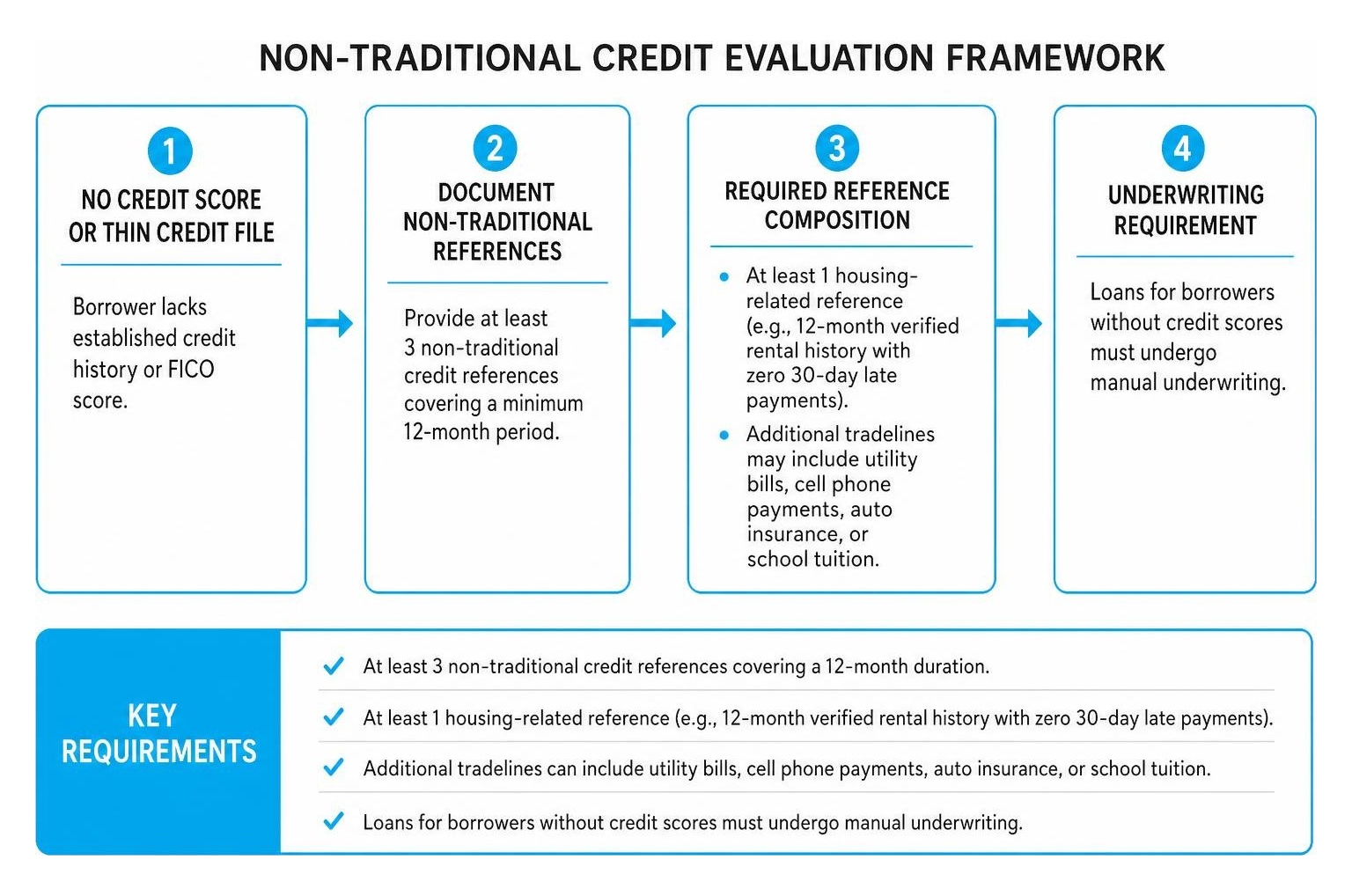
Under standard non-traditional credit guidelines:
- Borrowers must document at least three non-traditional credit references covering a 12-month duration.
- At least one reference must be housing-related, such as a 12-month verified rental history with zero 30-day late payments.
- Additional tradelines can include utility bills (gas, electricity, water), cell phone payments, auto insurance, or school tuition.
- Loans for borrowers without credit scores must undergo manual underwriting.
Debt-to-Income Limits, Underwriting Methods, and Compensating Factors
Your debt-to-income (DTI) ratio measures your monthly debt obligations against your gross effective income. Satisfying standard conditions for FHA loan approval requires balancing the front-end ratio (housing payment divided by gross income) and the back-end ratio (total recurring monthly debts divided by gross income).
Automated Underwriting System vs. Manual Underwriting Rules
FHA mortgages are processed through an Automated Underwriting System (AUS) utilizing HUD’s TOTAL Mortgage Scorecard. When an application receives an “Approve/Accept” recommendation, DTI limits are governed by the AUS engine, frequently approving ratios exceeding 45% if the overall profile is sound.
When a loan receives a “Refer” or involves non-traditional credit, it shifts to manual underwriting, where strict ratio benchmarks apply according to HUD’s borrower qualifying ratios guide.
| Underwriting Parameter | Automated Underwriting (AUS) | Manual Underwriting (No Score / Base) | Manual Underwriting (With Compensating Factors) |
|---|---|---|---|
| Standard DTI Cap | Determined by AUS findings | 31% Front / 43% Back | Up to 40% Front / 50% Back |
| Max DTI (FICO < 580) | Capped at 50% | 31% Front / 43% Back | 31% Front / 43% Back (strictly enforced) |
| Required Reserves | Determined by AUS findings | 1 Month PITI (1–2 units) | 3 Months PITI (3–4 units) |
| Tradeline Validation | Standard Bureau Pull | 3 Non-Traditional Tradelines (12 Mo.) | Documented 12-Month Satisfactory History |
Documenting Compensating Factors to Exceed 43% DTI
To exceed the standard 31/43% DTI caps under manual underwriting, lenders must document specific compensating factors on Form HUD-92900-LT:
- Liquid Cash Reserves: Verifying 3 to 6 months of total monthly housing payments (PITI) remaining in liquid reserves after closing.
- Minimal Payment Increase: A new housing payment that does not exceed the current verified housing payment by more than $100 or 5%.
- Substantial Residual Income: Documenting discretionary income remaining after all monthly living expenses and taxes that significantly exceeds regional norms.
- Significant Down Payment: Making a down payment of 10% or greater from the borrower’s own accumulated funds.
- Energy-Efficient Homes (EEH): Properties meeting recognized energy-efficiency criteria allow baseline qualifying ratios to expand automatically to 33% front-end and 45% back-end.
2026 FHA Loan Limits, Mortgage Insurance, and Total Borrowing Costs
Evaluating overall loan affordability requires assessing the full APR on an FHA loan, which factors in interest rates alongside mandatory mortgage insurance costs and regional lending caps.
Navigating FHA Loan Rate Requirements and 2026 County Limits
FHA lending ceilings adjust annually based on median home values across counties. Consulting our FHA home loans rates guide for 2026 details the current statutory thresholds:
- Low-Cost County Floor (1-Unit): $541,287
- High-Cost County Ceiling (1-Unit): $1,249,125
- Special Exception Areas (Alaska, Hawaii, Guam, U.S.V.I.): Up to $1,873,625 for 1-unit properties.
- Multi-Unit Limits: Duplex, triplex, and four-plex properties offer substantially higher borrowing caps, enabling multi-unit owner-occupancy strategies.
Upfront and Annual Mortgage Insurance Premium (MIP) Costs
Every FHA loan includes two distinct mortgage insurance layers. Reviewing the complete FHA mortgage insurance cost structure helps borrowers calculate long-term obligations:
- Upfront Mortgage Insurance Premium (UFMIP): Fixed at 1.75% of the base loan amount. This fee is typically financed directly into the total mortgage balance at closing.
- Annual Mortgage Insurance Premium (Annual MIP): Calculated on the remaining balance and divided across 12 monthly payments:
- LTV > 95% (3.5% down): 0.55% annually, payable for the entire life of the loan.
- LTV ≤ 90% (10%+ down): 0.50% annually, automatically canceling after 11 years.
Property Standards, Flipping Rules, and Special Housing Types
FHA financing requires properties to serve as the borrower’s primary residence and meet stringent safety, security, and soundness criteria.
Minimum Property Requirements and the 90-Day Flip Restriction
Under the FHA Minimum Property Requirements outlined in HUD Handbook 4000.1, appraisers verify essential structural and environmental standards:
- Operable heating systems capable of maintaining healthy interior temperatures.
- Complete absence of peeling or chipped lead-based paint (mandatory for homes built prior to 1978).
- Functional, undamaged roofing with a minimum remaining economic life of at least two years.
- Mandatory flood insurance for the entire loan duration if the property sits within a Special Flood Hazard Area (SFHA).
FHA Property Flipping Rules:
- 0 to 90 Days: Resale is strictly prohibited if the seller acquired title within 90 days of the new purchase agreement.
- 91 to 180 Days: If the resale price is 100% or more over the seller’s acquisition cost, a second independent appraisal is required at the lender’s expense.
Financing Condominiums and Manufactured Homes
- Condominiums: Condos must appear on the HUD-Approved Condo Roster or qualify for Single-Unit Approval (SUA). Buyers in urban markets can consult a local Chicago condo approval guide to verify HOA reserves, owner-occupancy ratios, and commercial space limitations (capped at 35% of total floor area).
- Manufactured Homes: The home must have been constructed after June 15, 1976, display an official HUD certification label, contain at least 400 square feet of living space, and be permanently affixed to a foundation certified under HUD guidelines.
Step-by-Step Documentation Checklist for FHA Loan Approval
Preparing accurate documentation accelerates your file through automated underwriting while locking in competitive current mortgage rates for FHA loans.
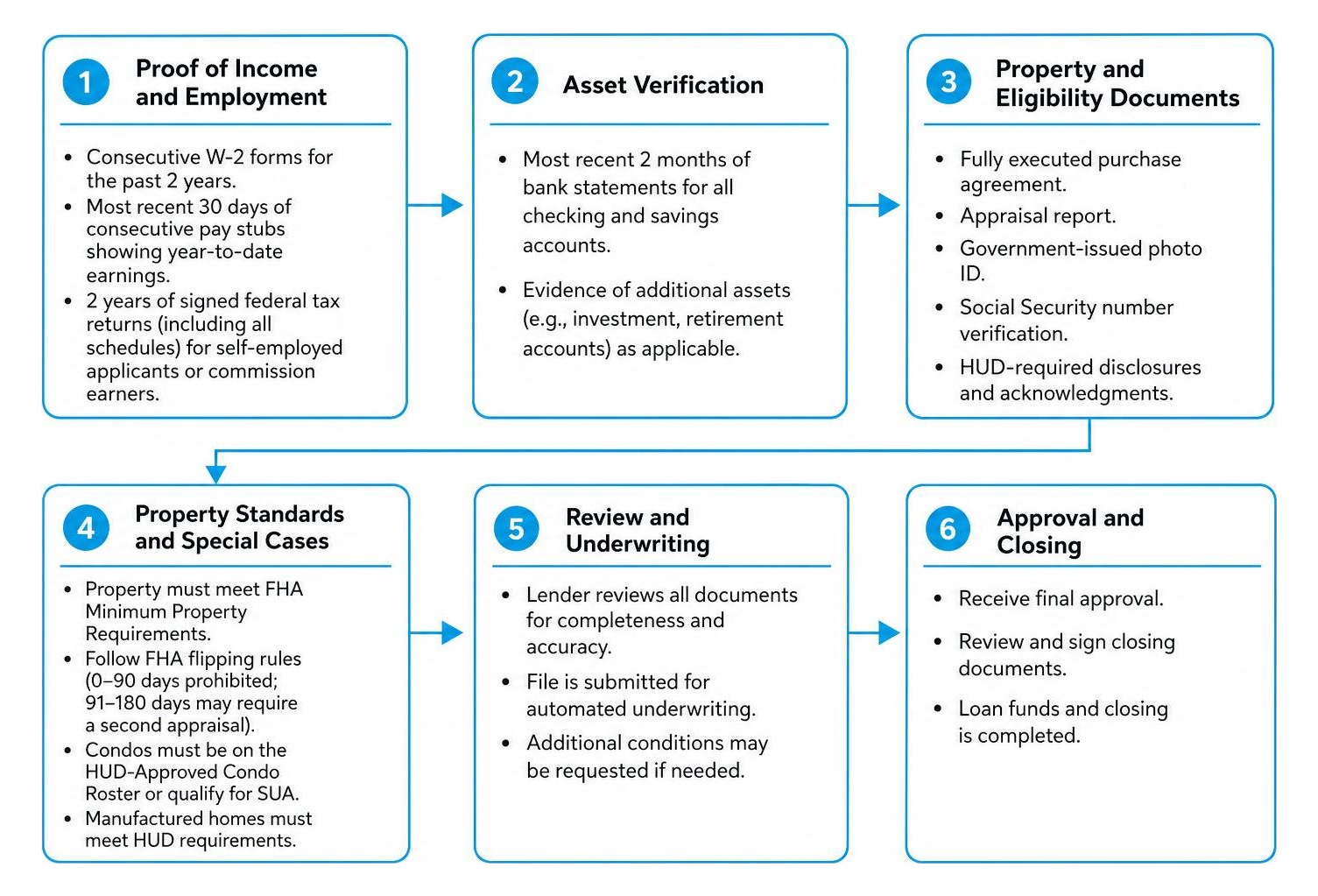
- Proof of Income and Employment:
- Consecutive W-2 forms for the past 2 years.
- Most recent 30 days of consecutive pay stubs displaying year-to-date earnings.
- 2 years of signed federal tax returns (including all schedules) for self-employed applicants or commission earners.
- Asset Verification:
- 2 months of consecutive checking, savings, or investment bank statements (all pages included).
- Documented paper trail for any large non-payroll deposits.
- Gift Funds Documentation (If Applicable):
- Signed HUD-compliant gift letter detailing the donor’s relationship and confirming no repayment is expected.
- Bank statement showing donor withdrawal and borrower deposit receipt.
- Identification and Credit Verification:
- Valid government-issued photo ID and Social Security card (or eligible EAD documentation).
- 12-month canceled rent checks or third-party institutional rental verification.
Frequently Asked Questions About FHA Loan Requirements
What is the minimum credit score required to get competitive FHA loan rates?
A 580 credit score secures the minimum 3.5% down payment option. While some lenders add overlays requiring a 620 or 640 score, borrowers with scores between 580 and 639 can still access competitive pricing without severe rate penalties.
Can you remove MIP from an FHA loan without refinancing?
MIP removal without refinancing is only possible if you put down 10% or more at purchase, in which case the annual MIP cancels automatically after 11 years. For loans with 3.5% down, MIP remains for the entire loan term, meaning the primary way to eliminate it is refinancing into a conventional mortgage once you reach 20% home equity.
How does the FHA 90-day flipping rule affect home purchases?
The 90-day rule prohibits financing a purchase if the seller has owned the property for 90 days or fewer between their deed recording date and the execution of your sales contract. Between 91 and 180 days, a second appraisal is mandatory if the resale price is double the original purchase price.
Conclusion
Navigating loan eligibility, property standards, and mortgage insurance rules is simple when guided by experienced professionals. At Simply Financial Inc, located at 5632 W Lawrence Ave in Chicago, IL, we provide local expertise across Illinois and Florida to deliver a seamless, stress-free mortgage experience.
Whether you have lower credit, a non-traditional credit profile, or need guidance on loan limits, we are ready to assist. Contact Simply Financial Inc today or explore your options directly through our complete FHA loan platform to get pre-approved.