

FHA Loan Rates Today: A Quick August 2026 Snapshot
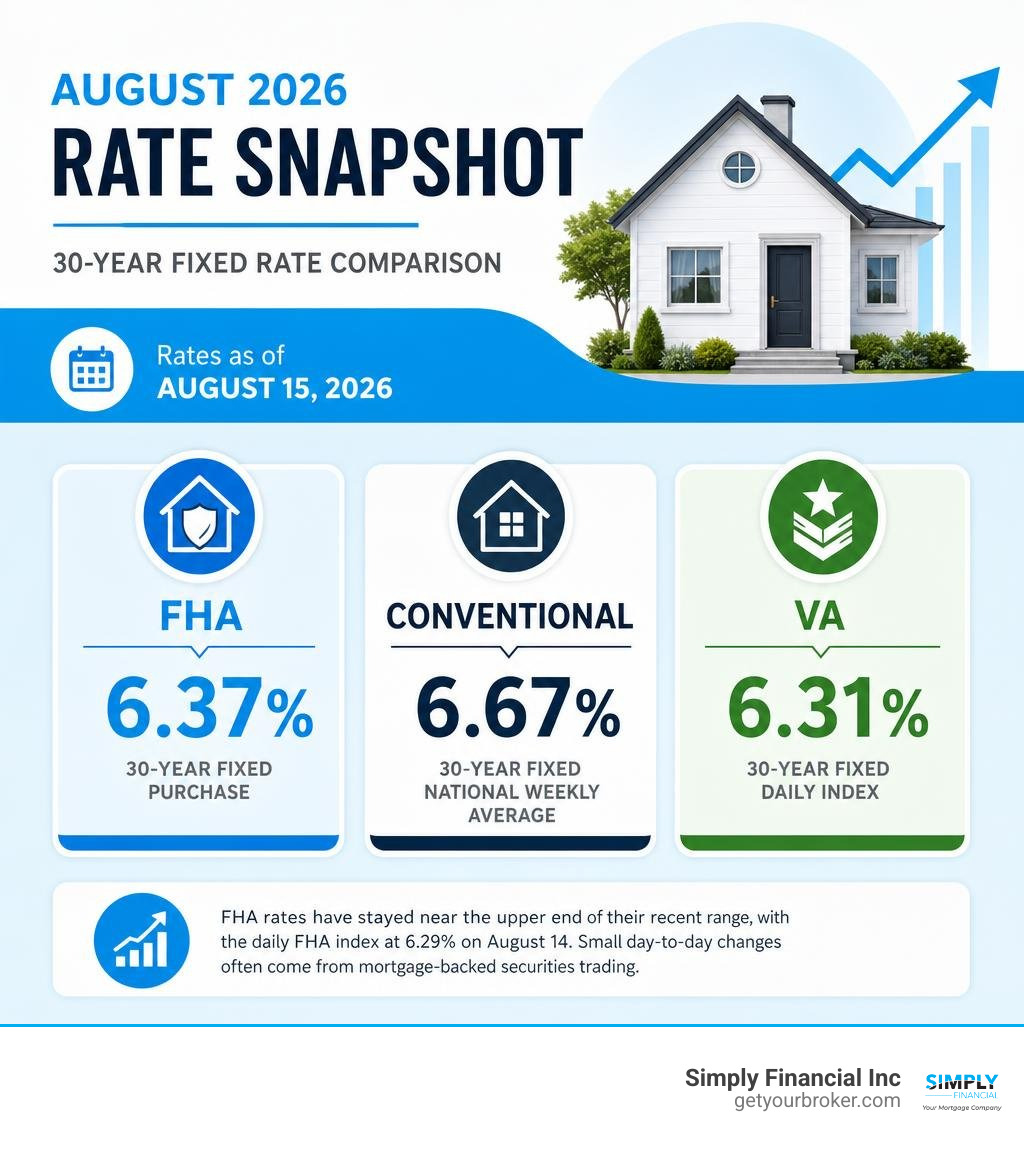
FHA loan rates today average 6.37% for a 30-year fixed purchase mortgage as of August 15, 2026. FHA refinance rates average 6.43%. Your actual quote can be higher or lower based on your credit, down payment, loan amount, lender fees, and rate-lock timing.
| Loan type | Recent 30-year fixed benchmark |
|---|---|
| FHA purchase | 6.37% |
| FHA refinance | 6.43% |
| Conventional | 6.67% national weekly average |
| VA | 6.31% daily index |
FHA rates have stayed near the upper end of their recent range, with the daily FHA index at 6.29% on August 14. Small day-to-day changes often come from mortgage-backed securities trading, not just headlines about inflation, jobs, or the Federal Reserve.
I’m Peter Babjak, a Chicago mortgage broker with Simply Financial Inc, and for more than 18 years I have helped homebuyers understand fha loan rates today, compare loan choices, and move through the mortgage process with clearer guidance. Next, we’ll put today’s rate numbers in context and explain what they can mean for your payment.
Benchmark Comparison: Overview of FHA Loan Rates Today
When evaluating fha loan rates today, it is vital to look at the broader borrowing landscape across multiple mortgage products. Mortgage pricing does not operate in a vacuum. As of mid-August 2026, the national average 30-year fixed FHA mortgage interest rate stands at 6.37%, while the FHA refinance rate rests at 6.43%.
To truly understand whether today’s FHA rates represent a good deal, we must compare them against conventional and government-backed alternatives:
- FHA 30-Year Fixed: 6.37% national purchase average (with daily tracking indices near 6.29%).
- Conventional 30-Year Fixed: 6.67% national weekly average reported by Freddie Mac’s Primary Mortgage Market Survey (PMMS).
- VA 30-Year Fixed: 6.31% national daily index average for eligible military service members and veterans.
At first glance, FHA loans appear notably cheaper than conventional mortgages—showing a base rate gap of nearly 30 basis points (0.30%). However, base interest rates tell only half the story. While government-backed FHA loans carry lower headline rates due to federal backing that protects lenders against default, they also carry mandatory mortgage insurance premiums that change the total annual cost.
Tracking daily and weekly survey sources gives us a complete view of market momentum. For instance, the Mortgage Bankers Association (MBA) weekly survey pegged the average 30-year FHA rate at 6.43% (with 0.77 points), while daily trackers like Mortgage News Daily noted a 6.29% baseline rate. Monitoring Current Mortgage Rates for FHA Loans helps buyers filter out short-term market noise and spot meaningful shifts.
Current Rate Snapshot and 52-Week Range
Understanding context is everything when reviewing fha loan rates today. Over the past 52 weeks, 30-year FHA interest rates have traded within a wide band, touching a low of 5.62% and a high of 6.40% on daily market trackers.
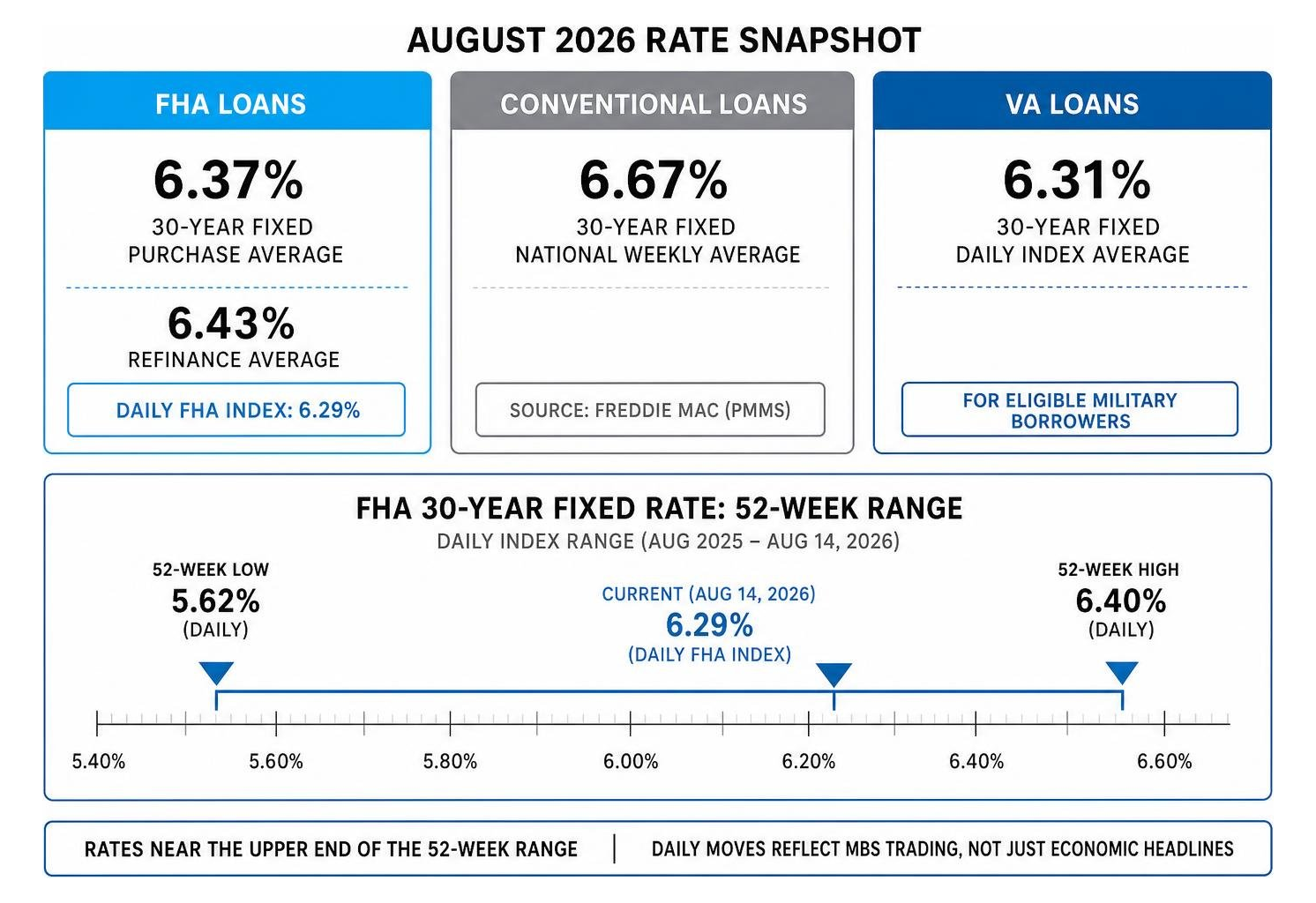
With current baseline rates sitting near 6.29% to 6.37%, today’s pricing rests near the upper end of the past year’s historical boundary. On a daily basis, mortgage pricing moves by basis points (hundredths of a percentage point). For example, a single daily tick of +0.01% may feel minor on paper, but over a 30-year term on a $300,000 home, small fractions add up.
For local buyers evaluating financing in Illinois or Florida, reviewing competitive pricing structures like Best FHA Rates Today and tracking historical 30 Day Interest Rates allows you to determine whether a lender’s rate lock quote aligns with current market benchmarks.
How Economic Factors Impact FHA Loan Rates Today
Why do mortgage rates move every morning before most of us have finished our first cup of coffee?
Many buyers assume the Federal Reserve directly sets mortgage rates. In reality, FHA loan rates are driven primarily by the trading activity of Mortgage-Backed Securities (MBS) and the yield on 10-year U.S. Treasury bonds. When institutional bond investors buy MBS, yields drop and mortgage rates fall. When investors sell bond holdings, yields rise, pushing consumer mortgage rates higher.
Economic indicators such as consumer price index (CPI) inflation reports, labor market statistics, and retail sales data heavily influence market sentiment. However, market mechanics can create unexpected rate movements:
- Economic Reports: A weaker-than-expected economic report (such as soft retail sales) typically signals economic slowing, which ought to push bond yields and mortgage rates lower.
- Trader Positioning: If weak economic data arrives on a Friday afternoon, institutional bond traders closing out positions before the weekend can override the economic news, causing rates to end slightly higher despite soft data.
- Yield Spreads: The spread between 10-year Treasury yields and 30-year mortgage rates reflects lender risk pricing and market volatility.
Understanding these dynamics reinforces why securing a timely rate lock is essential once your contract is accepted.
2026 FHA Eligibility and Underwriting Standards
Securing competitive fha loan rates today requires meeting updated federal qualification standards. The Federal Housing Administration designs its mortgage program to expand access to homeownership, but lenders enforce clear underwriting parameters to manage credit risk.
Here is a breakdown of core FHA qualification criteria for 2026:
- Minimum Credit Score: 580 to qualify for the minimum 3.5% down payment tier.
- Low-Credit Tier: Credit scores between 500 and 579 require a 10% down payment.
- Maximum Debt-to-Income (DTI) Limit: Strict back-end DTI cap of 50% in 2026 (tightened down from 52% in 2025).
- Occupancy: Primary residence only (investment properties and second homes do not qualify).
- Employment Stability: Minimum 2-year continuous work history in the same line of work or industry.
To verify these qualification standards, check detailed benchmark data on FHA Loan Requirements and Rates 2026 – Mortgage Data Index.
Credit Score and Down Payment Tiers
The 580 credit score threshold serves as the gateway for low down payment homebuying. If your credit score is 580 or higher, you can purchase a home with just 3.5% down. For example, on a $300,000 single-family purchase, your minimum down payment requirement would be $10,500.
For borrowers with credit scores between 500 and 579, FHA financing remains possible, but underwriting guidelines mandate a 10% down payment ($30,000 on a $300,000 purchase). Scores below 500 are ineligible for FHA insurance endorsement.
Down payment funds do not have to come entirely from your personal savings account. FHA rules permit 100% of your down payment and closing costs to be covered by documented gift funds from family members or approved down payment assistance (DPA) programs. Lenders require a signed gift letter stating no repayment is expected, supported by two months of bank statements from the donor showing the transfer of funds.
Furthermore, maintaining clean payment history is paramount. If your credit score sits near 580, automated underwriting software typically looks for zero 30-day late payments over the preceding 12 to 24 months.
Debt-to-Income and Property Standards
In 2026, the maximum debt-to-income (DTI) ratio for FHA loans has tightened to 50%, down from the 52% to 57% caps allowed under previous automated underwriting exceptions. This tightening means your total monthly debt obligations—including your prospective housing payment (principal, interest, taxes, homeowners insurance, and FHA monthly MIP) plus auto loans, student loans, and minimum credit card payments—cannot exceed 50% of your gross monthly income.
For instance, a household earning $6,000 per month in gross income can carry a maximum of $3,000 in combined monthly debt payments under 2026 guidelines. Review our complete FHA Home Loan Guide 2026 to calculate your exact DTI headroom.
In addition to credit and income rules, the physical property must meet rigorous safety and structural standards. FHA appraisers inspect properties against 18 specific safety guidelines, checking for:
- Fully functional heating, plumbing, and electrical systems.
- Sound roofs with at least two years of remaining physical life.
- Absence of defective paint (peeling or chipped lead paint on homes built prior to 1978).
- Proper GFCI electrical outlets near water sources and secure handrails on stairways.
- Dry, structurally sound basements and crawl spaces free of standing water or pest damage.
If an appraiser flags safety issues, the seller must complete necessary repairs prior to final loan closing.
Breaking Down FHA Mortgage Insurance Costs in 2026

When calculating the real financial cost of fha loan rates today, looking solely at the headline interest rate can be deceiving. The FHA insurance structure requires two separate mortgage insurance premiums (MIP): an Upfront Mortgage Insurance Premium (UFMIP) and an Annual Mortgage Insurance Premium (AMIP).
Together, these mortgage insurance components account for roughly 40% of the total borrowing expense over the lifetime of a 30-year FHA loan. Understanding these costs is crucial before signing your Loan Estimate. For more detail, refer to our FHA Mortgage Rates Guide 2026.
Upfront vs. Annual Mortgage Insurance Premiums
The Upfront Mortgage Insurance Premium (UFMIP) for standard FHA purchase loans in 2026 is 1.75% of the base loan amount. This represents the highest level set by HUD since 2015, driven by adjustments designed to protect the FHA Mutual Mortgage Insurance Fund.
How does UFMIP work in practice?
- Home Purchase Price: $300,000
- Down Payment (3.5%): $10,500
- Base Loan Amount: $289,500
- 1.75% Upfront MIP: $5,066.25
Borrowers rarely pay this $5,066.25 out of pocket at the closing table. Instead, FHA rules allow you to finance the UFMIP directly into your final mortgage balance, increasing your total starting loan balance to $294,566.25.
In addition to the upfront fee, borrowers pay an Annual Mortgage Insurance Premium (AMIP) of 0.55% for standard 30-year loans with 3.5% down. This annual fee is divided into 12 equal monthly installments and added directly to your monthly mortgage bill. On a $289,500 base loan, an AMIP of 0.55% adds approximately $132.68 per month to your mortgage payment.
Comparing FHA MIP to Conventional PMI
How does FHA mortgage insurance compare to Private Mortgage Insurance (PMI) on conventional loans?
On conventional loans, PMI cost is tied directly to your credit score. A borrower with a 760 credit score putting 3% down on a conventional loan might pay a low monthly PMI rate of just 0.30% with zero upfront insurance fee. Conversely, a borrower with a 640 credit score might face conventional PMI rates exceeding 1.00% monthly.
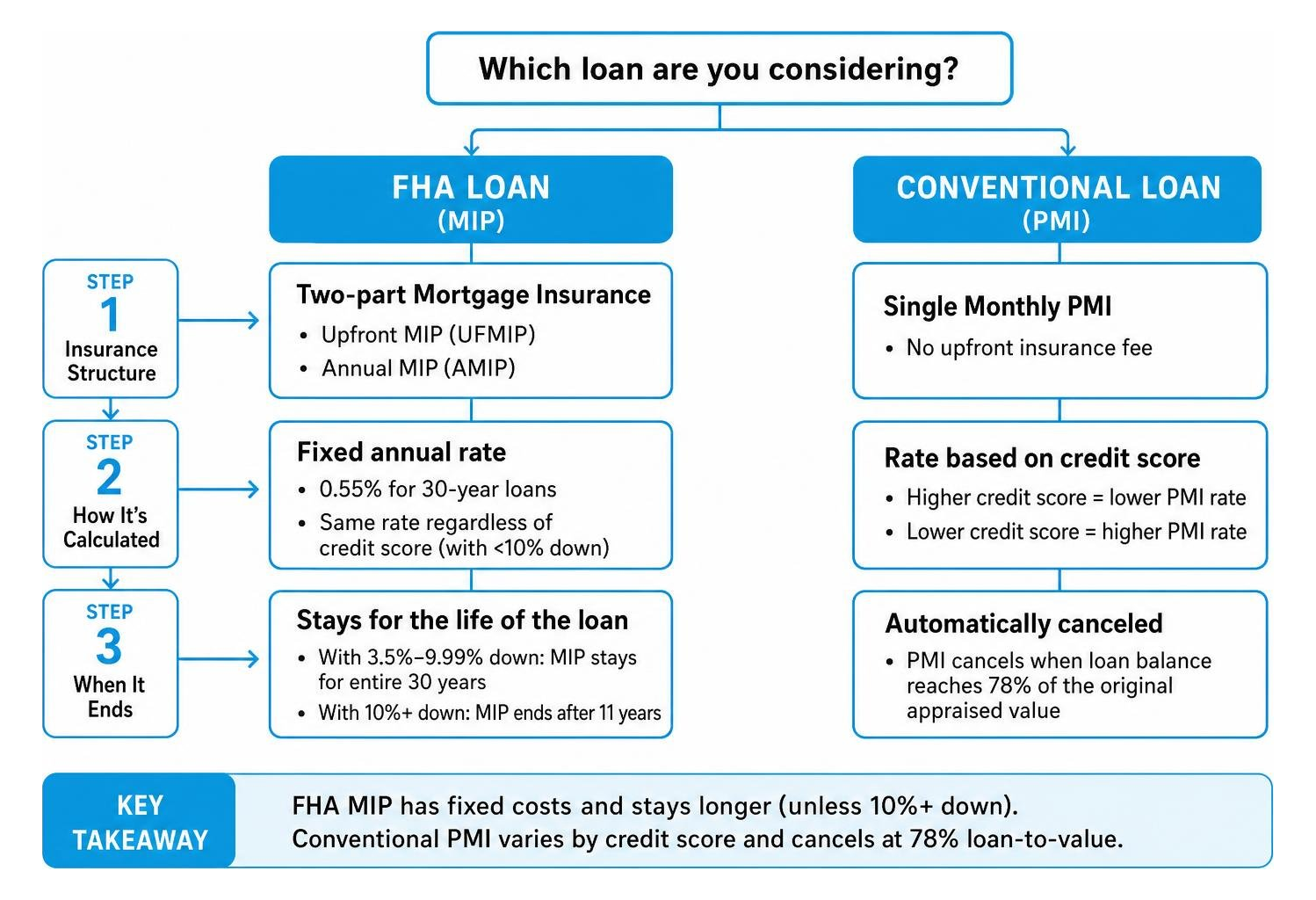
Crucially, conventional PMI is automatically canceled once your loan balance reaches 78% of the home’s original appraised value.
In contrast, FHA annual MIP rates are fixed regardless of credit score (0.55% for 30-year loans put down with less than 10%). However, if you make the minimum 3.5% down payment on an FHA loan, the annual MIP stays for the entire 30-year life of the loan. The only way to remove MIP when putting down less than 10% is to refinance the FHA mortgage into a conventional loan once you build sufficient home equity.
If you make a 10% down payment at purchase, FHA annual MIP automatically drops off after 11 years.
FHA vs. Conventional and VA Mortgages: Strategic Comparison
Choosing between mortgage options requires balancing immediate monthly affordability against long-term borrowing costs. While fha loan rates today sit at an attractive baseline average of 6.37%, alternative mortgage products offer distinct advantages depending on your credit tier, cash reserves, and military status.
To evaluate current national options across loan programs, it is helpful to look at key benchmark rates alongside your personal scenario.
Here is a side-by-side comparison of standard 30-year fixed loan programs:
| Feature | FHA Loan (3.5% Down) | Conventional Loan (3% Down) | VA Loan (0% Down) |
|---|---|---|---|
| Base Benchmark Rate | 6.37% | 6.67% (PMMS Average) | 6.31% |
| Minimum Credit Score | 580 (3.5% down) | 620 | No statutory minimum (lender overlays ~620) |
| Minimum Down Payment | 3.5% | 3.0% (First-time buyers) | 0.0% |
| Upfront Insurance / Fee | 1.75% UFMIP | None | 2.30% Funding Fee (First use) |
| Monthly Insurance | 0.55% AMIP | Risk-based PMI | None |
| Insurance Cancellation | Life of loan (if <10% down) | Cancels at 78% LTV | N/A (No monthly insurance) |
| Maximum Back-End DTI | Up to 50% | Typically 45% (up to 50% with AUS approval) | Evaluated on residual income |
| Assumable Loan? | Yes | No | Yes |
Reviewing our full suite of Mortgage Loan Options can help you select the exact structure tailored to your homebuying goals.
When FHA Makes the Most Financial Sense
An FHA loan is often the clear winner under specific financial circumstances:
- Credit Scores Between 580 and 660: Conventional lenders penalize moderate credit scores with higher base interest rates and elevated monthly PMI premiums. FHA pricing remains consistent across credit score bands.
- Debt-to-Income Ratios Between 43% and 50%: If car loans or student loan payments push your back-end DTI ratio above standard conventional thresholds, FHA underwriting offers flexible qualifying limits.
- Limited Capital for Closing: FHA guidelines allow sellers to contribute up to 6% of the purchase price toward buyer closing costs (compared to a 3% cap on conventional loans with less than 10% down).
- Assumable Mortgage Strategy: FHA loans are fully assumable by future qualified buyers. In a rising rate market, selling a home with an assumable 6.37% fixed rate can serve as a powerful marketing advantage.
Trade-Offs and Long-Term Cost Evaluation
While FHA financing opens doors for first-time buyers, savvy borrowers must evaluate long-term financial trade-offs:
- Higher Effective APR: A borrower securing an FHA loan today at 6.84% (inclusive of financed UFMIP and fees) pays roughly 42 basis points more in total annual APR than a comparable conventional borrower securing a 6.42% rate with 10% down.
- Slower Equity Accumulation: Financing the 1.75% upfront MIP into your loan balance increases your initial debt, reducing initial equity.
- Long-Term Refinance Planning: If you take an FHA loan with 3.5% down today, planning an eventual transition into a conventional loan once your home equity reaches 20% can eliminate monthly MIP payments entirely.
How to Shop and Secure Low Mortgage Rates
Mortgage rates vary widely from one financial institution to another. According to industry studies, American homebuyers overpay by an average of $3,656 annually simply by accepting the first mortgage quote they receive without shopping around.
When shopping for fha loan rates today, taking a structured approach ensures you secure the lowest overall borrowing costs.
How to Shop for the Best FHA Loan Rates Today
To secure the most competitive mortgage terms, follow these actionable steps:
- Check Your Credit Ahead of Time: Review your credit reports to correct errors and boost your score past key thresholds (such as 620, 640, or 680) to unlock better lender pricing tiers.
- Gather Quotes from Multiple Channels: Request formal Loan Estimates from at least three different sources—including mortgage brokers, credit unions, and retail banks.
- Evaluate Local Rate Sheets: In local markets, compare regional rate structures across different lenders to establish a competitive local baseline.
- Time Your Rate Lock Strategy: Standard rate locks protect your interest rate for 30 to 45 days while your loan undergoes processing and underwriting. If market volatility is high, negotiate a float-down option that allows you to capture lower rates if market pricing improves before closing.
Explore complete rate-shopping strategies in our comprehensive FHA Home Loans Rates Guide 2026.
Comparing APR vs. Base Interest Rate
A common mistake buyers make is comparing mortgage offers based strictly on the nominal interest rate.
The Interest Rate determines your base monthly principal and interest payment. The Annual Percentage Rate (APR) reflects the true cost of borrowing by combining the base interest rate, upfront mortgage insurance premiums (UFMIP), lender origination charges, processing fees, and discount points into a single annual percentage figure.
When comparing Loan Estimates:
- Examine Box A (Origination Charges) on page 2 of your Loan Estimate. These fees—including processing, underwriting, and application charges—are directly set by the lender and are negotiable.
- Compare line-item APR figures across all quotes to determine which lender offers the lowest total lifetime expense.
Frequently Asked Questions About FHA Loans
What is the minimum credit score required for an FHA loan in 2026?
The minimum credit score required for an FHA loan in 2026 is 580 to qualify for the standard low down payment option of 3.5%. If your credit score falls between 500 and 579, you can still qualify for an FHA loan, but underwriting rules require a larger down payment of at least 10%. Applicants with credit scores below 500 are ineligible for FHA loan endorsement.
Can FHA mortgage insurance premiums (MIP) be removed?
If you purchase a home with an FHA loan using a down payment of less than 10% (such as the minimum 3.5% down payment), federal regulations require the annual mortgage insurance premium (AMIP) to remain active for the entire life of the loan. The only way to eliminate monthly MIP in this scenario is to refinance your mortgage into a conventional loan once your property accumulates at least 20% equity.
If you make an initial down payment of 10% or more at purchase, FHA annual MIP automatically terminates after 11 years.
How does an FHA streamline refinance work?
An FHA Streamline Refinance allows existing FHA mortgage holders to reduce their current interest rate and monthly payment with minimal paperwork. Key characteristics of an FHA Streamline Refinance include:
- No Home Appraisal: Lenders do not require a new property appraisal in most cases.
- Streamlined Underwriting: Income and employment verification documentation is significantly reduced.
- Net Tangible Benefit Requirement: The new mortgage must provide a clear financial benefit to the borrower, such as reducing the combined interest and MIP rate by a minimum specified percentage.
- Cash-Back Restrictions: Borrowers cannot take out more than $500 in cash proceeds at closing.
- Eligibility Window: You must have made at least six consecutive monthly payments on your current FHA loan, and at least 210 days must have passed since your original loan closing date.
Conclusion
Navigating fha loan rates today requires looking beyond headline figures to understand how mortgage insurance premiums, debt-to-income limits, and bond market movements impact your monthly housing budget. While average 30-year FHA purchase rates sit near 6.37% in August 2026, government-backed financing remains one of the most flexible routes to homeownership for buyers with modest down payments or developing credit profiles.
At Simply Financial Inc, located at 5632 W Lawrence Ave in Chicago, IL, we specialize in delivering a seamless, expert-guided, stress-free mortgage experience. Whether you are searching for single-family homes in Chicago—such as properties near 5618 W Lawrence Ave, Unit 1E, Chicago, IL 60630—or exploring purchase options across Illinois and Florida, our mortgage team is here to tailor custom rate locks and loan structures to your budget.
Ready to take the next step toward your home buying goals? Explore your options with an FHA Loan today and lock in a rate structured for your long-term success.