

Understanding Your Total FHA Mortgage Insurance Cost
Your total FHA mortgage insurance cost consists of a mandatory 1.75% Upfront Mortgage Insurance Premium (UFMIP) paid at closing or financed into the loan, plus an annual Mortgage Insurance Premium (MIP) that typically ranges from 0.50% to 0.55% (or 0.15% to 0.75% depending on your loan term and LTV).
When you finance a home using an FHA Loan, the federal government doesn’t actually lend you the money. Instead, the Federal Housing Administration (FHA)—a part of the Department of Housing and Urban Development (HUD)—insures the mortgage.
To fund this safety net, FHA borrowers pay into the Mutual Mortgage Insurance Fund (MMIF). This pool of capital protects approved lenders from financial losses if a homeowner falls behind on payments. Because lenders have this built-in protection against default, they can extend loans with down payments as low as 3.5% and offer underwriting flexibility to buyers who might not fit into strict conventional loan boxes.
To calculate your true borrowing capacity, you must account for both components of FHA mortgage insurance:
- The Upfront Mortgage Insurance Premium (UFMIP): A one-time surcharge assessed at closing.
- The Annual Mortgage Insurance Premium (MIP): An ongoing fee divided into 12 monthly payments, bundled directly into your regular mortgage statement alongside principal, interest, taxes, and homeowners insurance (PITI).
Calculating Your Upfront FHA Mortgage Insurance Cost
The upfront mortgage insurance premium (UFMIP) is fixed at 1.75% of your base loan amount. This rate remains identical regardless of your credit score, down payment percentage, or property location—whether you are purchasing a bungalow in Chicago or a condo in Florida.
You have two choices for handling the upfront premium:
- Pay in cash at closing: You can cover the 1.75% fee out of pocket alongside your other settlement charges, which helps minimize your ongoing loan balance and avoid additional interest charges. Reviewing your estimated FHA Cash to Close will show you how this affects your total required funds.
- Finance it into the mortgage: Most buyers choose to roll the UFMIP directly into the total loan balance. While this saves liquid cash at closing, the financed premium increases your total principal, meaning you will pay interest on that 1.75% fee over the life of your loan.
The UFMIP Formula: Base Loan Amount × 0.0175 = Upfront MIP
For example, if you buy a home for $300,000 and put down the minimum 3.5% ($10,500), your base loan is $289,500.
- $289,500 × 0.0175 = $5,066.25 (Upfront MIP)
- Total financed loan amount = $289,500 + $5,066.25 = $294,566.25
How Annual FHA Mortgage Insurance Cost Is Calculated
Unlike flat private mortgage insurance policies, the annual FHA MIP is calculated using a dynamic formula established by HUD. Each year, your loan servicer recalculates the annual premium based on your annual average outstanding loan balance for the upcoming 12 months, rather than leaving the monthly charge identical for 30 years.
As you pay down your loan principal each month, your average outstanding balance drops, which gradually reduces the monthly MIP billed to your escrow account over time. You can verify your exact monthly amortization using an FHA Loan Calculator – Monthly Payment Estimator.
If you finance your upfront premium, HUD applies a specific adjustment formula so you aren’t charged annual insurance on top of the financed insurance fee:
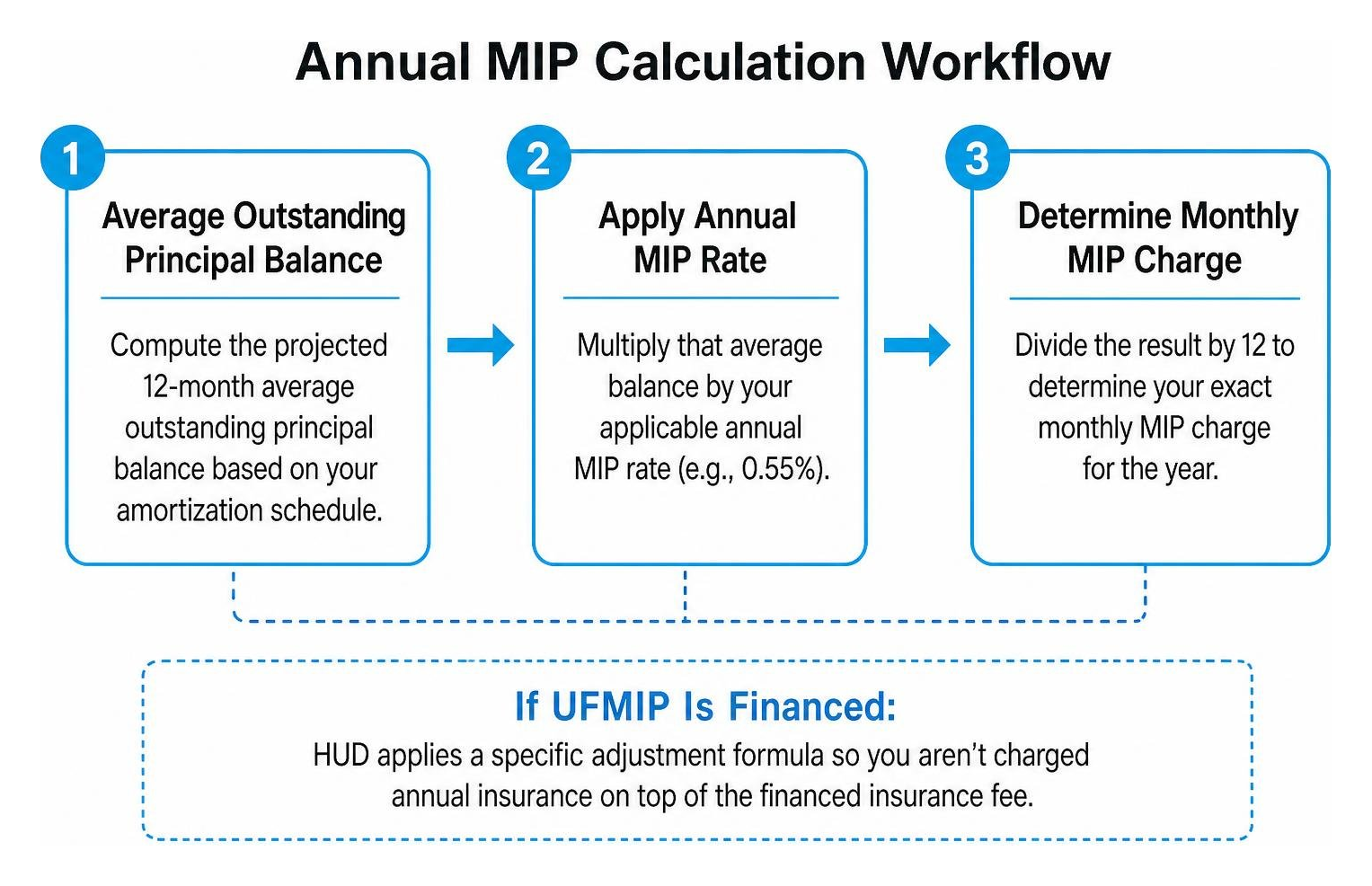
- Compute the projected 12-month average outstanding principal balance based on your amortization schedule.
- Multiply that average balance by your applicable annual MIP rate (e.g., 0.55%).
- Divide the result by 12 to determine your exact monthly MIP charge for the year.
2026 FHA MIP Rate Matrix by Term and Loan Amount
The annual MIP rate you pay depends on three factors: your loan term (greater than 15 years vs. 15 years or less), your base loan amount (relative to the standard threshold of $726,200), and your starting Loan-to-Value (LTV) ratio.
Our FHA Home Loan Guide 2026 outlines the active HUD rate tiers:
| Loan Term | Base Loan Amount | Loan-to-Value (LTV) | Annual MIP Rate (Basis Points) | Annual MIP Rate (%) | Duration |
|---|---|---|---|---|---|
| > 15 Years | ≤ $726,200 | ≤ 95.00% | 50 bps | 0.50% | 11 Years (if LTV ≤ 90%) / Life of Loan |
| > 15 Years | ≤ $726,200 | > 95.00% | 55 bps | 0.55% | Life of Loan |
| > 15 Years | > $726,200 | ≤ 95.00% | 70 bps | 0.70% | 11 Years (if LTV ≤ 90%) / Life of Loan |
| > 15 Years | > $726,200 | > 95.00% | 75 bps | 0.75% | Life of Loan |
| ≤ 15 Years | ≤ $726,200 | ≤ 90.00% | 15 bps | 0.15% | 11 Years |
| ≤ 15 Years | ≤ $726,200 | > 90.00% | 40 bps | 0.40% | Life of Loan |
| ≤ 15 Years | > $726,200 | ≤ 78.00% | 15 bps | 0.15% | 11 Years |
| ≤ 15 Years | > $726,200 | 78.01% – 90.00% | 40 bps | 0.40% | 11 Years |
| ≤ 15 Years | > $726,200 | > 90.00% | 65 bps | 0.65% | Life of Loan |
For 2026, the standard baseline single-family FHA loan limit across most non-high-cost counties is $541,287, while designated high-cost metro areas reach ceilings up to $1,249,125.
How Long Do You Pay FHA Mortgage Insurance?

How long you must pay annual MIP is determined strictly by your initial down payment and starting LTV ratio on the day your loan closes.
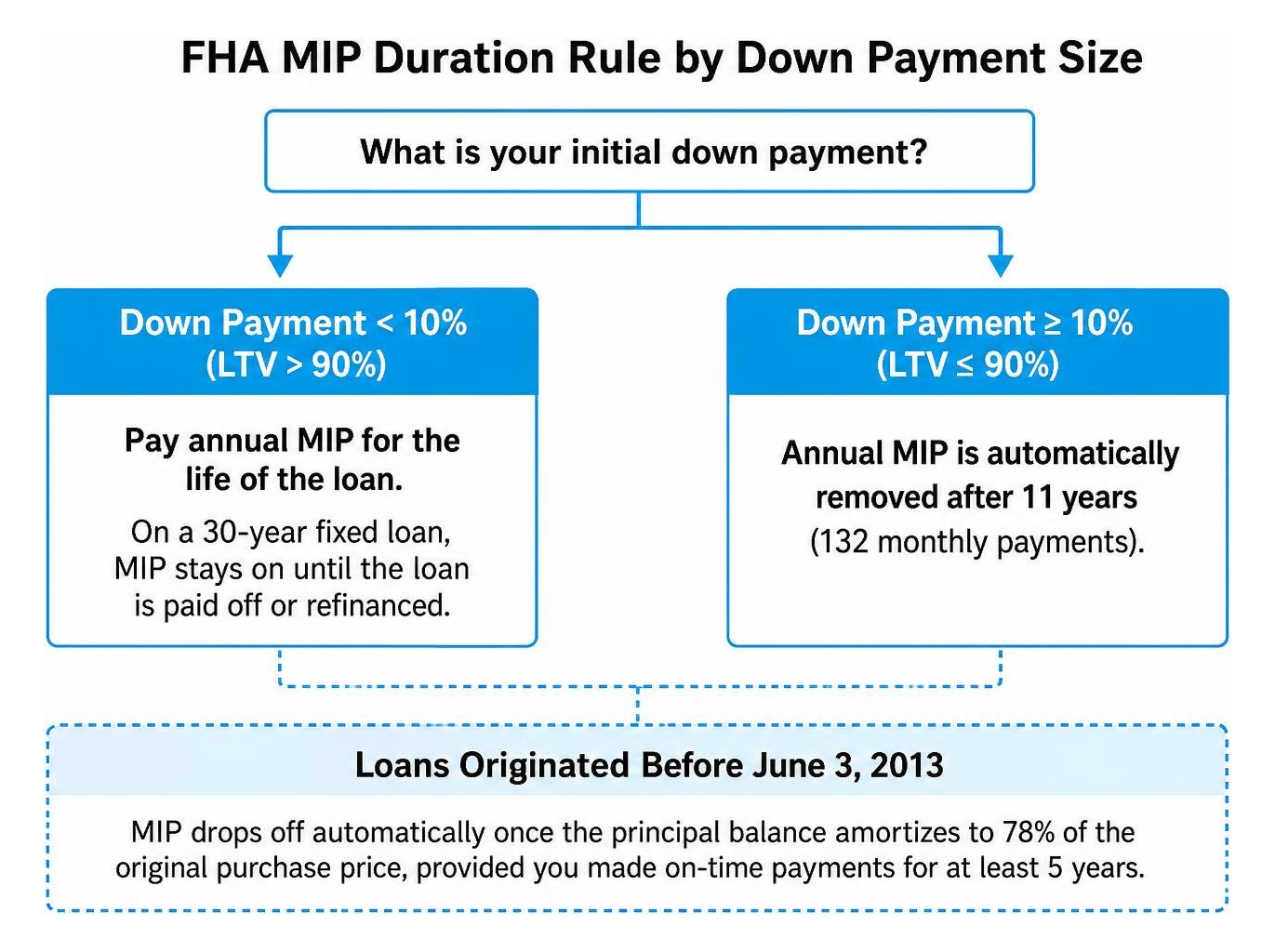
Under rules enacted on June 3, 2013, the traditional automatic cancellation at 78% LTV was eliminated for low-down-payment buyers. Today, the timeline is split into two distinct tracks:
The 11-Year Rule vs. Life-of-Loan Policy
- Down Payment Less Than 10% (LTV > 90%): If you make the minimum 3.5% down payment, you are required to pay annual MIP for the entire remaining term of the mortgage. On a 30-year fixed loan, that means MIP stays on the loan until it is completely paid off or refinanced.
- Down Payment of 10% or More (LTV ≤ 90%): If you put down at least 10% at purchase, HUD removes the annual MIP requirement automatically after 11 years (132 monthly payments).
- Loans Originated Before June 3, 2013: Older FHA mortgages retain grandfathered rules. For those loans, MIP drops off automatically once the principal balance amortizes to 78% of the original purchase price, provided you made on-time payments for at least 5 years.
Understanding these duration rules helps you evaluate the true APR on FHA Loan estimates when comparing different mortgage offers.
3.5% Down vs. 10% Down Payment Cost Comparison
Deciding between putting down 3.5% versus 10% has a major impact on your long-term wealth. Beyond lowering your monthly principal and interest payment, crossing the 10% down threshold triggers the 11-year MIP cancellation rule.
Let’s look at a realistic scenario for a $350,000 home purchase on a 30-year fixed term:
| Metric | Option A: 3.5% Down Payment | Option B: 10% Down Payment | Difference / Savings |
|---|---|---|---|
| Down Payment Amount | $12,250 | $35,000 | +$22,750 cash upfront |
| Base Loan Amount | $337,750 | $315,000 | -$22,750 lower balance |
| Upfront MIP (1.75%) | $5,910.63 | $5,512.50 | -$398.13 saved upfront |
| Starting LTV Ratio | 96.50% | 90.00% | Unlocks 11-Year Rule |
| Annual MIP Rate | 0.55% (55 bps) | 0.50% (50 bps) | -0.05% lower rate |
| Starting Monthly MIP | $154.80 / month | $131.25 / month | -$23.55 / month saved |
| MIP Duration | Life of Loan (360 months) | 11 Years (132 months) | 228 fewer monthly payments |
| Total Lifetime MIP Cost | ~$61,639 | ~$22,600 | $39,039 Total MIP Savings |
By providing an extra $22,750 upfront, the buyer eliminates 19 years of mortgage insurance payments, saving over $39,000 in MIP costs alone, not including additional interest savings on the smaller loan balance.
FHA MIP vs. Conventional PMI: Key Differences

Many home shoppers evaluate FHA financing alongside conventional programs like Fannie Mae HomeReady or Freddie Mac Home Possible. While both loan types allow low down payments, their mortgage insurance structures operate under very different rules. You can compare how these fee differences shape your monthly bottom line using an FHA Mortgage Calculator – FHA MIP Calculator.
Credit Score Impact and Risk Pricing
- FHA MIP Uses Flat Pricing: HUD does not change upfront or annual MIP rates based on your credit score. A borrower with a 580 FICO score receives the exact same 0.55% annual MIP rate as a borrower with a 780 FICO score.
- Conventional PMI Uses Risk-Based Pricing: Private mortgage insurers price coverage based on credit scores and loan-to-value tiers. A borrower with an 800 credit score might pay as little as 0.20% in annual PMI, while a buyer with a 640 credit score might be charged 1.20% or more for identical coverage.
- Underwriting Flexibility: As detailed in our guide on Credit Needed for FHA Loan, FHA loans accept credit scores down to 500 (with 10% down) or 580 (with 3.5% down), making them an accessible option when lower credit scores would make conventional PMI expensive.
Cancellation Rules and Equity Thresholds
- Conventional PMI Removal: Under the federal Homeowners Protection Act of 1998, conventional PMI can be cancelled upon written request once you reach 20% equity (80% LTV) based on original value or a new appraisal. Lenders must automatically drop PMI once the loan naturally amortizes to 78% LTV. Conventional loans with 20% down require no mortgage insurance at all.
- FHA MIP Removal: FHA loans require MIP regardless of down payment size, and loans with less than 10% down remain non-cancelable for the life of the mortgage unless refinanced.
Strategies to Eliminate or Lower FHA Mortgage Insurance
If you currently have an FHA loan with permanent MIP, you aren’t necessarily locked into those monthly fees forever. Here are the primary strategies we use at Simply Financial Inc to help homeowners lower or eliminate their mortgage insurance expenses.
Refinancing to a Conventional Mortgage
The most popular strategy to get rid of lifetime FHA MIP is refinancing into a conventional loan once your home reaches at least 20% equity (80% LTV). Equity builds through regular monthly principal payments, property appreciation, or home renovations.
To decide if this move makes financial sense, look at your break-even point:
- Estimated Closing Costs: ~$4,500
- Monthly MIP Elimination: ~$150 / month saved
- Payback Calculation:
$4,500 ÷ $150 = 30 months (2.5 years)
If you plan to stay in the home longer than 2.5 years, refinancing to remove MIP puts money back in your pocket. If you also need cash for home improvements or debt consolidation, an FHA Cash Out Refinance or conventional cash-out can help restructure your balance.
FHA Streamline Refinance and UFMIP Refunds
If market interest rates drop shortly after buying your home, you can use an FHA Streamline Refinance to lower your interest rate with reduced documentation.
If you refinance from one FHA loan to another within 36 months of your original closing date, HUD provides a prorated refund credit on your previous Upfront MIP, which is applied toward the new loan’s upfront insurance fee:
- Refinance within 1–6 months: ~80% UFMIP credit
- Refinance within 12 months: ~70% UFMIP credit
- Refinance within 24 months: ~46% UFMIP credit
- Refinance within 36 months: ~20% UFMIP credit
- After 36 months: No refund credit available
Frequently Asked Questions About FHA Mortgage Insurance
Does FHA mortgage insurance ever drop off automatically?
Yes, but only if you put down 10% or more at closing (initial LTV of 90% or less). In that scenario, annual MIP drops off automatically after 11 years (132 payments). If you put down the minimum 3.5%, annual MIP stays for the entire loan life unless you refinance or pay off the mortgage.
Can you remove FHA MIP without refinancing?
For loans originated on or after June 3, 2013 with less than 10% down, you cannot remove MIP without paying off the balance or refinancing into a conventional mortgage. For loans originated before June 3, 2013, servicers must cancel MIP once the balance drops to 78% of the original purchase price.
Is FHA mortgage insurance tax deductible in 2026?
No. Under current IRS regulations, mortgage insurance premiums (both upfront and monthly MIP) are not deductible on federal tax returns. Standard mortgage interest on your primary residence remains deductible if you itemize deductions.
Conclusion
Navigating the costs of an FHA loan doesn’t have to be confusing. While the upfront fee of 1.75% and monthly premiums between 0.50% and 0.55% add to your housing payment, the FHA program remains one of the most accessible paths to homeownership for buyers looking for low down payments and flexible credit guidelines.
At Simply Financial Inc, our team works directly with homebuyers and homeowners across Chicago, Illinois, and Florida. We believe in providing transparent numbers so you can compare loan options with confidence.
Ready to check your numbers? Connect with us to explore Current Mortgage Rates for FHA Loans and get a customized loan estimate tailored to your financial goals.