

The 2026 FHA Mortgage Pricing Guide: Core Cost Components
When calculating the true cost of an FHA loan, you need to look beyond the advertised interest rate. The Federal Housing Administration (FHA), an agency within the U.S. Department of Housing and Urban Development (HUD), insures mortgages issued by approved lenders. Because the government takes on the default risk, lenders offer competitive baseline rates. However, this safety net is funded entirely by borrowers through specific fees.
To determine your total borrowing expense, you must factor in four primary components:
- The Base Interest Rate (Note Rate): The nominal rate at which your monthly principal and interest payment is calculated.
- Upfront Mortgage Insurance Premium (UFMIP): A mandatory fee of 1.75% of your base loan amount.
- Annual Mortgage Insurance Premium (MIP): An ongoing fee (ranging from 0.15% to 0.75% depending on loan terms, typically 0.55% for standard purchases) broken into 12 equal parts and added to your monthly payment.
- Lender and Third-Party Closing Costs: Standard origination fees, appraisal fees, title insurance, and escrow setup fees.
Understanding the fha mortgage insurance cost is vital because it significantly alters the apr on fha loan estimates you receive from lenders. The Annual Percentage Rate (APR) reflects the total cost of credit, including the note rate, upfront premium, and annualized insurance charges over time.
Using This FHA Mortgage Pricing Guide to Calculate Upfront vs. Annual MIP
The UFMIP is assessed immediately at closing. While you have the option to pay this 1.75% fee in cash, the vast majority of borrowers roll it directly into their total loan balance. For example, on a $400,000 base loan, the 1.75% UFMIP is $7,000. Financing this fee increases your starting mortgage balance to $407,000.
The annual MIP is calculated annually based on the average remaining principal balance, divided by 12, and held in an escrow account. Reviewing current mortgage insurance rates shows how loan-to-value (LTV) ratios and loan terms impact what you pay each month:
| Loan Term | Base Loan Amount | Loan-to-Value (LTV) | Annual MIP (Basis Points) | Duration of Annual MIP |
|---|---|---|---|---|
| > 15 Years (e.g., 30-Year) | $\le$ $726,200 | $\le$ 90.00% (10%+ down) | 0.50% (50 bps) | 11 Years |
| > 15 Years (e.g., 30-Year) | $\le$ $726,200 | > 90.00% (3.5% down) | 0.55% (55 bps) | Life of Loan |
| > 15 Years (e.g., 30-Year) | > $726,200 | $\le$ 90.00% | 0.70% (70 bps) | 11 Years |
| > 15 Years (e.g., 30-Year) | > $726,200 | > 90.00% | 0.75% (75 bps) | Life of Loan |
| $\le$ 15 Years (e.g., 15-Year) | $\le$ $726,200 | $\le$ 90.00% | 0.15% (15 bps) | 11 Years |
| $\le$ 15 Years (e.g., 15-Year) | $\le$ $726,200 | > 90.00% | 0.40% (40 bps) | Life of Loan |
Borrowers who choose shorter amortization schedules can secure substantial insurance discounts by leveraging fha 15 yr rates, where premiums drop as low as 15 to 40 basis points.
FHA Mutual Mortgage Insurance Fund and the 2% Capital Reserve Ratio
FHA mortgage pricing isn’t arbitrary. All upfront and annual premiums flow directly into the Mutual Mortgage Insurance (MMI) Fund. By federal statute, the FHA must maintain an economic net worth of at least 2.0% of the total dollar balance of active insured mortgages.
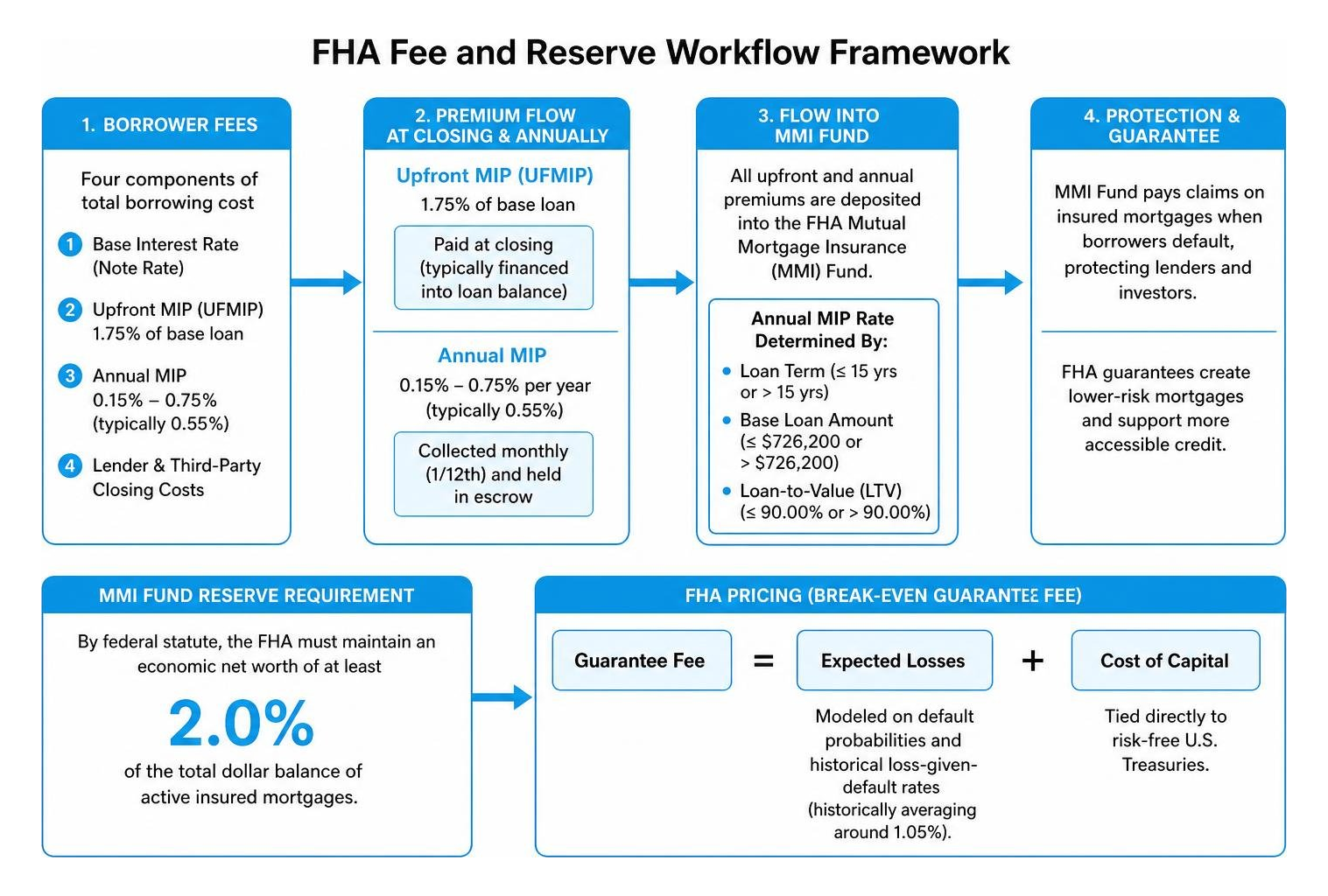
Unlike private mortgage guarantors that require private investor capital and market-rate returns, the FHA operates with a cost of capital tied directly to risk-free U.S. Treasuries. The break-even guarantee fee is modeled on two core components:
$$\text{Guarantee Fee} = \text{Expected Losses} + \text{Cost of Capital}$$
- Expected Losses: Modeled on default probabilities and historical loss-given-default rates (historically averaging around 1.05%).
- Cost of Capital: The capital reserve allocation multiplied by the required statutory return (historically roughly 38.25 basis points).
When the MMI Fund’s capital ratio comfortably exceeds the statutory 2.0% minimum, HUD has policy flexibility to adjust premiums downward to support affordable homeownership. To verify all structural rules, brokers consult the official HUD guidelines and insurance matrix.
How Credit Scores and Down Payments Impact FHA Loan Costs

One of the greatest advantages of an FHA-insured loan is risk-tolerant underwriting. Conventional loans rely heavily on Loan-Level Price Adjustments (LLPAs), which penalize lower credit scores with higher interest rates and steep private mortgage insurance premiums. In contrast, FHA base pricing remains remarkably stable across various credit bands.
FHA Mortgage Pricing Guide by Credit Score and Down Payment Tiers
Under standard HUD rules, your credit profile determines your minimum down payment requirement rather than driving severe rate hikes:
- Credit Scores 580 and Above: Eligible for the minimum 3.5% down payment.
- Credit Scores 500 to 579: Permitted to finance up to 90% LTV, requiring a minimum 10% down payment.
Understanding the baseline credit needed for fha loan helps you plan your initial cash outlay. Underwriters run applications through HUD’s automated underwriting system, the Technology Open To Approved Lenders (TOTAL) Mortgage Scorecard. When automated approval is not achieved, manual underwriting allows approvals with compensating factors—such as verified cash reserves, minimal debt increases, or a proven history of conservative credit usage.
Under standard underwriting guidelines, debt-to-income (DTI) limits are set at 31% for front-end housing costs and 43% for total back-end debt. However, automated approvals with strong compensating factors can see back-end DTI allowances reach up to 57%. You can explore these parameters in detail within our breakdown of conditions for fha loan approval and our broader analysis of fha home loan pricing.
Understanding Lender Overlays vs. Standard FHA Underwriting
While HUD establishes minimum national requirements, actual borrower pricing often depends on whether a lender applies “overlays.” Lender overlays are additional, restrictive guidelines added by individual retail banks. For instance:
- HUD allows credit scores down to 500, but a retail bank may set an overlay minimum of 620.
- HUD permits DTI ratios up to 57% via TOTAL Scorecard, but an institution may cap DTI at 45%.
At Simply Financial Inc, we operate as a mortgage brokerage. Rather than locking you into rigid retail overlays, we review wholesale pricing across multiple wholesale investor channels to find the most flexible terms for your specific credit and financial profile.
2026 FHA Loan Limits and High-Balance Pricing Tiers
Every year, HUD recalculates maximum loan limits based on median home prices across counties. The baseline national floor is set at 65% of the national conforming loan limit, while the high-cost ceiling is capped at 150%.
For 2026, the standard single-family limits are:
- National Low-Cost Floor (1-Unit): $541,287
- High-Cost Area Ceiling (1-Unit): $1,249,125
Borrowers can verify exact county thresholds using the official FHA Mortgage Limits lookup. If you purchase in an area designated as a high-cost market and borrow more than $726,200, your annual MIP increases from 55 basis points to 75 basis points (for LTV > 90%).
Impact of Loan Limits on Multi-Unit Properties and House Hacking
FHA loan limits scale upward for 2- to 4-unit residential properties, creating a wealth-building path known as “house hacking”:
- 2-Unit Limit: Substantially higher than single-family caps, enabling low-down-payment multi-family purchases.
- 3-Unit & 4-Unit Limits: Up to the statutory high-cost caps.
Borrowers can acquire a multi-unit property with as little as 3.5% down, live in one unit as their primary residence, and use up to 75% of the projected rental income from the remaining units to help qualify for the mortgage. For 3- and 4-unit properties, HUD requires the property to pass a “self-sufficiency test,” meaning total net market rents must exceed the full monthly mortgage payment (PITI).
FHA Pricing Compared with VA and USDA Loans
When evaluating government-backed loan options, comparing structural fees helps identify the most cost-effective solution for your situation.
| Loan Feature | FHA Loan | VA Loan | USDA Loan |
|---|---|---|---|
| Minimum Down Payment | 3.5% (580+ credit) or 10% (500–579 credit) | 0% down | 0% down |
| Upfront Government Fee | 1.75% (UFMIP) | 1.25% – 3.30% (VA Funding Fee; waived for disabled veterans) | 1.00% (Guarantee Fee) |
| Ongoing Annual Fee | 0.55% annual MIP (for $\le$ $726,200 and >90% LTV) | None (0.00%) | 0.35% annual fee |
| Minimum Credit Score Guidelines | 500 (10% down) / 580 (3.5% down) | No statutory floor (typically 580–620 overlay) | 640 standard automated underwriting |
| Primary Use Restriction | Primary residence | Primary residence (eligible military/veterans) | Primary residence in eligible rural areas |
Comparing Lifetime Costs, APR, and Mortgage Insurance
For eligible military borrowers, VA financing is almost always the most cost-effective path because it has zero ongoing annual mortgage insurance. For non-military buyers purchasing in designated rural boundaries, USDA financing offers lower upfront and monthly guarantee fees (1.00% upfront and 0.35% annually) compared to FHA’s 1.75% and 0.55%.
However, FHA remains the most flexible choice for urban and suburban buyers with moderate credit scores, higher debt-to-income ratios, or down payment gift funds from family members.
Strategic Ways to Lower Your Total FHA Mortgage Expense

1. Maximize Seller Concessions (Up to 6%)
HUD allows sellers to contribute up to 6% of the purchase price toward the buyer’s closing costs, prepaid taxes, homeowners insurance, and upfront mortgage insurance. On a $350,000 purchase, a 6% concession yields up to $21,000, minimizing out-of-pocket settlement expenses. To see how these credits lower your out-of-pocket requirements, review our guide to calculating fha cash to close.
2. Leverage Gift Funds for 100% of the Down Payment
FHA allows 100% of your 3.5% minimum investment to come from verified gifts provided by family members, employers, labor unions, or approved charitable down payment assistance programs, provided gift letters and bank transfers are properly documented.
3. Evaluate Discount Points Carefully
Purchasing discount points lowers your ongoing note rate. However, because FHA annual MIP remains fixed based on your principal balance, calculate your break-even period (cost of points divided by monthly interest savings) before paying upfront for rate reductions.
Refinancing and Cancellation Strategies to Eliminate Ongoing MIP
If you put down less than 10%, your annual MIP stays on the loan for its full term. The primary exit strategy is refinancing once your home gains sufficient value:
- Refinancing to Conventional: When your property reaches roughly 20% equity (80% LTV), refinancing into a conventional mortgage completely removes mortgage insurance.
- FHA Streamline Refinance: If interest rates drop, an FHA Streamline allows rate and payment reductions with reduced underwriting and documentation requirements.
- FHA Cash-Out Refinancing: Homeowners looking to consolidate debt can use an fha cash out refinance up to HUD’s standard maximum LTV limits.
Frequently Asked Questions about FHA Mortgage Pricing
How is the upfront mortgage insurance premium (UFMIP) paid at closing?
The 1.75% UFMIP is typically rolled into your total financed amount. For example, on a $300,000 base loan, $5,250 is added to create a final loan balance of $305,250. Alternatively, borrowers can pay the full amount in cash at closing to avoid paying interest on the premium over time.
Can I remove annual MIP from an FHA loan without refinancing?
Annual MIP can only be automatically canceled without refinancing if you made a down payment of at least 10% (an original LTV of 90% or less) at the time of purchase. Under this rule, HUD automatically drops the annual MIP after 11 years. If you put down 3.5%, the annual MIP lasts for the entire life of the loan unless you refinance into a conventional loan.
Why are FHA interest rates often lower than rates for other loan options?
Because the FHA government guarantee protects lenders against catastrophic default losses, secondary mortgage market investors (who buy Ginnie Mae mortgage-backed securities) accept lower yields. While the base note rate is often lower than conventional equivalents, the total APR may be higher once the 1.75% UFMIP and 0.55% annual MIP are included.
Conclusion
Securing an FHA mortgage is one of the most reliable ways to achieve homeownership, but finding the right terms requires looking at the complete pricing structure—interest rates, upfront fees, ongoing MIP, and lender overlays.
At Simply Financial Inc, our Chicago-based team helps homebuyers across Illinois and Florida navigate their mortgage options without unnecessary retail markups. Whether you are buying your first home, house hacking a multi-unit property, or planning your future refinance strategy, we provide clear, side-by-side pricing comparisons tailored to your financial goals.
To see today’s available terms and compare personalized options, check our updated current mortgage rates for fha loans and speak with our mortgage professionals today.