

What Today’s FHA Streamline Rate Means for Your Payment
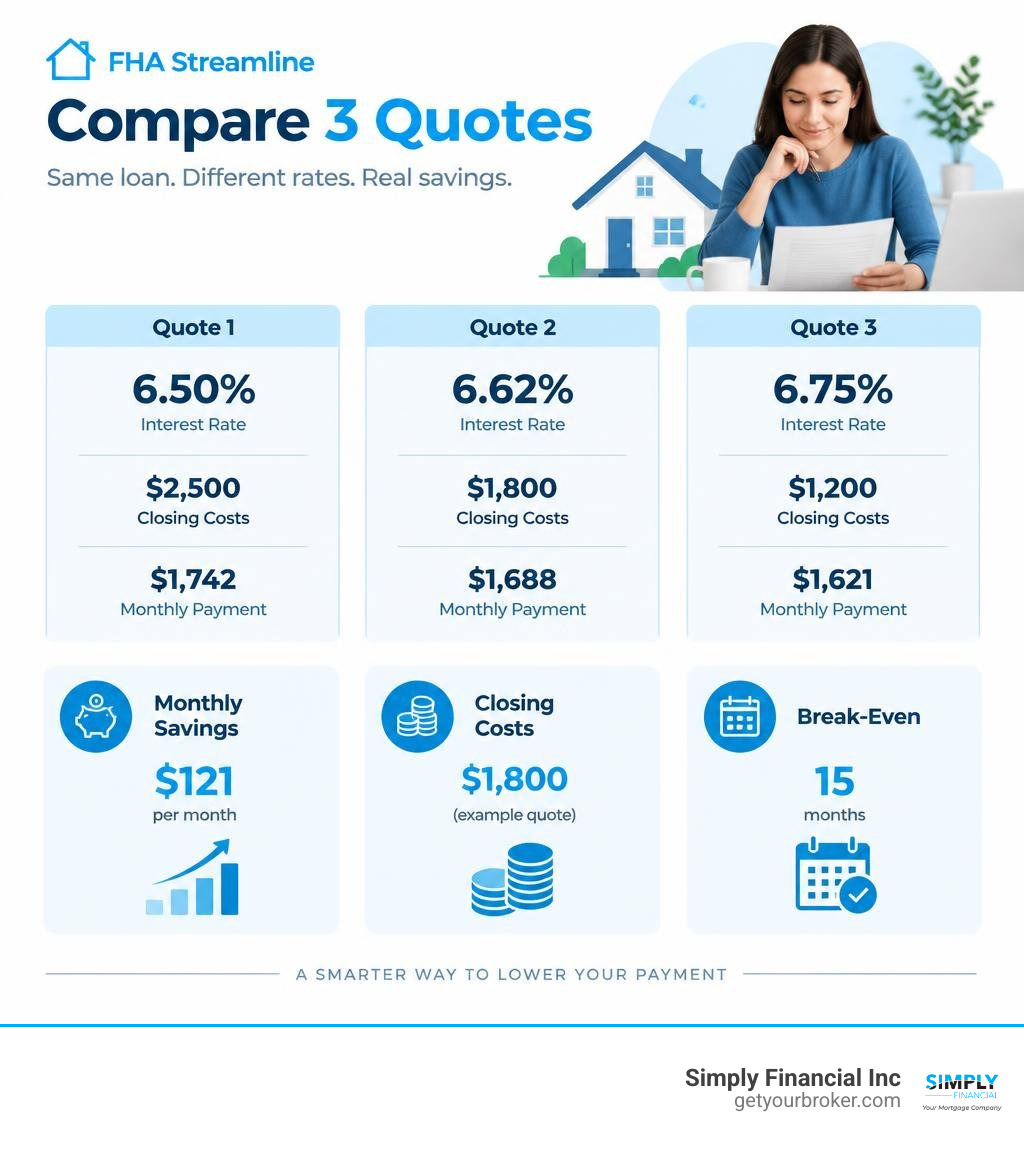
Recent 2026 reports put FHA streamline refinance rates near 6.62% nationally, but that is not a live quote for today. Your rate may differ by lender, loan term, and discount points. To see whether refinancing could save you money, get same-day quotes from at least three FHA lenders. Compare the rate, closing costs, and new monthly payment against your current loan.
An FHA streamline may let you refinance an existing FHA loan without a new appraisal. But a lower payment alone does not prove it is a good deal: check how long your monthly savings would take to cover the costs.
I’m Peter Babjak of Simply Financial Inc, a Chicago mortgage broker founded in 2007. I help homeowners compare the FHA streamline rate today with their current loan and understand the costs before they decide.
How to Check and Understand Your FHA Streamline Rate Today

Finding the right time to refinance starts with knowing how government-backed pricing works. When you look at current mortgage rates for FHA loans, you are viewing interest rates backed by the Federal Housing Administration. These loans carry lower risk for lenders because the federal government insures them against default, which helps keep rates competitive for eligible FHA borrowers.
To properly evaluate your options, you must look beyond top-line headline numbers. A published rate usually assumes specific borrower criteria, optional upfront fees, and standard loan structures. Understanding where current benchmarks sit will give you the baseline you need to review loan estimates accurately.
Current Benchmark Trends for the FHA Streamline Rate Today
In October 2026, national benchmark data shows standard 30-year FHA streamline rates hovering near 6.62%. Depending on market movements and whether you choose to purchase discount points, advertised rates across the market currently range from 5.50% to 6.50%. Shorter terms offer even greater discounts; for example, 15-year fixed FHA loans are available around 6.125%.
Tracking broader fha loan rate trends helps you spot when market windows open. Mortgage rates fluctuate daily alongside the 10-year Treasury yield and broader economic data. When yields dip, lenders adjust pricing sheets quickly. Even a minor dip creates an actionable window for homeowners who already hold higher-rate mortgages from recent years.
Factors That Influence Your Personalized Streamline Rate
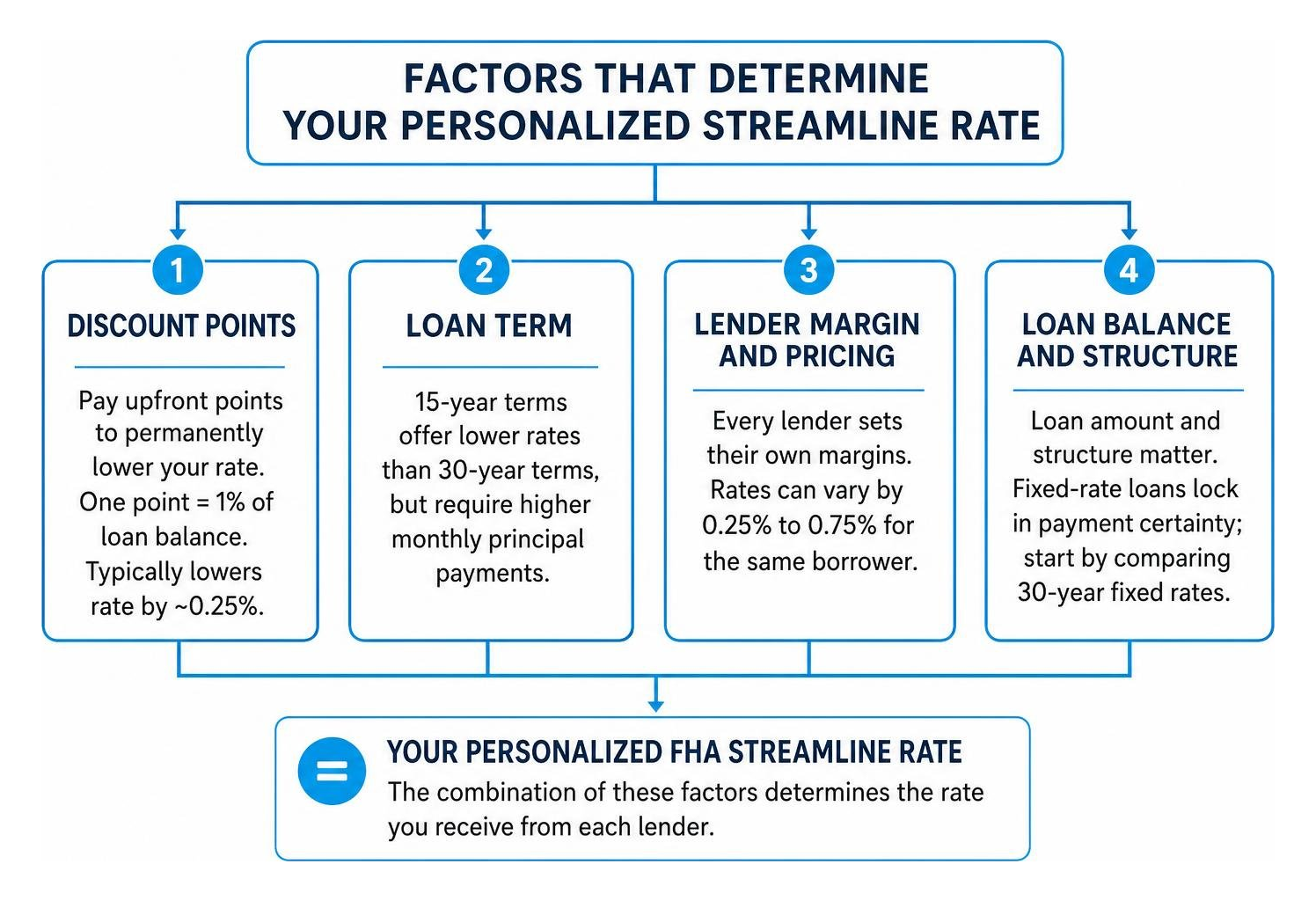
Your final interest rate depends on several customized elements:
- Discount Points: You can pay upfront points to permanently lower your interest rate. One point equals 1% of your total loan balance and typically shaves roughly 0.25% off your note rate.
- Loan Term: Opting for a 15-year term delivers lower rates than a 30-year term, though your required monthly principal payment will be higher.
- Lender Margin and Pricing: Every mortgage broker and lender sets their own margins. Two different lenders looking at the exact same borrower can offer rates that vary by 0.25% to 0.75%.
- Loan Balance and Structure: Fixed-rate structures lock in your payment certainty, which is why reviewing current mortgage rates FHA 30 year fixed is the best place to begin your comparisons.
How Much Money You Can Save by Refinancing in 2026

The primary goal of any refinance is improving your household cash flow or slashing long-term interest expenses. Our comprehensive fha mortgage rates guide 2026 outlines how modern loan adjustments make refinancing especially cost-effective this year.
Lower Monthly Payments and Interest Reductions
Lowering your rate by even half a percentage point can yield significant monthly relief. Here is how payment savings scale across common loan balances when lowering a rate from an existing 7.00% to a streamlined 5.75%:
- $250,000 Loan Balance: Refinancing reduces your monthly principal and interest payment by roughly $211, saving you approximately $2,532 every year.
- $300,000 Loan Balance: Dropping from 7.00% to 5.75% lowers your payment by $253 per month, putting $3,036 back into your pocket annually.
- $400,000 Loan Balance: Moving to a 5.75% rate cuts your monthly obligation by $389, delivering $4,668 in yearly savings.
Even smaller interest adjustments produce clear results. For a typical $250,000 loan, a modest 0.30% reduction reduces monthly payments by about $75. Over several years, those compounded savings make a huge difference in total interest paid across your fha home mortgage rates.
Mortgage Insurance Premium Reductions and MIP Refunds
FHA loans carry both an Upfront Mortgage Insurance Premium (UFMIP) and an Annual Mortgage Insurance Premium (annual MIP). The FHA maintains an annual MIP rate of 0.45% of the loan balance for streamlined refinances, significantly lower than historic benchmarks.
Additionally, if you purchased your home or took out your current FHA loan within the past 36 months, you are eligible for a partial refund on your previous upfront MIP. This refund is applied as a credit toward the new loan’s upfront insurance premium, drastically reducing your transaction costs:
- Refinancing within 12 months: Up to a 68% credit of your original upfront MIP.
- Refinancing between 13 and 24 months: A credit ranging from 44% down to 22%.
- Refinancing between 25 and 36 months: A credit ranging from 20% down to 10%.
After 36 months, the refund phase-out reaches zero, making earlier refinancing particularly advantageous.
How to Qualify for an FHA Streamline Refinance
Qualifying for an FHA streamline refinance is substantially simpler than applying for many other refinance options. Reviewing the basic fha loan rate requirements ensures your file sails through underwriting without surprises.
Core Eligibility and Net Tangible Benefit Rules
FHA’s official streamline refinance guidance explains that each streamline refinance must provide a clear “Net Tangible Benefit” to the homeowner:
- Payment Reduction: If you are refinancing from a fixed-rate loan to another fixed-rate loan, your combined principal, interest, and monthly MIP payment must drop by at least 0.50% (50 basis points).
- Loan Seasoning: You must have made at least six consecutive monthly payments on your current loan, and at least 210 days must have passed since your previous loan closing date.
- Payment History: You must have an on-time mortgage payment history for the past six months, with no more than one 30-day late payment over the previous 12 months.
- Occupancy: The property must serve as your primary residence.
Appraisal and Credit Documentation Requirements
The streamline program removes traditional underwriting hurdles:
- No Home Appraisal Required: Your current home value does not impact your eligibility. Even if local home values have softened, you can still refinance based on your original purchase valuation.
- No Income Documentation: Standard non-credit qualifying streamlines do not require tax returns, W-2 forms, or paystubs.
- No Credit Score Check: The program focuses primarily on your on-time mortgage payment history rather than standard credit bureau reporting.
How to Choose Between Standard and No-Cost Streamline Options
When setting up your new loan, you have two primary methods to handle transaction costs. FHA streamline closing fees typically range between $2,000 and $5,000, depending on local settlement fees and prepaid escrow requirements.
| Feature | Standard FHA Streamline | No-Cost FHA Streamline |
|---|---|---|
| Upfront Cash Required | $2,000 – $5,000 at closing | $0 out-of-pocket |
| Interest Rate | Lowest available market rate | Slightly higher (0.25% – 0.50% higher) |
| How Fees Are Paid | Paid directly with cash | Covered by lender credits |
| Best Suited For | Long-term homeowners (5+ years) | Short-to-medium stays (under 5 years) |
| Immediate Break-Even | Requires 12–24 months of savings | Immediate break-even on Day 1 |
Comparing Out-of-Pocket Fees and Lender Credits
With a standard streamline, you pay closing costs out of pocket at settlement. In exchange, you lock in the lowest possible note rate, ensuring maximum monthly savings for the entire life of your loan.
With a no-cost streamline, we provide a lender credit that covers your title, settlement, and processing costs. In exchange, you accept an interest rate that is typically 0.25% to 0.50% higher than the absolute lowest rate available. You bring zero dollars to the closing table while still lowering your monthly mortgage payment.
Calculating Your Break-Even Point
Your break-even point is the exact month where your accumulated monthly payment savings surpass the money spent on closing costs.
$$\text{Break-Even Months} = \frac{\text{Total Out-of-Pocket Closing Costs}}{\text{Monthly Payment Savings}}$$
For instance, if your closing costs total $2,400 and your monthly savings are $133 per month, your break-even period is 18 months ($2,400 / $133 = 18). If you plan to stay in your home longer than 18 months, paying the closing costs upfront makes complete financial sense. If you anticipate moving within two years, a no-cost option with immediate day-one savings is the smarter choice.
Step-by-Step Guide to Completing Your Refinance Fast
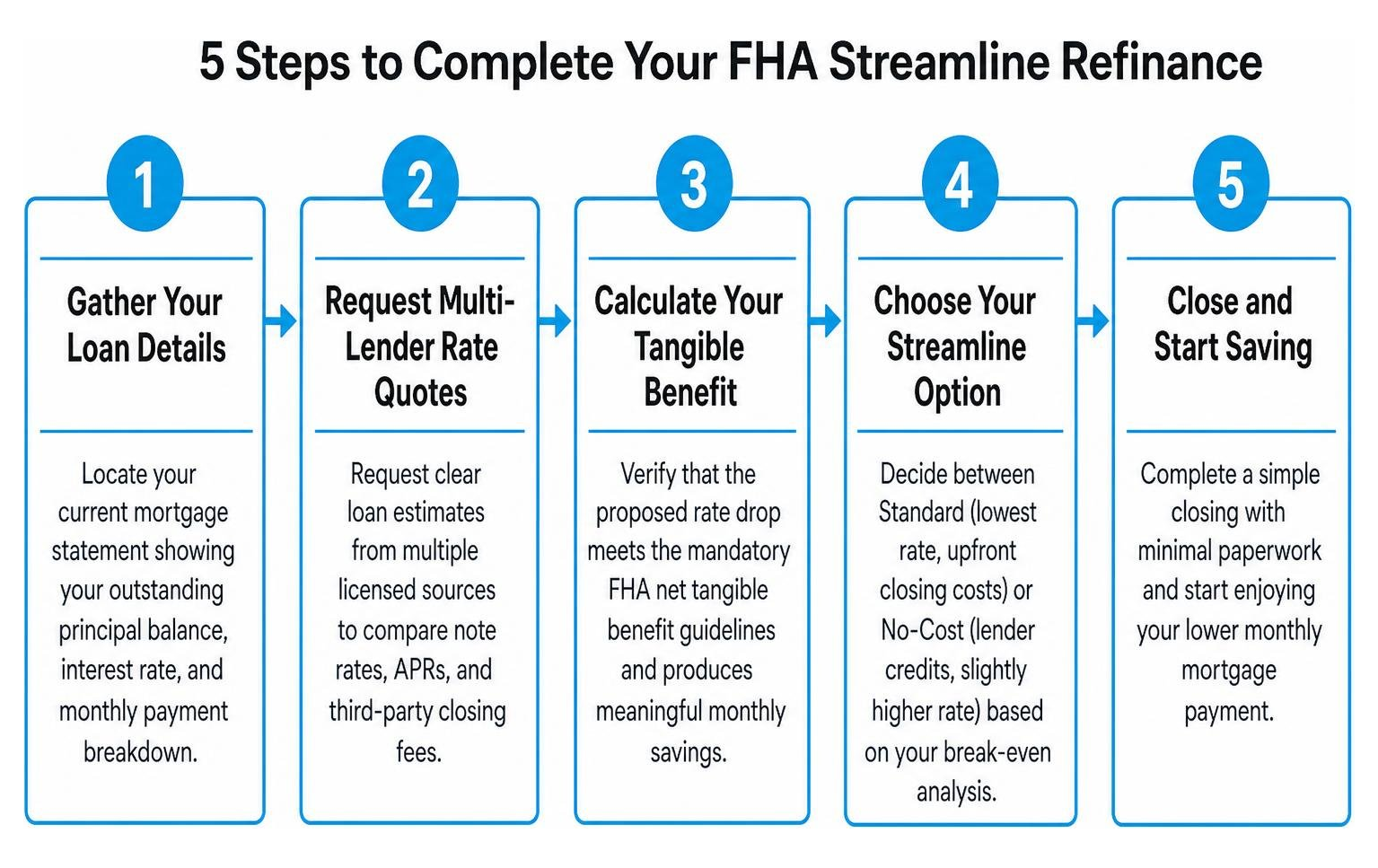
Executing an FHA streamline is straightforward when you follow a structured plan to secure the best FHA rates today:
- Gather Your Loan Details: Locate your current mortgage statement showing your outstanding principal balance, interest rate, and monthly payment breakdown.
- Request Multi-Lender Rate Quotes: Request clear loan estimates from multiple licensed sources to compare note rates, APRs, and third-party closing fees.
- Calculate Your Tangible Benefit: Verify that the proposed rate drop meets the mandatory FHA net tangible benefit guidelines and produces meaningful monthly savings.
- Lock In Your Pricing: Secure a written rate lock agreement to protect your terms from market volatility during underwriting.
- Review Disclosures and Close: Review your final Closing Disclosure (CD), sign the streamlined paperwork, and enjoy your lowered mortgage payment.
Locking in Your FHA Streamline Rate Today
Mortgage markets move continuously during trading hours. Reviewing current fha loan rates today gives you a clear picture of intraday pricing. Once you find a rate and payment that fits your budget, lock it in immediately. Standard rate locks run between 45 and 60 days, giving you ample time to complete the streamline process without risking sudden market spikes.
Timeline from Application to Closing in 14 to 21 Days
Because the streamline program bypasses home appraisals, physical property inspections, and comprehensive employment audits, turnaround times are remarkably fast. While traditional refinances often take 30 to 45 days, an FHA streamline typically wraps up in just 10 to 15 business days (14 to 21 calendar days). Submitting your mortgage statement and homeowner’s insurance policy promptly ensures the fastest possible closing.
Frequently Asked Questions About FHA Streamline Refinances
Can closing costs be rolled into an FHA streamline loan balance?
No. Under standard FHA streamline rules, you cannot roll regular closing costs into your new principal balance. With an FHA streamline refinance, those costs are generally paid at closing or covered through lender credits. Understanding what are FHA loan rates today helps you decide whether accepting a slightly higher rate with lender credits makes sense for your cash reserves.
How do FHA streamline rates compare to other FHA refinance rates?
FHA streamline rates are determined by the lender’s pricing, loan term, and any lender credits or discount points. Because streamline transactions require far less processing overhead, underwriting review, and administrative work for lenders, the cost savings are passed directly along to borrowers in the form of lower fees and competitive interest pricing.
Will refinancing reset my 30-year mortgage amortization schedule?
When you refinance into a new 30-year loan, your repayment timeline resets to 360 months. However, you are not required to choose another 30-year term. You can refinance into a 15-year, 20-year, or 25-year fixed loan structure. Alternatively, you can take a new 30-year streamline loan to lower your mandatory payment and voluntarily apply your monthly savings toward principal reduction, retiring your mortgage balance even faster.
Conclusion
Refinancing an FHA mortgage does not have to involve endless paperwork, invasive appraisals, or unexpected delays. At Simply Financial Inc, our Chicago-based mortgage brokerage team delivers a seamless, stress-free lending experience tailored directly to your financial goals across Illinois and Florida.
Take advantage of current market opportunities to cut your monthly overhead. When you are ready to lower your payments, explore your FHA loan refinancing options with our expert team and lock in your savings today.