

Understanding Jumbo Loan Closing Costs Chicago: Breakdown and Averages
Closing on a luxury single-family home in Lincoln Park or a high-rise condo in Streeterville involves a distinct set of numbers. In Illinois, closing fees are not a flat rate; they scale with the purchase price and loan amount. Because jumbo mortgages exceed the standard conforming loan limits set by the Federal Housing Finance Agency (FHFA), lenders take on non-conforming portfolio risk, which directly influences settlement requirements.
| Fee / Requirement Category | Conforming Conventional Loan | Jumbo Loan (Chicago / Cook County) |
|---|---|---|
| Typical Closing Cost % | 2% to 4% of purchase price | 2% to 3% of purchase price (lower % due to higher base, higher absolute $) |
| Lender Origination & Underwriting | $500 to $1,800 flat or 0.5% | $1,500 to $3,500 or 0.5% to 1.0% |
| Appraisal Requirements | Single appraisal ($400 – $700) | Single or Dual specialized appraisals ($600 – $1,800+) |
| Lender’s Title Policy | 0.3% to 0.5% of loan amount | 0.3% to 0.8% (tiered by loan size) |
| Post-Closing Asset Reserves | 0 to 2 months PITI | 6 to 12+ months PITI in verified liquid assets |
| City of Chicago Transfer Tax (Buyer) | $3.75 per $500 of purchase price | $3.75 per $500 of purchase price |
| Illinois State Transfer Tax (Buyer) | $0.50 per $500 of purchase price | $0.50 per $500 of purchase price |
When evaluating a Jumbo Loan vs Conventional financing structure, the core difference at closing comes down to larger absolute transfer taxes, higher title premiums, specialized valuation fees, and strict post-closing liquidity reserves.
How Jumbo Loan Closing Costs Chicago Differ from Conforming Mortgages
Conforming loans adhere to strict underwriting packages backed by Fannie Mae or Freddie Mac. When borrowing above non-conforming limits, private investors and portfolio lenders set their own rules.
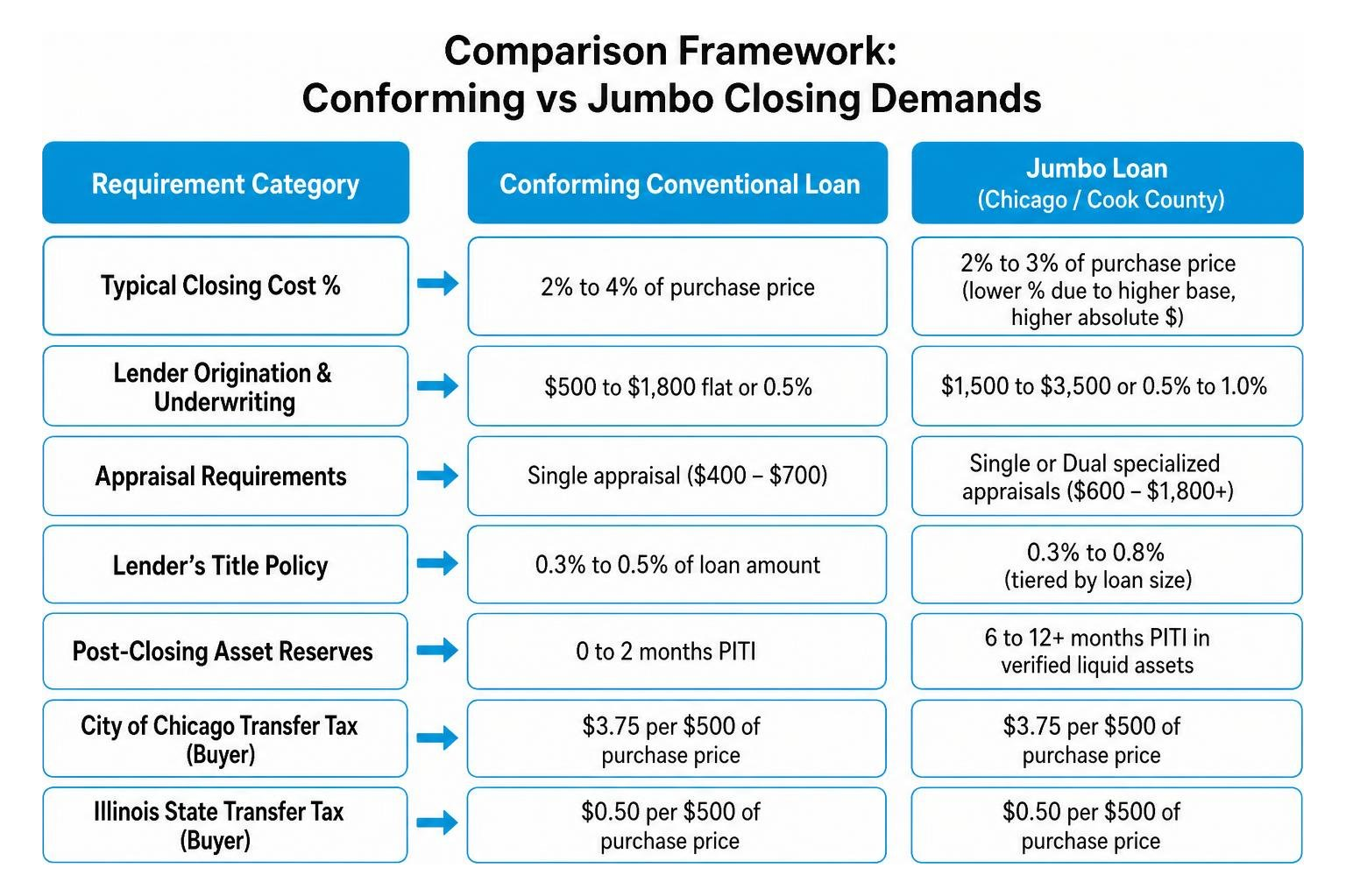
This introduces several key differences:
- Origination and Underwriting Charges: Non-conforming jumbo underwriting involves manual risk assessments, multi-layered asset verification, and complex tax return analyses. This complexity often translates to lender fees ranging from $1,500 to over $3,000.
- Appraisal Complexity: While smaller purchases might utilize automated valuation models or single standard appraisals, jumbo lenders frequently require detailed narrative appraisals or two independent valuations on multimillion-dollar properties.
- Down Payment and Escrow Scale: While smaller loan programs like FHA Loan Closing Costs Chicago allow low down payments with standardized mortgage insurance, jumbo products avoid conventional PMI by requiring larger down payments and robust initial escrow cushions.
Average Percentage and Dollar Expectations for Chicago High-Balance Purchases
For a standard financed purchase in Cook County, total buyer closing fees commonly land between 2% and 3% of the purchase price, excluding the down payment.
To see how this works in practice, consider a $1,000,000 purchase with an $800,000 jumbo loan compared to a $1,500,000 purchase with a $1,200,000 loan:
- $1,000,000 Purchase ($800,000 Loan):
- City & State Transfer Taxes (Buyer): $8,500
- Lender Origination & Underwriting: $2,000
- Appraisal & Credit Fees: $900
- Title & Closing Legal Fees: $4,500
- Prepaid Interest & Escrows (Taxes/Insurance): $8,500
- Estimated Settlement Costs: $24,400 (approx. 2.44%)
- $1,500,000 Purchase ($1,200,000 Loan):
- City & State Transfer Taxes (Buyer): $12,750
- Lender Origination & Processing: $2,500
- Specialized Dual Appraisals: $1,600
- Title, Recording & Legal Representation: $6,500
- Prepaid Interest & Initial Escrow Reserves: $12,500
- Estimated Settlement Costs: $35,850 (approx. 2.39%)
These estimates cover standard settlement and prepaid requirements. They do not account for independent buyer-broker compensation agreements or elective mortgage discount points.
Chicago and Cook County Specific Taxes, Fees, and Title Expenses
Closing on real estate in Cook County involves unique local customs and municipal charges that can catch out-of-state buyers off guard.
Municipal and State Transfer Stamps in Cook County
Unlike many jurisdictions where real estate transfer taxes are nominal or split evenly, the City of Chicago and the State of Illinois impose specific statutory rates:
- City of Chicago Buyer Transfer Tax: Chicago levies a transfer tax of $3.75 per $500 of the purchase price ($7.50 per $1,000) on the buyer. (The seller pays a separate municipal tax of $1.50 per $500).
- State of Illinois Transfer Tax: The state charges $0.50 per $500 ($1.00 per $1,000), which is collected from the buyer at settlement.
- Cook County Recording Fees: Recording the mortgage and deed with the Cook County Clerk typically runs between $150 and $300, depending on page counts and document riders.
On a $1,200,000 jumbo home purchase within Chicago city limits, the municipal and state transfer stamps paid by the buyer total $10,200 ($9,000 municipal + $1,200 state).
Illinois Title Insurance, Settlement Fees, and Attorney Representation
Illinois operates under specific legal traditions for title insurance and legal representation:
- Lender’s Title Policy: A mandatory, one-time premium paid by the buyer to protect the lender against title defects. Rates are tiered based on the loan balance, generally running 0.3% to 0.8% ($2,400 to $4,500+ on a typical jumbo balance).
- Owner’s Title Policy: By local custom in Chicago, the seller pays for the owner’s title insurance policy, protecting the buyer’s equity. This remains subject to the final terms of the purchase contract.
- Real Estate Attorney Fees: Chicago is an “attorney closing state.” Having a dedicated real estate attorney manage the title review, contract modifications, and settlement representation is standard practice. Expect attorney fees to run between $500 and $1,500 for a residential closing.
Jumbo Underwriting Demands, Prepaids, and Condo-Specific Assessments

High-balance financing introduces specialized due-diligence checks from underwriters alongside upfront carrying costs for insurance and local taxes.
Specialized Appraisals and Post-Closing Asset Reserves
Securing a Jumbo Loan requires satisfying stringent investor requirements:
- High-Value Appraisals: For properties valued over $1,000,000 to $1,500,000, lenders frequently require a full appraisal by a certified luxury specialist or two separate appraisals from different appraisal management companies to verify market value. These evaluations cost $600 to $1,800+.
- Post-Closing Liquidity Reserves: While not paid to a third party at closing, lenders mandate that buyers hold 6 to 12 months (or more) of PITI (Principal, Interest, Taxes, and Insurance) in verified liquid or semi-liquid assets after paying their down payment and closing costs. For an $8,000 monthly payment, this means showing an extra $48,000 to $96,000 in verified reserves.
Prepaid Interest, Property Tax Escrows, and HOA Capital Contributions
Prepaid items fund the ongoing ownership costs of your home:
- Cook County Property Tax Arrears & Escrows: In Illinois, property taxes are billed and paid one year in arrears. At closing, the seller gives the buyer a tax proration credit for the time they owned the home. In turn, the lender establishes an escrow account by collecting 2 to 3 months of upfront tax reserves.
- Homeowners / HO-6 Insurance: Lenders require the first full year of hazard insurance paid upfront ($1,200 to $3,000+ annually), plus a 2-month escrow cushion.
- Prepaid Per-Diem Interest: Daily interest charges from your closing date to the end of the calendar month ($100 to $2,500, depending on loan size and closing day).
- Chicago Condo Fees (Lake View, West Loop, Gold Coast): Buyers of luxury condominiums face association-specific closing fees. These include HOA transfer/move-in fees ($250 to $1,000), estoppel/resale disclosures ($100 to $400), and upfront capital reserve contributions (often equal to 1 to 2 months of regular HOA dues).
Strategies to Minimize and Calculate Jumbo Loan Closing Costs Chicago
Managing cash to close effectively requires planning ahead during your mortgage search:
- Schedule an End-of-Month Closing: Closing on the 28th rather than the 3rd eliminates weeks of prepaid per-diem interest charges.
- Shop Title and Settlement Closing Charges: While municipal transfer taxes are non-negotiable, title settlement fees and attorney rates can vary.
- Compare Official Loan Estimates: Request structured estimates from lenders to evaluate origination charges, administrative fees, and rate-lock options side by side.
- Leverage Lender Credits: You can trade a slightly higher interest rate for a lender closing cost credit to reduce out-of-pocket settlement expenses.
Estimating Cash to Close: How to Calculate Jumbo Loan Closing Costs Chicago
Accurately calculating your settlement capital means separating loan costs from prepaids and down payments.
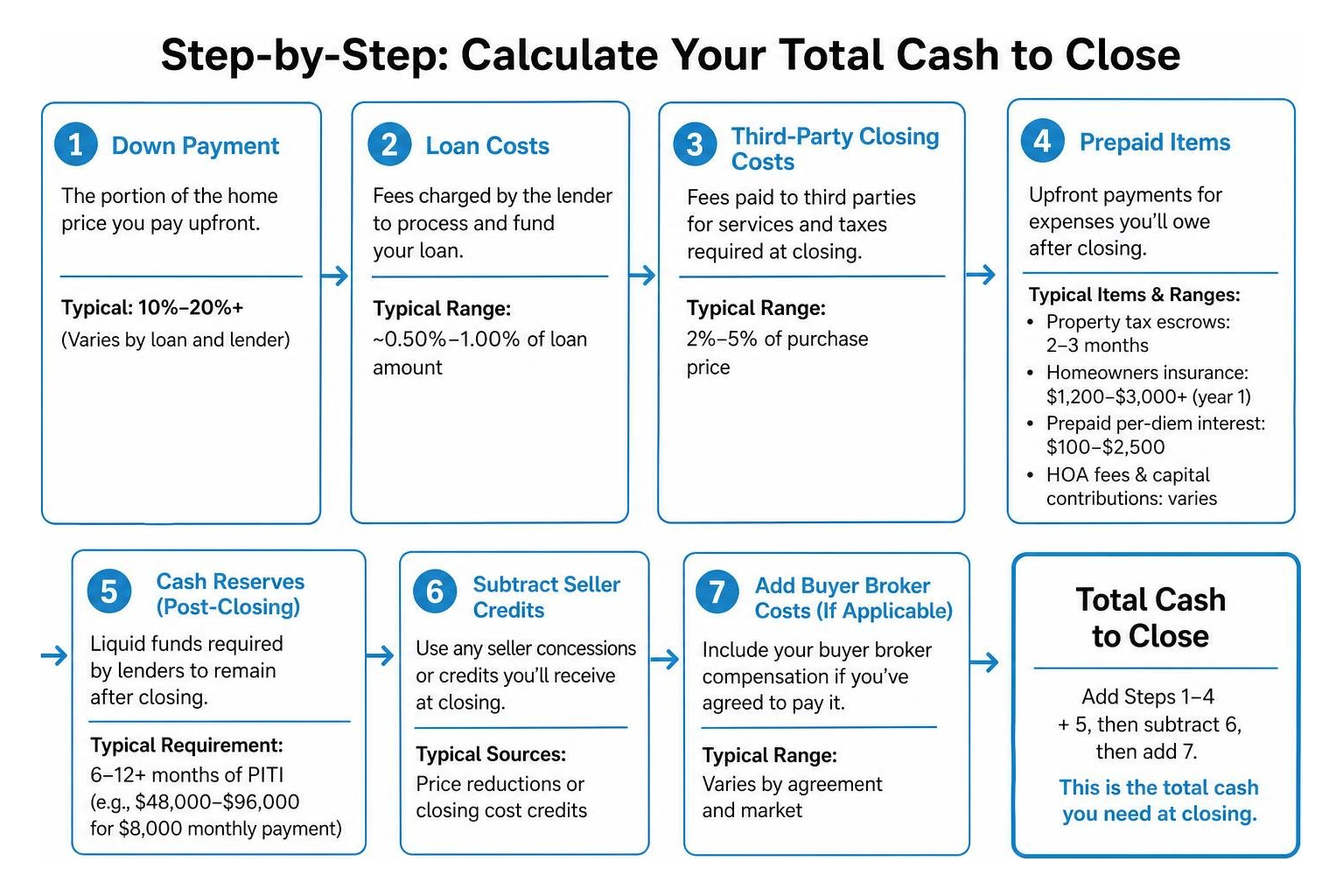
You can explore our interactive tools using the Jonesboro, IL Jumbo Loan Closing Cost Calculator or the local Chi, IL Jumbo Loan Closing Cost Calculator to view itemized breakdowns. For additional regional insights, refer to Closing Costs in Chicago: Complete Buyer’s Guide | Dee Savic.
Federal regulations require your lender to deliver an official Loan Estimate within 3 business days of receiving your application and a final Closing Disclosure at least 3 business days before your scheduled closing date. Compare these documents line by line to verify that your quoted fees match the final settlement statement.
Negotiating Seller Concessions and Factoring Buyer Broker Representation
Navigating modern purchase agreements requires accounting for two key transaction variables:
- Seller Concessions: You can negotiate seller closing cost credits during purchase contract discussions or following the home inspection. For conforming loans, seller concessions have strict caps; jumbo guidelines vary by investor, often allowing 3% to 6% in concessions depending on your down payment percentage.
- Buyer Broker Compensation: Following real estate industry settlement rules, buyer broker representation fees (typically 2% to 3%) are negotiated directly between the buyer and their broker via written representation agreements. If the seller does not offer a cooperating credit to cover this fee, you must account for it within your total cash-to-close plan.
Understanding every phase of the Chicago Mortgage Process and securing a reliable Mortgage Pre-Approval early helps ensure you are fully prepared for every closing line item.
Frequently Asked Questions About Chicago Jumbo Mortgage Fees
Who customarily pays transfer taxes and title policies on a Chicago jumbo purchase?
In the City of Chicago, the buyer pays the City buyer transfer tax ($3.75 per $500) and the State transfer tax ($0.50 per $500), while the seller pays the City seller transfer tax ($1.50 per $500). By local Cook County custom, the seller covers the owner’s title insurance policy, while the buyer pays for the lender’s title insurance policy. All terms remain subject to negotiation within your purchase contract.
How many months of mortgage reserves do jumbo lenders in Chicago require?
Most jumbo lenders require 6 to 12 months of PITI (Principal, Interest, Taxes, and Insurance) in verified liquid or semi-liquid reserves after closing. For very high loan balances ($1.5M+) or multi-unit luxury properties, some investors may require up to 18 to 24 months of reserves.
Can closing costs and escrow reserves be rolled into a Chicago jumbo loan?
Closing costs generally cannot be directly added on top of the purchase price if the resulting loan balance exceeds the lender’s maximum Loan-to-Value (LTV) limits. However, you can offset these expenses by negotiating seller concessions or choosing a slightly higher interest rate in exchange for a lender closing credit.
Navigating Your Chicago Luxury Home Purchase with Confidence
Navigating jumbo mortgage settlement expenses does not need to be overwhelming. At Simply Financial Inc, our Chicago team—based right at 5632 W Lawrence Ave—specializes in delivering a seamless, expert-guided, stress-free mortgage experience. Whether you are purchasing a historic brownstone in Lincoln Park or a penthouse in River North, we help you structure high-balance financing that aligns with your long-term wealth goals.
Ready to explore your financing options? Discover our comprehensive mortgage loan options and connect with our experienced brokerage team today.