

What You Need to Know About Getting a Jumbo Loan
A jumbo loan is a mortgage that exceeds the conforming loan limits set each year by the Federal Housing Finance Agency (FHFA). In simple terms: if you need to borrow more than the standard limit, you’re in jumbo territory.
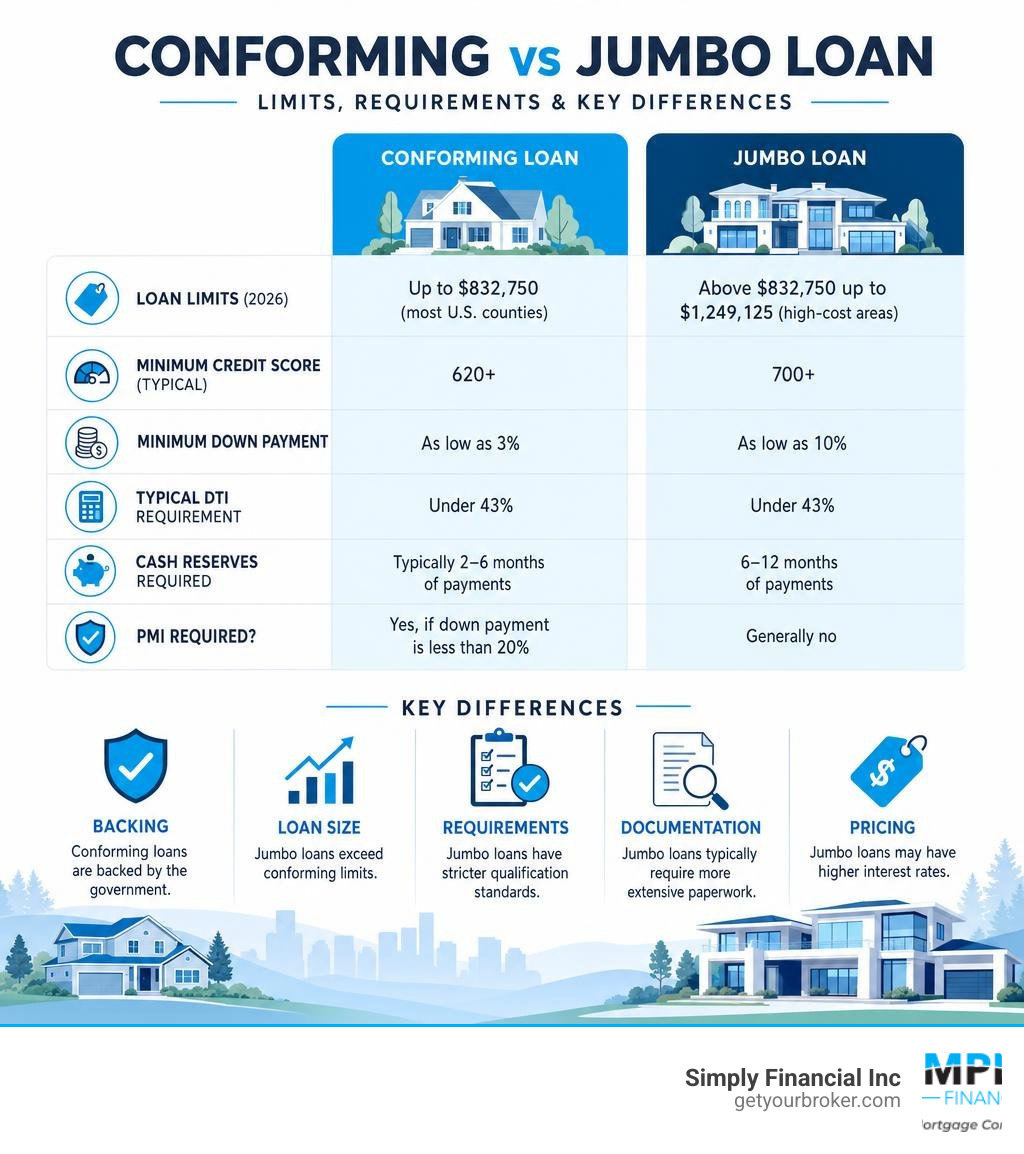
Here’s a quick snapshot for 2026:
| Key Factor | Details |
|---|---|
| Baseline limit (most U.S. counties) | $832,750 |
| High-cost area ceiling | $1,249,125 |
| Minimum credit score (typical) | 700+ |
| Minimum down payment | As low as 10% |
| Typical DTI requirement | Under 43% |
| Cash reserves required | 6–12 months of payments |
| PMI required? | Generally no |
Jumbo loans are not backed by Fannie Mae or Freddie Mac. That means lenders carry more risk — and they price and underwrite accordingly. Requirements are stricter, documentation is heavier, and the stakes are higher than a standard conforming mortgage.
But here’s what surprises many buyers: jumbo loans are not just for mansions. In high-cost markets, even a modest single-family home can push you past the conforming limit. And with some programs now allowing as little as 10% down, they’re more accessible than most people think.
I’m Peter Babjak, founder of Simply Financial Inc, a Chicago-based mortgage broker with over 18 years of experience helping homebuyers navigate complex financing — including jumbo loan scenarios across a wide range of budgets and borrower profiles. In this guide, I’ll walk you through everything you need to know to qualify, compare programs, and make a confident decision.
What Is a Jumbo Loan and How Does It Work?
To understand how a jumbo loan works, we have to look behind the scenes of the mortgage market. When you get a standard mortgage, the lender usually doesn’t keep that loan forever. Instead, they package it and sell it to government-sponsored enterprises (GSEs) like Fannie Mae and Freddie Mac. This frees up capital so the lender can issue more loans to other buyers.
However, Fannie Mae and Freddie Mac can only buy loans that “conform” to specific guidelines set by the Federal Housing Finance Agency (FHFA). If a mortgage exceeds these limits, it is classified as a non-conforming loan, more commonly known as a jumbo loan. You can learn more about this basic definition in this guide on What Is a Jumbo Loan? | Bankrate.
Because these loans cannot be sold to Fannie Mae or Freddie Mac, lenders must either keep them on their own balance sheets (known as holding them “in portfolio”) or sell them to private investors on the secondary market. This lack of government backing means the lender takes on 100% of the risk if a borrower defaults.
To offset this risk, lenders implement much more rigorous underwriting guidelines. Instead of relying solely on automated algorithms, jumbo underwriting is almost always a manual process. A human underwriter will carefully scrutinize every detail of your financial life, including your tax returns, business structures, assets, and credit history.
2026 Jumbo Loan Limits by County and Property Type
Conforming loan limits are adjusted annually based on the FHFA House Price Index. For the current year of 2026, the baseline conforming loan limit for a single-family home in most of the United States is $832,750. This is a $26,250 increase from the 2025 limit of $806,500, reflecting the steady appreciation of home values nationwide.
However, the housing market is local, and some areas are significantly more expensive than others. To accommodate these markets, the FHFA establishes higher limits in designated high-cost counties, capping out at a ceiling of $1,249,125 for single-family homes.
Let’s look at how these limits apply to our primary service areas of Illinois and Florida:
- Illinois: In almost every county across Illinois, including Cook, DuPage, Lake, and Will counties, the standard baseline limit of $832,750 applies. Any mortgage loan amount above this threshold is considered a jumbo loan. If you are looking to buy in the Chicago metropolitan area, you can read more about local options through the Jumbo loan limit in Illinois (2026) – Rocket Mortgage page or check out specialized local rates with Jumbo Mortgage Loans in Chicago, Illinois | Chase.
- Florida: Most counties in Florida also adhere to the baseline limit of $832,750. However, high-cost vacation and coastal markets may feature higher limits. For example, Monroe County (which encompasses the Florida Keys) has historically carried a much higher conforming limit, pushing the threshold for a jumbo loan higher. To explore how these regional limits fluctuate across the Sunshine State, see the Florida Jumbo Loan Limits – MIDFLORIDA Credit Union resource.
It is also important to note that conforming limits increase for multi-unit properties. For 2026, the limits for multi-unit properties are structured as follows:
- 2-Unit Property: Baseline limit of $1,066,150
- 3-Unit Property: Baseline limit of $1,288,700
- 4-Unit Property: Baseline limit of $1,601,550
If you are buying a two-to-four-unit property and your mortgage falls below these amounts, you can still utilize standard conforming financing. Anything above these tiered limits officially crosses over into jumbo territory.
Eligible Property Types for Jumbo Financing
Jumbo loans are highly versatile and can be used to finance various types of real estate, though the underwriting guidelines and down payment requirements will vary based on how you plan to use the property:
- Primary Residences: This is your main home. Because it represents the lowest risk to lenders, primary residences qualify for the lowest interest rates, the lowest down payment options (sometimes as low as 10% or even 5% through select wholesale channels), and the most flexible debt-to-income (DTI) limits.
- Second Homes and Vacation Properties: Whether you are buying a condo on the Florida coast or a lake house in Illinois, jumbo loans are widely available for second homes. However, expect lenders to require a larger down payment (typically 20% to 25%), a slightly higher credit score, and stronger cash reserves. You can explore regional vacation home options with the Jumbo Home Loans – Space Coast Credit Union program.
- Investment Properties: Buying high-value rental properties is a proven wealth-building strategy. We offer specialized jumbo financing for a Chicago Investment Property, allowing you to acquire multi-unit buildings or high-end single-family rentals. Investment jumbo loans carry the strictest guidelines, often requiring 25% to 30% down and a DTI ratio strictly capped at 43% or lower unless using alternative programs like Debt Service Coverage Ratio (DSCR) financing.
- Multi-Unit Properties: Financing a 2-to-4 unit property with a jumbo loan is entirely possible, whether as an owner-occupant or an investor. These properties are excellent for “house hacking” in Chicago neighborhoods, where you can live in one unit and rent out the others to help pay down your jumbo mortgage.
Qualifying for a Jumbo Loan in 2026
Because lenders cannot pass the risk of a jumbo loan onto Fannie Mae or Freddie Mac, they want to make absolutely sure you have the financial strength to weather any economic storm. Qualifying requires a combination of excellent credit, a manageable debt load, solid income documentation, and significant cash reserves.
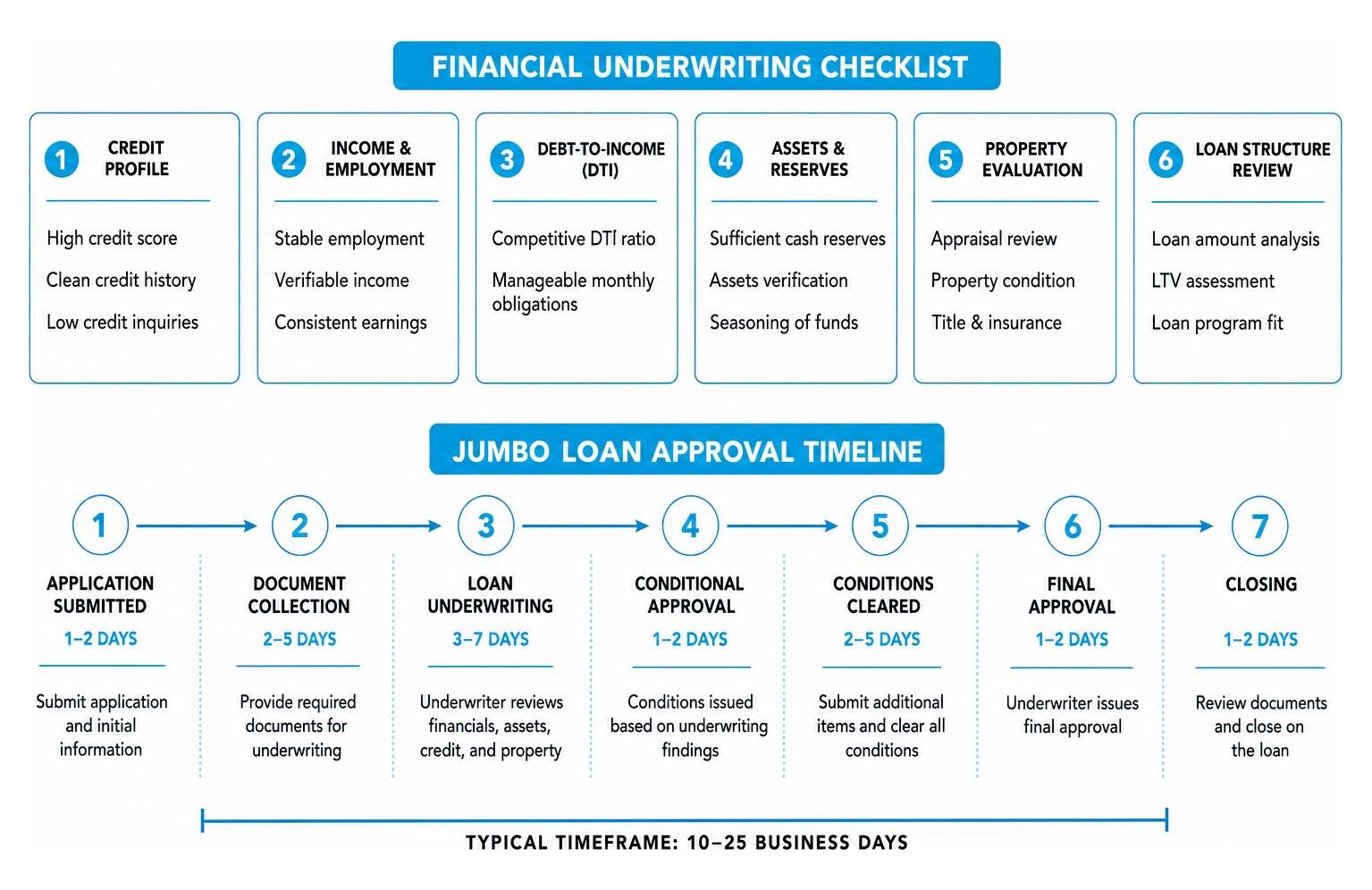
To give you a clear comparison of how the qualification standards differ, take a look at the table below:
| Qualification Metric | Conventional Conforming Loan | Jumbo Mortgage Loan |
|---|---|---|
| Minimum Credit Score | 620 | 700 (720–740+ for best rates) |
| Minimum Down Payment | 3% to 5% | 10% to 20% (select 5% options exist) |
| Maximum DTI Ratio | Up to 45% (sometimes 50% with AUS approval) | Typically 43% (up to 50% with compensating factors) |
| Cash Reserves Required | 0 to 2 months of payments | 6 to 12+ months of payments (PITI) |
| Underwriting Style | Automated (AUS-driven) | Manual (scrutinized by a human underwriter) |
Let’s break down these core qualification pillars in detail:
- Credit Score: While you can secure a conventional conforming loan with a credit score of 620, most jumbo programs require a minimum credit score of 700. If you want to unlock the absolute best pricing, lowest down payment options, and most flexible terms, you should aim for a score of 740 or higher.
- Debt-to-Income (DTI) Ratio: Your DTI ratio is the percentage of your gross monthly income that goes toward paying your recurring monthly debts (including your new mortgage payment, property taxes, home insurance, and any HOA fees). Lenders prefer to see a DTI under 43% for jumbo loans. Some programs will allow DTIs up to 45% or even 50%, but only if you have strong compensating factors, such as an exceptionally high credit score or millions of dollars in liquid assets.
- Cash Reserves: This is often the biggest hurdle for jumbo borrowers. Lenders want to see that you won’t be “house poor” after closing. They require you to have “reserves” — liquid or semi-liquid funds left over in your accounts after you make your down payment and pay your closing costs. These reserves are measured in months of PITIA (Principal, Interest, Taxes, Insurance, and Association dues) payments. For loans under $1 million, expect to show 6 months of reserves. For loans between $1 million and $2 million, 12 months is standard. For loans exceeding $2 million, lenders may require 18 to 36 months of reserves.
How Jumbo Loan Rates Compare to Conforming Mortgages
Historically, jumbo loan rates carried a significant premium over conventional mortgage rates because of the added risk lenders had to assume. However, that dynamic has shifted dramatically. In recent years, jumbo loan interest rates have frequently run neck-and-neck with, and sometimes even lower than, conforming rates.
This interest rate parity occurs because jumbo borrowers represent an incredibly attractive demographic for banks and portfolio lenders. These are often high-net-worth individuals who may bring lucrative wealth management, business banking, or personal deposit accounts to the institution. To win this business, lenders are willing to price their jumbo mortgages aggressively.
When shopping for a jumbo mortgage, you will have the choice between a Fixed Rate Mortgage Chicago and an Adjustable-Rate Mortgage (ARM).
- Fixed-Rate Jumbo: This option lock in your interest rate for the entire life of the loan (typically 15 or 30 years), offering maximum predictability and peace of mind.
- Adjustable-Rate Jumbo (ARM): ARMs (such as 7/1 or 10/1 programs) offer a fixed, lower interest rate for the first 7 or 10 years, after which the rate adjusts annually based on a financial index like the Secured Overnight Financing Rate (SOFR). If you plan to sell the home, refinance, or pay down the principal significantly within that initial fixed period, an ARM can save you tens of thousands of dollars in interest.
Documentation and Income Verification for Self-Employed Borrowers
If you are a W-2 employee with a steady salary, documenting your income is relatively straightforward: you’ll provide your two most recent W-2 forms, 30 days of consecutive pay stubs, and your two most recent federal tax returns.
However, if you are a self-employed business owner, entrepreneur, or independent contractor, the documentation process for a standard full-doc jumbo loan can become incredibly complex. Lenders will require:
- Two years of personal federal tax returns.
- Two years of business federal tax returns (including K-1s, 1120S, or 1065 forms).
- A year-to-date Profit and Loss (P&L) statement signed by your CPA.
- Two to three months of business bank statements to verify cash flow.
The challenge for many self-employed borrowers is that their tax professionals write off as many business expenses as legally possible to minimize their tax liability. While this is great for your tax bill, it reduces your “net qualifying income” on paper, making it difficult to qualify for a traditional jumbo mortgage.
Fortunately, we offer alternative documentation programs specifically designed for self-employed individuals:
- Bank Statement Loans: Instead of looking at your tax returns, we can qualify you based on the average monthly deposits into your personal or business bank statements over the last 12 to 24 months. This allows us to use your true gross cash flow to calculate your qualifying income.
- Asset Depletion / Asset-Based Lending: If you are retired or have significant liquid wealth but limited monthly income, we can set up a program that calculates a monthly qualifying income based on a formula that “depletes” your total assets over a set period (usually 180 to 360 months).
- 1099 Income Programs: If you are a contract worker who receives 1099 forms from one or two primary clients, we can qualify you using your 1099 earnings rather than requiring full business tax returns.
Comparing the 8 Main Jumbo Loan Programs
Not all jumbo loans are created equal. Depending on your credit profile, down payment capability, and employment structure, we can match you with one of eight distinct jumbo loan programs.

1. Entry-Level and AUS-Driven Jumbo Programs
These programs are designed for borrowers who are just crossing the line from conforming to jumbo territory (typically loan amounts between $832,750 and $1.5 million).
- Entry-Level Jumbo: These programs feature highly competitive rates but require strict adherence to standard guidelines: a minimum credit score of 720, a maximum 80% loan-to-value (LTV) ratio (meaning a 20% down payment), and a DTI strictly capped at 43%.
- AUS-Driven Jumbo: This is a highly flexible program that utilizes the Automated Underwriting System (AUS) from Fannie Mae or Freddie Mac. Even though the loan amount is in the jumbo range, some specialized portfolio lenders will accept an automated “Approve/Eligible” finding from the software. This program can allow for a DTI ratio up to 50% and more lenient reserve requirements if your overall credit profile is exceptionally strong.
2. Low Down Payment and Lender-Paid MI Options
The old myth that you always need a 20% down payment to secure a jumbo loan is officially busted. We have options that allow you to purchase high-value real estate with much less cash upfront:
- 10% Down Jumbo: This program allows you to secure a mortgage up to $2 million with only a 10% down payment (89.99% LTV). It is an excellent option for buyers who want to keep their cash liquid for renovations, investments, or business capital. To explore low down payment structures in the Chicago market, visit our page on Low Down Payment Mortgage Chicago.
- Lender-Paid Mortgage Insurance (LPMI) Jumbo: On a standard conventional loan, putting down less than 20% means you must pay monthly private mortgage insurance (PMI). With our specialized LPMI jumbo programs, the lender absorbs the risk of the low down payment by adjusting the interest rate slightly, completely eliminating the need for a separate monthly PMI payment.
3. Interest-Only and High-Balance Jumbo Programs
For affluent buyers who want to maximize their monthly cash flow, these specialized structures offer incredible financial flexibility:
- Interest-Only Jumbo: This program allows you to pay only the interest portion of your mortgage payment for an initial period (usually the first 10 years of a 30-year term). Because you aren’t paying down any principal, your monthly payment is significantly lower. This is highly popular among executives, sales professionals with large annual bonuses, and investors who want to keep monthly carrying costs low and make lump-sum principal payments at their own discretion.
- High-Balance Jumbo: This program bridges the gap for buyers in high-cost counties where the conforming limit is elevated (up to $1,249,125). It allows you to access conforming-style underwriting guidelines and pricing even though your loan amount is well above the national baseline of $832,750.
4. VA Jumbo and Non-QM Jumbo Programs
These programs cater to military veterans and borrowers with complex financial profiles who don’t fit into standard banking boxes:
- VA Jumbo: If you are an eligible veteran, active-duty service member, or surviving spouse, the VA Loan Chicago program is one of the most powerful financial tools in existence. With full VA entitlement, you can secure a jumbo loan with $0 down payment, no maximum loan limit, and no monthly mortgage insurance. Best of all, VA jumbo interest rates are typically lower than conventional jumbo rates.
- Non-QM Jumbo: Non-Qualified Mortgage (Non-QM) jumbo loans are portfolio products that do not have to meet standard federal consumer protection guidelines regarding income documentation. This program includes DSCR loans (which qualify investment properties solely on the rental income generated by the property rather than your personal income) and alternative bank statement programs.
Pros, Cons, and Strategic Alternatives to Jumbo Financing
Before committing to a jumbo loan, it is crucial to weigh the advantages and disadvantages of this financing path:
The Pros:
- Higher Buying Power: You can purchase your dream home in competitive, high-cost neighborhoods without being limited by conforming loan ceilings.
- No Monthly PMI: Many of our jumbo programs do not require private mortgage insurance, even with down payments as low as 10%.
- Competitive Rates: Jumbo rates are often equal to or even lower than standard conventional rates for highly qualified borrowers.
The Cons:
- Stricter Underwriting: You must provide extensive documentation and undergo a rigorous manual review of your financial profile.
- Higher Closing Costs: Closing costs for jumbo loans typically range from 2% to 6% of the loan amount. On a $900,000 mortgage, this means you should prepare to pay between $27,000 and $54,000 in closing fees, title charges, and transfer taxes.
- Limited Tax Deductions: Under current tax law, you can only deduct the interest on the first $750,000 of mortgage debt for primary or second homes purchased after December 16, 2017. Any interest paid on debt exceeding this cap is not tax-deductible.
- Substantial Reserve Requirements: You must have significant liquid cash left over in your accounts after closing, which can tie up capital that could otherwise be invested elsewhere.
Refinancing a Jumbo Loan and Texas-Specific Rules
Just like a conventional mortgage, you can refinance an existing jumbo loan to secure a lower interest rate, shorten your loan term, switch from an ARM to a fixed rate, or tap into your home’s equity.
- Rate-and-Term Refinance: If market interest rates drop, refinancing your jumbo loan can save you hundreds or thousands of dollars a month. Because jumbo balances are so large, even a minor 0.25% drop in rate can translate into massive savings over time.
- Cash-Out Refinance: If you have built up significant equity in your home, you can do a cash-out refinance to fund renovations, consolidate high-interest debt, or access capital for business opportunities. Most lenders limit jumbo cash-out loans to a maximum 70% to 75% LTV.
- Texas Section 50(a)(6) Rules: While our physical office locations are in Illinois and Florida, it is worth noting for clients relocating or holding portfolio assets across different regions that states like Texas have incredibly strict constitutional homestead laws. These rules govern how much equity you can take out of a primary residence and limit the types of jumbo programs that can facilitate cash-out transactions.
Who Is the Best Candidate and When to Consider Alternatives
The ideal candidate for a jumbo loan is a high-income earner who has solid credit and strong assets, but perhaps hasn’t accumulated enough cash to make a massive down payment that would bring their loan balance under the conforming limit. This demographic is often referred to as HENRYs (High Earners, Not Rich Yet) — professionals like doctors, attorneys, tech executives, and business owners making $250,000 to $500,000 annually.
If you don’t quite fit the jumbo qualification mold, or if you want to avoid the strict reserve requirements, you might consider these strategic alternatives:
- Piggyback Loans (80-10-10 or 80-15-5): This strategy involves splitting your financing into two separate loans to avoid jumbo territory. You secure a first mortgage at exactly the conforming loan limit (80% of the purchase price), take out a second mortgage (HELOC or home equity loan) for 10% or 15% of the price, and put down a 5% or 10% cash down payment. This allows you to avoid both jumbo underwriting and monthly PMI.
- FHA High-Balance Loans: If your credit score is in the 600s or you have a higher DTI, you can utilize an FHA Loan Chicago up to the local high-balance limit. While FHA loans require monthly mortgage insurance, their credit and DTI requirements are far more forgiving than jumbo guidelines.
- USDA and First-Time Buyer Programs: For properties in designated rural areas, a USDA Loan Chicago offers unique zero-down options, though these are strictly capped by conforming limits. For buyers looking for down payment assistance on standard properties, exploring First Time Home Buyer Programs Chicago can yield valuable grants and soft seconds, though these are typically restricted to conforming loan structures.
Frequently Asked Questions About Jumbo Loans
Do jumbo loans require private mortgage insurance (PMI)?
In most cases, no. While conventional conforming loans require you to pay monthly PMI if you put down less than 20%, many jumbo programs waive this requirement entirely. Lenders who offer 10% down jumbo options typically absorb the risk of the lower down payment through their internal pricing structures (such as a slightly higher interest rate) rather than forcing you to pay a separate monthly PMI premium.
How many months of cash reserves are required for a jumbo loan?
The exact reserve requirement depends on your loan amount, credit score, and down payment:
- Loans up to $1 Million: Typically require 6 months of PITIA reserves.
- Loans from $1 Million to $2 Million: Typically require 12 months of reserves.
- Loans over $2 Million: Can require 18 to 36 months of reserves.
These reserves do not have to be kept entirely in a standard checking account. Lenders will count retirement accounts (like 401ks or IRAs, often discounted by 30% to 40% to account for potential market fluctuations and tax penalties), vested stock options, mutual funds, and business funds (subject to CPA approval) toward your reserve requirements.
Can I get a jumbo loan if I am self-employed?
Absolutely. While traditional retail banks might make you jump through endless hoops, we specialize in helping self-employed business owners secure jumbo financing. If your tax returns don’t show enough net income due to legal write-offs, we can utilize alternative documentation paths like our 1099 programs, bank statement loans, or CPA-signed Profit & Loss statement loans to qualify you based on your true cash flow.
Conclusion
Navigating the complex world of jumbo financing doesn’t have to be overwhelming. At Simply Financial Inc, we are committed to delivering a seamless, expert-guided, and stress-free mortgage experience. Whether you are looking to purchase a beautiful historic home in Chicago, buy a multi-unit investment property, or secure a vacation home on the Florida coast, we have the wholesale relationships and underwriting expertise to find the perfect program for your unique financial profile.
Our physical doors are always open at 5632 W Lawrence Ave Chicago IL, and we proudly serve clients throughout Illinois and Florida.
Ready to explore your options? Let us handle the heavy lifting. To get started on your custom scenario, check out our specialized Jumbo Loan Chicago options or reach out to us today to speak with one of our experienced lending specialists. Your dream home is within reach — let’s make it a reality together.