

Understanding the Loan Pre Qualification Process and Its Core Benefits
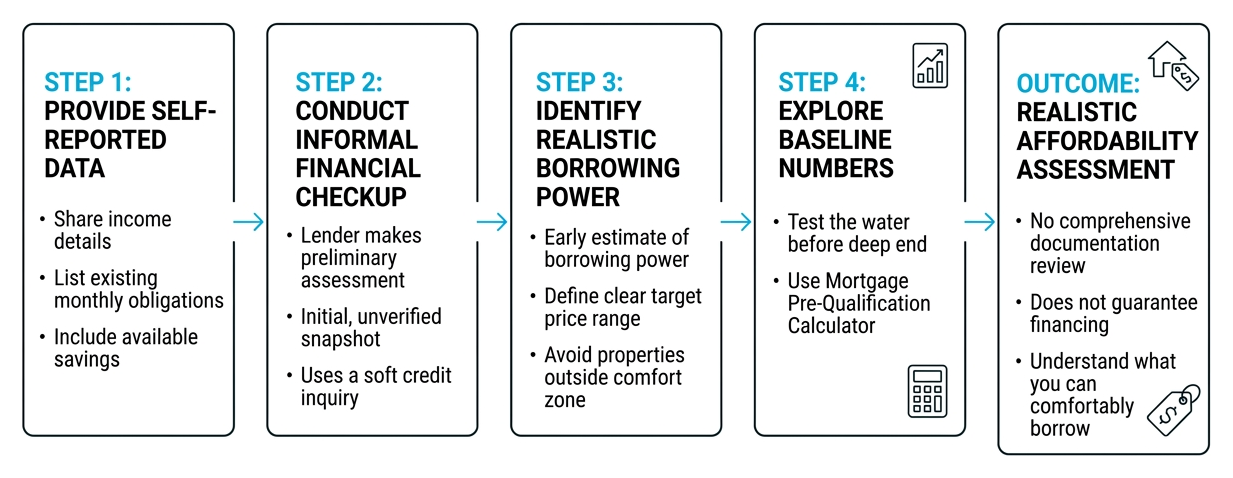
A loan pre qualification is an initial, informal financial assessment that estimates how much you can borrow for a home loan based on self-reported details about your income, monthly debts, and available savings. Conducted with a soft credit check that does not impact your credit score, it evaluates your baseline finances to give you a realistic target budget before you start shopping for properties.
Think of it as testing the water before jumping into the deep end of the pool. It gives you a clear target price range so you do not spend weekends falling in love with properties outside your comfort zone. To explore your baseline numbers right away, you can use our Mortgage Pre-Qualification Calculator to see where you stand.
What Is a Loan Pre Qualification vs Pre-Approval?
While buyers often use these terms interchangeably, they represent two distinct milestones in the mortgage journey. The primary differences come down to application depth, credit inquiry type, and whether the lender verifies your documentation.
A pre-qualification is an initial, unverified snapshot. It relies primarily on the financial information you share and uses a soft credit inquiry. Because there is no comprehensive documentation review, it does not guarantee financing.
A pre-approval, by contrast, is a rigorous evaluation. You submit tax returns, W-2s, pay stubs, and bank statements. The lender pulls a full credit report using a hard inquiry and runs your file through automated underwriting. The result is a formal, conditional commitment letter specifying an exact loan amount, interest rate structure, and purchase timeline. Sellers take pre-approval letters seriously because they show that a mortgage underwriter has already vetted your financial profile.
| Feature | Loan Pre-Qualification | Loan Pre-Approval |
|---|---|---|
| Credit Check Type | Soft inquiry (no score impact) | Hard inquiry (temporary minor impact) |
| Documentation | Self-reported basics (income, debt) | Full verification (W-2s, tax returns, bank statements) |
| Turnaround Time | Minutes to 48 hours | 1 to 10 business days |
| Lender Commitment | Informal estimate | Conditional written commitment |
| Best Stage To Use | Early budgeting and exploratory shopping | Active house hunting and submitting offers |
| Seller Perception | General interest indicator | Strong, competitive proof of purchasing power |
When you are ready to start placing offers on homes, securing a verified Mortgage Pre-Approval gives you the negotiating strength you need in competitive markets across Illinois and Florida.
How Soft Credit Checks Protect Your Credit Score
A major benefit of exploring your initial loan options is that it protects your credit profile.
During pre-qualification, lenders use a soft inquiry to review your credit score and payment history. Soft inquiries are visible on your personal credit file for up to two years, but they are invisible to third parties and have zero impact on your FICO scores. You can check your options across several loan types without worrying about dinging your credit.
In contrast, hard credit inquiries happen when you submit a formal credit application. A hard pull allows a lender to evaluate your comprehensive credit report from the three nationwide bureaus: Equifax, Experian, and TransUnion. While hard inquiries also stay on your credit report for up to two years, they typically only affect your credit score for 12 months. Keeping hard inquiries to a minimum until you are actively house hunting keeps your credit profile in top shape.
Key Information and Documents Needed for Pre-Qualification
Because pre-qualification is designed to be fast and low-stress, you do not need to hunt down years of financial archives to get started. You can complete our online Pre-Qualify Form in just a few minutes.
Here is what you will typically need to have on hand:
- Contact & Identification Info: Full legal name, current address, phone number, date of birth, and Social Security number (to facilitate the soft credit check).
- Employment Details: Current employer, job title, and length of employment.
- Gross Income: Your pre-tax monthly or annual earnings from wages, salaries, bonuses, or self-employment.
- Monthly Debt Obligations: Minimum monthly payments for auto loans, student loans, credit cards, and personal loans.
- Liquid Assets: Estimated cash on hand for your down payment and closing costs.
Basic Financial Details and Eligibility Criteria
Every loan program has basic baseline standards. For example, applicants must be at least 18 years old with a valid Social Security number and demonstrate a reliable source of income.
During the initial review, we evaluate your overall stability. Having at least two years of consistent employment history—or steady progress in a specific career path—helps demonstrate dependable earnings. If you are self-employed or work on commission, having a clear idea of your average net income over the past two years ensures your preliminary loan numbers are as accurate as possible.
Debt-to-Income Limits and the 28/36 Rule
Your debt-to-income (DTI) ratio is one of the most critical metrics lenders look at when sizing up a loan. It measures how much of your gross monthly income goes toward recurring debt obligations.
Lenders evaluate two distinct DTI metrics:
- Front-End DTI: The percentage of your gross monthly income dedicated solely to housing costs, including principal, interest, property taxes, homeowners insurance, and any HOA fees.
- Back-End DTI: The percentage of your gross monthly income required to cover all recurring monthly debt payments combined (housing expenses plus student loans, car notes, minimum credit card payments, and personal loans).
A classic guideline in mortgage underwriting is the 28/36 rule. Under this framework:
- Your total housing expenses should not exceed 28% of your gross monthly income.
- Your total monthly debt obligations (housing + consumer debts) should not exceed 36% of your gross monthly income.
Conventional loan programs often look for a back-end DTI of 36% to 43%, though certain automated underwriting systems allow higher limits depending on your credit score and down payment. Government-backed programs like FHA and VA loans offer even more leeway on debt ratios. If you want to optimize your financial profile before applying, reviewing practical Mortgage Tips can help you lower debt and maximize your borrowing capacity.
Comparing Options Across Different Mortgage Loan Programs
Pre-qualification helps you identify which specific loan structure aligns with your long-term plans, down payment savings, and credit profile. Every borrower’s situation is unique, and exploring diverse Mortgage Loan Options ensures you choose the right path.
Securing a Loan Pre Qualification for Different Mortgage Types
At Simply Financial Inc, we guide buyers through several primary home loan structures:
- Conventional Mortgages: Ideal for borrowers with solid credit scores (typically 620+) and stable income. Down payments start as low as 3% for first-time buyers.
- FHA Loans: Insured by the Federal Housing Administration, these loans are popular among first-time buyers because they allow credit scores as low as 580 with a 3.5% down payment and flexible DTI limits.
- VA Loans: Guaranteed by the Department of Veterans Affairs, VA loans offer exceptional terms for eligible active-duty service members, veterans, and surviving spouses, including 0% down payment requirements and no monthly mortgage insurance.
- USDA Loans: Designed for rural and suburban homebuyers who meet local income thresholds, offering 100% financing (0% down payment) on qualifying properties.
- Jumbo Mortgages: For higher-priced luxury properties that exceed standard conforming loan limits. These require higher credit scores, lower DTI ratios, and larger cash reserves.
Whether you are evaluating a starter condo in Chicago or a single-family home in Florida, pre-qualifying across these programs clarifies your interest rate options and estimated monthly out-of-pocket costs.
Turnaround Times and Validity Windows
How fast can you expect answers? Initial pre-qualification estimates are remarkably quick. In many cases, online portals return an initial estimate within minutes. If your scenario involves complex self-employment income or multi-layered assets, a mortgage broker can review your file and deliver numbers within 24 to 48 hours.
Once issued, a pre-qualification estimate is generally useful for 60 to 90 days. That market interest rates fluctuate daily. If interest rates shift significantly or your personal financial picture changes (such as taking on a new car loan), your maximum borrowing numbers will adjust accordingly.
Next Steps: Moving from Pre-Qualified Status to Final Approval

A pre-qualification provides the roadmap, but what happens when you find the right property? Understanding the milestones of the Chicago Mortgage Process makes the transition to homeowner straightforward and stress-free.
When to Transition from Pre-Qualification to Pre-Approval
As soon as you shift from casually browsing home listings to actively attending open houses with a real estate agent, you should upgrade to a formal pre-approval.
In competitive markets, listing agents and sellers expect a verified pre-approval letter alongside any purchase offer. Having your income and assets fully vetted in advance shows sellers you are a serious, qualified buyer whose financing is secure. Connecting with a knowledgeable Mortgage Lender Chicago IL ensures your pre-approval letter is customized for your specific purchase offers, giving you an edge in competitive bidding situations.
What to Expect During Final Underwriting
Once a seller accepts your purchase contract, your loan file moves into formal processing and underwriting.
During this phase, we collect your complete documentation package:
- Recent 30 days of pay stubs
- Two years of W-2 forms and federal tax returns
- Two months of complete bank and investment asset statements
- Real estate purchase contract and property disclosures
An underwriter reviews these documents, orders a formal home appraisal to verify the property value, and performs a final verification of employment. Once all underwriting conditions are satisfied, you receive a “Clear to Close,” followed by your Closing Disclosure detailing your final loan terms, interest rate, and exact cash-to-close amount.
Frequently Asked Questions About Loan Pre-Qualifications
Does pre-qualification guarantee that I will be approved for a loan?
No, a pre-qualification does not guarantee loan approval. It is an informal estimate calculated from self-reported data and a soft credit pull. Final loan approval requires full document verification, an appraisal of the property, a hard credit inquiry, and formal sign-off from a mortgage underwriter.
How long does the pre-qualification process take?
The process is fast. Using modern digital tools, you can often receive an estimate within minutes. When working directly with a broker who manually reviews your initial scenario, the process typically takes anywhere from a few hours to two business days.
Does getting pre-qualified hurt my credit score?
No. Initial pre-qualification relies on a soft credit inquiry that does not affect your FICO credit scores in any way. You can explore multiple financing options and budget scenarios safely without worrying about damaging your credit rating.
Conclusion
Laying the groundwork for a home purchase does not have to be stressful. By starting with a pre-qualification, you gain a clear, realistic understanding of your borrowing power without risking your credit score or getting bogged down in endless paperwork.
At Simply Financial Inc, our goal is to deliver a seamless, expert-guided, and stress-free mortgage experience from your very first estimate all the way through closing day. Whether you are looking for an FHA, VA, USDA, conventional, or jumbo loan across Illinois or Florida, our team is here to guide you every step of the way.
Take the first step toward owning your dream home by getting your Pre-Qualify Chicago Mortgage Pre-Approval today.