

Compare Refinance Mortgage Rates Before You Commit
A refinance mortgage replaces your current home loan with a new one. It can make sense when the new loan lowers your rate, reduces your payment, shortens your payoff time, or changes an adjustable-rate mortgage to a fixed rate.
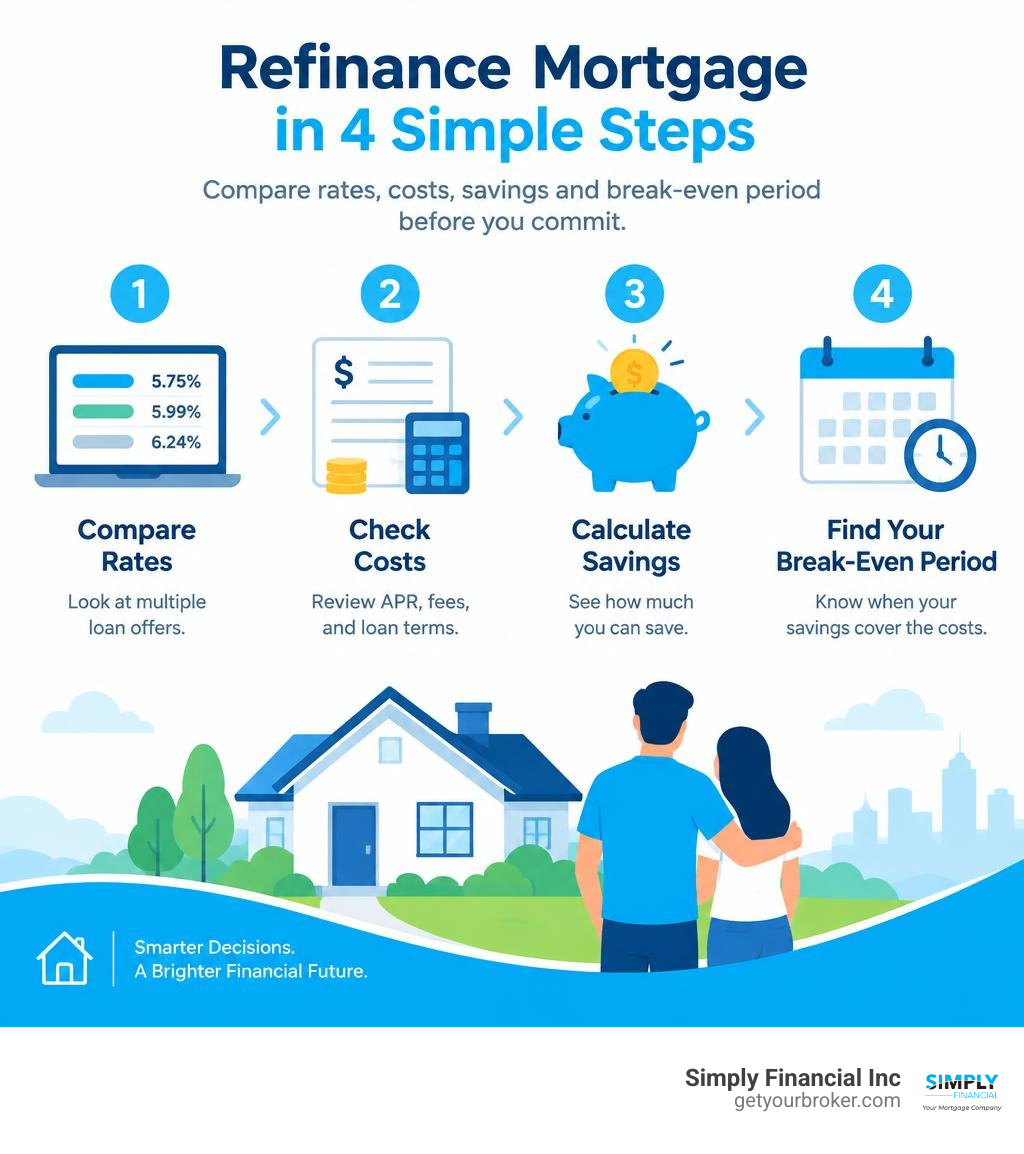
Before you apply, compare at least three written loan offers and look beyond the interest rate. Check the APR, monthly principal and interest payment, closing costs, loan term, and break-even period. Refinancing commonly costs 2% to 5% of the new loan amount, so the savings need to outweigh those upfront charges before you plan to sell or move.
Small rate differences can have a large cost. In 2025, 78.7% of refinance borrowers paid more than the most competitive rate available to them. The right comparison can help you avoid paying more than necessary while keeping the paperwork and decisions manageable.
I’m Peter Babjak of Simply Financial Inc, a Chicago mortgage broker who has helped homebuyers and homeowners navigate home loans and refinance mortgage decisions since 2007. This guide will show you how to compare offers, calculate real savings, and decide whether refinancing fits your goals.
How to Refinance Mortgage Loans for Maximum Savings

When market conditions shift, refinancing can provide substantial monthly relief or shave years off your debt. However, securing the best terms requires understanding how lenders evaluate your financial profile.
Lenders focus on three primary metrics:
- Credit Score: While you can qualify for certain government-backed programs with lower scores, aiming for a score above 740 to 780 unlocks the most competitive pricing.
- Debt-to-Income (DTI) Ratio: Most lenders prefer a total DTI ratio below 43%, though some loan programs allow flexibility depending on your overall financial strength.
- Loan-to-Value (LTV) Ratio: Maintaining an LTV at or below 80% allows you to avoid private mortgage insurance (PMI) on conventional loans, immediately lowering your monthly carrying costs.
Industry data reveals that 87% of borrowers in 2025 paid above the most competitive rate available to them, costing an average of $3,343 every year. By securing an accurate mortgage pre-approval and using an interactive refinance calculator, you can benchmark market rates and ensure you do not leave money on the table.
Understanding Rate-and-Term vs. Cash-Out Refinancing
There are two primary structures when replacing your existing mortgage:
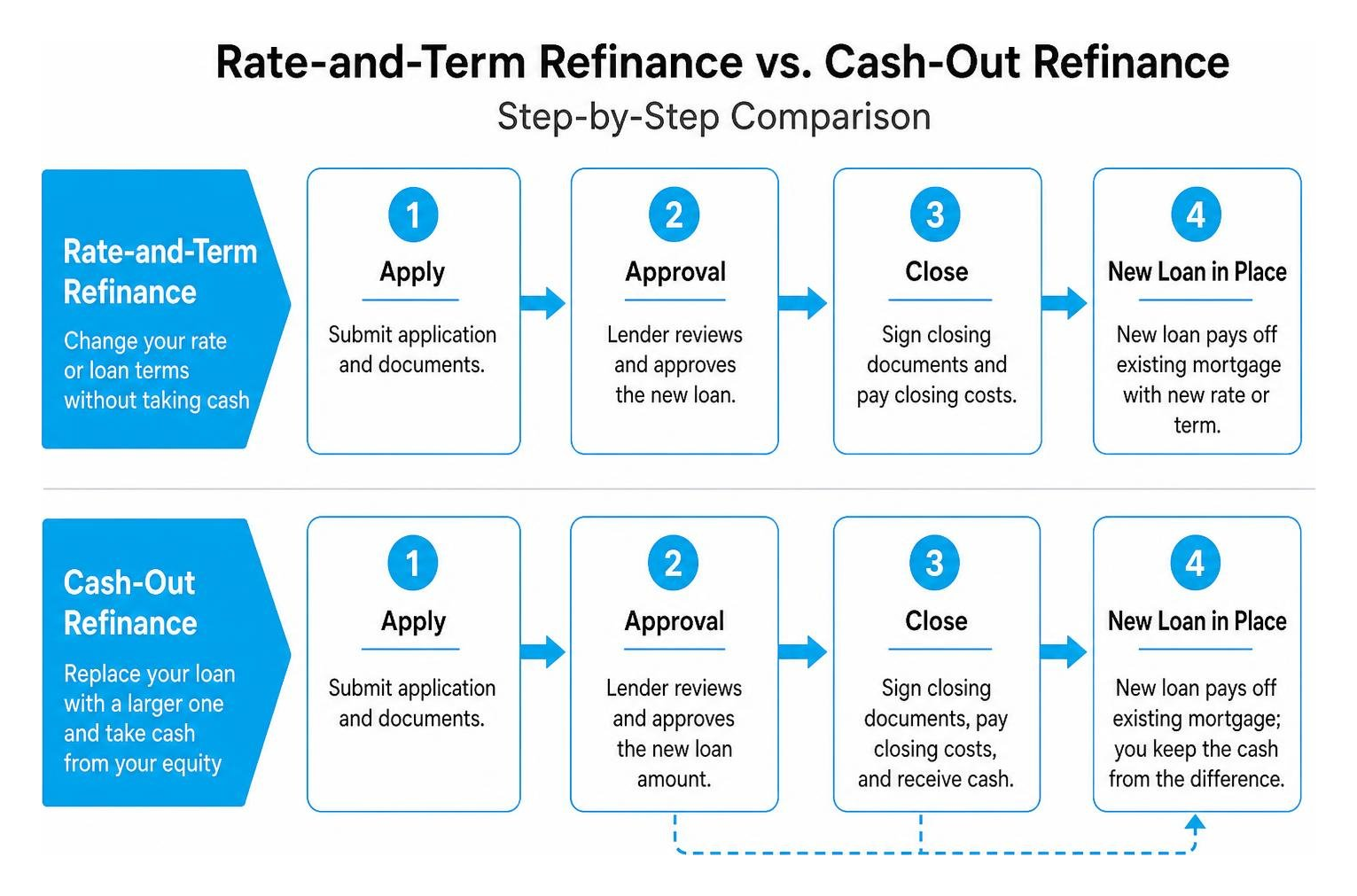
- Rate-and-Term Refinancing: This option focuses solely on changing your interest rate, adjusting your loan duration, or moving from an adjustable-rate mortgage (ARM) to a stable fixed rate. It alters how you repay the existing principal balance without pulling out equity.
- Cash-Out Refinancing: This structure replaces your current mortgage with a larger loan balance, allowing you to take the difference in cash. Homeowners frequently use these funds for home improvements, major life events, or consolidating high-interest credit card debt into a single, lower-rate monthly payment.
For homeowners utilizing government-insured programs, an FHA cash-out refinance offers structured guidelines to access equity, while eligible military service members and veterans can leverage VA cash-out refinance loans to achieve high LTV allowances with competitive terms.
How to Shop and Compare Refinance Mortgage Rates
Shopping for a mortgage requires looking at the total cost of borrowing rather than just the headline interest rate.
- Examine the Annual Percentage Rate (APR): The APR reflects the true annual cost of the loan, incorporating upfront lender fees, points, and processing charges alongside the interest rate.
- Review Written Loan Estimates: Collect official Loan Estimates from multiple lenders within a standard shopping window, as recommended by the Consumer Financial Protection Bureau. This allows you to evaluate third-party fees line-by-line.
- Evaluate Regional Rate Trends: Interest rate environments fluctuate across markets. Check the latest Illinois mortgage and refinance rates alongside current mortgage rates for FHA loans to know where standard pricing sits before negotiating terms.
- Lock at the Right Time: Once you identify an offer that meets your target savings and break-even metrics, secure a formal rate lock to protect against daily market volatility during underwriting.
Breaking Down Refinancing Costs, Fees, and Loan Term Options
Refinancing is not free. Upfront closing costs generally fall between 2% and 5% of the new loan balance, and it is not unusual to see overall closing expenses land between 3% and 6% of the outstanding principal depending on location and loan structure.
Typical itemized fees include:
- Origination and Processing Fees: Typically 0% to 1.5% of the loan principal.
- Discount Points: 0% to 3% of the loan amount, paid voluntarily to buy down the interest rate.
- Appraisal Fees: Usually $300 to $700 to determine current market valuation.
- Title Search and Title Insurance: Generally $700 to $900 to ensure clear property ownership.
Choosing the right loan term also significantly influences your monthly payment and total lifetime interest:
| Loan Scenario | Interest Rate | Monthly Payment (P&I) | Total Interest Paid |
|---|---|---|---|
| $200,000 (30-Year Fixed) | 6.0% | $1,199 | $231,640 |
| $200,000 (15-Year Fixed) | 5.5% | $1,634 | $94,120 |
| $200,000 (10-Year Fixed) | 5.25% | $2,146 | $57,515 |
While a 15-year or 10-year loan requires a higher monthly outlay, it yields massive interest savings over the life of the loan. You can explore current 10-year refi rates or review our fixed-rate mortgage guide to model which term length fits your monthly budget.
Using a Refinance Mortgage Calculator to Find Break-Even
Your break-even period is the exact month where your accumulated monthly savings exceed the total upfront costs paid to secure the new loan.
The Break-Even Formula: $$\text{Break-Even Period (Months)} = \frac{\text{Total Closing Costs}}{\text{Monthly Payment Savings}}$$
For example, refinancing a $200,000 loan balance from 6.0% down to 5.0% lowers your monthly principal and interest payment by roughly $93. If your closing fees total $2,500, the break-even period is approximately 27 months ($2,500 ÷ $93). If you plan to remain in your home longer than 27 months, the refinance creates net positive savings. You can quickly run your personal numbers using our mortgage pre-qualification calculator.
The Trade-Offs of “No-Cost” Refinancing
A “no-cost” refinance is a misnomer; closing costs are never simply erased. Instead, lenders cover these expenses in one of two ways:
- Charging a Higher Interest Rate: The lender provides a credit to pay your closing fees in exchange for a higher ongoing interest rate.
- Capitalizing Costs into the Principal: Closing fees are rolled into the total loan balance, increasing your debt and the overall interest accrued over time.
While a no-cost refinance preserves upfront liquidity, it increases lifetime borrowing expenses. Homeowners evaluating different loan sizes—such as comparing a jumbo loan vs conventional product—should weigh whether saving cash today justifies higher payments over the loan term.
When Refinancing Makes Sense (and When It Doesn’t)

Refinancing is a strategic tool, but it is not beneficial in every circumstance.
When Refinancing Makes Sense:
- Securing a Lower Rate: Dropping your interest rate by 0.50% to 1.00% or more can generate substantial savings.
- Shortening the Loan Term: Moving from a 30-year to a 15-year mortgage accelerates equity accumulation. If higher payments are not feasible, even making modest principal prepayments—such as adding $50 monthly to a $200,000 loan at 6.0%—can reduce your payoff time by 3 years and save over $27,000 in interest without closing costs.
- Switching from an ARM to a Fixed Rate: Transitioning to a fixed payment locks in predictable costs if adjustable rates are scheduled to adjust upward.
- Eliminating Mortgage Insurance: Rising property values may allow you to remove private mortgage insurance once equity reaches 20%.
When Refinancing Is Not Advised:
- You Plan to Move Soon: If you expect to relocate before reaching your break-even point, you will lose money on the transaction.
- Late-Stage Amortization: If you are decades into a 30-year mortgage, resetting to a new 30-year term resets the amortization schedule, meaning the majority of your early payments will once again go toward interest rather than principal.
- Prepayment Penalties: Check if your existing loan includes a penalty fee for paying off the balance early.
For a broader evaluation of loan programs, explore our home loan options guide.
Frequently Asked Questions About Refinancing
What credit score and DTI do I need to refinance?
Conventional refinances generally require a minimum credit score of 620, while scores of 740 and above secure optimal pricing tiers. Government-backed options like FHA and VA loans offer more lenient credit score thresholds. Lenders typically look for a DTI ratio below 43%, though strong compensating factors—such as cash reserves—can expand eligibility. Review the standard conditions for FHA loan approval for specific guidelines.
How much does it typically cost to refinance a mortgage?
Total closing fees usually range from 2% to 5% of the loan amount. On a $300,000 mortgage, closing costs typically fall between $6,000 and $15,000, covering origination fees, appraisal services, title searches, credit checks, and recording fees. Review your final FHA cash to close figures or standard Closing Disclosure to see a complete breakdown.
How long does it take to break even on refinance closing costs?
Most break-even periods range between 24 and 48 months, depending on upfront fees and the size of your rate reduction. Dividing total closing expenses by your net monthly savings gives you the exact number of months needed to recover costs.
Conclusion
Comparing refinance offers requires looking past initial rate advertisements to evaluate closing costs, APR, loan duration, and break-even timelines. Avoiding the common trap of overpaying on your rate starts with gathering multiple written quotes and evaluating how each option supports your long-term financial plan.
At Simply Financial Inc, located at 5632 W Lawrence Ave in Chicago, IL, we guide homeowners throughout Illinois and Florida through transparent, stress-free mortgage solutions. Whether you want to lower monthly payments, access home equity, or shorten your loan term, our team is ready to help you explore your mortgage refinancing options today.