

Understanding USDA Home Financing Programs in Illinois
A USDA loan in Illinois rural areas lets eligible homebuyers purchase a qualifying home with 100% financing, meaning no down payment is required. The United States Department of Agriculture (USDA) home financing initiative traces its origins back to the Housing Act of 1949. While many people think the USDA only deals with agriculture, farming, and food safety, the agency manages one of the most effective homeownership programs in the country through USDA Rural Development. Designed to stimulate economic growth and expand homeownership in non-metropolitan communities, these loans allow buyers to finance up to 100% of an eligible home’s purchase price without a traditional down payment.
When securing financing through the USDA in Illinois, you will encounter two distinct programs: the Section 502 Direct Loan Program and the Section 502 Guaranteed Loan Program. Exploring our in-depth guide to USDA loan benefits will give you a clear baseline on how government-backed financing operates nationwide. In Illinois, both programs help eliminate the upfront capital barrier that keeps many hardworking families from buying a home.
Whether you are looking to purchase a quiet property in Boone County, a farmhouse in McLean County, or a starter home outside Champaign, understanding these programs is essential.
| Feature | Section 502 Direct Loan | Section 502 Guaranteed Loan |
|---|---|---|
| Primary Administrator | USDA Rural Development (Direct Government) | Approved Private Lenders (Mortgage Brokers) |
| Target Income Level | Very-low and low-income borrowers | Low-to-moderate income borrowers |
| Household Income Limit | Specific local low-income thresholds | Up to 115% of Area Median Income (AMI) |
| Down Payment | 0% down payment required | 0% down payment required |
| Standard Interest Rate | Fixed (5.250% base rate as of late 2026) | Market rates set by approved lenders |
| Payment Assistance | Available (can reduce effective rate to 1%) | Not available |
| Standard Repayment Term | 33 years (up to 38 years for very low-income) | 30 years |
| Eligible Properties | Modest single-family homes in rural zones | Single-family detached homes/PUDs/Condos |
Section 502 Direct vs. Guaranteed Loans
The fundamental difference between these two pathways lies in who lends the money and the income levels they serve.
The Direct Loan program is funded directly by the federal government for low- and very-low-income applicants who lack safe housing and cannot secure standard private mortgage financing. For more specific details on state-level administration, you can review the Single Family Housing Direct Home Loans in Illinois program guidelines. Direct loans are tailored to help families with limited financial resources achieve homeownership with the help of federal payment subsidies.
In contrast, the Single Family Housing Guaranteed Loan Program operates through approved private mortgage lenders, including brokerages like Simply Financial Inc. With a Guaranteed loan, the USDA backs a portion of the mortgage against default. This federal guarantee allows private lenders to offer 100% financing with zero down payment to moderate-income households. Both loan options require the property to be a single-unit primary residence; multi-unit properties and duplexes are strictly ineligible.
Interest Rates and Repayment Terms for 2026
Interest rates and loan terms vary significantly between the Direct and Guaranteed paths:
- USDA Direct Loans: As of late 2026, the standard fixed interest rate for Direct loans is 5.250% for low-income and very-low-income borrowers. Qualifying applicants can access payment assistance subsidies that reduce the effective interest rate down to as low as 1.000%, providing exceptional monthly savings.
- Repayment Terms for Direct Loans: The standard repayment schedule is 33 years. For very-low-income borrowers who cannot afford payments over 33 years, the USDA can extend the term up to 38 years.
- USDA Guaranteed Loans: Interest rates are based on standard competitive market rates determined by private lenders. Guaranteed loans feature a standard 30-year fixed term.
For buyers seeking full financing without draining their personal savings, these programs offer an accessible alternative to high-down-payment mortgages. To compare other no-down-payment options, explore 100 percent financing home loans for first-time buyers.
Finding Eligible USDA Loan Illinois Rural Areas and Properties
Many buyers assume “rural” means living miles away from neighbors, paved roads, and modern conveniences. Under USDA guidelines, however, the definition of an eligible rural area is broader than you might expect. For homebuyers looking to secure a USDA loan, Illinois rural areas offer extensive coverage, and about 72% of ZIP centers across Illinois qualify for USDA financing.
When exploring options for a USDA loan, Illinois rural areas provide vast opportunities, including many semi-rural suburbs, satellite towns, and unincorporated neighborhoods surrounding major metropolitan hubs. To learn more about how zero-down financing works across different programs, check out our guide on buying a house with no down payment.
Navigating Property Boundaries for a USDA Loan in Illinois Rural Areas
To qualify for USDA financing, a property must be located in an eligible rural area designated by the USDA. In general, eligible locations are open country or towns and communities with populations under 35,000 that maintain a rural character.
Checking an address on the USDA Property Eligibility Map is the quickest way to confirm whether a home qualifies.
Eligible regions across Illinois include:
- Central Illinois: Communities and outskirts surrounding Champaign, Bloomington-Normal, and Decatur.
- Western Illinois: Outlying neighborhoods around Galesburg, Quincy, and Moline.
- Southern Illinois: Broad sections across Marion, Carbondale, and Harrisburg.
- Northern/Collar Suburbs: Select outer pockets located just beyond the dense Chicago metro footprint.
Eligible homes must be modest, safe, and sanitary single-family dwellings, including manufactured and modular homes that meet permanent foundation and local code standards.
Illinois County-by-County Property Verification
Illinois features diverse regional real estate markets. Here is how USDA property eligibility breaks down across key areas:
- Chicago Collar Counties (Kane, McHenry, Lake, Will): While dense urban centers are excluded, the outer western and northern rural borders of McHenry, western Kane, and southern Will County frequently feature eligible zones.
- Kendall & Grundy Counties: Fast-growing areas like Kendall County still retain large agricultural and semi-rural sectors that meet USDA standards. Grundy County offers extensive eligibility across nearly all communities outside Morris.
- McLean & Champaign Counties: While the university areas of Urbana-Champaign and central Bloomington are non-eligible, the surrounding agricultural communities qualify under the program.
- Southern & Western Illinois (Boone, Williamson, Adams): Almost all land outside central city commercial districts in these regions is fully eligible for USDA financing.
Financial Eligibility and Credit Standards
To qualify for a USDA loan, your household must meet specific financial criteria. Unlike standard mortgage underwriting, which looks solely at the borrower on the loan application, the USDA evaluates the total household income of all adult residents (18 and older) living in the home.
Household income must fall at or below the USDA income ceiling for that specific county, which is pegged at 115% of the Area Median Income (AMI). Even with these income limits, qualifying buyers can afford substantial home purchases. In most Illinois counties, the standard 2026 FHA baseline comparison of $541,287 illustrates the strong local purchasing power available. To review down payment guidelines across all loan types, read our complete low down payment guide.
Income Limits for a USDA Loan in Illinois Rural Areas
The USDA sets county-level income limits adjusted for household size. The 2026 Illinois moderate-income thresholds for households with 1 to 4 members include:
- Standard Illinois Baseline (Most Counties): $122,800
- Kendall County: $153,550
- Cook, DuPage, Kane, Lake, McHenry, and Will Counties: $139,750
- Grundy & McLean Counties: $136,650
- 5- to 8-Person Households: Limits increase significantly (e.g., up to $162,100–$202,700 depending on county).
These thresholds apply to the Section 502 Guaranteed loan program. The Section 502 Direct loan program uses lower income caps targeted directly to low- and very-low-income households.
Credit Score and Underwriting Criteria
Securing approval for a USDA loan involves several key criteria:
- Credit Score Benchmark: While the USDA does not set a hard minimum credit score, most lenders require a 640 credit score to process applications through the USDA’s automated Guaranteed Underwriting System (GUS). Applicants with credit scores below 640 can still qualify through manual underwriting by demonstrating compensating factors, such as reliable payment history and cash reserves.
- Debt-to-Income (DTI) Ratios: The standard benchmark is 29% for housing costs and 41% for total monthly debt. Ratios above these numbers can be approved when automated underwriting finds strong compensating strengths.
- Citizenship: Borrowers must be U.S. citizens, U.S. non-citizen nationals, or qualified resident aliens.
- Occupancy: The home must serve as your primary residence. Investment properties, second homes, and income-generating farms are not eligible.
If you are just beginning your home search, review our first-time buyer resources in Illinois to help structure your financial profile.
Step-by-Step USDA Application Process and Local Support
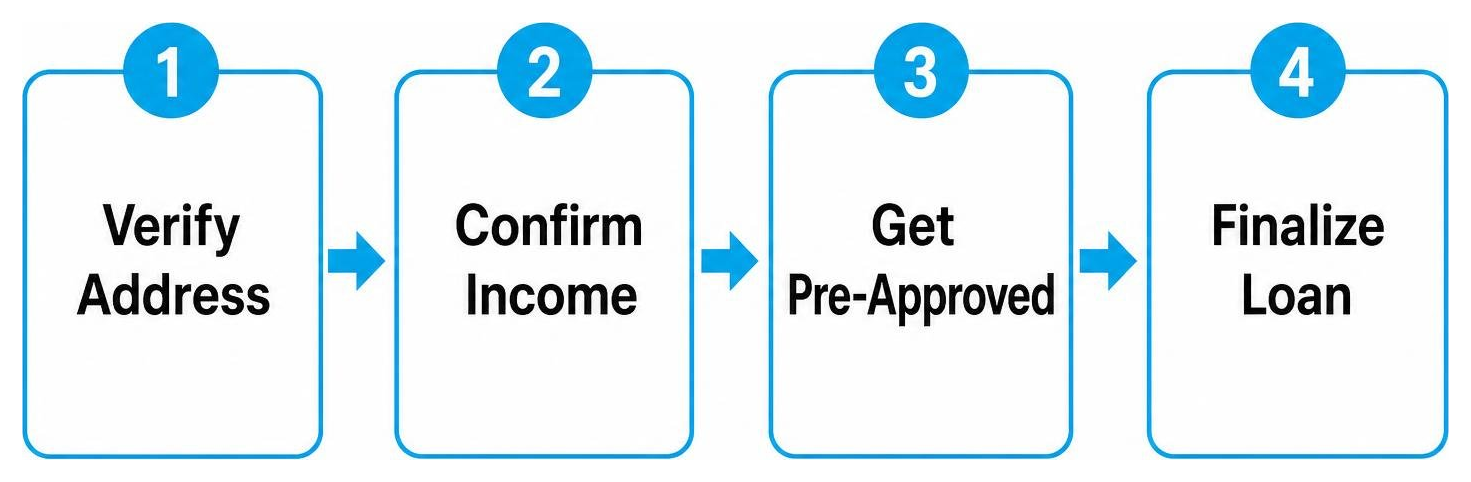
Securing a USDA loan requires an organized, step-by-step approach. Because the application processes for Direct and Guaranteed loans differ, selecting the right pathway early will help keep your purchase on track. To see how this fits into the broader buying journey, explore the steps to navigate your mortgage process.
The USDA Loan Application Roadmap
- Determine Your Program Type: Decide between a Section 502 Direct loan (applied for directly through USDA Rural Development) or a Section 502 Guaranteed loan (applied for through an approved mortgage lender like Simply Financial Inc).
- Verify Address and Household Income: Enter prospective target addresses into the eligibility map and calculate total household income against your county’s limits.
- Gather Income and Asset Documentation:
- 30 days of standard pay stubs.
- W-2 and 1099 statements for the past two years.
- Federal tax returns (complete with all schedules) for the past two years.
- Two months of recent bank account statements.
- Documentation of any secondary income, child support, or disability payments.
- Obtain Pre-Approval: Work with an approved mortgage broker to receive a formal pre-approval letter outlining your maximum purchase budget.
- Shop for a Home and Execute a Purchase Contract: Partner with a real estate agent familiar with rural properties to find a home that meets USDA safety and condition guidelines.
- Underwriting and USDA Agency Review: Once your lender underwrites and approves the loan file, it is sent to the local USDA Rural Development office for its final Loan Note Guarantee.
- Loan Closing: Sign your final documents, complete your closing, and receive the keys to your new home.
Navigating Application Milestones and Preventing Delays
The most common reasons for delays during USDA loan processing include incomplete documentation of household income, appraisal condition disputes, and gaps in communication.
- Undisclosed Household Members: Ensure every adult resident’s income is disclosed upfront to avoid last-minute qualification issues.
- Property Condition Requirements: The USDA requires properties to meet basic safety, structural, and sanitary standards. Peeling paint in older homes, roof damage, or non-functioning mechanical systems must be repaired before closing.
- Well and Septic Inspections: Rural properties utilizing private wells or septic tanks require testing to ensure water safety and adequate system operation.
Connecting with Illinois Rural Development Field Offices
Borrowers applying for Direct loans or seeking community assistance can contact the state and regional offices maintained by USDA Rural Development:
- Illinois State Office: USDA Rural Development, 2118 W. Park Court, Suite A, Champaign, IL 61821 | Phone: (217) 403-6200
- Northern Area Field Office (Oregon, IL): Servicing northern and collar counties.
- Central Area Field Office (Champaign / Jacksonville, IL): Servicing central agricultural counties.
- Southern Area Field Office (Marion / Mt. Vernon, IL): Servicing southern counties.
For Guaranteed loans, your primary contact will be your licensed mortgage broker, who coordinates with the USDA on your behalf.
Frequently Asked Questions About USDA Loans in Illinois
Can I purchase a multi-family property with a USDA loan in Illinois?
No. USDA Single Family Housing Direct and Guaranteed loans are strictly reserved for single-unit primary residences. Duplexes, triplexes, fourplexes, and commercial properties do not qualify. Eligible property types include single-family detached homes, approved condominiums, planned unit developments (PUDs), and eligible modular or manufactured homes on permanent foundations.
How does payment assistance reduce interest rates on Direct loans?
For Section 502 Direct loans, USDA Rural Development provides payment assistance subsidies to qualifying low- and very-low-income households. This subsidy lowers the borrower’s monthly payment by reducing the effective interest rate to as low as 1.000%.
Note: This assistance is subject to subsidy recapture, meaning when you eventually sell or transfer the home, a portion of the subsidized amount may be repaid to the government from property equity.
What is the maximum loan limit for a USDA loan in Illinois?
For the USDA Guaranteed Loan Program, there is no set maximum dollar loan limit. Your maximum loan amount is determined entirely by your debt-to-income ratio, repayment ability, and credit profile. For the USDA Direct Loan Program, loan limits are established by individual county caps, which are updated annually by USDA Rural Development.
Conclusion
Securing a country home or suburban retreat across Illinois does not require years of saving for a massive down payment. With the USDA Section 502 program, qualified buyers can access 100% financing, competitive interest rates, and predictable fixed terms across 72% of the state’s ZIP codes.
At Simply Financial Inc, our goal is to deliver a smooth, expert-guided, and stress-free mortgage experience. Whether you are buying your first home in Boone County, relocating to a peaceful parcel in McLean County, or exploring property outside the Chicago metropolitan area, our team will help you evaluate your options.
Explore our wide selection of expert mortgage loan options and connect with us today to start your path toward Illinois homeownership.