

What Is a USDA Loan? A Quick Answer for Homebuyers
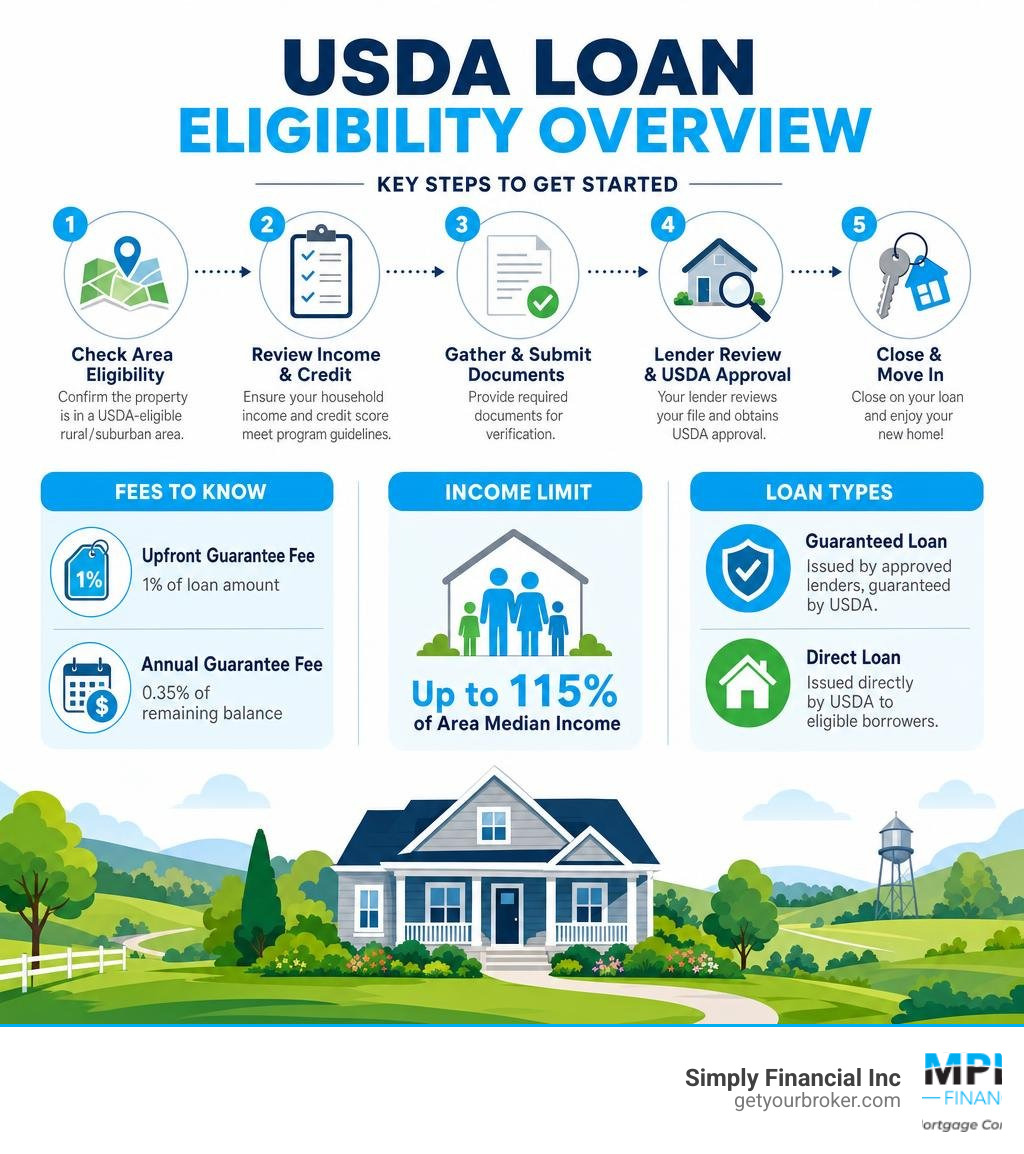
A USDA loan is a government-backed mortgage that lets eligible buyers purchase a home in a qualifying rural or suburban area with no down payment required.
Here’s what you need to know at a glance:
| Feature | Details |
|---|---|
| Who it’s for | Low- to moderate-income buyers in eligible rural/suburban areas |
| Down payment | $0 required |
| Income limit | Up to 115% of area median income |
| Loan types | Guaranteed (through lenders) or Direct (through USDA) |
| Loan term | 30-year fixed (Guaranteed) / up to 38 years (Direct) |
| Upfront fee | 1% of loan amount |
| Annual fee | 0.35% of remaining balance |
| Credit score | Typically 640+ (some lenders accept lower) |
No PMI. No down payment. Competitive rates. That’s the short version.
If you’re a first-time buyer feeling overwhelmed by mortgage options, you’re not alone. The USDA loan program is one of the most underused homebuying tools available — largely because many people don’t know they qualify, or assume “rural” means the middle of nowhere. It doesn’t.
In this guide, we’ll break down exactly how these loans work, who qualifies, and how to figure out if a property is eligible — in plain English, no jargon.
I’m Peter Babjak, a mortgage broker at Simply Financial Inc with over 18 years of experience helping Chicago-area homebuyers navigate the mortgage process, including USDA loan options for qualifying suburban properties. If you’ve ever felt lost in the paperwork, that’s exactly the kind of stress we help take off your plate.
What is a USDA Loan and How Does It Work?
At its core, a usda loan (also known as a Rural Development or RD loan) is a mortgage program created by the U.S. Department of Agriculture. The primary goal is to encourage economic growth and homeownership in less densely populated areas.
To make these loans highly attractive to buyers, the federal government steps in to back them. Specifically, the USDA provides a 90% loan note guarantee to approved private lenders. This government backing dramatically reduces the lender’s risk. Because the government promises to cover the majority of the lender’s losses if a borrower defaults, lenders are comfortable offering 100% financing with zero down payment and incredibly competitive interest rates.
These loans are strictly designed for properties that will serve as the borrower’s primary residence. You cannot use a usda loan to buy a vacation home, an investment property, or a commercial farm.
The program is split into two primary paths depending on your household income: the Guaranteed Loan Program and the Direct Loan Program. Both paths share the goal of affordable housing, but they serve different income brackets and are administered differently. You can learn more about the official guidelines on the Single Family Housing Guaranteed Loan Program page.
Guaranteed vs. Direct Rural Housing Programs
The USDA offers two distinct paths under Section 502 of the Housing Act of 1949: the Guaranteed Loan Program and the Direct Loan Program.
The main difference lies in who funds the loan and how much money your household makes.
- Guaranteed Loans are funded by approved private lenders (like us at Simply Financial Inc) and backed by the USDA. They are designed for moderate-income households.
- Direct Loans are funded directly by the government. They are designed for low- and very-low-income households who cannot secure a mortgage from traditional sources. The Direct program also features a “payment assistance” subsidy that can temporarily reduce the borrower’s effective interest rate to as low as 1%.
Here is a quick breakdown to help you compare the two programs:
| Feature | Guaranteed Loan Program | Direct Loan Program |
|---|---|---|
| Lender | Approved private lenders | USDA Rural Development |
| Income Limit | Up to 115% of Area Median Income (AMI) | Low to very-low income (varies by county) |
| Loan Terms | 30-year fixed-rate only | Standard 33 years (up to 38 years for very-low income) |
| Interest Rate | Set by lender based on market | Fixed at 5.00% (as of May 1, 2026; can go as low as 1% with subsidy) |
| Payment Subsidy | Not available | Available based on income |
| Property Limits | Modest, standard market homes | Modest size, strict value limits, no in-ground pools |
Understanding the USDA Loan Guaranteed Program
The Section 502 Guaranteed Loan Program is the most common path for everyday homebuyers. To qualify, your household income cannot exceed 115% of the area median income (AMI).
Because these loans are processed through private lenders, the application process feels very similar to a conventional mortgage. However, you get the distinct advantage of 100% financing. These loans are structured exclusively as 30-year fixed-rate mortgages, protecting you from unpredictable rate hikes down the road. You can explore the program details on the official Single Family Housing Guaranteed Loan Program | Rural Development page.
Understanding the USDA Loan Direct Program
The Section 502 Direct Loan Program is tailored for those who need a helping hand to achieve homeownership. To qualify, applicants must have an adjusted household income at or below the “low-income” limit established for their specific county.
As of May 1, 2026, the standard interest rate for a Direct Loan is fixed at 5.00%. However, if you qualify for the program’s payment assistance subsidy, your effective rate can drop to 1.00%.
The payback period for Direct Loans is typically 33 years. However, for very-low-income applicants who cannot afford the monthly payments on a 33-year term, the USDA can extend the payback period up to 38 years. That if you receive a payment subsidy, you may be required to repay all or part of that subsidy when you eventually sell the home or move out. You can read more about this on the Single Family Housing Direct Home Loans program page.
Requirements for Rural Housing Eligibility
To qualify for a usda loan, you must meet several criteria spanning your personal finances, your household income, and your citizenship status.

At Simply Financial Inc, we specialize in walking you through these requirements step-by-step to ensure your application is built for success. If you want to see where you stand, you can start the process today with our Pre-Qualify Chicago Mortgage Pre-Approval tool.
Income Limits and Calculations
Because the USDA loan program is designed to assist low-to-moderate-income families, your total household income is heavily scrutinized. For the Guaranteed program, your household income cannot exceed 115% of the local area median income.
When calculating your income, the USDA looks at the entire household. This means the income of every adult living in the home—even if they aren’t on the mortgage loan—is counted toward the 115% limit. However, you can make adjustments to your calculated income based on household size, dependent children, elderly family members, or medical expenses. You can verify your household’s eligibility by county using the official USDA Eligibility portal.
Credit and Underwriting Standards
While the USDA does not establish a strict, government-mandated minimum credit score, private lenders do set their own guidelines.
Most lenders look for a credit score of 640 or higher to utilize the USDA’s automated underwriting system. If your score is between 580 and 620, you may still qualify through manual underwriting. During manual underwriting, a human underwriter will carefully review your credit history, looking for a strong demonstration of your willingness and ability to manage debt.
Additionally, underwriters look at your debt-to-income (DTI) ratio. The standard target DTI for a USDA loan is 41%, meaning your monthly debt payments (including your new mortgage) shouldn’t exceed 41% of your gross monthly income. However, higher DTIs are frequently approved if you have compensating factors, such as excellent credit or significant cash reserves.
How to Apply and Required Documentation
Applying for a usda loan requires gathering standard financial documentation to verify your employment, assets, and identity.
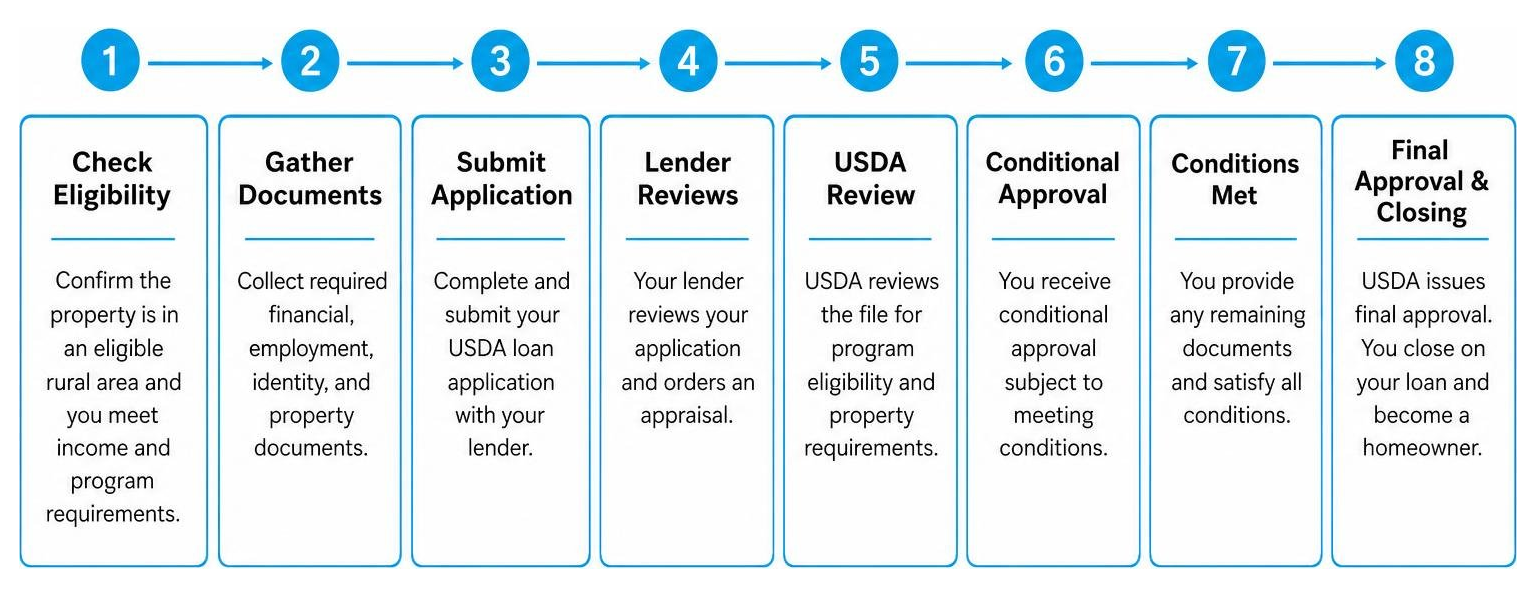
To ensure a stress-free process, we recommend preparing the following documents in advance:
- State-issued ID or driver’s license
- Proof of citizenship, U.S. non-citizen national status, or Qualified Alien status
- Two years of federal tax returns and W-2 forms
- Recent pay stubs covering the last 30 to 60 days
- Bank statements for all active accounts covering the last 60 days
- Written explanations for any credit issues or recent employment gaps
When you submit your application, there is a non-refundable credit report fee of $30 per applicant. If you are a first-time homebuyer, you will also need to complete an approved homeownership education course before closing on your home.
Property and Location Requirements
The property you buy must meet strict geographic and physical guidelines to qualify for USDA financing.

First and foremost, the home must be located in a USDA-defined rural area. Generally, the USDA defines a rural area as a town or community with a population of 20,000 or less. However, many quiet suburban pockets just outside major metropolitan areas also qualify.
Under the Direct program, the home must also be modest in size, must not have an in-ground swimming pool, and must not be designed for income-producing activities. You can check specific addresses on the official USDA Eligibility site.
How to Check Property Eligibility
Checking if a home qualifies is simple. Navigate to the USDA eligibility map, select the program you are interested in, and type in the specific address of the property.
If you don’t have a specific home in mind yet, you can zoom in on the map to see the exact boundaries where eligible areas begin. You might be surprised to find that suburban neighborhoods just a short drive from city centers qualify for 100% USDA financing.
State-Specific Direct Loan Guidelines
Because property values and income levels vary wildly across the country, the USDA establishes regional limits for its Direct Loan program.
At Simply Financial Inc, we focus on helping buyers navigate the local housing markets where we operate. If you are looking to buy in Florida, you can check the specific regional limits on the Single Family Housing Direct Home Loans in Florida page.
If you are looking to purchase a home in Illinois, you can find your county’s specific direct loan guidelines on the Single Family Housing Direct Home Loans in Illinois page.
Costs, Fees, and Mortgage Comparisons
While USDA loans require $0 down, they are not entirely free of fees. To keep the program self-sustaining without relying on taxpayer dollars, the USDA charges two specific guarantee fees:
- Upfront Guarantee Fee: This is currently 1% of the total loan amount. For example, on a $250,000 loan, the upfront fee is $2,500. Fortunately, the USDA allows you to roll this fee directly into your loan amount so you don’t have to pay it out of pocket at closing.
- Annual Guarantee Fee: This is currently 0.35% of the remaining unpaid principal balance. This fee is split into 12 equal parts and added to your monthly mortgage payment.
If you are trying to minimize your upfront costs, a USDA loan is an exceptional choice. You can learn more about how this compares to other options with our Low Down Payment Mortgage Chicago resource.
Comparing Government-Backed Mortgages
How does a USDA loan stack up against other popular home loans? Let’s take a look:
- Conventional Loans: Conventional loans typically require a minimum 3% down payment and charge Private Mortgage Insurance (PMI) if you put down less than 20%. USDA loans require 0% down and have no traditional PMI (though they have the 0.35% annual fee, which is often much cheaper than conventional PMI).
- FHA Loans: FHA loans require a 3.5% down payment and carry a 1.75% upfront mortgage insurance premium (MIP) plus a 0.55% to 0.85% annual fee. USDA loans have a lower upfront fee (1%) and a lower annual fee (0.35%), making them significantly cheaper monthly.
- VA Loans: VA loans also offer 0% down and have no monthly mortgage insurance. However, they are strictly reserved for military service members, veterans, and surviving spouses. If you don’t have military service, a USDA loan is your best path to 100% financing.
You can compare all of these structures side-by-side using our comprehensive guide to Mortgage Loan Options.
Frequently Asked Questions
Do these mortgages require private mortgage insurance (PMI)?
No, USDA loans do not require conventional Private Mortgage Insurance (PMI). Instead, the program utilizes an upfront guarantee fee (1%) and an annual guarantee fee (0.35%). Because the annual fee is built into your monthly payment, it functions similarly to mortgage insurance, but it is typically much more affordable than the PMI charged on FHA or conventional loans.
Can I refinance an existing rural housing mortgage?
Yes! If you currently have a USDA loan, you can take advantage of streamline refinance options. These programs allow current borrowers to refinance into a new USDA loan with a lower interest rate without requiring a new appraisal, credit check, or extensive underwriting, making the process incredibly fast and simple.
Are there other rural housing programs available?
Yes, the USDA also administers the Section 504 Housing Repair program. This program provides home improvement loans of up to $40,000 and grants of up to $10,000 to very-low-income homeowners. These funds are designed to help rural homeowners repair, improve, or modernize their homes, or to remove health and safety hazards from their properties.
Conclusion
Navigating the path to homeownership doesn’t have to be a stressful, confusing journey. At Simply Financial Inc, our mission is to deliver a seamless, expert-guided, and completely stress-free mortgage experience. Whether you are looking to buy a home in the quiet suburbs of Illinois or the sun-drenched communities of Florida, we are here to help you find the perfect loan program for your goals.
If you are ready to explore your suburban and rural homeownership options, visit our dedicated USDA Loan Chicago page or stop by our office at 5632 W Lawrence Ave, Chicago, IL to speak with one of our mortgage experts today!