

VA Cash-Out Refinance Loans: A Quick Look at Rates and Choices
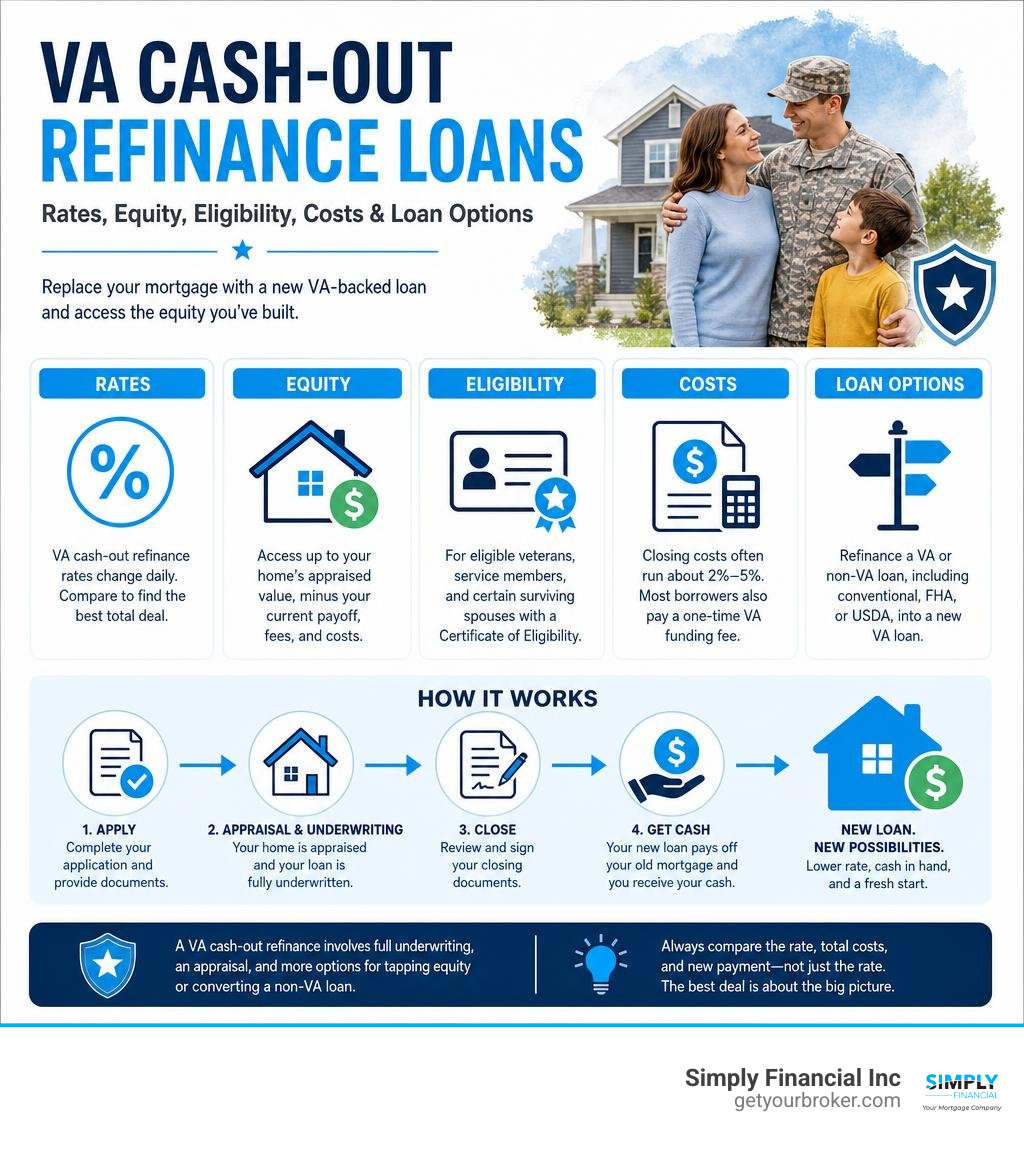
VA cash out refinance loans replace your current mortgage with a new VA-backed loan and may let you use some of your home equity as cash. They can also refinance a conventional, FHA, or USDA mortgage into a VA loan. The VA permits loans up to 100% of the home’s appraised value, but the rate, lender limits, closing costs, and funding fee determine whether the deal is worthwhile.
| Quick comparison point | What it means |
|---|---|
| Who can use it | Eligible veterans, service members, and certain surviving spouses with a Certificate of Eligibility |
| Current mortgage | May be VA or non-VA |
| Cash available | Up to the appraised value, less your current payoff, fees, and costs |
| Typical lender credit benchmark | Often 580-620 or higher, depending on the lender |
| Key costs | Closing costs often run about 2%-5%; most borrowers also pay a one-time VA funding fee |
| Best reason to compare rates | A lower rate is helpful, but total costs and the new payment matter just as much |
A VA cash-out refinance is not the same as a VA IRRRL, also called a Streamline Refinance. An IRRRL is generally for replacing an existing VA loan with little or no cash back, while a cash-out refinance involves full underwriting, an appraisal, and more options for tapping equity or converting a non-VA loan.
I am Peter Babjak, and through Simply Financial Inc, I have helped borrowers navigate refinancing and home-equity decisions since 2007. My experience with VA cash out refinance loans focuses on making the paperwork, costs, and loan choices easier to understand before you move ahead.
Understanding VA Cash Out Refinance Loans and Key Options
When evaluating home equity extraction strategies in 2026, va cash out refinance loans offer one of the most flexible financing structures available in the mortgage industry. Governed by the Department of Veterans Affairs, these loans allow qualified military homeowners to replace an existing mortgage with a brand-new home loan under completely fresh terms while withdrawing cash directly from their accumulated property equity.
A critical distinction to make early in your research is how a VA cash-out mortgage differs from a Interest Rate Reduction Refinance Loan (IRRRL). An IRRRL (or Streamline Refinance) is strictly designed for existing VA loan holders who want to quickly lower their rate or switch from an adjustable rate to a fixed rate with minimal documentation and no home appraisal. However, an IRRRL prohibits taking cash out at closing (beyond up to $6,000 for energy efficiency improvements).
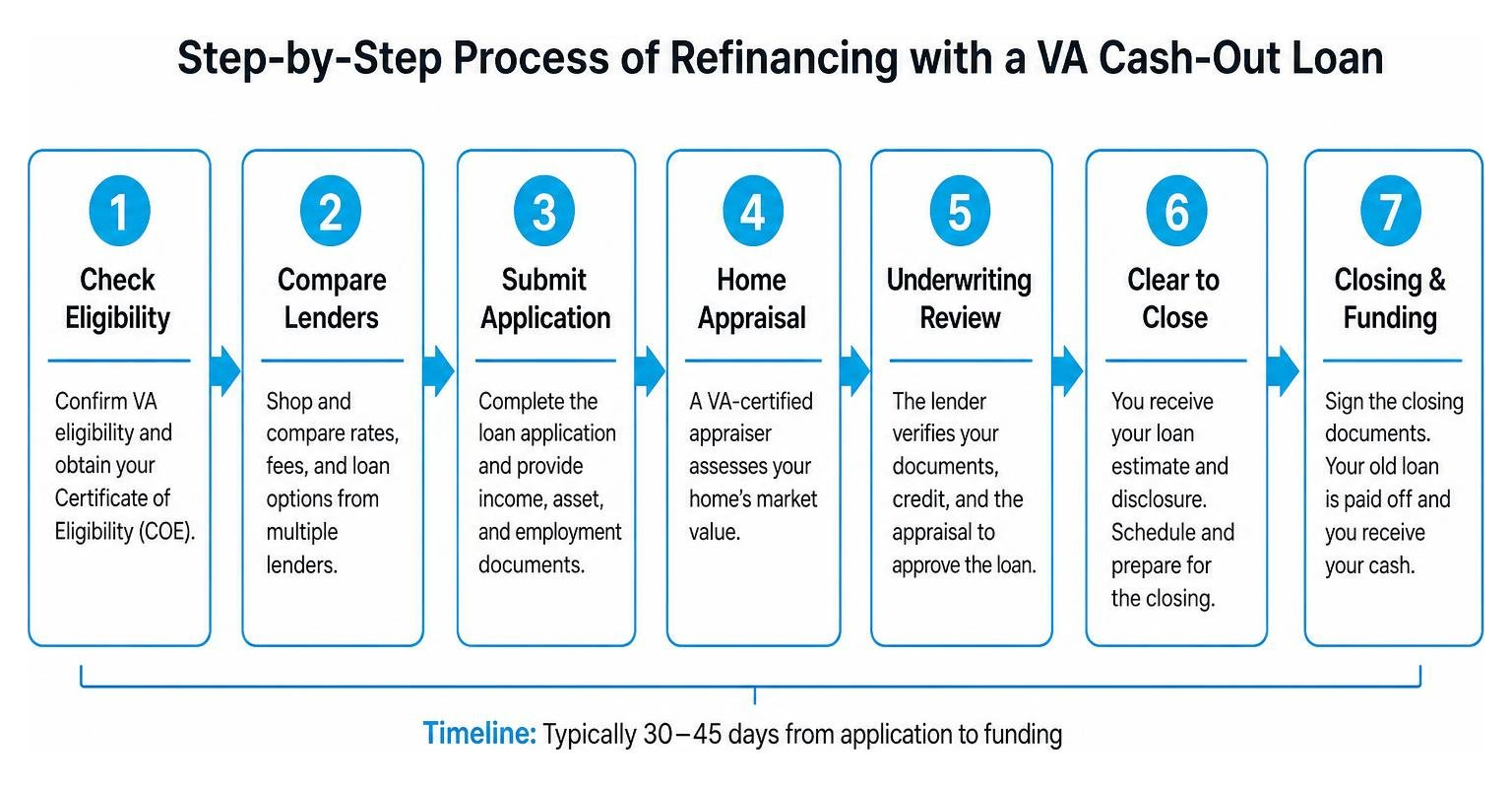
By contrast, a VA cash-out refinance is a full-underwriting mortgage product governed by official Cash-Out Refinance Loan | Veterans Affairs guidelines. It requires:
- A full home appraisal by a VA-certified appraiser to establish current market value.
- Complete income, employment, and asset verification.
- A fresh credit report and underwriting evaluation.
- Application to primary residences only (investment properties and second homes do not qualify).
One of the stand-out features of VA cash-out financing is the statutory maximum Loan-to-Value (LTV) limit. While traditional conventional cash-out mortgages typically enforce a strict 80% LTV cap—meaning you must retain at least 20% equity in your home—the Department of Veterans Affairs legally allows financing up to 100% of your property’s appraised value. While some individual lenders enforce internal overlays capping cash-out refinances at 90% LTV, the federal guidelines permit borrowing all the way up to full equity value minus existing liens, closing costs, and funding fees.
Keeping an eye on competitive market rates is vital. Reviewing current VA Loan Rates alongside your long-term equity goals helps determine how much net cash you can extract at closing.
Key Eligibility Rules for VA Cash Out Refinance Loans
Qualifying for a VA cash-out refinance requires meeting both federal government standards and specific lender underwriting guidelines. At Simply Financial Inc, we help homeowners navigate these requirements step-by-step to ensure full compliance before starting the underwriting process.
- Certificate of Eligibility (COE): You must possess an active COE showing sufficient entitlement. Service requirements include:
- 90 consecutive days of active duty service during wartime.
- 181 continuous days of active service during peacetime.
- 6 credited years in the National Guard or Selected Reserve.
- Being an unremarried surviving spouse of a service member who died in the line of duty or from a service-connected disability.
- Primary Occupancy Standard: You must certify under penalty of law that you intend to occupy the subject property as your primary residence within a reasonable period (typically 60 days after closing).
- Credit and Income Qualification: While the Department of Veterans Affairs does not set a hard minimum credit score, most private lenders look for a score between 580 and 620.
- Residual Income Benchmarks: Beyond the debt-to-income (DTI) ratio, the VA requires lenders to evaluate “residual income”—the amount of gross discretionary income remaining each month after paying all housing expenses, taxes, maintenance costs, and installment obligations. This residual buffer varies depending on family size and geographic region (for instance, the Midwest and South regions have distinct dollar benchmarks).
How Non-VA Mortgages Qualify for VA Cash Out Refinance Loans
A common misconception among military homeowners is that you must already hold a VA home loan to apply for a cash-out refinance. In reality, you can use a VA cash-out refinance to replace any type of existing mortgage structure.
If you currently hold a conventional home loan, a USDA mortgage, or an FHA Cash Out Refinance structure, you can transition that balance directly into a VA-backed mortgage.
This conversion provides immediate financial advantages:
- PMI/MIP Elimination: Conventional mortgages with less than 20% equity carry private mortgage insurance (PMI), while FHA loans mandate an ongoing annual Mortgage Insurance Premium (MIP) regardless of loan-to-value ratio. Replacing these loans with a VA cash-out mortgage eliminates monthly insurance fees entirely, as VA loans require zero monthly mortgage insurance premiums.
- Lower Rate Structures: VA loans consistently offer some of the lowest average interest rates on the market compared to conventional or FHA equivalents.
- Cash Extraction: You can refinance a non-VA balance equal to your current payoff while simultaneously extracting liquid equity in a single transaction.
Whether you are considering refinancing a conventional mortgage in Illinois or converting an FHA home loan in Florida, changing your loan type to a VA option allows you to leverage your military benefits to maximum advantage.
Comparing Type I and Type II Cash-Out Refinance Rules
Federal regulations under Public Law 115-174 and Department of Veterans Affairs guidelines classify va cash out refinance loans into two distinct legal categories: Type I and Type II. Understanding which category your refinance falls into determines the regulatory protections, cost recoupment checks, and disclosure forms required during loan processing.
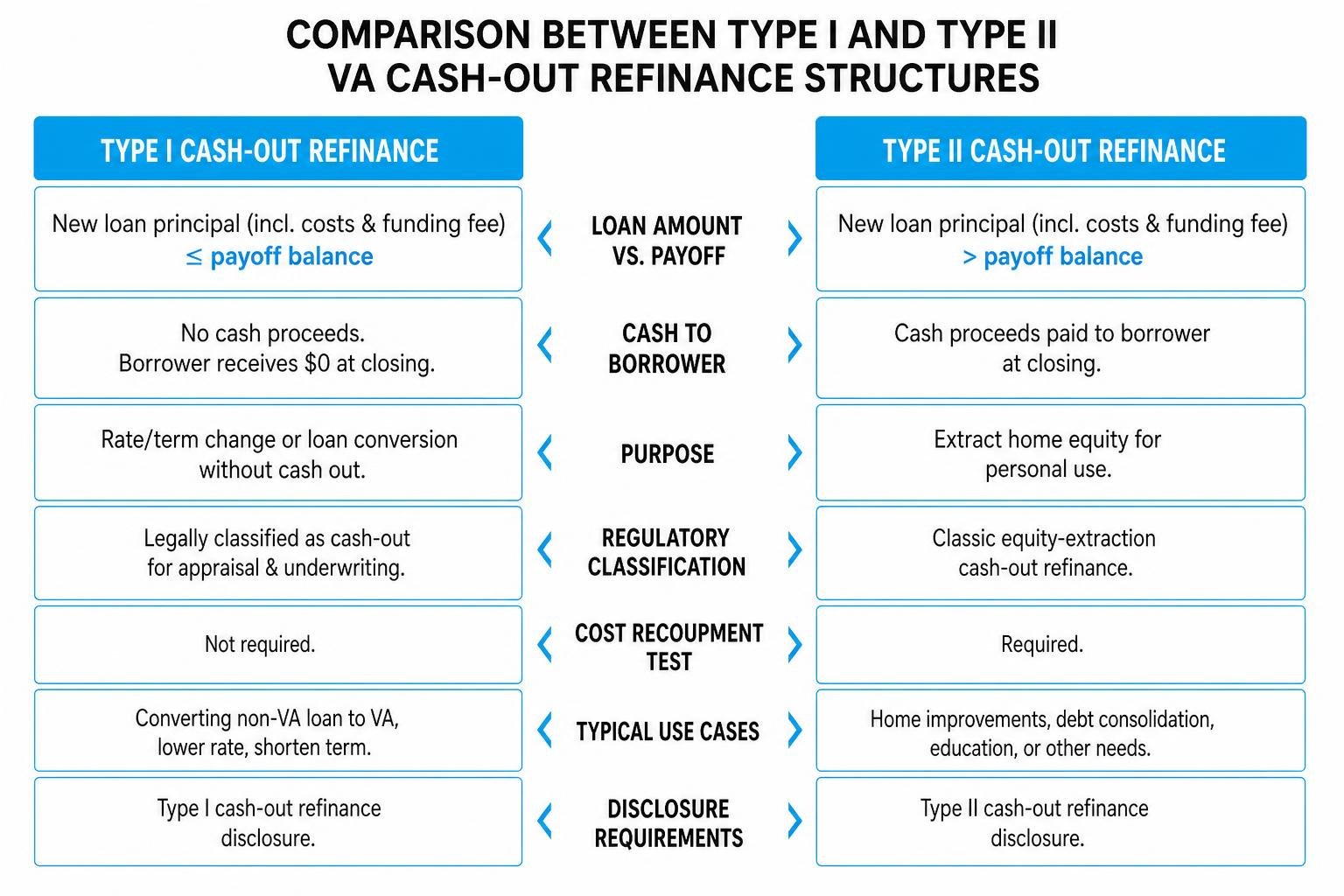
The core legal distinction between Type I and Type II refinancing rests upon how the new loan balance compares to the payoff amount of your existing debt:
- Type I Cash-Out Refinance: Occurs when the new total loan principal (including financed closing costs and funding fees) is less than or equal to the payoff balance of the existing mortgage being refinanced. Even though it is legally categorized as a cash-out loan due to full underwriting and appraisal requirements, the borrower receives no net cash proceeds at closing. This setup is frequently used when converting a non-VA or conventional loan into a VA mortgage or shortening a loan term.
- Type II Cash-Out Refinance: The classic equity-extraction mortgage. Occurs when the new principal loan amount exceeds the payoff balance of the existing debt, yielding actual cash proceeds paid directly to the borrower at closing.
Detailed regulatory breakdowns for both categories can be found directly within official government documentation such as Circular 26-18-30 and federal rulemaking files like 64459.
The Net Tangible Benefit (NTB) Test Criteria
To shield military families from aggressive lending tactics, equity stripping, and loan churning, the VA enforces a strict, mandatory “Net Tangible Benefit” (NTB) test. A lender cannot legally issue a VA cash-out loan guaranty unless the transaction provides a verifiable, positive financial benefit to the borrower.
Under federal rules, a VA cash-out refinance must satisfy at least one of eight statutory Net Tangible Benefit criteria:
- Elimination of Monthly Mortgage Insurance: Removing private mortgage insurance (PMI) or FHA mortgage insurance premiums (MIP).
- Reduction in Loan Term: Shortening the overall duration of the mortgage (e.g., refinancing from a 30-year term to a 15-year term).
- Reduction in Monthly Principal and Interest (P&I): Decreasing the monthly mortgage payment.
- Reduction in Note Interest Rate: Lowering the baseline interest rate on the home loan.
- Fixed-to-Fixed Rule: Refinancing from one fixed-rate mortgage to another fixed-rate mortgage requires a minimum interest rate reduction of at least 50 basis points (0.50%).
- Fixed-to-ARM Rule: Refinancing from a fixed-rate loan to an Adjustable-Rate Mortgage (ARM) requires a minimum rate drop of at least 200 basis points (2.00%).
- Reduction in Loan-to-Value (LTV): Lowering the overall LTV ratio, or maintaining an LTV ratio equal to or less than 90%.
- Refinancing an Interim Loan: Converting a temporary construction loan or bridge line into permanent VA financing (such as transitioning projects backed by VA Construction Loans Lenders).
- Increase in Discretionary Residual Income: Measurably increasing the veteran’s net monthly residual cash flow.
- ARM to Fixed Conversion: Replacing an unstable adjustable-rate mortgage with a predictable, long-term fixed-rate mortgage.
Lenders must provide clear NTB disclosures to the applicant within three business days of receiving the initial mortgage application and re-confirm these disclosures at the closing table.
Seasoning and Recoupment Requirements
When refinancing an existing VA loan into a new VA cash-out mortgage, strict statutory “seasoning” rules apply to ensure the prior mortgage has been held long enough before being replaced.
The 210-Day and 6-Payment Rule: A prior VA home loan is officially considered fully seasoned only on the later of the following two milestone dates:
- The date that is exactly 210 days after the date on which the first monthly payment was due on the existing loan.
- The date on which six full consecutive monthly payments have been successfully made on the existing loan.
Industry statistics published by regulatory bodies indicate that approximately 96.8 percent of Type II Cash-Out refinances comfortably meet this 210-day benchmark.
Fee Recoupment Rule for Type I Refinances: For Type I VA-to-VA cash-out refinances (where no extra cash is extracted), all closing costs, origination fees, expenses, and incurred fees—excluding pre-paid items like escrow deposits and property taxes—must be fully recouped through monthly savings within 36 months from loan closing. If the recoupment calculation exceeds 36 months, the loan cannot be approved under federal regulations.
Rates, VA Funding Fees, and Total Refinance Costs
While va cash out refinance loans offer exceptional financing structures, borrowers must carefully evaluate closing expenses, interest rates, and government charges to calculate their net financial gain accurately.

One of the main expenses associated with VA home loans is the one-time VA Funding Fee. Collected by the government to offset program expenses for taxpayers, this fee is calculated as a direct percentage of the total loan amount and can either be paid in cash at closing or financed directly into the final balance.
2026 VA Cash-Out Refinance Funding Fee Rates
| Borrower Category | First-Time Use Fee | Subsequent Use Fee |
|---|---|---|
| Regular Military, Veterans, Reservists, & Guard | 2.15% | 3.30% |
Unlike initial VA purchase loans—where down payment amounts can reduce the funding fee percentage—the cash-out refinance funding fee remains set at 2.15% for first-time users and 3.30% for subsequent usage, regardless of loan-to-value ratios.
Funding Fee Exemptions: You are completely exempt from paying the VA funding fee if you meet any of the following service conditions:
- You receive VA compensation for a service-connected disability.
- You are entitled to receive VA disability compensation but receive active-duty retirement or compensation pay instead.
- You are an active-duty service member who has been awarded the Purple Heart.
- You are a surviving spouse receiving Dependency and Indemnity Compensation (DIC).
Standard closing costs (excluding the funding fee) typically range between 2% and 5% of the total mortgage amount. These costs include lender origination fees (which the VA strictly caps at 1.00%), appraisal fees, credit report checks, title search and title insurance fees, and local government recording costs. Official procedures detailing these administrative cost caps can be referenced in the Department’s Cash Out Refinance User Guide.
Underwriting Standards and Required Documentation
Although the Department of Veterans Affairs guarantees these mortgages against default, private lenders handle underwriting and risk management. As a mortgage brokerage, Simply Financial Inc reviews applicant files against both VA minimums and institutional lender overlays.
To secure an approval, applicants generally must provide:
- Credit Benchmarks: A minimum middle credit score of 580 to 620 is standard across most mortgage lenders, though scores of 640+ yield more competitive interest rate pricing.
- Debt-to-Income (DTI) Guideline: The standard benchmark DTI ratio is 41%. However, applicants carrying higher DTIs can often achieve approval if strong compensating factors—such as extensive residual income or substantial liquid reserves—are present.
- Income Verification:
- Most recent 30 consecutive days of pay stubs.
- Previous 2 years of W-2 statements.
- Previous 2 years of signed federal tax returns (essential for self-employed borrowers or those using rental/commission income).
- Property Valuation: A complete appraisal ordered through the VA’s WebLGY portal to establish property value, safety, structural soundness, and sanitation compliance.
Before submitting a formal application, securing a robust Mortgage Pre-Approval allows you to calculate your available home equity and verify your entitlement balance.
Evaluating Financial Benefit vs. Alternative Options
A VA cash-out refinance is a powerful financial vehicle, but it isn’t always the ideal solution for every homeowner situation. Comparing cash-out refinancing against alternative home equity strategies ensures you choose the right path for your household.
Frequently Asked Questions About VA Cash-Out Mortgages
Can I get a VA cash-out refinance up to 100% of my home value?
Yes. Federal statutory rules permit va cash out refinance loans up to 100% of the property’s appraised value as determined by a certified VA appraiser. However, individual mortgage lenders reserve the right to establish internal underwriting overlays that cap maximum LTV at 90% or 95%. Furthermore, any portion of the VA funding fee that pushes the total loan balance beyond 100% of the appraised value must be paid in cash at closing. If you are comparing maximum LTV constraints across loan types, reviewing parameters like FHA Cash Out Refi Max LTV provides helpful context.
How does a VA cash-out refinance differ from a VA IRRRL streamline refinance?
A VA IRRRL (Interest Rate Reduction Refinance Loan) is limited strictly to refinancing an existing VA loan into another VA loan to lower your interest rate or monthly payment. IRRRLs require no home appraisal, minimal income documentation, and strictly prohibit liquid cash-out at closing. Conversely, a VA cash-out refinance requires full underwriting, income verification, and a complete appraisal, but allows you to tap equity, receive liquid cash proceeds, or refinance non-VA mortgages (like conventional, FHA, or USDA loans).
Who qualifies for an exemption from the VA funding fee?
Borrowers who receive VA compensation for a service-connected disability, veterans eligible to receive disability compensation who receive active duty or retirement pay instead, active-duty service members who have received the Purple Heart, and surviving spouses receiving Dependency and Indemnity Compensation (DIC) are exempt from paying the VA funding fee.
Conclusion
VA cash out refinance loans stand out as one of the most flexible equity-extraction tools available in the mortgage market today. Offering loan-to-value limits up to 100%, zero monthly mortgage insurance requirements, and the unique ability to refinance conventional or government-backed loans into a VA structure, these loans provide military homeowners with substantial financial leverage.
However, extracting equity requires careful planning. Evaluating the net tangible benefit, calculating fee recoupment periods, comparing current interest rates, and reviewing the one-time funding fee are essential steps before tapping into your property equity. If you want to compare your current rate, explore options for removing mortgage insurance, or calculate how much equity you can withdraw, working with an experienced mortgage broker makes the journey clear and transparent.
At Simply Financial Inc, located at 5632 W Lawrence Ave in Chicago, IL, we specialize in helping military families navigate refinancing options across Illinois and Florida. Whether you are seeking pre-approval, analyzing rate options, or evaluating cash-out structures, our team is ready to guide you through a stress-free mortgage experience.
Ready to explore your home equity options? Contact Us Chicago Mortgage Lender or explore our comprehensive guide on VA Loan Chicago to start comparing competitive mortgage options today.